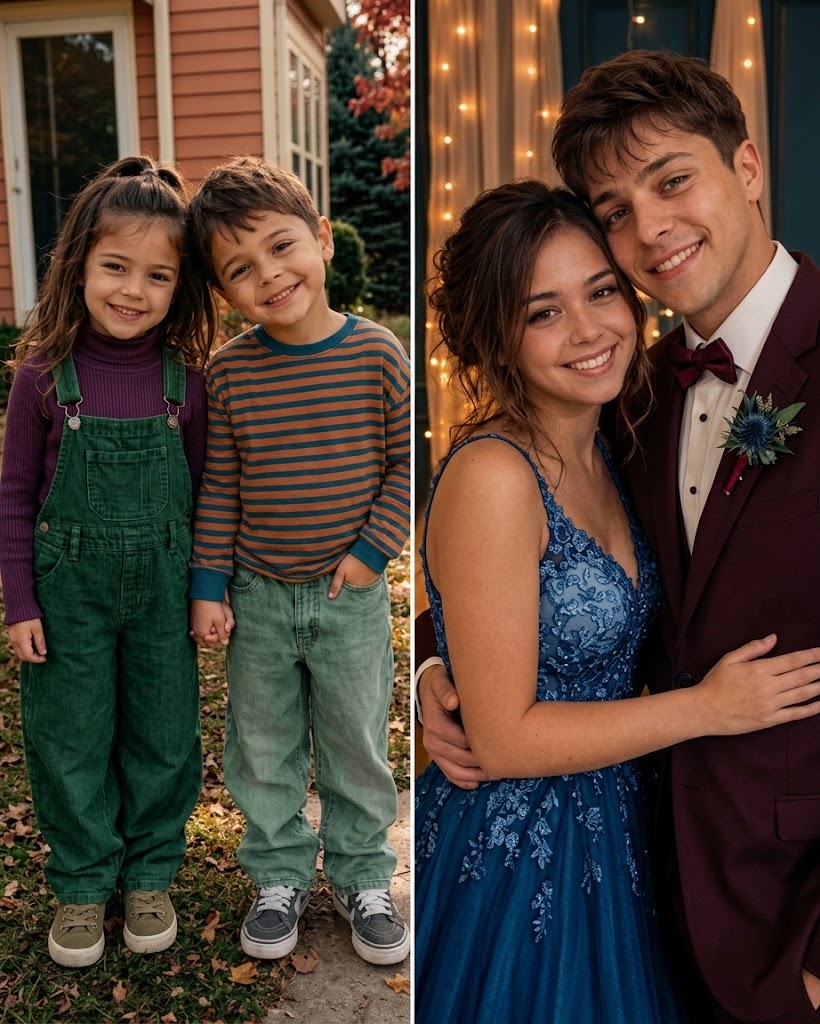
hen we were five years old, Leo Bennett and I made a promise that only children could take completely seriously.
We lived three houses apart in Fairview, Ohio, and spent nearly every day together. We built forts, shared snacks, rode our bikes around the neighborhood, and played beneath the huge oak tree in my backyard.
One summer afternoon, Leo found a plastic ring inside a cereal box and slipped it onto my finger.
“When we grow up, I’m going to marry you,” he declared.
I laughed. “You don’t even have a job.”
“I’ll get one.”
“You don’t have a car either.”
“I’ll get that too.”
At five, every problem seemed easy to solve.
But only a few weeks later, Leo’s family suddenly moved away after his father lost his business. I stood on the sidewalk crying as Leo climbed into their car.
Before they drove away, he leaned out the window. “I’ll come back someday!” he shouted. “And I’ll marry you!”
Then the car disappeared.
Life went on. I went to college, built a career managing a bakery, and had relationships of my own. I never completely forgot Leo, but after enough years passed, I stopped expecting him to return.
My mother occasionally teased me about our childhood promise. “You’re waiting for a ghost,” she’d say.
“I’m not waiting,” I always insisted.
Then, twenty years after Leo left, a man walked into my bakery. He stood at the counter and looked at me with those green eyes and that crooked smile.
“I told you I’d find you,” he said.
I dropped the tray in my hands. It was Leo.
At first, I couldn’t believe him. I asked questions only the real Leo would know. He remembered our dog, Murphy, my yellow bicycle, the mailbox I crashed into, and the little blue biscuit tin we buried beneath the oak tree. Inside that tin were a marble, two pennies, a bracelet, and a childish drawing of the house we once imagined living in together.
There was no doubt. Leo had really come back.
Over the next several months, we slowly rebuilt the friendship we had lost. He told me about his family moving from state to state after his father’s financial problems. Eventually, his parents separated, and Leo began building an independent life of his own. He admitted that he had searched for me online several times before finally finding an article about my bakery and booking a flight.
The years between us began disappearing faster than either of us expected. We talked for hours, laughed about our childhood adventures, and discovered that many of the things we loved as children still mattered to us.
Eventually, Leo took me back to the old oak tree. This time, he had a real ring. He got down on one knee, and I said yes.
We began planning our wedding. It was supposed to be everything I had once imagined—family, friends, a beautiful church, my grandmother’s veil, and the man I had known since I was five.
But on the wedding day, everything changed.
at the altar, Leo held my hands, but I noticed his fingers were trembling. He looked directly into my eyes.
“Monica, there’s something I need to tell you before we get married.”
My stomach dropped. He reached into his jacket and pulled out an old photograph of a young Leo standing beside a woman in a white dress who was holding a baby.
“Who is she?” I asked.
“My ex-wife.”
I stared at him. “You were married?”
“Yes.”
My eyes moved toward the child. “And that’s your son?”
He nodded. “His name is Jack.”
The room seemed to disappear around me. He had told me he had never been married and didn’t have children. And now, minutes before our wedding, I was discovering that he had both an ex-wife and a seven-year-old son.
“Why didn’t you tell me?”
Leo looked ashamed. “I was afraid.”
He explained that he had married young after his former girlfriend became pregnant. They eventually realized they weren’t right for each other and divorced when Jack was two. There was no secret affair or hidden second family; Leo stayed involved in his son’s life and supported him.
But he had still lied to me.
“You had two years to tell me,” I said.
“I know.”
The wedding was canceled.
That night, I went to my mother’s house and tried to understand how the man I trusted could keep something so important from me.
The following day, Leo came to see me. This time, he didn’t make excuses. He admitted he was terrified I would look at him differently if I knew the whole truth.
“You didn’t trust me enough to let me decide for myself,” I told him.
He lowered his head. “I know.”
He handed me a folder containing his divorce papers, photographs of Jack, school drawings, and other pieces of his life. There was no second secret—just the truth he should have shared from the beginning.
A few days later, I met Jack. He was seven, cheerful, curious, and had green eyes just like his father. His backpack was covered in planets, and the first thing he noticed when he walked into my bakery was the smell of cinnamon rolls.
“Your bakery smells really good,” he said.
“That’s how we convince people to buy things,” I joked.
He smiled. Jack knew who I was and that the wedding had been called off, but he didn’t understand the complicated reasons behind it.
I made sure he knew one thing. “I’m upset with your dad,” I told him gently. “But none of this is your fault.”
That moment changed everything. Jack wasn’t just part of a secret anymore; he was a real little boy with a laugh, favorite foods, and feelings.
Over the following months, Leo and I stayed apart. Eventually, we began talking again. I told him that if we were ever going to have another chance, there couldn’t be any more secrets. He agreed.
There would be no rushing toward another wedding, no pretending the past didn’t happen, and no romantic fantasy built on incomplete information. We would start over—with the truth.
Leo worked hard to become more honest and stop avoiding difficult conversations. I also met Rachel, Jack’s mother. She confirmed what Leo had told me and made it clear that she wanted Jack to have a healthy relationship with his father.
Slowly, I became part of Jack’s life too. He loved dinosaurs, hated tomatoes, and could eat an unbelievable number of cinnamon rolls.
One evening, while we were making pizza, he looked at me seriously. “If you marry Dad, do I have to call you Mom?”
“No,” I said.
He looked relieved. “You can call me Monica.”
He thought for a moment. “Can I call you Mo?”
“Absolutely not.”
He laughed so hard that Leo nearly dropped the plate in his hands. For the first time, I realized our future didn’t have to resemble the childish dream we’d created beneath the oak tree. It could be messier, more complicated, but also more honest.
A year and a half passed. Leo never asked me to marry him again.
Then one autumn afternoon, I found him beneath the old oak tree. My mother and Jack were there too. Leo was holding the blue biscuit tin we’d buried as children. Inside were the same treasures from our childhood: the plastic ring and the drawing of our imaginary house.
Leo looked at me. “When I came back, I thought loving you meant keeping the promise I made when I was five. I thought I had to become the person you remembered. But I was wrong.”
He explained that real love wasn’t about pretending the past had been perfect; it was about telling someone the whole truth and allowing them to decide whether they still wanted to build a future together.
Then he handed me the biscuit tin. “I asked you to marry me before I had earned the right to ask,” he said. “I don’t want to make that mistake again.”
He didn’t propose. And somehow, that meant more than any proposal could have.
Three months later, I walked into the kitchen while Leo was washing dishes. I was holding the old plastic ring.
He looked at me in confusion. “Monica…”
“When we were five, you made a terrible proposal,” I said. “No job. No car. No plan for where we were going to live.”
He started laughing.
“So I thought we should try again.”
I slipped the plastic ring onto his finger. He began to cry, and then he said yes.
Our second wedding was small. Thirty-two people gathered beneath the same oak tree where everything had started. My mother sat in the front row, Rachel was there, and Jack stood beside Leo wearing a navy tie covered with tiny planets while I wore my grandmother’s veil.
This time, there were no surprises.
Leo took my hands. “When I was five, I promised I’d come back and marry you. For years, I thought the important part was coming back.” He looked toward Jack. “But I learned that returning is easy compared with staying.”
He talked about staying when you’re wrong, staying when you’re embarrassed, apologizing when you’ve hurt someone, and having the courage to let another person know the truth. “I can’t promise you a perfect marriage,” he said. “But I can promise you that you’ll never again discover something important about my life from someone else.”
I smiled through my tears. When it was my turn, I told him, “I don’t love you because you came back. I love you because after everything fell apart, you learned how to stay.”
The ceremony ended with everyone laughing when Jack suddenly shouted: “Finally!”
Later that evening, Jack placed a small metal box beneath the oak tree. Inside were the plastic ring, a photograph from our wedding, and a note that said: My dad promised Monica he would marry her when he was five. He made a mistake, but he told the truth and tried again.
I cried when I read it. Leo smiled and said, “You’re still emotional.”
“I have every right to be.”
For years, I believed the most romantic part of our story was that Leo kept a promise he made as a five-year-old. I finally understood that it wasn’t. The most important part was what happened after that promise failed.
We learned that love isn’t built on childhood dreams, perfect memories, or grand promises. It’s built on honesty, patience, responsibility, forgiveness, and the courage to face uncomfortable truths together.
Leo didn’t simply return after twenty years. He learned how to stay. And in the end, that became the promise that mattered most.