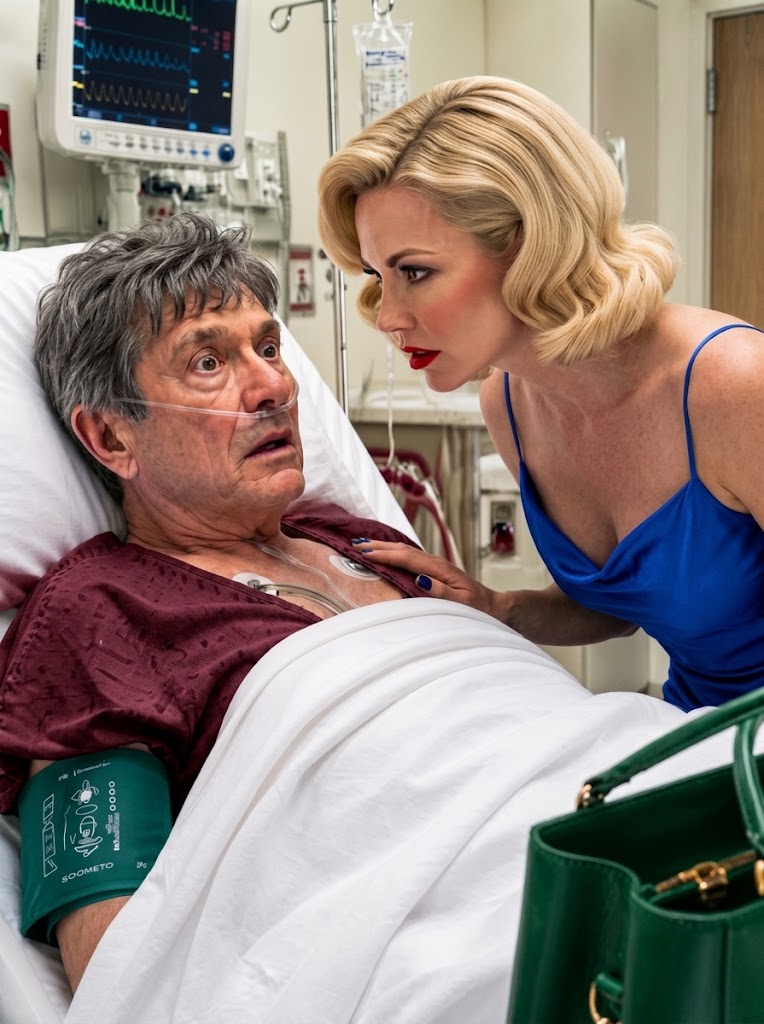
This story follows Thomas Mercer, a wealthy 57-year-old owner of a $90 million furnishings company, whose dramatic journey unfolds through key plot points:
-
The Betrayal: Lying in a Chicago hospital with a failing heart, Thomas overhears his wife, Claire, whisper her confession. Believing he has less than a week to live, she admits to poisoning his food and supplements so she can inherit his fortune and move to Malibu with her lover, Evan Cross.
-
The Response: Thomas secretly contacts his attorney, Rachel Monroe, with the help of Noah Bennett, an honest hospital orderly. With a doctor verifying his mental competence, Thomas signs a sworn legal declaration detailing Claire’s confession and revokes her access to his estate. He redirects most of his assets to an employee ownership trust, charities, family, and a medical fund for Noah’s sick sister.
-
The Investigation: Hospital staff restrict Claire’s access to Thomas’s food and medicine, immediately stabilizing his health. Toxicology reports confirm toxic substances were administered to him outside the hospital. Detectives Lena Ortiz intercept evidence—including text messages between Claire and Evan, security footage of Claire discarding evidence, and poison packaging.
-
The Arrest: Realizing the police and legal team are closing in, Claire and Evan try to destroy evidence at Evan’s condo. Both are arrested and charged with conspiracy and attempted homicide. It is later revealed Evan deliberately targeted Claire due to his own massive financial debts.
-
The Aftermath: Thomas fully recovers after 29 days in the hospital, transitions his company’s ownership to his 800 employees, and funds the surgery for Noah’s sister, Sophie, who recovers and pursues a career in nursing. Claire and Evan enter plea deals and are sentenced to prison, leaving Thomas with a second chance at life and a renewed sense of purpose.
- PART -2
If you’re asking me to hide evidence or do anything illegal—” “That’s exactly why I’m asking you.” He frowned. “Because you think I’ll say no?” “Because I think you have a conscience.” For the first time, his expression softened. I gave him Rachel’s number from memory. He called from his own phone. Twenty minutes later, I heard Rachel’s voice. “Thomas?” I almost broke down. “I need you here first thing tomorrow.” “What happened?” “I’ll explain in person.” “Are you in immediate danger?” I looked toward the door. “I don’t know.” That was enough. Rachel told Noah to inform the charge nurse that no medication or supplement brought from home was to be given to me under any circumstances. Then she told me something I had not considered. “Thomas, don’t confront Claire.” “I wasn’t planning to.” “Don’t accuse her. Don’t threaten her. Don’t warn her. Right now, the most important things are your safety and preserving evidence.” Evidence. Hearing that word made everything real. Before Noah left, I called him back. “If something happens tonight…” “Nothing’s going to happen.” “But if it does.” He waited. “Tell Rachel I want my estate changed.” Noah looked uncomfortable. “Changed how?” “Claire gets nothing.” He swallowed. “Mr. Mercer…” “Most of the company should go into an employee trust. The charitable foundation gets the investment portfolio. My nieces and nephews are already provided for.” I paused. “And I want money set aside for your sister’s operation.” His face hardened. “No.” I blinked. “I’m sorry?” “No.” He looked almost offended. “You’re scared and sick. I helped you make a phone call. That doesn’t mean I’m taking your money.” For the first time that night, I smiled. “Do you realize that refusing money is making me trust you more?” “I don’t care.” “Good.” He shook his head. “You are impossible.” “So I’ve been told.” He left. And for the first time since Claire’s confession, I didn’t feel completely alone. But the next morning, we discovered that Claire had already tried to get back into my room. Twice.
PART 3 — THE DOCUMENT At 7:10 a.m., Rachel arrived. She was sixty-two, silver-haired, direct, and one of the few people on earth who had known me before I had money. With her came an independent physician, a legal assistant, and two witnesses. Rachel did not hug me. That wasn’t her style. She put her briefcase down and said, “Tell me everything.” So I did. Every word Claire had spoken. Every reference to Evan. Every comment about the medicine. Rachel took notes without interrupting. When I finished, she asked, “Are you certain you were fully conscious?” “Yes.” “Any confusion?” “No.” “Hallucinations?” “No.” The independent physician examined me and asked a long series of questions. My name. The date. Where I was. The names of my companies. The approximate value of my estate. Why I wanted to change my plans. What consequences I understood. Finally, he told Rachel, “In my opinion, Mr. Mercer is mentally competent to make legal decisions.” Only then did she open her folder. The first paper was not a will. It was a sworn declaration. It described Claire’s confession in my own words. It included the time, place, circumstances, and the names she had mentioned. It requested preservation of relevant medical records and authorized my legal team to provide the statement to law enforcement. I signed it. My hand shook badly. But the signature was mine. The witnesses signed next. Rachel looked at me. “This is the beginning, Thomas. Not the end.” Then we handled my estate. Years earlier, Claire and I had signed a prenuptial agreement because most of Mercer Home & Design predated our marriage. Under that agreement, each of us had waived claims against certain separate assets. My estate plan could therefore be changed without handing Claire automatic control over everything I owned. Rachel had prepared emergency amendments. If I died, the majority of my company interest would pass into an employee ownership trust. My charitable foundation would receive a large portion of my investment assets. Several family trusts would protect my nieces, nephews, and longtime employees. Claire would receive only property that was clearly hers under our existing agreements. Nothing more. I also created a $500,000 medical and education trust for Noah’s family. When he found out later, he was furious. But that came afterward. First, Rachel made a phone call. By noon, two detectives arrived. Detective Lena Ortiz did most of the talking. She listened carefully. Then she asked the question I had been afraid to answer. “Mr. Mercer, who normally prepares your medication at home?” “My wife.” “Who purchases your supplements?” “Claire.” “Does anyone else regularly handle them?” “No.” “Have you noticed your symptoms becoming worse after particular meals or drinks?” I thought about it. The nightly tea. The pills Claire organized. The small packets she said were natural supplements recommended by a wellness specialist. “I don’t know.” Detective Ortiz nodded. “That’s fine. Don’t guess.” The hospital agreed to run expanded testing and preserve samples of everything Claire had brought in. One bottle had been found inside her purse after hospital staff stopped her from giving me something from home that morning. Claire had argued with a nurse. “My husband always takes these.” The nurse refused. That bottle was now sealed away. I felt sick looking at it. Claire had handed those same capsules to me hundreds of times. Detective Ortiz stood. “We’ll take it from here.” “What should I do?” “Stay alive.” It sounded almost like a joke. It wasn’t. Then my hospital door opened. Claire walked in carrying flowers. She stopped when she saw Rachel. Her smile remained in place. But only just. “Rachel,” she said. “What a surprise.” Rachel smiled politely. “Good morning, Claire.” Claire looked at the papers beside my bed. Then at me. “What’s going on?” I forced myself to sound weak. “Estate planning.” Her eyes sharpened. For half a second, the loving wife disappeared. Then she smiled again. “Of course.” She placed the flowers on the table. “You shouldn’t worry about business right now, darling.” She kissed my cheek. Her lips were cold. “I’ll take care of everything.” I looked directly into her eyes. “I know you will.” She had no idea how differently I meant it.
PART 4 — SHE STARTED TO PANIC For the next thirty-six hours, I played dying. It wasn’t difficult. I was genuinely very sick. But now doctors had changed one crucial thing. Claire no longer controlled anything entering my body. No home medication. No supplements. No tea. No food she brought herself. Everything was administered and documented by the hospital. Something unexpected happened. I stopped getting worse. At first, nobody wanted to draw conclusions. My heart was still dangerously weak. But the rapid decline slowed. By the second evening, several measurements had stabilized. My cardiologist, Dr. Samuel Grant, came into my room carrying a folder. “There’s something we need to discuss.” Rachel was present. So was Detective Ortiz. Dr. Grant closed the door. “The expanded toxicology results found substances in your system that are inconsistent with your prescribed treatment.” I stared at him. “What does that mean?” “It means we have reason to believe something you were taking outside the hospital may have been contributing to your condition.” “Contributing?” “Possibly significantly.” Rachel asked the question I could not. “Could it have killed him?” Dr. Grant’s face became serious. “Yes.” The room went silent. I stared at my hands. For months, I had blamed age. Stress. Genetics. Bad luck. But somebody had been weakening me. Slowly enough that nobody had noticed. Detective Ortiz stepped outside and made several calls. By that evening, investigators had obtained the legal authority needed to search parts of my home and retrieve relevant records. That was when Claire started making mistakes. At 9:40 p.m., she texted me. How are you feeling? I replied: Very tired. She wrote: Did you take what I left with the nurse? I stared at the message. My pulse rose. I answered: I don’t know. They’re handling everything. Three dots appeared. Then disappeared. Then returned. You need those supplements. They’re part of your routine. I showed Detective Ortiz. She photographed the screen. A minute later, another message arrived. Please tell them I’m your wife and I know your medical history better than they do. Detective Ortiz raised an eyebrow. “She’s nervous.” She was right. Claire came to the hospital the next morning. This time, she did not bring flowers. She closed the door behind her. “You look better.” Her voice sounded almost accusing. “Do I?” “The doctor said you were stable.” “For now.” She stared at me. “What exactly did Rachel change yesterday?” “My funeral arrangements.” It was cruel. But effective. Claire’s shoulders relaxed. “Oh.” She sat beside me. “I’m sorry. I’m just stressed.” I watched her closely. “Are you?” “Of course I am.” She took my hand. “I love you.” For eleven years, those words had comforted me. Now they made my skin crawl. Then she said something I will never forget. “Promise me you won’t leave everything tied up in complicated trusts. You know how difficult that would make things for me.” There it was. Even with me lying inches away from death, she was still thinking about access to the money. “I’ll try not to inconvenience you,” I whispered. She smiled. “Thank you.” Two hours after she left, Detective Ortiz returned. “We found Evan Cross.” My throat tightened. “And?” “He isn’t just your wife’s property consultant.” I already knew what she was about to say. But somehow hearing it still hurt. “They’ve been having an affair for at least eight months.” She placed several printed photographs on the table. Claire and Evan entering a hotel. Claire and Evan outside a restaurant in Milwaukee. Claire and Evan standing on the balcony of a rental property in California. Then Ortiz placed one final image in front of me. It showed them touring a house near Malibu. The date was three weeks earlier. Claire had told me she was visiting her sick aunt. I looked away. Detective Ortiz wasn’t finished. “We also found messages.” “What kind?” Her expression changed. “The kind that make this much bigger.”
PART 5 — THE MAN SHE LOVED The detectives did not show me everything. They didn’t need to. The important parts were enough. Claire and Evan had been discussing my death for months. They referred to me as “the deadline.” Not Thomas. Not her husband. The deadline. One message from Evan read: How much longer? Claire replied: He’s getting weaker. Another said: Once this is over, we don’t have to pretend anymore. There were also conversations about my estate. My properties. My company. My life insurance. The California house. But investigators found something else. Evan was in serious financial trouble. His image of success was mostly an illusion. He had debts. Failed investments. Civil judgments. He had been borrowing money to maintain his lifestyle. Suddenly his relationship with Claire made even more sense. Maybe she loved him. Maybe he loved her. Or maybe both of them loved what they thought my death would buy. Detective Ortiz warned me not to assume they had enough evidence for charges yet. “A terrible conversation isn’t always enough,” she said. “We need to establish what happened to you, who caused it, and whether there was intent.” But then the search of my home produced a breakthrough. Claire had thrown away several containers after I was hospitalized. Ordinarily, they might have disappeared forever. But our home had exterior security cameras connected to a cloud backup I had installed after a burglary in the neighborhood. Claire had apparently forgotten about them. Footage showed her leaving the house shortly before visiting me at the hospital. She carried a bag to the trash bins. Investigators recovered what remained. Some of the packaging matched products found in my medical testing. Again, nobody told me technical details. I didn’t want them. I only wanted to know one thing. “Did she do this?” Detective Ortiz answered carefully. “The evidence is moving strongly in that direction.” I closed my eyes. A strange grief came over me. Not rage. Grief. I kept remembering our wedding. Claire walking toward me beneath white flowers. My best friend whispering, “You’re a lucky man.” I remembered buying our first house together. I remembered her crying when our old Labrador died. I remembered the night she sat beside me after my mother’s funeral and held my hand until dawn. Had she been pretending then? Or had something changed? It almost would have been easier if the whole marriage had been false. Because the alternative was worse. Maybe she had once loved me. Maybe greed, resentment, entitlement, or obsession had slowly replaced whatever we once had. That evening, Noah came into my room. “You look terrible.” “Thank you.” “You know what I mean.” He pulled a chair closer. I told him investigators had found evidence. He was silent for a while. Then he said, “My dad used to say people think betrayal hurts because somebody hated you.” I looked at him. “He said it hurts because they loved you first.” That sentence broke something inside me. I cried. Not dramatically. Not loudly. Just quietly, while a twenty-six-year-old hospital orderly sat beside me pretending not to notice. Eventually, I wiped my face. “How’s your sister?” He smiled faintly. “Still waiting.” “For surgery?” “Yeah.” “You know I set up a medical trust.” His smile vanished. “You what?” “It’s done.” “No.” “Noah—” “I helped you because somebody was trying to hurt you.” “I know.” “That doesn’t mean you owe me half a million dollars.” “I’m not paying you.” “Then what do you call it?” “Investing in a family that still knows what loyalty looks like.” He stared at me. Then he stood. “You rich people are unbelievable.” “I’ve heard that too.” At the door, he stopped. “Thank you.” Then he walked out quickly. I smiled for the first time in days. Ten minutes later, Detective Ortiz entered at nearly a run. “We have a problem.” “What happened?” “Evan knows we’re investigating.” “How?” “We don’t know.” “And Claire?” Ortiz looked directly at me. “She may know too.”
PART 6 — THEIR LAST MOVE That night, Claire did not come to the hospital. She called instead. I let it ring twice before answering. “Hello?” “Thomas.” Her voice sounded different. No sweetness. No performance. “You’ve been talking to police.” I said nothing. “I know you have.” “Why would police be interested in me?” “Don’t play games.” I heard breathing on the other end. Then she said, “Rachel changed your estate plan, didn’t she?” So that was what mattered. Not whether I was afraid. Not whether I was dying. The money. “What makes you think that?” “Because Rachel doesn’t spend six hours in a hospital unless someone is moving assets.” “You’ve been keeping track?” “I’m your wife.” “That answer used to mean something.” Silence. Then Claire’s voice softened. “Thomas, whatever you think you heard…” My skin went cold. She knew. “I was emotional,” she continued. “I said things I didn’t mean.” “You said you were waiting for me to die.” “I was angry.” “You said the things you gave me were making me weaker.” Silence again. Longer this time. Then she whispered, “You were awake.” “Yes.” The performance ended. “How much did you hear?” “Enough.” For several seconds neither of us spoke. Then Claire said, “You don’t understand.” “Then explain.” “It wasn’t supposed to go this far.” Those words told me more than any confession. I closed my eyes. “Claire…” “You were always working. Always traveling. Always building something. Even when you were home, the company came first.” “So you tried to kill me?” “I didn’t say that.” “You just said it wasn’t supposed to go this far.” She started crying. Maybe genuinely. Maybe not. “Evan told me the things were harmless in small amounts. He said they would just make you tired. Make you slow down.” I felt physically sick. “Why?” “So you’d step away from the company. So you’d finally change.” “And when doctors said I was dying?” She didn’t answer. “You kept going.” “I panicked.” “No. You planned a house in Malibu.” Her crying stopped. That was the moment I understood. The tears had been another tool. “You recorded this, didn’t you?” she asked suddenly. I hadn’t. Detective Ortiz had told me not to attempt amateur evidence gathering without guidance. But I answered carefully. “You should assume everything matters now.” Claire hung up. Within an hour, police learned that she had left our house. Evan was gone too. For a terrifying moment, everyone thought they were fleeing. Then investigators discovered their vehicles at Evan’s condo. They were inside. Destroying records. Officers arrived with a warrant. Evan tried to leave through the service entrance carrying a laptop bag. Claire stayed inside and demanded an attorney. Later, I was told investigators recovered several devices and documents. They also discovered evidence that Evan had researched my estate months before Claire claimed their relationship had become serious. He had known who I was. He had known what I owned. And he had targeted a woman who already felt neglected and resentful. That didn’t excuse Claire. But it explained the path. The next morning, Detective Ortiz came to my room. “Claire Mercer and Evan Cross have been arrested.” The words felt unreal. “What are they charged with?” “The initial charges include conspiracy and attempted homicide-related offenses. More may follow depending on the prosecutor’s review.” I stared out at the Chicago skyline. I had expected to feel victory. Instead, I felt empty. My wife was in custody. Her lover was in custody. My marriage was finished. My heart was damaged. And according to doctors, I still might die. Justice meant very little if I never left that hospital bed. Then Dr. Grant walked in. He was smiling. I had never seen him do that before. “What?” He pulled up a chair. “Thomas, I think we were wrong about your week.”
PART 7 — THE SECOND CHANCE Once doctors identified what had been interfering with my health, they were able to treat me differently. Nobody promised a miracle. My heart had been under enormous strain. There had been genuine damage. But I was no longer deteriorating at the same terrifying speed. First I survived another week. Then another. After eighteen days, I stood beside my hospital bed with a physical therapist holding my arm. My legs shook. I took four steps. Noah happened to walk past the doorway. He stopped. “Well, look at you.” “Don’t sound so surprised.” “You almost fell into a chair yesterday.” “I was testing gravity.” He laughed. It was the first normal sound I had heard in weeks. I spent twenty-nine days in the hospital. When I finally left, reporters were outside. News of Claire’s arrest had leaked. Cameras flashed. People shouted questions. “Mr. Mercer, did your wife try to kill you for your fortune?” “Are you filing for divorce?” “Did you disinherit her?” “Are you selling the company?” I answered none of them. Rachel helped me into the car. As we drove away, she asked, “Where do you want to go?” Not home. I knew that immediately. The house where Claire had prepared my medicine no longer felt like mine. So I went to a smaller apartment I owned downtown. For the first time since I was twenty-four, I lived alone. Recovery was slow. Some mornings I woke up furious. Other mornings I missed Claire so badly I hated myself for it. That confused people. Friends assumed that once I knew what she had done, every good memory would disappear. It didn’t. That was the problem. I still remembered dancing with her in our kitchen. I still remembered the ridiculous Christmas sweaters she bought every year. I still remembered how she used to fall asleep during movies and deny it afterward. You can hate what someone became and still grieve who you thought they were. My therapist helped me understand that. Yes, I had a therapist. A younger version of me would have laughed at the idea. The younger version of me had also nearly worked himself into a grave while allowing someone else to control every detail of his health. I had learned humility. Three months after leaving the hospital, I returned to Mercer Home & Design. Eight hundred employees had gathered inside our main distribution center. When I walked onto the platform, they applauded. I couldn’t speak for almost a minute. Finally, I told them the truth. “Some of you have heard stories about what happened to me.” The room became silent. “I won’t discuss the criminal case. But I will tell you this. I spent most of my life believing a legacy was something you owned.” I looked around. “Buildings. Accounts. Companies.” I shook my head. “I was wrong.” I announced that a significant percentage of my ownership would still be transferred gradually into an employee trust. The decision I had made in the hospital would not disappear simply because I survived. People cried. So did I. Afterward, Noah found me near the loading docks. His sister, Sophie, was with him. She was twenty-two. Thin. Shy. And recovering well after finally receiving the procedure she had needed. “This is the stubborn man I told you about,” Noah said. Sophie hugged me. I wasn’t expecting it. “Thank you for helping me.” I looked at Noah. “You told her?” “She has eyes. She figured out hospital bills don’t magically vanish.” Sophie smiled. “I’m going back to college in the fall.” “What are you studying?” “Nursing.” Something about that felt perfect. But while my life was rebuilding, Claire’s was collapsing. And six months after her arrest, I received a letter from her. I almost threw it away. Then I noticed the first sentence. Thomas, there is one thing about Evan you still don’t know.
PART 8 — CLAIRE’S FINAL TRUTH My attorney advised me not to respond. So I didn’t. But I read the letter. Claire wrote that Evan had approached her deliberately. Not randomly. He had studied me. My company. My public filings. Our charitable appearances. Even my travel schedule. He knew Claire attended fundraising events without me. He knew our marriage had become strained. He made himself available. Attentive. Interested. Everything I had stopped being. Again, none of that excused her. Claire made choices. Terrible ones. But according to her, Evan had gradually convinced her that I would never change while I remained healthy and in control. At first, she said she only wanted me to become dependent on her. Then she wanted me to step away from the company. Then Evan started talking about what would happen “if Thomas wasn’t around.” She claimed the plan grew slowly. One compromise at a time. One lie at a time. Until she was standing beside a hospital bed telling her dying husband that she couldn’t wait to spend his money. The letter ended with: I don’t expect forgiveness. For a long time I told myself you had failed me as a husband, and that somehow made what I was doing less terrible. It didn’t. You neglected our marriage. I betrayed it. Those are not equal things. I don’t know when I became the woman who stood beside your bed that night. But I know she was me. I folded the letter. And for the first time, I felt something I had not felt before. Closure. Not forgiveness. Not yet. Maybe never. But clarity. I had made mistakes in our marriage. I had worked too much. I had missed dinners. I had canceled vacations. I had treated business emergencies as though the world would end if I didn’t personally solve them. I could take responsibility for those failures. What I would never do again was carry responsibility for someone else’s choices. Nearly a year after my hospitalization, Claire entered a plea agreement. Evan did too, after investigators presented overwhelming financial and digital evidence connecting him to the conspiracy. I did not attend every hearing. I went to one. Claire looked older. So did I. At one point, she turned toward me. Our eyes met. There was no hatred in her face. Only regret. Maybe that was worse. At sentencing, I gave a short statement. I did not ask the judge for revenge. I said: “What was taken from me was not money. It was trust. For months, I believed my body was betraying me. I believed I was dying because I was unlucky. In reality, the person I trusted most was helping create the illness I was fighting. I survived. But survival is not the same as living. I hope they both find a way to become better human beings than the ones who stood inside my hospital room.” The judge sentenced Evan to eighteen years. Claire received fourteen. When I walked out of the courthouse that afternoon, the sun was bright against the stone steps. Rachel walked beside me. “Where to now?” I thought about it. Not the office. Not my apartment. “I think I’d like to buy some flowers,” I said. Rachel frowned. “For whom?” “For myself.” She smiled. “That sounds like a start.” I am sixty now. My heart isn’t perfect. I take medication every morning. I walk three miles every day. I spend less time behind a desk and more time listening to people who work for me. My company is thriving under employee ownership. Noah’s sister graduated from nursing school last month. She works at the same hospital where her brother once brought me fresh water in the middle of the night. Sometimes people ask me how I survived hearing my wife say she was waiting for me to die. They expect a story about money. Or law. Or revenge. I tell them the truth. I survived because one honest stranger agreed to make a phone call. And because sometimes, the worst night of your life is just the moment you finally stop pretending and start living.