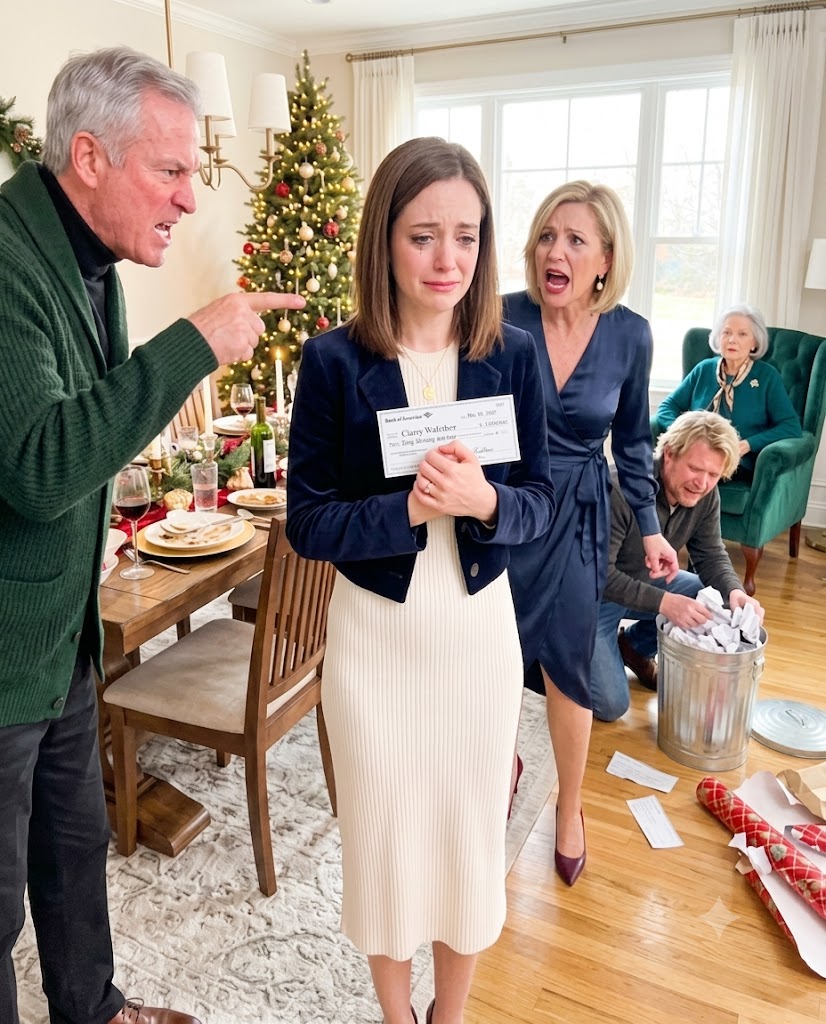
At Christmas dinner, Grandma Evelyn Whitaker handed each of us a $5 million check.
For several seconds, the room was completely silent.
Then my older brother Marcus burst into laughter so violently that he nearly knocked over his wineglass. My cousin Brittany slapped the table and wheezed, “Grandma, this is the best prank you’ve ever pulled.”
My father glanced at his check for barely a second before throwing it beside his plate. “It’s obviously fake,” he scoffed. “Don’t be stupid.”
Grandma remained seated at the head of the long table in a red cardigan, her silver hair pinned neatly above her ears. She did not smile. She did not offer an explanation. She simply watched everyone with calm blue eyes that made the room feel colder than the December air outside.
I was her youngest granddaughter, thirty-two, divorced, and working two jobs in Denver to afford a small apartment. All evening, I had listened to relatives boast about promotions, new homes, and expensive vacations. My father introduced me as “the one still figuring things out,” as though my divorce had made me a permanent family disappointment.
So when Grandma pushed the check toward me, I did not laugh.
Pay to the order of: Claire Whitaker. Five million dollars.
Her fingers trembled slightly as they touched my wrist. “Don’t lose it, Claire.”
I looked at her. “Grandma, what is this?”
“A choice,” she said softly.
My father gave an irritated snort. “Mom, please. Don’t encourage her.”
Grandma turned toward him. “Richard, you never did like things you couldn’t control.”
The table fell quiet again, but only briefly. Then the laughter returned, louder and crueler. Marcus waved his check above his head. “Should I frame mine or cash it at a gas station?”
Brittany folded hers into a paper airplane and sent it across the room. It landed directly in the mashed potatoes.
My aunt Linda shook her head. “Mom, you could’ve at least made it believable. Five million each? Come on.”
Grandma made no attempt to defend herself. She merely asked Rosa, her housekeeper, to serve dessert.
I folded my check carefully and slipped it into the inner pocket of my coat.
My father noticed. “Claire. Don’t tell me you’re actually keeping that.”
I stared down at my plate. “It has my name on it.”
“It’s humiliating,” he said. “You’re a grown woman.”
Grandma looked toward me, and for the first time that evening, I recognized something hidden behind her expression. It was not amusement. It was not confusion. It was urgency.
The next morning, I drove to First Mountain Trust Bank with the check secured inside a folder. I expected the teller to smile politely and explain that my grandmother had made some kind of mistake.
Instead, the teller examined the check and stopped smiling. She called over the branch manager, a tall man named David Callahan. He looked at the check, then at me, and then back at the check. His face lost all color.
He guided me into a glass office and closed the door behind us. “Ma’am,” he whispered, “we need to talk.”
David Callahan did not sit immediately. He remained standing, holding the check in both hands as though it were evidence in a criminal investigation.
“Is there a problem?” I asked.
He glanced through the glass wall toward the lobby, then closed the blinds. “Where did you get this?”
“My grandmother gave it to me last night.”
“Evelyn Whitaker?”
I nodded.
His jaw tightened. “Mrs. Whitaker has been a private client of this bank for nearly twenty years.”
My stomach dropped. “So the check is real?”
David finally sat across from me. “Yes. The check is real.”
The answer struck me so hard that I gave a single nervous laugh. Nothing about the situation was funny, but my mind had no other way to process it.
He slid the check toward me, though one finger remained pressed against the corner. “However, there’s something important you need to understand. This check was not issued from a standard personal account. It is connected to a trust: The Whitaker Family Preservation Trust.”
I stared at him. “I’ve never heard of it.”
“I’m not surprised,” he replied carefully. “The instructions specifically stated that beneficiaries were not to be informed until Mrs. Whitaker initiated the distribution.”
“Beneficiaries?” I repeated. “So everyone’s checks were real?”
“Yes.”
I immediately pictured Marcus laughing, Brittany launching hers into the mashed potatoes, and my father discarding his as though it were a dirty napkin.
David leaned forward. “Ms. Whitaker, when your grandmother distributed those checks, she activated a clause in the trust. Each check must be deposited or formally rejected within seventy-two hours. If the beneficiary fails to act, the distribution is forfeited—to the remaining beneficiaries who accepted their distributions.”
Cold spread through me. Grandma knew they would laugh. David did not respond, but his silence was answer enough.
He opened another folder and removed several documents bearing Grandma’s signature. “There is more. Your grandmother revised the trust six months ago. She included competency statements from two doctors, a recorded affidavit, and a letter explaining her decision.”
“Why would she need that?”
David looked uncomfortable. “She believed her children were pressuring her to change her estate plan. Mrs. Whitaker documented several attempts to take control of her assets, including efforts to place her in a managed-care facility and restrict her access to her own finances.”
My mouth went dry. My father had told us she was becoming forgetful, but David confirmed the medical reports stated otherwise.
He pushed a sealed envelope toward me with Grandma’s handwriting: For Claire only.
My hands trembled as I opened it. Inside was a brief letter:
Claire, if you are reading this, you were the only one who listened before deciding. That matters more than money. Do not call your father first. Do not trust anyone who mocked what they did not understand. Come see me today. Bring this letter. There are things I must tell you before they find out.
I stood so quickly that my chair scraped against the floor.
David rose as well. “Ms. Whitaker, there is one more issue. Your father called the bank thirty minutes ago asking whether anyone had attempted a large transaction from Evelyn Whitaker’s accounts, claiming he held financial power of attorney.”
“Does he?”
David’s mouth tightened. “No. He does not.”
I drove directly to Grandma’s house while my phone vibrated continuously in the cup holder with ignored calls from Dad, Marcus, and Aunt Linda.
Snow was falling over her Cherry Creek neighborhood. Two vehicles were already parked in her driveway: my father’s black Lexus and Aunt Linda’s silver Mercedes.
I walked up to the house and heard raised voices from inside.
“You embarrassed all of us!” my father shouted.
Grandma answered with calm precision. “No, Richard. You embarrassed yourselves.”
I used my key and entered. Everyone turned. My father stood in the foyer, his face red with anger. Aunt Linda stood beside him, Marcus leaned against the staircase pretending to be absorbed in his phone, and Grandma sat beside the fireplace in her wingback chair with Rosa standing protective behind her.
Dad’s eyes dropped to my folder. “Where have you been?”
“At the bank.”
Dad laughed once. “Claire, don’t tell me you actually tried to cash that ridiculous thing.”
“It was real. Every check was real.”
The room became completely still.
“That’s impossible,” Aunt Linda stepped forward.
“No,” Grandma said. “It is not.”
Dad pointed toward me. “You deposited it?”
“Not yet. The manager explained the trust first.”
The color vanished from my father’s face as he realized what had happened.
Marcus demanded, “What trust?”
Grandma looked at him calmly. “The one your grandfather and I established before most of you understood how expensive your opinions would become.”
She had Rosa bring a blue folder containing documents from six months ago when Richard and Linda had tried to trick her into signing over her assets under the guise of “tax planning.” When she refused, they had begun claiming she was confused, sending brochures for assisted-living facilities, and taking advantage of her past financial help.
She handed me the document stack: signed statements from a neurologist, a psychiatrist, and her estate attorney confirming her full mental competency.
“You created a trap for your own children,” Dad accused.
“No, Richard. I offered every person the same gift. You decided what it was worth before understanding it.”
Marcus suddenly gasped. “Wait. If we threw the checks away—”
“You have until tomorrow night,” I said quietly. “Seventy-two hours from the time she handed them to you.”
Marcus ran toward the dining room, but Grandma stopped him. “The housekeeper already cleaned.”
Rosa confirmed, “The trash was collected this morning.”
Marcus looked sick. “Mine landed in the mashed potatoes.”
“And then you laughed,” Grandma reminded him.
Dad turned to me angrily, but before he could press further, the doorbell rang. Rosa ushered in Patricia Bell, Grandma’s estate attorney.
Patricia distributed copies of the trust summary and explained: “Every beneficiary received a valid cashier’s check. Acceptance requires depositing the check or submitting written acknowledgment before the deadline. Failure to act, destruction, or refusal is treated as rejection.”
When my father called it cruel, Grandma replied, “Cruel was telling my grandchildren that I was losing my mind because I refused to give you my passwords. You were protecting your inheritance.”
She reached for my hand. “Claire visited me every Thursday after her divorce. She did not come because she wanted money. She came because she noticed I was lonely.”
Grandma then looked at my father. “Richard, you will leave my house now.”
When he hesitated, Patricia reminded him to comply. Defeated, Marcus left to search his car, Aunt Linda left whispering into her phone, and Dad finally walked out after glaring at me.
That afternoon, I deposited the check under direct bank supervision into a protected account. Grandma also named me temporary trustee over another part of her estate.
Over the next twenty-four hours, chaos ensued. Marcus claimed his check was stolen but couldn’t prove it. Aunt Linda’s attorney sent threats, which were answered with Grandma’s medical records. Dad tried to claim authority over her accounts again, but the bank documented the unauthorized attempt.
By the deadline, only two checks were accepted: mine and Rosa’s.
After the family left on Christmas night, Grandma had given Rosa a check as well, honoring her twelve years of selfless care.
A week later, Grandma moved into a downtown condominium, and Rosa bought a home nearby, remaining close as chosen family.
Dad challenged the trust in court, but he lost completely after the judge reviewed the medical affidavits and an incriminating email from Aunt Linda stating: “If Mom signs before Claire gets involved, we can keep this clean.”
Outside the courthouse, Dad accused me: “You destroyed this family.”
I replied, “No. Grandma told the truth. That’s what destroyed the lie.”
I used the money wisely: paid off debts, bought a modest townhouse, left my second job, and joined a nonprofit legal clinic helping elderly people fight financial exploitation.
Grandma lived three peaceful, wonderful years longer before passing away at eighty-nine. At her funeral, I gave the eulogy, speaking not of money or legal battles, but of her love, mindfulness, and character.
Afterward, Rosa pointed to a framed copy of the check hanging in my office and reminded me of what Grandma truly gave me that Christmas night: not just financial freedom, but my dignity.