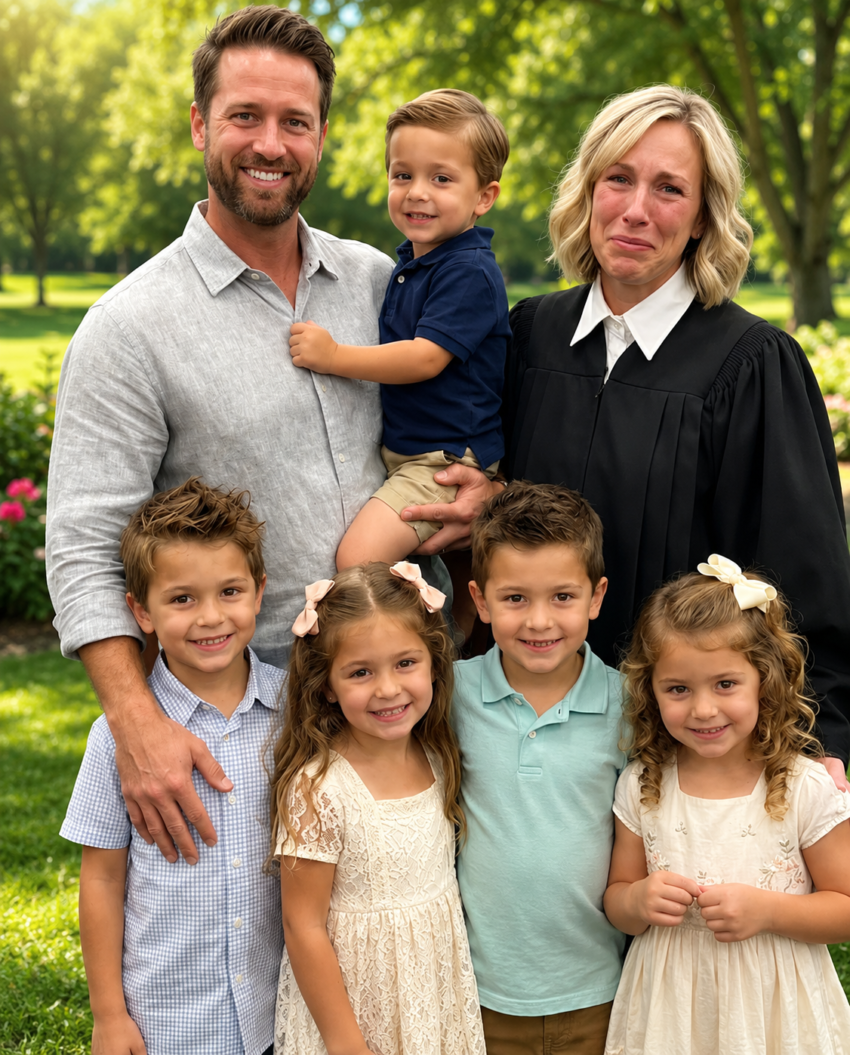
Part One: Five Children on a Courtroom Bench
Everyone arrived at family court that morning expecting the same painful outcome.
Five young siblings would be divided among three foster homes.
The paperwork had already been prepared. Transportation had been arranged. By Friday afternoon, the children would be living in separate counties, sleeping beneath unfamiliar roofs and learning how to exist without the brothers and sisters who had been their only source of comfort.
No one expected a quiet carpenter with rough hands, worn boots, and a borrowed tie to challenge the plan.
And no one knew that twenty years earlier, he had sat in the same courthouse waiting for his own family to be torn apart.
The hallway smelled of furniture polish, aging files, and the faint bitterness of old coffee. Every sound seemed too loud—the squeak of shoes, the rustle of documents, the low murmur of attorneys speaking behind closed doors.
I sat on a stiff wooden bench with a thick folder balanced on my knee.
Inside it were inspection reports, bank statements, medical forms, receipts for car seats, photographs of newly built bedrooms, and every other piece of evidence I had managed to collect during the most exhausting three weeks of my life.
My fingers would not stop trembling.
Across the hallway, five children sat close together.
Eli, the oldest, was only six, but he carried himself like someone much older. He kept one arm wrapped around his three-year-old sister, Lila, while gently wiping the tears from her cheeks with the hem of his shirt.
“It’s all right,” he whispered. “We just have to wait.”
The four-year-old twins sat beside him, their hands locked together so tightly that their knuckles had turned pale.
The youngest child rested on Eli’s lap, bundled inside a winter coat far too large for such a small body. A battered stuffed rabbit was tucked beneath one arm. One of its ears had been torn away long ago, yet the child held it as though it were the most valuable thing in the world.
Watching them, I felt something twisting beneath my ribs.
Three weeks earlier, they had been strangers to me.
Now the thought of anyone placing them into separate vehicles made it difficult to breathe.
A clerk approached me carrying a stack of papers.
“Carter?”
I stood quickly.
“Yes, ma’am.”
She looked to be in her late fifties, with silver threaded through her dark hair and the calm expression of someone who had spent years watching families enter courtrooms with hope and leave with heartbreak.
“My name is Margaret. You’re here for the ten o’clock hearing?”
“Yes.”
She glanced at my face.
“Are you managing all right?”
A nervous laugh escaped me.
“I haven’t slept properly in about three weeks, so probably not.”
Her gaze moved toward the children.
“You brought all five of them?”
“I couldn’t leave them with anyone else.”
Margaret studied me for a moment.
“They’ve already been handed from one person to another too many times,” I added. “I wanted them to know I wasn’t disappearing before the hearing.”
Her expression softened.
She looked back at the children, then pressed her lips together as though she were holding back words that were not hers to say.
“I hope things go well for you,” she said quietly.
“Thank you.”
After she walked away, Eli lifted his head.
“Carter?”
I crossed the hallway and crouched in front of him.
“What is it, buddy?”
His eyes moved toward the courtroom doors.
“Are they going to send us to different houses?”
The twins stopped whispering.
Lila stared at me with wet, frightened eyes.
Even the youngest child seemed to tighten their grip around the stuffed rabbit.
I wanted to tell them no.
I wanted to promise that no one would separate them, that they would all sleep beneath the same roof that night, and that the worst part of their lives was finally over.
But I had learned long ago that adults sometimes made promises because they could not bear to speak the truth.
I refused to do that to them.
“Not if I can stop it,” I said.
Eli searched my face.
“Do you promise?”
My throat tightened.
I had spent most of my life avoiding promises. Promises had a way of turning into memories that hurt.
Still, five children were waiting for my answer.
“I promise I will fight harder for you than I have ever fought for anything.”
Eli nodded slowly.
For him, that was enough.
He pulled Lila closer and resumed whispering reassuring words into her hair.
Then the courtroom door opened.
The bailiff stepped into the hallway and called our case number.
The children flinched as though someone had shouted.
I stood, tightened my grip around the folder, and followed my attorney inside.
Her name was Diane, and she had spent the previous week warning me that love would not be enough.
The court needed proof.
It needed stability, money, space, medical coverage, childcare arrangements, background checks, emergency contacts, and a detailed plan for nearly every hour of the children’s lives.
My intentions might have been sincere, she said, but sincere intentions did not automatically make someone qualified to raise five children under seven.
I understood that.
What frightened me was that the state’s alternative was not keeping them together somewhere else.
The alternative was separation.
During the first recess, Diane guided me into a small conference room and closed the door.
Her face told me the news was bad before she spoke.
“They finalized the placements last night,” she said.
I placed my folder on the table.
“What does that mean?”
“Three foster families have agreed to take them.”
“All together?”
She hesitated.
“No.”
The room seemed to tilt.
“How many homes?”
“Three.”
I looked at her without speaking.
“The transportation vans are scheduled for Friday,” she continued. “The twins will remain together. Eli will likely be placed with the youngest. Lila will go to another county.”
“Friday?”
“Yes.”
“That’s only five days away.”
“I know.”
I walked to the window, though there was nothing outside except a brick wall and the metal frame of a fire escape.
“Tell me honestly,” I said. “Do I have any real chance?”
Diane did not offer me false comfort.
“Your chances are not strong. You’re single. You’re relatively young. You have no previous parenting experience, and your home still needs final placement approval.”
“It’s safe.”
“I believe you. But the judge must be convinced.”
“I renovated every room myself. I installed alarms, locks, railings, and new wiring. The inspector said the remaining issues were minor.”
“I know.”
“I spent everything I had.”
“I know that too.”
Before she could say more, the door opened.
Beverly, the senior caseworker, stepped inside carrying a clipboard.
She had worked in child placement for more than two decades. During the past three weeks, she had visited my home almost every day.
Sometimes she asked questions.
Sometimes she checked cupboards, beds, windows, and medicine cabinets.
Sometimes she simply watched.
“May I sit?” she asked.
“Of course.”
She took the chair across from me and folded her hands over the clipboard.
“Carter, I need you to understand something. I am not trying to punish you, and I am not your enemy.”
“I understand.”
“I have watched kind people accept responsibilities they could not sustain. When they became overwhelmed, the children suffered another loss. I cannot ignore that possibility.”
“You shouldn’t.”
Her eyebrows lifted slightly, perhaps surprised that I had agreed.
“You do not have a spouse or co-parent,” she continued. “You do not yet have a health insurance plan covering five dependents. Your living area was created inside a property that was once used primarily as a workshop.”
“I’ve separated the workshop from the house,” I explained. “There are fire-rated walls between them. The bedrooms are insulated, and every window meets safety requirements.”
“I saw the renovations.”
“I built two oak bunk beds and a smaller bed for Lila. The youngest has a toddler bed. I put night-lights in the hallway because none of them likes the dark.”
Something passed through Beverly’s eyes, but her professional expression remained steady.
“I purchased five car seats,” I continued. “I contacted a pediatrician on Elm Street, and she agreed to accept all of them. My neighbor is a retired teacher and has offered to help after school. I also reduced the number of jobs I take each week.”
“You also emptied most of your savings.”
“I did.”
“That worries me.”
“Separating them worries me more.”
For several seconds, she said nothing.
Then she looked toward the door.
“I would like to speak with Eli privately.”
My stomach tightened, but I nodded.
An aide brought him into the room.
Eli’s eyes immediately found mine.
“It’s okay,” I told him. “Just tell the truth.”
He climbed into the chair opposite Beverly, his feet hanging several inches above the floor.
She asked whether he had enough food.
“Yes.”
Whether I became angry with him.
“No.”
Whether he felt safe in my home.
He looked at me before answering.
“Yes.”
Beverly asked where he went when he felt frightened.
His small fingers twisted around a pink ribbon that belonged to Lila.
“To Carter’s room,” he whispered.
“Why?”
“Because he wakes up.”
The simplicity of his answer struck me harder than any speech could have.
He did not say I always knew what to do.
He did not say I could fix everything.
He only knew that when he was afraid in the middle of the night, I woke up.
After the aide took him back to the others, Beverly thanked me and left.
Diane waited until the door closed.
“There’s one more problem,” she said.
“What now?”
“The state’s attorney has reviewed your background.”
My hands went still.
“He found gaps in your records between the ages of nine and seventeen.”
I stared at the tabletop.
“He’s going to ask about them,” she continued. “He’ll also ask why you chose these particular children.”
“I’ll answer what I can.”
“Carter, listen to me. Whatever happened during those years may matter today.”
I looked toward the ceiling, fighting the familiar pressure behind my eyes.
“I have never told anyone the entire story.”
“You may have to tell the court.”
“I’m not sure I can.”
Diane leaned forward.
“Then do it for the five children sitting outside.”
Before I could respond, the bailiff called us back into the courtroom.

Part Two: The Question I Had Avoided for Twenty Years
The state’s attorney was named Daniel.
He was calm, prepared, and careful with his words. He did not speak cruelly, nor did he treat me like a criminal.
In some ways, that made the situation harder.
He stood before the judge with several charts arranged neatly on the podium.
“Your Honor,” he began, “the state does not question Mr. Carter’s compassion. His efforts during the past three weeks have been significant.”
He turned a page.
“However, compassion alone cannot guarantee the long-term welfare of five young children.”
I kept my eyes on the judge.
Daniel listed every weakness in my application.
I had no spouse.
No co-guardian.
No previous parenting experience.
My medical coverage had not yet been expanded.
My home had passed preliminary inspections but had not received final foster licensing approval.
My income as a carpenter was steady but not large.
“The state has three licensed foster homes prepared to receive the children,” Daniel concluded. “Separation is not ideal, but each home has been vetted and approved. The court’s first responsibility must be stability.”
Stability.
The word stayed in the air like smoke.
I looked toward the back row.
Eli was holding the youngest child while the twins leaned against one another. Lila sat pressed against Beverly’s side, staring at me.
They did not look stable.
They looked like five children waiting to learn which pieces of their family they would be allowed to keep.
Diane called me to the witness stand.
After she asked about my employment, the renovations, and my plans for the children, Daniel approached.
“You have worked as a carpenter for eleven years?” he asked.
“Yes.”
“At the same business?”
“Yes.”
“You own the property?”
“The bank still owns part of it, but my name is on the deed.”
“And you converted a portion of the building into living space?”
“It was already partly residential. I expanded it and brought everything up to code.”
“You completed much of the work yourself?”
“Yes.”
He nodded.
“That demonstrates commitment. But taking care of five children is very different from building a bedroom.”
“I know.”
“You have no partner to share the daily responsibilities.”
“That’s true.”
“No living parents listed as emergency support.”
“No.”
“No prior experience as a foster parent.”
“No.”
Daniel studied me.
“Why would a single man with a modest income voluntarily accept this level of responsibility?”
“Because the children need a home.”
“Many children need homes.”
“I know.”
“Yet you did not apply to foster one child. You did not request two. You asked for all five members of this particular sibling group.”
“Yes.”
“Why?”
“Because they belong together.”
His expression remained respectful, but firm.
“Sibling relationships are important. However, that statement alone does not explain why you were willing to empty your savings, alter your home, reduce your work schedule, and accept a responsibility that could last for the rest of your life.”
I gripped the wooden rail.
“It explains enough to me.”
“But the court requires more.”
Diane rose.
“Your Honor, my client has already demonstrated his reasons through his actions.”
Daniel turned slightly.
“His actions are precisely why the state is asking the question. Sudden, extreme decisions can come from compassion, but they can also come from unresolved personal issues. The court must understand his motivation.”
The judge considered both attorneys.
“I will allow the question,” he said. “But keep it focused.”
Daniel faced me again.
“Mr. Carter, your records contain very little information about your childhood between the ages of nine and seventeen.”
A faint buzzing filled my ears.
“Were you in foster care during those years?”
I looked down.
“Yes.”
“Were you placed in multiple homes?”
“Yes.”
“Does that history explain your interest in these children?”
“I would rather not discuss it.”
“I understand this is difficult.”
“No, you don’t.”
The words escaped before I could stop them.
Daniel paused.
“You’re right,” he said quietly. “I may not understand. But the judge is being asked to entrust five lives to you. The court deserves an honest explanation.”
My chest felt too tight.
Diane objected again, but I barely heard her.
I saw the courtroom only in fragments—the judge’s dark robe, Daniel’s hand resting on the podium, the edge of my folder, Eli’s worried face.
The judge raised one hand.
“That is enough, counsel.”
Daniel returned to his table.
Then the judge removed his glasses and looked directly at me.
Not at my application.
Not at my financial records.
At me.
“Mr. Carter,” he said, his voice quieter now, “I have served in this courthouse for twenty-eight years. I have heard people speak through fear, anger, grief, and shame. I am not asking you to perform for this courtroom.”
He leaned forward.
“I am asking you to tell us, in your own words, why these children matter so deeply to you.”
My fingers tightened around the witness rail.
For twenty years, I had locked the memory inside a part of myself no one was allowed to enter.
I had learned to work around it.
I could build tables, repair roofs, laugh with customers, attend weddings, and sit through holiday dinners without speaking of it.
But every few months, I still dreamed of a red plastic truck and a small hand against a car window.
I glanced toward Eli.
He was whispering to Lila, trying to comfort her even though he was terrified himself.
Suddenly, I was no longer looking at him.
I was looking at myself.
Nine years old.
Trying to be brave for four younger children because no adult had explained what would happen next.
I drew a breath.
“Twenty years ago,” I began.
My voice failed.
No one interrupted.
I swallowed and tried again.
“Twenty years ago, I sat in this courthouse with my own brothers and sisters.”
The judge slowly lowered his pen.
“There were five of us,” I continued. “I was the oldest. Our parents died in a house fire.”
The room became completely still.
“Afterward, we were brought here. I didn’t understand the hearings or the paperwork. I only understood that adults kept asking questions and no one would tell me whether we could stay together.”
I stared at my hands.
“A judge signed an order placing us in three different counties.”
The judge’s face changed.
He glanced toward an old file beside him, then looked back at me.
“It might have happened in this courtroom,” I said. “I don’t know. I tried for years not to remember the details.”
My voice began to shake.
“My youngest brother carried a little red truck everywhere. It was cheap plastic, and one wheel was missing. He held it while they led him to a car.”
The courtroom blurred.
“When they closed the door, his fingers were still near the frame. Someone had to open it again. He was crying and calling my name through the window.”
I stopped to breathe.
“I ran after the car when it pulled away. I ran until I fell in the parking lot.”
No one moved.
“I never saw him again.”
A sound came from the back row. I could not tell whether it was Beverly or Diane.
“I searched when I became old enough,” I continued. “I wrote letters. I requested records. I hired people when I could afford it. I eventually found two of my siblings, but there are still two I have never been able to locate.”
Daniel’s notepad was resting untouched on the table.
“When I saw the photograph of these five children on the emergency placement registry, I recognized the look on Eli’s face.”
I turned toward him.
“It was the same look I had when I realized the adults around me had already made a decision.”
Eli’s chin trembled.
“I know that loving them does not automatically make me qualified,” I said. “I know five children are more than one person should take on without careful planning. I know I may spend the rest of my life working to give them what they need.”
My voice grew steadier.
“But I also know what happens when the last person fighting to keep a family together stops fighting.”
I looked back at the judge.
“I could not change what happened to my brothers and sisters. But when I saw these children, I knew I had one chance to prevent the same thing from happening again.”
Daniel remained silent.
He did not ask another question.

Part Three: What Eli Asked the Judge
For several moments, the judge said nothing.
His glasses remained on the desk in front of him. One hand covered part of his mouth as he looked toward the children.
Then he spoke.
“Eli, would you come forward?”
The boy carefully passed the youngest child to Beverly and walked down the aisle.
He looked impossibly small beneath the high courtroom ceiling.
When he reached the front, the judge softened his voice.
“You are not in trouble, son.”
Eli nodded.
“I only need to ask you one question.”
The boy twisted Lila’s pink ribbon between his fingers.
“What do you want to happen today?”
Eli turned around.
He looked first at the twins.
Then at Lila.
Then at the youngest child in Beverly’s arms.
When he faced the judge again, his eyes were shining.
“I want us to stay together.”
The judge’s jaw tightened.
“Is there anything else?”
Eli shook his head.
“No, sir. Just that.”
The judge leaned back.
His eyes remained closed for a brief moment before he put his glasses on again.
“Ms. Beverly,” he said, “you have supervised the emergency placement?”
“Yes, Your Honor.”
“You initially opposed Mr. Carter’s petition?”
“I had serious reservations.”
“Do you still have them?”
Beverly stood with her clipboard held against her chest.
“Some practical concerns remain. Five children are an enormous responsibility. Mr. Carter will need support, supervision, and continued assistance.”
My stomach dropped.
Then she looked at me.
“However, I have also observed the children in his home almost every day.”
She faced the judge again.
“During the first week, Lila cried whenever Mr. Carter left the room. The twins refused to sleep unless their beds touched. Eli hid food inside his pillowcase because he was afraid there would not be breakfast the next morning.”
My eyes closed briefly.
I had found the crackers on the third night.
I had not confronted him. I had simply placed a small basket of snacks beside his bed and told him it would be refilled every morning.
“By the second week,” Beverly continued, “the children were beginning to settle. Mr. Carter developed routines for meals, baths, school, and bedtime. He did not punish Eli for hiding food. He made sure the child understood that the kitchen would always have something to eat.”
Eli looked toward me.
“The children now seek Mr. Carter when they are frightened,” Beverly said. “They respond to his guidance, and he has demonstrated unusual patience. More importantly, they have remained together through the most destabilizing period of their lives.”
She lowered the clipboard.
“I entered this case believing his request was unrealistic. I now believe removing them from his home and separating them would cause greater harm than allowing the placement to continue under close supervision.”
Silence filled the room once more.
The judge turned to Daniel.
“Does the state wish to respond?”
Daniel rose slowly.
“The state maintains its concerns regarding licensing and financial preparedness.”
“Understood.”
Daniel glanced toward the children.
“However, in light of the testimony, the state would not oppose a temporary placement with enhanced supervision, provided all remaining requirements are completed promptly.”
I stared at him.
He gave the smallest nod before sitting down.
The judge reviewed the papers before him.
Every second stretched painfully.
Lila slipped away from the aide and took Beverly’s free hand. The twins leaned forward in their seats. Eli remained standing near the witness box.
Finally, the judge looked up.
“The request to transfer these children into three separate foster homes is denied.”
For a moment, I was certain I had misunderstood.
No one spoke.
The judge continued.
“Given the emergency circumstances and the evidence presented today, the court grants Mr. Carter temporary custody of all five children, effective immediately.”
Diane covered her mouth.
My knees nearly gave way.
“This order is conditional,” the judge said. “The home must pass its final inspection. Mr. Carter must complete the outstanding licensing requirements, secure appropriate medical coverage, and cooperate fully with continued caseworker visits.”
“I will,” I said, barely able to form the words.
The judge looked at me.
“I will retain direct oversight of this case until a permanent placement determination is made.”
He paused.
“Mr. Carter, what you are attempting will not be easy.”
“I know, Your Honor.”
“Those children will need more than beds and meals.”
“I know.”
“They will need patience on the difficult days, consistency when they push you away, and honesty when you do not have every answer.”
My eyes burned.
“Yes, sir.”
The judge looked toward the five siblings.
“They will also need someone who understands why keeping them together matters.”
His voice became unsteady.
He removed his glasses and pressed his fingers briefly against his eyes.
When he spoke again, the formal distance had disappeared.
“Do not make this court regret believing in you.”
“I won’t.”
The words came out as a whisper, but I meant them with every part of me.
The judge struck the gavel once.
“Temporary custody is granted.”
Lila gasped.
Then she ran.
An aide reached for her, but the judge lifted one hand and let her pass.
I stepped away from the witness stand and dropped to one knee just as she threw both arms around my neck.
“Are we going home?” she whispered.
I held her tightly.
“Yes, sweetheart.”
My voice broke.
“We’re going home.”
The twins reached me next, wrapping themselves around my shoulders and waist. The youngest child pressed the damaged stuffed rabbit against my chest.
Eli remained a few feet away.
For three weeks, he had tried to be the strong one.
He had wiped his siblings’ tears, divided his snacks, checked their blankets, and whispered comforting words he was too young to understand himself.
Now he no longer had to pretend.
His face crumpled.
I reached out one arm.
He ran into it.
“I told them you would keep trying,” he cried. “I told them you wouldn’t let them take us.”
I held all five children as closely as I could.
“You helped me keep my promise,” I told him.
Beverly approached carrying the temporary custody documents.
Her own eyes were wet.
“Take care of them,” she said.
“I will.”
She looked at the children clinging to me.
“I believe you.”
Diane placed a hand on my shoulder.
“You were brave today.”
“I didn’t feel brave.”
“Most people don’t when it matters.”

Part Four: The First Drive Home
Outside the courthouse, the afternoon sunlight seemed brighter than it had that morning.
The air was cold, but for the first time in weeks, I could breathe without feeling a weight pressing against my chest.
The children followed me toward the van.
There was no transport officer waiting beside three separate vehicles.
No caseworker carrying labels with different addresses.
No one asking the children to say goodbye.
I opened the van doors and helped them climb inside.
One by one, I checked every buckle.
The youngest child sat with the stuffed rabbit tucked beneath their chin.
The twins chose seats beside each other, though they did not immediately reach for one another’s hands.
Lila was asleep before we reached the first traffic light.
For several miles, the van remained quiet.
It was not the frightened silence of children waiting for bad news.
It was the exhausted silence that comes after fear finally loosens its grip.
I watched them through the rearview mirror.
Eli was staring out the window.
After a while, he looked up and caught my eye in the mirror.
“Carter?”
“Yes, buddy?”
“We’re really staying together?”
I smiled.
“Yes.”
“All of us?”
“All five of you.”
“At your house?”
“Our house,” I corrected gently.
He stared at me for a moment.
Then, for the first time since I had met him, Eli smiled.
It was small and uncertain, as though the expression had been hidden away for so long that he had forgotten how to use it.
But it was real.
He leaned back against the seat and looked out at the road ahead.
I tightened my hands around the steering wheel.
There would be difficult days.
There would be nightmares, arguments, school meetings, illnesses, and expenses I had not yet imagined. There would be questions about their past that I could not answer and moments when my own memories would return without warning.
I knew love alone would not solve everything.
But love could wake up when a frightened child called in the middle of the night.
Love could refill the snack basket each morning without demanding an explanation.
Love could build five beds, install five car seats, and spend every saved dollar creating a place where no one had to say goodbye.
Most importantly, love could stay.
As the courthouse disappeared behind us, I thought of my little brother with the red plastic truck.
For two decades, I had wondered whether I had failed him by being too young and powerless to stop that car.
That afternoon, I finally understood something.
I could not return to the parking lot of my childhood.
I could not chase the vehicle again.
I could not change the order that had separated my family.
But I could choose what happened next for these children.
I glanced at the five small faces reflected in the mirror.
“I kept the promise,” I whispered.
I was not speaking only to Eli.
I was speaking to the brother whose voice I still remembered calling my name through a closing window.
The road stretched ahead of us.
Behind me, five siblings were traveling to the same home.
And this time, no one was being left behind.
Sometimes a family begins with birth.
Sometimes it begins with marriage.
And sometimes it begins in a courtroom, when one person stands up and refuses to let five frightened children lose one another.
Carter did not know whether he could give them a perfect life.
He only knew they would face it together.
Note: This story is a work of fiction inspired by real events. Names, characters, and details have been altered. Any resemblance is coincidental. The author and publisher disclaim accuracy, liability, and responsibility for interpretations or reliance. All images are for illustration purposes only.