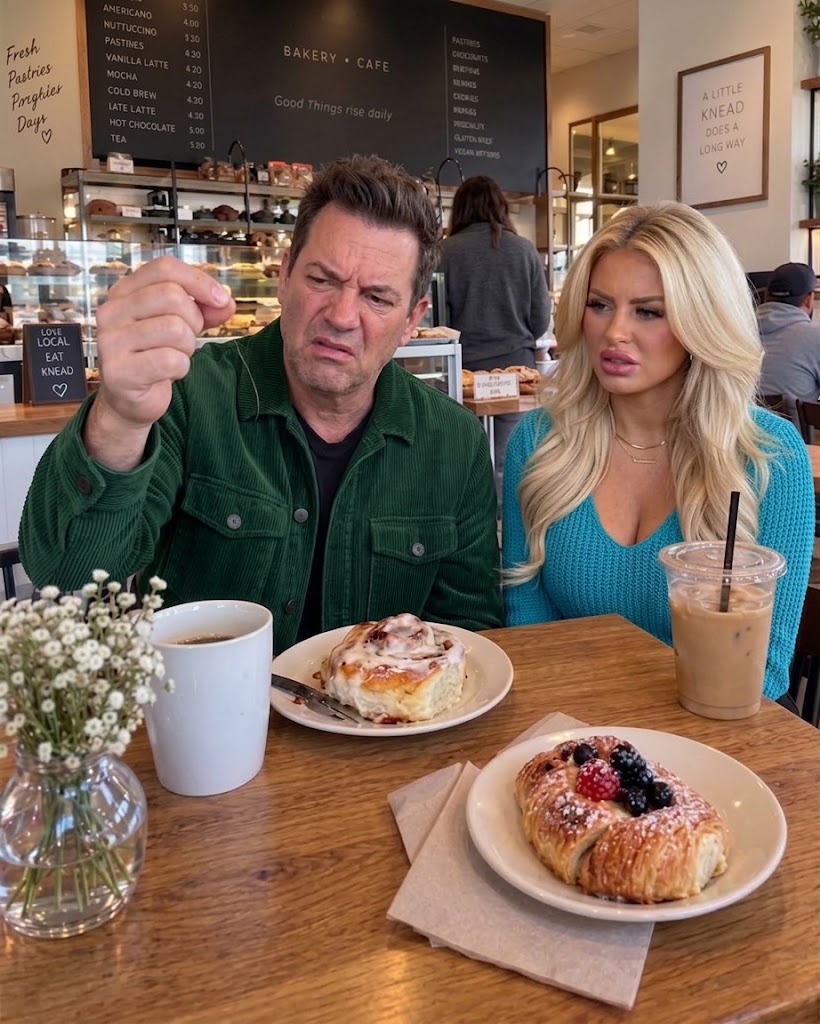
My Ex-Husband Walked Into the Bakery I Built From the Ashes of Our Marriage
He slipped a hair into his own pastry and announced to a full room that I was serving filthy food. I saw him do it, but I couldn’t prove it.
Then my sixteen-year-old daughter stepped out from the back with a small gift bag in her hands—and a smile I had never seen on her before.
Part 1: The Man Who Wouldn’t Say Sorry
When I found out my husband was cheating, I waited for an apology that never came.
Edward stood in our kitchen with his arms crossed while I held his phone in a trembling hand. The messages were still on the screen. Photos. Hotel confirmations. Months of late-night conversations with a woman named Vanessa, nearly twenty years younger than him.
Out of everything I could have said, the only thing that came out was, “How long?”
He didn’t flinch. “Does it matter?”
“Yes, Edward. It matters to me.”
He let out a tired sigh, as if I were the one inconveniencing him. And then he said the words that would echo in my head for years.
“A smart wife would look the other way and keep her family together. You’re the one blowing this up, Claire. Not me.”
Something inside me went still. Not broken—just quiet, like a room after the lights go out.
For years I had explained him away, smoothed over his moods, made myself smaller so he could feel bigger. But watching him stand there and hand me the blame for his own betrayal, I finally understood.
He was never going to admit he had hurt me. Not then. Not ever.
So I filed for divorce.
And Edward made me pay for it in every way he could. He kept the house. He kept the newer car. He fought me over every receipt, every school fee, every pair of shoes, and found endless excuses to be late with child support.
Meanwhile, I had two children depending on me: Nicole, sixteen, and Josh, eleven.
Some nights, after they were asleep, I sat alone at the kitchen table with a stack of bills, choosing which one could wait another week.
Part 2: Grandma Rose
My grandmother saved us.
Rose was eighty-one, living alone in a little two-bedroom house with a kitchen that always smelled of butter and cinnamon. She didn’t ask questions when I called. She simply said, “You’ll stay here.”
“Grandma, there are three of us.”
She waved her hand like I’d said something silly. “Then we’ll squeeze. There is always room for family.”
Years earlier, Edward had once called Rose’s house part of “our family’s future.” I’d told him, sharply, that my grandmother was not a retirement plan. He’d acted wounded, and I’d let myself believe he hadn’t really meant it.
Rose was the one who had taught me to bake when I was a little girl standing on a stool beside her. After the divorce, I started again—not for pleasure, but because I couldn’t sleep.
At two in the morning, she would shuffle into the kitchen and find me at the counter, flour on my shirt, eyes red.
“Pie?” she’d ask.
“Pie.”
And without another word, she would tie on her apron and roll out dough beside me.
We rarely talked about Edward on those nights. We didn’t need to. Her hands next to mine said everything.
Those quiet hours held me together.
Then her health began to fail, faster than any of us were ready for. One evening, as I sat by her bed, she reached for my hand. Her grip was thin but determined.
“Don’t let that man make you small,” she whispered.
I didn’t have to ask who she meant.
“I’m trying, Grandma.”
“No, sweetheart. You’re surviving.” She squeezed my fingers. “I want you to try living. You deserve to…”
She didn’t finish the sentence.
Six weeks later, she was gone.
Rose had been my shelter for as long as I could remember. Without her, the whole world felt colder, and the silence in her kitchen was unbearable.
Part 3: Rose’s Bakery
She left me a modest sum of money. I used nearly all of it to open a bakery.
People told me it was reckless. A terrible financial decision. I didn’t care.
For the first time in years, I wanted to build something instead of just holding things together.
The place was tiny. Six tables. Mismatched secondhand chairs. A counter I painted myself at midnight.
I framed a few of Grandma’s handwritten recipe cards, the ink faded and the corners stained with butter, and hung them on the wall where I could see them every morning.
I named it Rose’s Bakery.
Nicole helped after school, and it quickly became clear she understood social media far better than I did—which, admittedly, was not a high bar.
“Mom, you cannot post another blurry picture of bread.”
“It looks fine.”
“It looks like crime scene evidence. This is sourdough. People want to see the crust patterns. In 4K.”
So she took over.
She filmed me glazing cinnamon rolls, folding pastry dough, scrubbing down the counters, and pulling golden pies from the oven.
Slowly, people started coming. Then they started coming back.
By the fourth month, there was a line on Saturday mornings.
For the first time since my marriage ended, I had something that was mine. Something he couldn’t take.
Edward hated it. He never said so outright, but his little comments said enough.
“So how much can you really make selling muffins, Claire?”
I didn’t answer.
I just kept baking.
Part 4: Table Four
Then one Saturday, the bell over the door chimed, and Edward walked in with Vanessa on his arm.
He smiled as if he’d come to inspect a property.
“Well. So this is the big business.”
Vanessa glanced around, unimpressed.
“Cute.”
Behind me, Nicole had been restocking napkins. I felt her freeze.
“Mom,” she said under her breath.
“I know.”
Edward strolled up to the counter.
“We’d like a table.”
Every part of me wanted to tell him to get out. But the room was full, and I refused to give him a scene.
I kept my voice even. “Table four is open.”
He sat down like he owned the building.
Vanessa snapped photos of the display case while Edward watched me the way he used to when he was waiting for me to make a mistake.
They ordered two coffees and two cinnamon rolls.
When I set the plates down, he looked up at me with that familiar half-smile.
“Grandma Rose’s recipe? Hope you didn’t ruin it.”
I held his gaze.
“Enjoy.”
Then I walked away before he could see my hands shake.
A few minutes later, I was carrying coffee to another table when something pulled at the corner of my eye.
Vanessa lifted her oversized purse onto the table, placing it just so—right in front of her plate, blocking the view from the counter.
Edward leaned forward.
His hand moved.
He pulled something from a folded napkin.
My stomach dropped.
I was halfway to their table when Vanessa shrieked.
“Oh my God!”
Every conversation in the room died at once.
Edward leapt to his feet.
“What the hell is this?”
He held up his plate. Draped across the white icing was a long, dark hair.
The woman at the next table looked down at her own food. Vanessa shoved her chair back dramatically.
“That is so disgusting.”
I stared at Edward.
My voice came out low and steady.
“You put that there.”
For one split second, something flickered across his face. Then he laughed.
“Oh, please.”
“I saw you.”
Edward turned to address the room, arms open like a showman.
“Is everyone hearing this? She serves me food with hair in it, and now she’s accusing me of planting it.”
Vanessa folded her arms.
“Instead of apologizing, you’re attacking your customers?”
Heat rushed up my neck and into my face.
Twenty people were staring at me. I could hear the whispers starting. I could feel their doubt settling over me like dust.
Edward leaned in, just enough for me to see the satisfaction in his eyes.
“Maybe running a business is a little harder than baking cookies in Grandma’s kitchen.”
And in that moment, I was back in our old kitchen, being told it was all my fault.
My throat closed. My pride crumbled. I opened my mouth to apologize—to him, to everyone—just to make it stop.
That’s when the door to the dish room swung open.
Part 5: The Gift Bag
Nicole stepped out.
She had been back there for several minutes. I had assumed she was loading the dishwasher. But her face was completely calm—too calm for a sixteen-year-old who had just heard her father humiliate her mother in front of a crowd.
“Dad, you’re right,” she said.
Edward turned, surprised.
Nicole walked behind the counter.
“A customer should always be compensated.”
I stared at her.
“Nicole?”
She reached under the register and pulled out a small gift bag, the kind we used for birthday orders, with pink tissue paper sticking out the top.
She walked over and set it in front of him.
Edward frowned.
“What’s this?”
“Open it.”
Vanessa narrowed her eyes.
“Is this supposed to be a joke?”
“No.”
Edward reached in and pulled out several folded sheets of paper.
His face changed before he even finished opening the first one. The color drained from it, slowly, like water from a sink.
Vanessa leaned closer.
“What is that?”
He snapped the page shut.
“Nothing.”
“They’re your messages to me,” Nicole said quietly.
I looked at my daughter.
“What messages?”
Edward’s eyes locked onto her.
“Don’t.”
That one word hung in the air, and somehow the room grew even quieter.
Nicole calmly took the pages back from his hand and unfolded the first.
“For the last few weeks, Dad’s been asking me to come live with him.”
Something twisted in my chest.
“What?”
“He said you were working too much. That the bakery was swallowing everything. That Josh and I needed a more stable home.”
Edward took a step toward her.
“Nicole, those were private conversations.”
She moved the papers out of his reach.
“They were private until you walked in here and tried to destroy Mom’s business.”
Vanessa turned to him, stunned.
“You asked her to move in with us?”
Edward didn’t answer her.
And that silence told me she hadn’t known either.
Nicole looked at the next page.
“This one’s from Tuesday.”
She read it aloud, her voice steady.
“‘Your mother is too proud to admit that bakery is failing. Give it six months.’”
A ripple of murmurs moved through the room.
Nicole turned another page.
“‘Your mother took Rose’s money and threw it into that bakery. That was supposed to be security for this family. When she loses it all, maybe she’ll finally understand what she walked away from.’”
For a moment, I forgot the customers. I forgot the hair, the noise, the stares.
I was back at our old kitchen table years ago, hearing him say our family’s future.
I had believed he meant our children.
Now I wasn’t so sure he ever had.
Vanessa’s voice was thin.
“You never told me any of that.”
“Because there’s nothing to tell,” Edward snapped.
I turned to Nicole, my voice cracking.
“Why didn’t you tell me, sweetheart?”
She glanced at me, and for the first time, I saw the hurt beneath her calm.
“Because I didn’t want to believe he’d go this far. I wanted to be wrong about him.”
Part 6: Proof
Edward’s jaw tightened.
“You have no idea what you’re talking about.”
He jabbed a finger at the plate.
“There’s still a hair in my food. That’s the problem here.”
Nicole looked at the cinnamon roll.
Then, slowly, she smiled.
Edward saw it.
“What?”
She didn’t answer.
Near the front window sat Denise, a regular who came in almost every Saturday. She set her coffee down with a quiet clink.
“I’ve been eating here since the second week this place opened,” she said. “I have never once seen anything dirty in this bakery.”
Another woman raised her hand.
“I follow their page. They post videos of the kitchen all the time. It’s spotless.”
Vanessa rolled her eyes. Edward gave a hollow laugh. But the mood in the room was shifting, and he could feel it.
I looked at him, then down at the pages scattered on the table.
And suddenly, the hair in the icing wasn’t just a petty, cruel stunt. It was the final piece of something I should have seen long ago.
I had thought Edward hated the bakery because I built it without him.
But that wasn’t it.
“You thought Grandma’s house would end up benefiting you,” I said.
His expression faltered. Vanessa turned to look at him.
I kept going.
“You thought I’d stay. Even after the affair. You thought I’d close my eyes, keep the family together like a smart wife, and one day everything Grandma had would become part of our future.”
“Claire—”
“But I left. And Grandma helped me build a future that had nothing to do with you.”
I looked at the dark hair lying across the icing.
“You weren’t trying to prove my bakery was dirty. You were trying to prove I never deserved it in the first place.”
His face hardened.
“Don’t be ridiculous.”
“You told our daughter this place would fail. Then you came here to make sure it did.”
I stepped closer.
“I watched you take something out of that napkin and put it in the icing.”
“Then prove it.”
He spread his arms wide.
“Go on. Nobody else saw anything.”
Nicole’s small smile returned.
“Okay, Dad.”
She reached beneath the counter and lifted the bakery tablet—the one connected to the security cameras she had insisted we install when we opened.
And I knew exactly what she was about to do.
“You want proof?”
She turned the screen toward the room.
There they were at table four, clear as day. Vanessa sliding her purse into place. Edward unfolding his napkin, pulling something out, leaning over the cinnamon roll, and pressing it deliberately into the icing.
A beat later, Vanessa glanced down—and screamed.
No one spoke for several long seconds.
Then Denise stood up.
“You tried to set her up.”
Vanessa’s face went crimson.
“We were just making a point.”
“What point?” someone called out.
Vanessa had no answer.
Edward pointed at me, his voice sharp.
“Turn that off.”
“No.”
“Claire…” He moved toward the counter.
Nicole stepped to my side.
I raised my hand.
“Don’t come any closer.”
He stopped.
His voice dropped to the tone that used to make my stomach knot.
“You have no idea what you’re doing.”
For years, those words would have sent me shrinking.
That day, they meant nothing.
I walked to his table, picked up the ruined cinnamon roll, and turned to face him.
“You need to leave.”
He stared at me.
“I’m a paying customer.”
“No.”
I carried the plate behind the counter and dropped it into the trash.
“You stopped being a customer the moment you sabotaged my food and tried to ruin my business. This is my bakery. You are not welcome here anymore.”
His face twisted.
“I can leave reviews. I can tell everyone how I was treated.”
Denise laughed out loud.
“Please do.”
Another customer held up her phone.
“And tell them to ask about the security footage.”
Vanessa grabbed his arm.
“We’re leaving. Now.”
And finally, he let himself be pulled out the door.
Part 7: Beginning Again
The bell chimed behind them, and the room fell silent.
I stood behind the counter, gripping the edge so hard my knuckles turned white.
“I’m so sorry, everyone,” I said. “I never… you shouldn’t have had to see that.”
Denise shook her head immediately.
“No. You have absolutely nothing to apologize for.”
A man by the window lifted his empty plate.
“Could I get two more of those cinnamon rolls?”
“Make it four,” someone else said.
A woman near the register stood up.
“I’ll take six croissants to go.”
Just like that, the chatter returned. Chairs scraped. Cups clinked. The room came back to life, warmer than before.
I turned to Nicole.
“You checked the cameras before you came out.”
She shrugged, like it was nothing.
“I knew Dad wasn’t as clever as he thinks he is.”
I looked at the little gift bag still sitting on the counter, then at my daughter—my brave, sharp, sixteen-year-old girl who had carried her father’s cruelty in silence for weeks, just to protect me.
My throat tightened.
And then, without warning, I broke down.
Nicole came around the counter and wrapped her arms around me.
“Mom.”
“I’m okay.”
I pressed my face into her hair and held on.
“I just hate that he put you in the middle. That was never your burden.”
She only hugged me tighter.
Edward had once looked at Grandma’s little house and seen something that might one day belong to him.
Grandma had seen something else entirely: a place for me to start over. A kitchen where I could remember who I was.
Rose had told me to stop surviving and start living.
Standing in that bakery, surrounded by people who believed in me, with my daughter’s arms around me, I finally understood what she meant.
I turned around. Six people were waiting at the counter. Denise gave me a knowing smile.
“Those cinnamon rolls aren’t going to sell themselves.”
I wiped my eyes and laughed for the first time all day.
“No,” I said. “Apparently not.”
Then I tied my apron a little tighter, washed my hands, and went back to work.