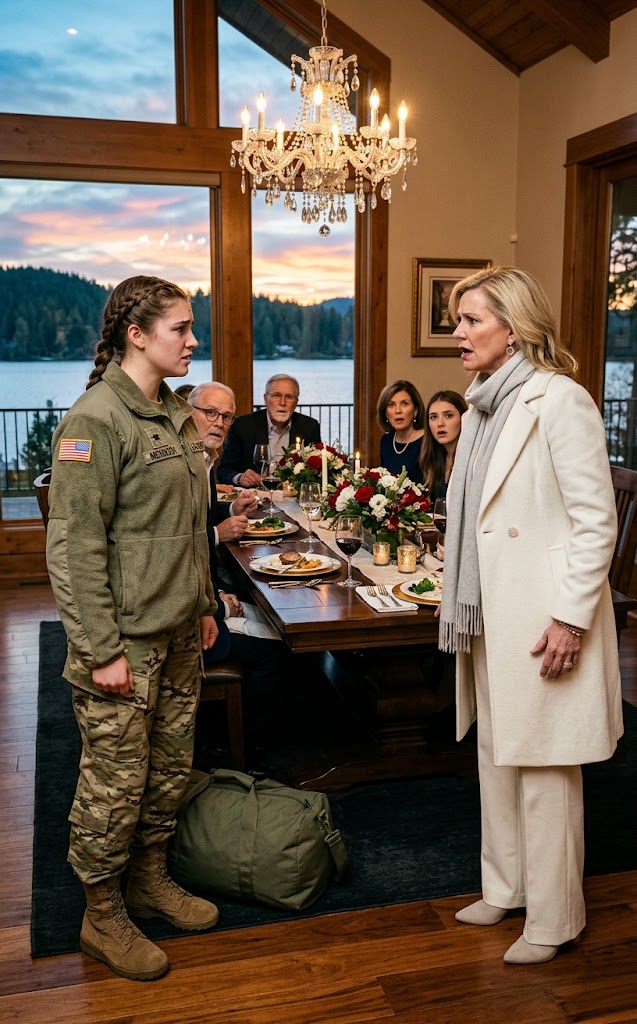
My Adoptive Mother Mocked Me in Front of Her Wealthy Guests at the $17 Million Lake House: “She’s Just My Husband’s Charity Case.” My Sister Added, “We Never Include Her in Family Decisions.” Then Their Lawyer Looked at Me, Went Pale, and Asked, “Wait… You Own This Place?”
The woman had once locked herself out of her own Mercedes because she couldn’t figure out how the key fob worked. Nobody noticed when I walked inside.
Being invisible in the right family became less painful once I stopped trying to make myself seen. I entered the hallway beside the dining room just as Diane’s voice drifted through the house.
“Oh my goodness, Chloe. Sweetheart, sit over here. The lighting is so much better for photographs, obviously.”
Then a man asked, “So, where’s your other daughter tonight?”
It was Richard Sterling, Marcus’s father, whom I recognized from the engagement party two years earlier. He was a commercial real estate investor with the permanent expression of someone who had just smelled spoiled milk.
Diane gave a soft laugh.
It wasn’t nervous or uncomfortable. It was dismissive.
“Oh, Elena?” she said. “She’s just Arthur’s little charity project.”
Several guests chuckled politely.
My fingers went still on the strap of my duffel bag.
“She isn’t really family, so we don’t include her in estate planning.”
She spoke as though I were an inconvenient tax problem. Nobody defended me.
Not Chloe. Not Marcus. Not the Sterlings.
I heard silverware tapping against china. Someone requested more Pinot Noir. Then Marcus laughed.
“Elena’s more comfortable blowing things up than managing assets.”
That earned a much louder laugh.
Which was ironic, considering that two months earlier, I’d overseen a $12.8 million military infrastructure operation without losing a single soldier or contractor. Meanwhile, Marcus had once accidentally overdrawn his own business account while purchasing a boat called Financial Freedom.
I stared at the hardwood floor for perhaps three seconds.
I wasn’t devastated or surprised. I was simply exhausted in a very particular way.
Arthur adopted me when I was four. He never called me adopted. Not once.
Diane, however, always discovered subtle ways to remind me of the difference. My Christmas presents were different. The rules were different. The expectations were different.
When Chloe wrecked her BMW at nineteen, Diane called it a learning experience. When I earned a B+ in chemistry at sixteen, Diane asked whether community college might be a more realistic option for someone like me.
Arthur noticed everything.
He just rarely confronted her about it.
When I was younger, that used to make me angry.
Inside the dining room, Diane spoke again.
“I mean, Arthur always had a good heart. Sometimes, perhaps, too good.”
Another round of quiet laughter followed.
That was when I finally moved.
I didn’t make a dramatic entrance like someone in a movie. I simply walked into the room.
The forks stopped halfway to people’s mouths. Heads turned. Everyone began reassessing the situation in real time.
Chloe looked irritated at first, then nervous. Marcus looked like a man who had just realized his joke had gone on about fourteen seconds too long.
I stopped beside the end of the table and carefully placed my duffel bag on the hardwood floor.
Then I smiled.
Not a forced smile. Not an angry one, either.
Nobody spoke.
Even the servers stood motionless.
Diane cleared her throat and rose from her chair too quickly.
“Elena,” she said. “We didn’t realize you’d arrived already.”
“I know,” I replied.
That was all. Two words.
Chloe reached for her wineglass as though she needed emotional support from fermented grapes.
I didn’t sit near Diane or Chloe. Instead, I took a seat beside the windows overlooking the lake.
It was the same lake where Arthur used to take me fishing at 5:30 every morning, long before anyone else in the house woke up.
A server approached.
“Would you prefer red wine or white?”
“Coffee, please,” I answered.
Marcus blinked.
“At dinner?” he asked.
I glanced at him briefly.
“I’ve Been Awake Since Yesterday Morning, Marcus. Some of Us Actually Work for a Living.”
A few guests coughed into their napkins, struggling to hide their laughter.
Perhaps I was finally home and paying attention.
Comment below. And if you believe dignity matters more than blood, subscribe to the channel.
The following morning, I stood barefoot in Arthur’s old kitchen, finishing my second cup of coffee at 6:18.
Outside the windows, the lake was perfectly still.
The house always felt different before Diane woke up. Quieter. More honest.
I’d managed perhaps four hours of sleep in one of the upstairs guest rooms.
I opened the refrigerator to find some creamer and discovered six bottles of champagne, imported cheese, and a carton of almond milk that had already expired.
Classic Diane priorities.
I was pouring my coffee when Chloe walked into the kitchen wearing silk pajamas that probably cost more than my monthly truck payment.
“You’re up early,” she remarked.
“I spent fourteen months in a desert. My body still thinks sleep is optional.”
She ignored my answer and looked at her phone.
Chloe treated eye contact the way vampires treated sunlight.
About thirty seconds later, Diane appeared in an ivory cashmere robe, her hair perfectly styled at 6:30 in the morning, as though Fox News might unexpectedly interview her beside the toaster.
“Good,” she said. “You’re both here.”
I recognized that tone. It was the same voice bank managers used just before rejecting a loan application.
I took another sip of coffee.
Diane gestured toward the kitchen island.
“Sit down, Elena. We need to discuss something important concerning the family.”
Interesting wording, considering she’d declared me not part of the family just twelve hours earlier.
Chloe pushed a thick folder across the marble countertop toward me.
The paper was heavy, the binding professional, and the dividers marked with gold tabs. Everything about it looked expensive.
Now that I was paying attention, the warning signs were obvious.
The Rolex was gone.
So was the leased Aston Martin from last Christmas.
Interesting.
Diane folded her hands.
“Marcus has an extraordinary opportunity,” she announced. “He’s expanding Sterling Urban Development into mixed-use commercial properties.”
I nearly smiled into my coffee.
Chloe quickly joined the conversation.
“The lender just needs stronger collateral partners temporarily. It’s only procedural.”
I opened the folder.
Inside was a commercial loan guarantee agreement totaling $4 million through Ridgemont Capital Bank.
There was also an ownership transfer clause connected to Wright Industrial Holdings, a business in which I supposedly held a passive fifteen percent share. It was a small regional construction company with estimated annual revenue of approximately $2.3 million.
I continued reading.
Then I reached page seventeen.
Debt restructuring disclosures. Outstanding private liabilities. Personal guarantees.
My eyes stopped at one figure: $3,819,760.
Jesus.
This wasn’t expansion debt. It was survival debt.
Marcus wasn’t building an empire. He was drowning while wearing Italian loafers.
I turned another page.
Missed interest payments. Default warnings. Concerns about inflated asset valuations.
This wasn’t an investment opportunity.
It was a financial trap.
And they wanted me to absorb the damage.
Diane mistook my silence for uncertainty.
“Elena,” she said, “family members support each other during strategic moments.”
I looked up.
“Strategic moments?”
Marcus cleared his throat.
“The market slowed down unexpectedly.”
“The market?” I asked. “Or was it the fact that you purchased twelve condominium lots outside Richmond at peak prices using adjustable-rate commercial financing?”
Nobody answered.
That caught their attention.
Marcus blinked rapidly.
“How do you know about that?”
“I can read.”
Chloe folded her arms.
“You always do this.”
“Do what?”
“Act superior because you served in the military.”
I looked at her for a moment.
“No, Chloe. I get concerned when someone with the financial instincts of a raccoon outside a casino asks me to cosign four million dollars.”
Marcus’s expression hardened.
Diane quickly intervened.
“This attitude is exactly why Arthur worried about whether you’d ever fit into this family socially.”
That nearly made me laugh.
Arthur had spent countless family dinners quietly sipping bourbon while Marcus explained basic economics incorrectly.
I returned my attention to the contract.
Then I discovered the final clause.
If the loan defaulted, my ownership interest would bear the primary recovery exposure before the assets belonging to Sterling Urban Development.
There it was.
The decisive provision.
This wasn’t about helping the family. It was about making me the financial shield while Marcus escaped the wreckage.
I leaned back slightly in my chair.
Then Diane delivered the sentence she’d probably rehearsed beforehand.
“You owe this family, Elena.”
I met her gaze calmly.
“For what?”
“For taking in a stray.”
Nobody moved. Not even Chloe.
Yet Diane continued.
“We fed you, educated you, and gave you opportunities you never would have had otherwise.”
I nodded.
“Arthur did.”
The atmosphere changed instantly.
Marcus lowered his eyes to the countertop. Chloe looked furious. Diane appeared personally offended by the truth.
I reached for the pen lying beside the documents.
All three visibly relaxed.
They had always mistaken my patience for surrender.
I removed the cap, reviewed the signature line one final time, and slid the contract back across the marble island.
“No.”
One quiet word. Flat. Final.
Marcus muttered, “Jesus Christ.”
Chloe exploded first.
“Are you seriously doing this right now?”
Diane’s expression turned icy.
“If You Refuse to Help This Family,” She Said, “Then Perhaps It’s Time We Officially Reconsider Your Place Here.”
There it was. The real issue.
Not money. Not business.
Punishment.
I stood up and picked up my coffee mug.
Diane continued.
“You will not attend the Wright Heritage Gala next week. And if necessary, I’ll make your separation from this family official.”
I gently placed my mug in the sink.
“If you want to disown me,” I said, “put it in writing.”
Chloe drew in a sharp breath.
Somewhere deep inside the house, Marcus’s phone began ringing again.
I sat in my truck outside the lakehouse, watching rain gather on the windshield for nearly ten minutes.
My phone kept buzzing like a slot machine from hell.
Three voicemails. Two text messages.
Let’s resolve this like adults.
I deleted everything without opening the messages.
Then I reached into the side pocket of my duffel bag and took out the envelope Arthur had given me six days before he died.
I hadn’t opened it until then.
Arthur had always been a steady man. Even quiet people can possess a certain gravity.
“Open this if Diane ever asks you for money,” he’d told me.
Now I sat in my truck outside a gas station off Route 17, reading his handwriting while rain tapped gently against the windows.
Elena, if you’re reading this, it means I waited too long to handle something myself. Go see Victor. Don’t tell Diane first. And don’t sign anything.
Beneath the message was a handwritten address.
No explanation. No emotional speech.
Classic Arthur.
The drive took about forty minutes west, along two-lane roads bordered by rain-soaked pine trees and old farmland.
Northern Virginia has a strange kind of beauty once you leave the wealthy neighborhoods behind.
The hallway lights flickered as I climbed the stairs carrying my duffel bag.
Victor opened his office door before I could knock.
“About time,” he said.
He was sixty-five, lean, silver-haired, and permanently irritated by modern technology. Arthur used to call him the last honest lawyer in Virginia.
Victor glanced at my bag.
“You look exhausted.”
“I just returned from the Middle East.”
He nodded once.
“And somehow, this is still probably more stressful.”
“Fair point.”
His office looked as though it had been frozen in 1997. Metal filing cabinets. Framed Navy certificates. A massive wooden desk covered in neatly arranged stacks of paper.
No trendy minimalist furniture. No unnecessary decorations.
A real office for real problems.
Victor handed me black coffee in a chipped mug labeled World’s Okayest Lawyer.
Then he walked toward a tall gray safe secured to the wall behind a bookshelf.
“Do you know why Arthur hired me instead of Diane’s attorneys?” he asked as he turned the lock.
“Because you’re cheaper?”
Victor snorted.
“Because I don’t care about wealthy people’s feelings.”
The safe clicked open.
Inside were several thick folders, a locked cedar box, and a stack of certified legal binders.
Victor carried everything over to his desk and looked at me.
“Your father knew exactly what Diane was.”
His words hit harder than I expected.
Not because they surprised me, but because someone had finally said it plainly.
Victor pushed a folder across the desk.
“Arthur began documenting financial concerns three years ago, after Diane attempted to restructure several property assets without disclosing the changes.”
I opened the folder.
Inside were bank statements, rental agreements, internal emails, notarized legal notes, and detailed financial records.
Every amount. Every signature.
Arthur had kept track of everything.
Diane had assumed his cancer treatments made him less attentive.
That was a serious mistake.
I almost smiled.
Arthur had always noticed more than people realized.
Victor turned to another document.
“Marcus Sterling entered private debt restructuring eighteen months ago.”
That matched what I’d discovered in the kitchen.
Arthur had uncovered the problem shortly before his second surgery.
Of course he had.
To Diane, Marcus wasn’t simply a husband. He was a LinkedIn profile with teeth.
Victor opened one of the certified binders and removed a sealed document bearing gold notarization stamps along the bottom.
Then he stopped speaking.
The room suddenly felt smaller. Even the rain outside seemed to grow quieter.
Victor placed the document in front of me.
“Arthur amended the trust before he died.”
I looked down at the title page.
Irrevocable Property Trust Transfer.
My eyes moved farther down.
Property Designation: Wright Lake Estate.
I blinked once, then read it again.
And then a third time, more slowly.
Victor leaned back in his chair.
“The lakehouse belongs to you, Elena.”
Everything seemed to shift into a different position.
Victor pointed toward the final transfer page.
“Arthur transferred the entire property into the trust eighteen months ago. Diane was never informed.”
I examined the attached valuation documents.
The current assessed market value was listed as $17,240,000.
Jesus Christ.
The entire estate. The main house. The boat dock. The guesthouses. The lake access properties.
All of it belonged to me.
Victor slid another folder across the desk.
“This part concerns six separate short-term luxury rental agreements for the guesthouses on the property.”
Inside were monthly deposits, wire transfer records, and occupancy schedules.
I added the figures in my head.
“At least $140,000,” I said.
“Probably more,” Victor replied before I could ask.
“Diane and Chloe have been illegally renting portions of the property for nearly two years.”
He handed me a typed audit summary.
The exact amount was highlighted near the bottom.
$142,850, plus seven percent annual recovery interest under Clause Seven of the trust’s enforcement provisions.
Arthur really had thought of everything.
I leaned back in the chair, staring at the documents spread across the desk.
I didn’t feel excited or triumphant.
I felt recognized.
For the first time, someone had put safeguards in place to protect me before the damage could happen.
Victor studied me for a moment.
“Do you know what’s strange about all this?”
“What?”
“Arthur never sounded angry when he talked about Diane.”
I frowned slightly.
Victor adjusted his glasses.
“He sounded disappointed in himself.”
One winter, when I was seventeen, Arthur had watched me replace the brake pads on my truck.
“You Learn a Lot About People When Money Gets Close to Them,” He Told Me.
Perhaps he had been right all along.
Victor pushed the cedar box across the desk toward me.
“Arthur wanted you to have this once the trust became active.”
I recognized it immediately.
Arthur had built it by hand years earlier in the workshop behind the lakehouse.
Walnut corners. Cedar panels. A small scratch near the hinge from the day I’d dropped it while helping him carry tools.
I rested my hand gently on the lid.
Then Victor spoke the sentence that changed the entire shape of the conflict unfolding before me.
Diane was now attempting to use the lakehouse as collateral to secure Marcus’s recovery financing.
I looked up abruptly. Victor gave a single nod.
“She has no idea that the property isn’t hers.”
Thunder rumbled quietly outside as I studied the trust documents in front of me. For the first time since returning home, I finally understood something that mattered.
I was no longer trapped in Diane’s game.
I was the one holding the board.
At 11:43 that night, I laid every document across the bed in my Fredericksburg motel room. Trust agreements, audit reports, property transfers, and Marcus’s debt disclosures covered nearly every inch of the blanket.
A cooking competition played quietly on the television mounted near the ceiling while I sat cross-legged with a yellow legal pad and three black pens.
Everything became remarkably predictable once panic entered the picture.
I began organizing the events into a timeline.
Marcus’s private restructuring filings went back eighteen months. Unauthorized rental deposits had started twenty-two months earlier. Diane had increased her gala fundraising activities six months ago.
And three venture capital firms had confirmed they would attend the following Saturday evening.
Interesting.
Very interesting.
Around midnight, Victor emailed me additional records.
The subject line read: You’re going to love this.
Attached were copies of preliminary financing proposals Marcus had presented to potential investors. Under projected collateral, he had listed the Wright Lake estate.
I leaned back in the motel chair.
That idiot.
Marcus wasn’t merely lying to people at dinner parties anymore. He was actively using property he didn’t own to secure emergency funding.
That had moved beyond embarrassing behavior and into territory that could become a federal matter frighteningly quickly.
I called Victor.
“You saw it?” he asked.
“Marcus listed the estate as secured collateral.”
“Correct.”
“Does Diane know?”
Victor gave a quiet laugh.
“Oh, she knows.”
That changed the situation considerably.
I briefly stared through the motel window at the dark highway.
“Do you think they’re desperate enough to sign everything before verifying the ownership?”
Victor didn’t hesitate.
“Elena, wealthy people skip due diligence every day when somebody pours enough wine first.”
Fair enough.
I rubbed my tired eyes.
“So, what do we do?”
Victor remained calm.
“We—”
I almost smiled.
“You know what I mean.”
“Yes,” he replied. “I do.”
His voice became slightly firmer.
“You do nothing emotional. That’s what you do.”
“Paperwork doesn’t get emotional.”
By 2:15 a.m., I had mapped out the entire sequence.
Step one: File an ownership enforcement notice with the county clerk.
Step two: Activate the trust audit under Clause Seven.
Step three: Prepare a financial recovery demand for the unauthorized rental income.
Step four: Wait.
No threats. No theatrical confrontations. No warning shots.
The wonderful thing about county offices was that nobody there cared about your wealth.
A billionaire and a man arguing about fishing permits still took numbers and waited beneath the same fluorescent lights.
At 9:26 the following morning, I filed the notice of default enforcement.
Three certified copies. One trust verification packet. One preliminary audit request.
Thunk. Thunk. Thunk.
Years of Diane’s Social Posturing Had Been Reduced to Office Sounds and Carbon Paper. Honestly, It Was Beautiful.
Marcus wasn’t trying to rescue his company anymore. He was desperately trying to survive another week.
There was a difference.
One involved strategy. The other involved drowning politely in expensive shoes.
Nobody stopped me from entering the property.
That made sense.
Technically, they were living on my property.
The thought still felt strange.
Diane noticed me immediately.
Her smile appeared professionally manufactured.
“Elena,” she said. “I wasn’t expecting you to return today.”
“I live here.”
Her smile twitched slightly.
Small victories mattered.
Marcus stood near the bar, talking through an earpiece while pretending he wasn’t sweating through a $4,000 jacket. Meanwhile, Chloe was arguing with an event planner about the proper height of the candles.
I walked past them toward Arthur’s old workshop behind the garage.
Nobody followed.
The workshop smelled exactly as I remembered it: cedarwood, motor oil, and dust.
I opened the cedar box Victor had given me and placed the trust documents inside.
The wood felt smooth beneath my fingers. Arthur had built that box during the summer I turned fifteen, after teaching me how to measure lumber correctly.
“Slow is smooth,” he used to say. “Smooth becomes fast.”
Later, my military instructors would repeat almost exactly the same words.
At 4:07 p.m., my phone vibrated.
An unknown number.
I answered.
“Lieutenant Wright?” a man asked.
“Yes.”
“This is Eastern Courier Services. I have a certified legal delivery for Elena Wright.”
Interesting.
The courier arrived twenty minutes later wearing a navy polo shirt and carrying a flat legal envelope.
Diane watched from the front porch as he approached me near the driveway.
That alone told me everything I needed to know.
The courier checked my identification before handing me his signature tablet.
“This is restricted legal correspondence,” he explained.
I signed without hesitation.
The man glanced awkwardly between me and Diane, who stood near the entrance pretending she wasn’t watching us.
I opened the envelope beside my truck.
Inside was notarized legal stationery bearing the name of Diane’s attorney.
A formal family separation notice.
Jesus Christ.
Even her cruelty sounded expensive enough for a country club.
The letter included a statement about protecting the family’s reputation and preserving its legacy.
I laughed.
Not loudly, but enough that the courier glanced back nervously before driving away.
Diane folded her arms on the porch.
“Well,” she called coldly, “you asked for it in writing.”
I looked at the letter again and folded it carefully.
I wasn’t angry.
I wasn’t hurt.
Without answering her, I walked back toward the workshop.
Diane had just formally barred the legal owner of the estate from attending her own gala.
At 6:41 p.m., I adjusted the cuff of my Army dress blues in the truck’s mirror while rainwater slid down the windshield.
Tonight, they weren’t merely a uniform.
They were evidence.
Evidence that at least one person in the Wright family had earned what she wore.
Valet attendants moved vehicles continuously along the circular driveway while guests in tuxedos and designer gowns entered beneath strings of white lights.
Two hundred people, easily. Perhaps more.
Diane loved a large audience for her emotional performances. Smaller gatherings created too many opportunities for follow-up questions.
I watched a Bentley pull up near the entrance as a man stepped out wearing loafers without socks, despite the forty-eight-degree weather.
Rich men would apparently sacrifice blood circulation for appearances.
My phone buzzed once in the cup holder.
“Victor, are you ready?” he asked.
“I was in Baghdad during mortar season,” I replied.
Victor chuckled quietly.
“Fair enough.”
Then his voice turned serious.
“Remember, don’t improvise emotionally.”
“I know. No shouting. No speeches. Let the paperwork do the damage.”
I ended the call and reached for the passenger seat, where Arthur’s cedar box rested beneath the folded trust documents.
At 7:02 p.m., I stepped out of the truck.
The cold air struck my face.
A valet near the entrance glanced toward me, then quickly straightened when he recognized my uniform.
That sometimes happened when people saw military dress uniforms.
I walked up the stone pathway as music drifted from inside the estate.
Tonight’s entertainment was a jazz quartet. Diane always selected music that sounded expensive but emotionally empty through the enormous front windows.
Inside the ballroom, servers carried crystal trays of champagne beneath towering floral arrangements.
Nobody stopped me at the entrance.
That almost made me laugh.
The legal owner of the estate didn’t need a plus-one.
I stepped into the foyer, and the nearby conversations began to slow.
Polished black shoes. Service ribbons. Combat insignia.
No fake luxury labels. No performance.
Just the weight of something earned.
An older man standing near the staircase straightened immediately when he noticed me.
Retired military.
You could always tell. Posture recognized posture before words ever became necessary.
Inside the ballroom, Diane stood beneath a massive chandelier, holding a champagne glass as she delivered one of her theatrical speeches.
“And family legacy isn’t simply about wealth,” she said emotionally. “It’s about creating something meaningful for future generations.”
Jesus Christ.
I almost admired her dedication to fiction.
Then Diane continued.
“And tonight is especially meaningful because Arthur devoted his life to creating opportunities for this family.”
That word again.
Family.
Interesting timing.
I moved forward.
The ballroom doors swung wider behind me, their heavy oak hinges producing a low creak.
The sound carried farther than I expected.
Heads Turned Across the Ballroom One After Another. Conversations Fell Silent in Waves. Not the Dramatic Kind You See in Movies. Real Ones.
Confused pauses. Glasses lowering. Forks stopping halfway to mouths.
Then something unexpected happened.
Three men near the center table rose to their feet.
Military men.
One active-duty colonel and two retired Marines, judging by their posture alone.
Instinct.
They noticed the uniform before they noticed my face.
Within seconds, nearly half the ballroom had fallen silent.
Diane turned toward the entrance, and I watched the exact moment the color drained from her face.
Marcus turned next.
His expression nearly collapsed.
That told me everything I needed to know.
He recognized the danger before Diane did.
Smart enough to panic. Not smart enough to avoid creating the problem.
I continued across the ballroom floor as heels clicked behind me and whispers spread throughout the crowd.
“Who is that?”
“Isn’t that Elena?”
“I thought she wasn’t coming.”
Oh, I was definitely coming.
Diane recovered just enough to force a smile at her guests.
Then she sharply turned toward two private security guards standing beside the back wall.
“Remove her,” she hissed.
Her voice wasn’t loud enough for the room, but it was loud enough for them.
The guards approached, both looking deeply uncomfortable already.
One stopped about six feet away from me.
“Ma’am,” he began, “I think there might be some confusion.”
“There is no confusion,” Diane interrupted sharply from the stage. “She wasn’t invited.”
The statement landed heavily in the silence.
Not invited.
Again, that familiar pattern.
I stopped in the exact center of the ballroom beneath the chandelier Arthur had imported from Italy twenty years earlier, after Diane complained that Virginia chandeliers looked emotionally middle-class.
Everyone watched.
Champagne glasses remained suspended in midair. Investors stared. Servers stood motionless.
Then I spoke in a calm, clear voice.
No trembling. No anger.
“I am not a guest, Diane.”
Through the windows, the faint sound of lake water moving against the shore was almost audible.
The security guards exchanged nervous glances.
Then I finished my sentence.
“I am the landlord.”
Silence.
Complete, absolute silence.
One investor near the front laughed once because he assumed I was joking.
Marcus didn’t laugh.
And Diane stared at me with the expression of someone watching reality arrive fifteen minutes earlier than expected.
Marcus moved first.
Not Diane.
When I announced that I was the landlord, Marcus placed his champagne glass on a cocktail table so abruptly that it tipped sideways.
Several drops splashed across his sleeve.
He didn’t even notice.
Chloe did.
And then Chloe completely lost control.
“Oh my God,” she snapped, laughing far too loudly. “Elena, stop. Seriously, this is embarrassing.”
Nobody joined her laughter.
That was a bad sign.
She pointed toward me from the stage as though I were a drunken relative ruining Thanksgiving.
“You’re delusional.”
Still, nobody laughed.
I gave a small nod.
Nothing dramatic. Just a signal.
The audiovisual technician froze for half a second before pressing a button on his control panel.
Behind Diane, the enormous projection screen flickered to life.
The ballroom lights automatically dimmed, and a scanned legal document appeared across the wall, complete with Bright County certification stamps along the bottom.
Irrevocable Trust Property Transfer — Owner of Record.
Elena Mary Wright.
Wright Lake Estate.
Current Assessed Value: $17,240,000.
People seemed to forget how to breathe.
Diane turned toward the screen, and her face went completely blank.
There was no performance left. No social mask.
Only raw confusion struggling to survive reality.
Marcus whispered as though he already knew everything was over.
An investor near the front approached the screen.
He was an older man wearing a blue tie, probably from a private equity firm.
“Is this authentic?” he asked.
I opened the cedar box in my hands and removed the certified copies.
“Filed with the county three days ago,” I replied calmly. “The verification numbers are part of the public record.”
Victor had taught me something important the previous day.
When exposing dishonest people, never exaggerate.
The truth is already unbelievable enough.
The investor accepted the documents from me.
Another man joined him, followed by a third.
Within thirty seconds, the ballroom had transformed from a glamorous gala into the scene of a financial investigation.
Guests began checking their phones, whispering to one another, and quietly moving around the room.
Diane finally broke out of her paralysis.
“This is ridiculous,” she declared sharply.
“Arthur would never have done this.”
“He did,” I interrupted calmly.
Then I gestured toward the screen again.
The presentation changed.
This time, the audit summary appeared.
Itemized transactions. Wire transfers. Dates.
Every unauthorized rental payment Diane and Chloe had collected from the guesthouses over the previous two years was displayed in enormous letters thirty feet behind them.
Unauthorized Rental Income: $142,850.
Annual Recovery Interest: 7% under Clause Seven.
Total Liability Pending Completion of Audit: $153,441.82.
A Woman Near the Back Muttered, “Jesus Christ.”
A perfectly reasonable reaction.
Chloe rushed toward the screen in a panic.
“That’s fake!”
I looked at her.
“You deposited the February Aspen rental payment into your personal trust account at 9:14 a.m. on March second.”
Chloe stopped moving.
So did the room.
Then I added, “The amount was $8,700.”
Now she looked frightened.
Not angry.
Frightened.
Marcus hurried toward me.
“Elena,” he whispered sharply, forcing a smile for the surrounding guests. “We can discuss this privately.”
“No,” I replied.
He lowered his voice even further.
“You’re destroying everything.”
That almost made me laugh.
Marcus spoke about his company the way gamblers talked about their systems, as though a financial collapse were merely a temporary misunderstanding.
I met his gaze evenly.
“You used property you didn’t own as collateral.”
“That’s not what happened.”
I tilted my head slightly.
“You listed the estate in your Ridgemont recovery proposal.”
His jaw immediately tightened.
One of the investors overheard me.
Then another did.
The atmosphere shifted again, and it happened quickly.
That was the thing about wealthy investors.
They didn’t panic emotionally.
They retreated mathematically.
The venture capital partner in the blue tie handed Marcus’s proposal folder back to him as though it contained something dangerous.
“We’re finished here,” he said flatly.
Another investor spoke.
“You represented this estate as secured leverage.”
Marcus opened his mouth.
Nothing came out.
There was nothing left to say.
Diane stepped forward.
“This is a misunderstanding caused by grief,” she announced desperately. “Elena has been under tremendous stress since her deployment.”
Ah, yes.
The classic wealthy-person defense: call a woman emotional after she arrives carrying documented evidence.
I reached into the cedar box once more and removed another document.
A summary of Sterling Urban Development’s outstanding liabilities.
Total outstanding debt: $3,842,119.76.
Missed restructuring payments.
Three pending recovery actions.
Two projected insolvency windows within forty-six days.
I handed copies to the nearest investors.
A younger banker scanned the page for perhaps five seconds before whispering, “Oh, this company is finished.”
Marcus heard him.
Everyone did.
And something inside Marcus finally cracked.
“You don’t understand!” he shouted.
Wrong move.
Very wrong move.
Marcus ran both hands through his hair.
“I had deals lined up. The market changed. We only needed short-term stabilization.”
“No,” I said calmly. “You needed someone else to absorb the damage.”
As everything fell apart, the room grew silent.
Diane now looked physically unsteady.
Behind them, Arthur’s lakehouse towered over the ballroom exactly as it always had.
Only now, everyone understood something different.
The Wright family empire hadn’t been elegant.
It had been leveraged.
Its appearance of stability depended on borrowed money, manufactured prestige, and assumptions that had never been legitimate.
One investor closed his folder.
Another headed toward the exit without even collecting his coat.
Then another followed.
And another.
There was no shouting. No dramatic music.
Just silence and consequences.
Honestly, that was the cruelest part.
Nobody looked shocked anymore.
They looked embarrassed that they’d ever believed Marcus.
Diane whispered my name.
“Elena.”
Her voice was soft.
Not commanding this time. Not superior.
Simply stunned.
Arthur hadn’t accidentally left me protected.
He had planned everything.
I watched the final investor leave at 8:34 p.m.
That was how wealthy people panicked.
Politely. Quickly. Cowardly.
The ballroom looked different now.
Half-empty champagne glasses had been abandoned across tables covered in white linen.
Nobody wanted to make eye contact anymore.
Not with Marcus.
Not with Diane.
And certainly not with me.
Marcus stood near the back bar, staring at his phone as call after call came through.
His hands were visibly shaking.
At one point, he tried calling someone himself.
“Pick up,” he muttered under his breath. “Come on, pick up.”
Nobody answered.
Of course they didn’t.
A drowning man attracts lifeguards in movies.
In real life, he attracts distance.
Chloe sat frozen in a ballroom chair beside the stage, mascara streaking down one side of her face.
Artificial lighting really does help.
And Diane.
Diane stood alone near the podium Arthur had paid to have imported from Charleston twenty-three years earlier because she once claimed locally made podiums looked municipal.
The woman had opinions about podiums.
Meanwhile, Her Entire World Fell Apart Beside a Tower of Shrimp. What a Strange World.
I closed the cedar box and headed toward the stage. With the crowd no longer making noise, every click of a heel and scrape of a dress shoe echoed throughout the ballroom.
Nobody tried to stop me. Nobody even said a word.
Then Diane moved quickly. Far too quickly.
I finally saw her face clearly.
No perfectly applied makeup. No polished performance. Just fear. Genuine, unmistakable fear.
“Elena,” she said urgently, almost breathless.
“Please.”
The word sounded unfamiliar coming from her.
Please.
I continued walking. Diane followed me for several more steps before one of her heels caught awkwardly on the edge of the carpet.
Several servers gasped quietly. Chloe jumped to her feet.
“Mom!”
But Diane barely seemed to hear her.
“I did the best I could,” she said.
I stopped. Not because her words wounded me, but because they sounded rehearsed.
Not something she’d practiced that evening, but something she’d repeated to herself for years.
“I took you in,” Diane whispered. “I raised you.”
Behind her, Marcus continued staring at his phone as though ignoring his creditors aggressively enough might somehow make them disappear.
I remembered the second-grade school talent show. I had played the violin badly for three minutes while Chloe sang Christina Aguilera in a rhinestone-covered outfit. Diane spent the following two months bragging about Chloe’s performance.
Afterward, Diane bought Chloe flowers.
She told me my posture was getting better.
That pretty much explained our entire relationship.
“I did everything I could,” Diane repeated, crying harder now.
The strange thing was that a part of me believed she genuinely thought that was true.
I no longer felt angry.
I walked past Diane without responding and climbed onto the stage. The ballroom remained silent, except for the quiet sobbing coming from the tables.
Not mine.
Chloe’s.
That surprised me a little.
I placed Arthur’s cedar box on the podium, the same one Diane had used twenty minutes earlier to deliver her speech about family legacy, as though she were starring in community theater for billionaires.
Then I opened the lid.
Inside lay the documents, neatly arranged beneath Arthur’s handwritten letter.
I unfolded it. Somewhere near the back of the ballroom, someone switched off the remaining music.
I remained calm and steady.
“When Arthur gave me this letter,” I began, “he told me to open it if Diane ever asked me for money.”
Nobody moved.
Then I began reading.
“Elena, if you’re hearing these words read aloud someday, it means I failed to protect you properly while I was still alive.”
Diane immediately covered her mouth.
I continued.
“I spent too many years convincing myself that maintaining peace inside our home mattered more than confronting the truth that existed within it.”
The ballroom felt impossibly still. Even Marcus had stopped looking at his phone.
I continued reading in the same steady voice.
“Blood doesn’t create a family. Character does. And Elena became the strongest person in this house long before anyone bothered to notice.”
Silence.
Absolute silence.
I carefully folded the letter and returned it to the cedar box.
Then I looked at Diane again.
She was still sitting on the ballroom floor, staring up at me with swollen eyes and trembling hands.
For the first time in my life, she looked small.
Not socially insignificant. Just human.
And that almost made me feel sorry for her.
Almost.
“You didn’t disown me, Diane,” I said.
My voice carried gently across the ballroom.
“You simply arranged things so that I was legally separated from the family while you absorbed all of Marcus’s debt and handed me the perfect shield.”
I watched the meaning of my words spread across her face.
Confusion first.
Then understanding.
Finally, absolute horror.
Because Diane now understood what Arthur had done.
The trust protected me from every liability connected to the estate. Meanwhile, her notarized separation document had severed me legally from the remaining family financial obligations associated with Marcus and Chloe.
She had believed she was removing me from the impending collapse.
Instead, she had trapped herself inside it alone.
Marcus whispered, “Oh my God,” sounding like a man who had finally realized just how deep the hole beneath his feet really was.
And Somewhere Beyond the Ballroom Windows, Thunder Rolled Across the Lake Arthur Had Left to Me.
Federal investigators arrived eleven days later.
There was no dramatic raid. No armored vehicles. No agents smashing through windows.
Instead, two dark sedans pulled into the circular driveway at 8:13 on a Tuesday morning while landscapers trimmed the hedges beside the lake.
That was probably the funniest part.
The hydrangeas still looked magnificent.
Marcus initially attempted to maintain his confidence.
Unfortunately for him, investigators handling wire fraud cases generally preferred documents over confidence.
And there were plenty of documents.
The Ridgemont financing proposals. The property ownership representations. The fraudulent collateral claims. The email conversations.
It turned out that transmitting fraudulent financial statements electronically created a surprisingly traceable trail.
Who knew?
By the third week, Sterling Urban Development had collapsed.
Employees stopped reporting to work. Projects were frozen. Subcontractors filed claims against the company.
Honestly, that seemed fair.
Marcus eventually agreed to a federal plea negotiation after his attorneys realized the paper trail was practically gift-wrapped.
That feeling of satisfaction didn’t last long.
Diane’s downfall unfolded more gradually.
First came the distancing. Then the silence. Finally, the sudden scheduling conflicts from friends who had previously called her three times a day.
Her country club memberships came under review. Charity boards replaced her. Dinner invitations disappeared.
Nobody announced anything publicly.
That wasn’t how old-money circles operated.
They erased people politely.
One afternoon, about two weeks after the gala, I found Diane sitting alone in the breakfast room, staring across the lake without makeup.
I couldn’t remember the last time I’d seen her that way.
She looked older, though not simply in a physical sense. It was as if the framework holding her entire identity together had been removed.
“I never thought Arthur would do this,” she said.
I stood beside the coffee machine, filling my mug.
“He didn’t do this to you.”
Those words hurt more than shouting ever could.
Because deep down, Diane understood something terrible.
Arthur hadn’t destroyed her life.
He had simply stopped shielding her from the consequences of her own choices.
The court-approved property enforcement order gave Diane and Chloe thirty days to leave the estate.
Victor handled the entire process professionally.
No cruelty. No revenge schemes.
Just paperwork.
Always paperwork.
By the fourth week, moving trucks appeared in the driveway almost every day. Workers carried out the imported furniture Diane had once bragged about endlessly.
Italian dining sets. French mirrors. Custom velvet chairs that nobody ever seemed comfortable sitting in.
At one point, two movers spent forty minutes trying to remove a marble sculpture purchased because a lifestyle influencer had described it as quiet luxury.
The thing weighed six hundred pounds and looked like a depressed egg.
Arthur would have hated it.
I kept my distance throughout the move.
There was no forced laughter, no performative hospitality, and no endless discussions about appearances.
There was only the wind moving across the lake, the settling floorboards, and the sound of coffee brewing each morning.
On the final day, low rainclouds hung over the water while the movers loaded the last truck around noon.
Diane had no jewelry on, no designer coat, and no audience.
She looked at the chandeliers, the staircase, and the lake stretching beyond the windows.
Then she turned toward me.
“Where are we supposed to go?” she asked.
Her question lingered in the air.
For once, she didn’t sound manipulative.
She sounded old.
The bitterness had disappeared, and that surprised me more than anything else.
People often believe revenge brings peace.
Usually, it doesn’t.
It merely transfers pain from one person to another.
But this felt different.
It wasn’t victory.
It was correction.
I took a slow sip of coffee as rain tapped softly against the windows.
Then I answered her quietly, without anger.
“That’s a family matter, Diane.”
She Closed Her Eyes, and I Finished What I Had to Say.
“As you pointed out yourself, I’m not family.”
Diane lowered her gaze toward the floor.
There was no dramatic sobbing this time. No collapse. No desperate attempt to change my mind.
Only silence.
She gave a small nod.
Then she walked outside toward the driveway, where Chloe was waiting beside the last remaining SUV.
Neither of them looked back.
I closed the heavy front door behind them.
The lock clicked firmly into place.
Properly.
A month later, contractors began renovating the eastern guest wing.
Nobody paid any attention to the notices posted around the property.
I used part of the estate trust to establish the Arthur Wright Foundation for transitioning veterans.
Victor handled the legal arrangements.
Apparently, lawyers became remarkably effective nonprofit advisers when they had a personal reason to care about the outcome.
Our first group arrived in early spring.
Six veterans.
Three women and three men.
One former combat medic stood on the back porch one morning, holding a cup of coffee in both hands and looking out across the lake.
“This place feels strange,” he admitted. “It’s so quiet.”
I understood what he meant.
Eventually, though, your nervous system learns the difference between silence and danger.
The lake stretched peacefully beneath the setting sun.
There were no gala lights, no artificial speeches, and no performances.
Only calm water moving gently beneath the fading sky.
Arthur used to tell me something while we fished here early in the morning.
“Strong foundations don’t make noise,” he would say.
For the first time, I finally understood what he meant.
Peace isn’t something other people hand to you.
Sometimes, you have to build it yourself.
I once believed the cruelest thing Diane had ever called me was her charity project.
It wasn’t.
The real wound was realizing that I’d spent most of my life trying to earn comfort from people who valued me only when I was useful.
That kind of realization changes you.
You become excessively competent, fiercely independent, dependable to everyone around you, and completely exhausted.
One day, someone asked me a question that stayed with me.
“Did your family actually hate you, or did they simply need you to remain small?”
That question made me reconsider everything.
Perhaps they didn’t need me to disappear entirely.
They needed me to remain uncertain enough to control.
There’s a difference.
Diane liked me best when I apologized quickly, kept my opinions to myself, and accepted less than I deserved.
Many people find themselves trapped in similar patterns, especially responsible children, adopted children, military families, oldest daughters, and lifelong caretakers.
You grow up believing that love is something you earn by being useful.
So you become the dependable one.
The stable one.
The calm one.
The person solving emergencies at two in the morning while everyone else creates them.
Eventually, people begin treating you like infrastructure.
That’s why Diane was so shocked when I finally said no.
I learned something ugly after the gala.
Some families operate through hierarchy, image management, financial pressure, and punishment whenever someone refuses to comply.
One woman wrote to me after hearing the story.
“My mother paid for my college education, so now she believes she owns every decision I make.”
I understood exactly what she meant.
Manipulative people are remarkably skilled at turning acts of kindness into lifelong leverage.
But that isn’t generosity.
True generosity doesn’t keep a permanent record of every favor so it can demand repayment years later.
Diane used to behave the same way whenever guests visited the house.
I would laugh politely and pretend everything was fine because confronting her felt exhausting.
But we aren’t calm simply because nothing hurts us.
There’s a difference between peace and silence.
And enduring something doesn’t necessarily mean you’re strong.
Sometimes, endurance means you’ve remained in a damaging environment longer than necessary because leaving felt emotionally complicated.
Understanding that distinction changed my life.
My military experience helped me understand boundaries more clearly than almost anything else.
You either reinforce a boundary properly, or you stop crossing it.
It’s that simple.
Yet people remain inside collapsing family systems for decades because guilt can sound more noble than self-respect.
You’re always the one apologizing first.
The one checking in first.
The one fixing every problem first.
Then, when you finally stop, the relationship falls apart.
That should tell you something important.
Healthy relationships don’t require one person to carry the entire emotional burden just to keep the peace.
Arthur understood that, too.
Unfortunately, he understood it too late.
He loved me deeply.
But for years, Arthur tried to manage Diane rather than confront her.
I understand why now.
Conflict exhausted him.
Many good men mistake keeping the peace for protecting the people they love.
But when you remain silent while someone is repeatedly diminished, your silence eventually becomes part of the environment that harms them.
I had to learn to accept both realities at the same time. Arthur loved me, and Arthur also waited far too long to act.
That is what healing with maturity often looks like.
If there’s one practical lesson I can share from everything I went through, it’s this:
When the pressure rises, slow down.
Seriously, whenever someone tells you, “Sign this immediately. Trust me. Don’t think too much about it,” take a step back. Family shouldn’t require you to abandon your judgment over paperwork.
Slow down.
Marcus and Diane both relied on urgency. Urgency clouds your thinking and makes it harder to recognize danger. Documentation clears that fog.
Red flag.
Protect Your Legal Identity. Never Cosign Someone Else’s Panic. And Learn to Distinguish Guilt From Responsibility.
That single lesson could spare some people a decade of unnecessary suffering.
For most of my life, I assumed that being needed meant being valued.
It doesn’t.
That’s not love. That’s someone outsourcing their emotional responsibilities to you.
I believe Diane spent her entire life terrified of losing her status, control, public image, and approval from others.
People who live that way can become emotionally dangerous because maintaining appearances matters more to them than telling the truth.
I simply stopped volunteering to play that part.
That was what changed everything.
Not revenge. Not money. Not the house.
Boundaries. Genuine boundaries.
The kind that remain firm even when someone cries, manipulates you with guilt, shames you, or calls you selfish for protecting yourself.
They simply couldn’t manipulate me the same way twice.
I expected winning to feel much louder.
After the gala, after the investigations, after Diane and Chloe left, I thought there would be some enormous emotional reward waiting for me.
Something cinematic.
Maybe a sudden wave of relief. Perhaps all my anger would disappear. Maybe I’d experience some dramatic feeling of closure.
Instead, I noticed something surprisingly ordinary.
At night, I could hear the refrigerator humming.
That wasn’t a metaphor. I mean it literally.
There had always been a layer of emotional static beneath everything.
Judgment, surveillance, tension. Even when nobody argued, the tension remained. Sometimes, especially when nobody argued.
You learn to assess everyone’s mood before entering a room.
You listen for cabinet doors being slammed too hard. You unconsciously monitor footsteps. Before you realize it, you’ve become emotionally fluent in conflict.
Then, one day, the tension disappears, and your body has no idea what to do with the silence.
A few weeks after Diane moved out, I woke up at 4:52 a.m. because I thought I heard someone angrily moving around downstairs.
I walked halfway through the house before realizing there was no argument.
It was simply the ice maker dropping cubes into the freezer tray.
That’s how profoundly stress can rewire a person.
People hear stories like mine and think, “Well, you won. Good for you.”
And yes, technically, I did.
But defeating people you once loved still leaves invisible bruises.
I didn’t miss the manipulation. I didn’t miss the constant tension.
What I struggled to let go of was the fantasy that perhaps, someday, things would finally become safe.
Accepting that truth hurts in a grown-up way, particularly when you’ve spent years being the understanding one.
A former Navy corpsman once spoke with me. He was a quiet man who could repair practically anything with duct tape and profanity.
He looked across the lake and asked, “Does it ever feel strange not having to defend yourself all the time anymore?”
I laughed because he’d found exactly the right words.
At first, peace felt suspicious.
That’s another thing about toxic environments.
If some of you struggle to relax, constantly explain harmless decisions, or panic whenever someone sounds even slightly disappointed in you, perhaps you’re not overly sensitive.
You may simply have been emotionally conditioned by years of living in survival mode.
That conditioning affects how you move through the world.
One lesson I had to learn the hard way was this:
Stop giving lengthy explanations for your boundaries to people who are determined to misunderstand them.
Seriously, you don’t need twelve PowerPoint slides to explain why basic respect matters.
Healthy people listen when you communicate clearly and adjust their behavior accordingly.
There’s a difference.
No, because understanding was never the real problem.
Control was.
Recognizing that freed me more than the inheritance ever could.
And there’s something else some of you might need to hear.
Distance isn’t cruelty.
Sometimes, creating distance is the healthiest decision you’ve made in years.
Many people remain emotionally trapped because they confuse giving someone access to their lives with showing compassion.
You can forgive someone without giving them permanent control over your nervous system. You can love someone while acknowledging that their repeated behavior damages your peace.
You can care about another person’s suffering without volunteering to become the permanent container for all their pain.
That lesson helped me, too.
Strangely enough, emotional well-being works in much the same way.
Listen to what your emotions are telling you.
Another thing I discovered through this experience was how severely money can distort family relationships when emotional maturity is absent.
It doesn’t automatically make people better.
Paperwork isn’t necessarily cold or impersonal. Sometimes, it’s the only thing standing between your future and someone else’s disastrous decisions.
The older I become, the more I recognize that stability is one of the greatest forms of love a person can offer.
Not expensive presents. Not grand speeches. Not appearances.
Stability. Safety. Consistency. Calm.
Not wealth. Not revenge.
Safety.
If you grew up surrounded by emotional instability, feeling safe can initially seem almost luxurious.
No shouting. No manipulation. No pressure to perform for anyone.
Just peace that comes without conditions.
Honestly, that still feels unfamiliar to me sometimes.
But unfamiliar doesn’t mean wrong.
Sometimes, it simply means your life is becoming healthier than the circumstances that shaped you.
I once believed that surviving something automatically meant I had healed from it.
It doesn’t.
Survival means the fire has stopped spreading.
Healing begins afterward, when you decide what deserves to be rebuilt.
It took me longer than expected to understand that.
About four months after the gala, the eastern guest wing reopened following renovations.
Nothing extravagant. No unnecessary luxury spa nonsense.
Just clean rooms, peaceful surroundings, good coffee, and enough privacy for people to breathe again.
The first group of veterans arrived on a cold Monday morning at approximately 9:15.
Duffel bags. Exhausted eyes. Courteous silence.
I recognized every bit of it.
One man stood near the parking area for almost ten minutes before finally coming inside.
He was a thirty-one-year-old former Marine infantryman with tattoos, a back injury, and divorce papers still sitting in his truck’s glove compartment.
He kept apologizing for little things that didn’t require apologies.
Another veteran, a former Army medic, slept for nearly fourteen consecutive hours on her second night at the retreat.
When she woke up, she looked embarrassed.
No, she was safer than she realized.
There’s a difference.
That became the unusual heartbeat of the retreat.
One afternoon, I walked down to the dock and discovered two veterans repairing loose boards without anyone asking them to do it.
One looked up at me and shrugged.
“Couldn’t sleep,” he explained. “Doc, am I bothering you a little?”
I nodded.
“Carry on.”
That was all it took.
And Before Anyone Misinterprets That Statement, No, I’m Not Against Therapy.
Healing doesn’t always involve crying sessions and inspirational speeches.
That matters more than most people realize.
“You ever get angry?” he asked. “Angry that you had to become this strong just to survive your own life?”
The question struck harder than he probably intended.
Because the answer was yes.
Some people get the opportunity to grow gradually.
Others become emotionally self-sufficient at thirteen because nobody dependable is coming to help them.
That changes the way your mind works.
It sounds admirable until you realize that hyperindependence is often just neglected emotional exhaustion wearing work boots.
And honestly, I understand why some people develop it.
Pain needs somewhere to go.
After everything involving Diane and Marcus fell apart, I had every opportunity to become permanently consumed by revenge.
Many people unintentionally build their entire identities around the things that hurt them.
That’s when I understood something important.
Pain can become poison, or it can become purpose.
Usually, it doesn’t become both.
The retreat helped me understand that distinction.
Life isn’t a Disney movie.
But having a purpose can help reorganize the way you carry pain.
That matters.
Arthur understood that, too.
His construction company, the estate, the workshop, and eventually the foundation gave him things to create.
Building things kept him emotionally alive.
Now I understand why.
Destruction is easy.
Anyone can ruin relationships. Anyone can remain angry indefinitely. Anyone can become cynical about the world.
Creating something stable after experiencing chaos requires discipline.
It requires character.
Many people who follow my story ask whether I eventually forgave Diane.
Honestly, I think forgiveness is widely misunderstood.
Forgiveness doesn’t mean pretending someone treated you well. It doesn’t mean reopening doors through which people repeatedly hurt you. And it certainly doesn’t require giving someone continued access to your peace.
I don’t spend my days hating Diane.
But I also refuse to rewrite reality simply to make other people comfortable.
Eventually, the lesson belongs to them, not to you.
If I could leave you with one meaningful piece of advice after everything that happened, it would be this:
Build a life that doesn’t depend on approval from people who are committed to misunderstanding you.
Develop useful skills. Protect your finances. Safeguard your peace.
Choose relationships where respect doesn’t require constant negotiation.
And please remember something important.
Quiet confidence can change everything.
Not loud confidence. Not confidence performed for an audience.
Quiet confidence.
The kind that allows you to stop explaining yourself unnecessarily.
The kind that helps you recognize that being alone can be far less painful than allowing the wrong people to manage your emotions.
That kind of peace can transform your entire nervous system.
This morning, I woke up around 5:40, before sunrise, and stepped onto the back porch with my coffee while fog drifted gently across the lake.
A new group of veterans had arrived the previous evening. Their trucks were parked beside the eastern guest wing, and warm lights glowed through the windows.
No shouting. No manipulation. No performances.
Just people working to rebuild their lives.
And I realized something simple.
My entire life changed when I stopped asking other people for permission to protect my dignity.