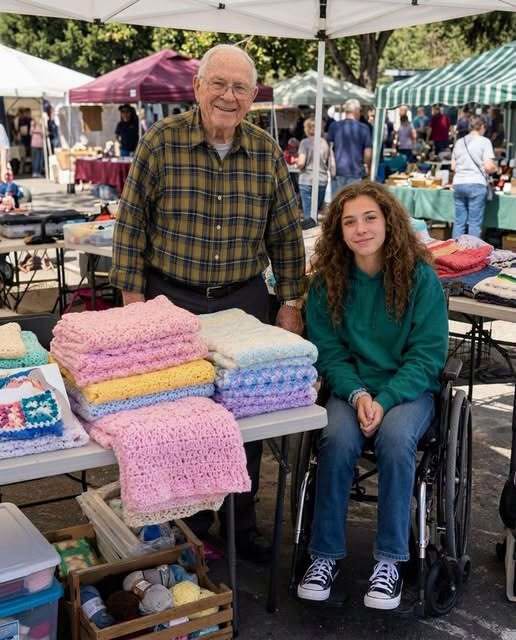
After a car crash changed my life, my 76-year-old grandfather worked himself to exhaustion sewing quilts to pay for my therapy. I believed his sacrifice proved there was nothing he wouldn’t do for me.
Then a stranger recognized one of my mother’s old dresses stitched into a quilt and said words that shattered everything I thought I knew.
“You told me my daughter was dead.”
The flea market fell silent.
A customer lowered the quilt she was holding. Someone nearby stopped unpacking boxes. My best friend, Tessa, covered her mouth in shock.
I looked up at Grandpa.
“His daughter?” I asked.
“Maisie, we’re leaving,” Grandpa said, trying to push my wheelchair away.
I locked the brakes.
“No.”
His face tightened.
“Please, sweetheart.”
“You don’t get to say something like that and remove me from the conversation.”
The biker stepped forward.
“My name is Cole,” he said. “Hannah was the person I loved most.”
“My mother’s name was Hannah.”
“I know.”
Grandpa stepped between us.
“You have no right to come here.”
Cole pulled a worn envelope from his vest.
“I’ve wanted answers for twenty years, Benjamin. I know what you did.”
He placed the envelope on the table.
Grandpa opened it. A photograph slipped out.
His face turned pale.
“No… Is that really you?”
It was a picture of my mother standing beside a younger Cole. She wore a yellow floral dress. I recognized the fabric because pieces of it had been sewn into the quilt across my lap.
On the back she had written:
“Cole and me. Five years later. Maybe this time we’ll be brave.”
My hands began to shake.
“What does ‘five years later’ mean?”
Neither man answered.
“Grandpa… tell me.”
Cole looked at him.
“He decided I wasn’t good enough for your mother.”
“You had no steady job,” Grandpa replied. “No plan.”
“I was 21. I was trying.”
“So you made her choose between me and having a home.”
“I protected my daughter.”
“You hid my letters.”
I stared at Grandpa.
“What letters?”
Cole handed me a folded note.
Grandpa grabbed my wrist.
“Don’t, Maisie.”
I slowly opened it.
Cole,
If you’re reading this, something happened before I could fix things myself. Our baby is healthy and growing stronger every day. My father may never forgive you, but he has no right to erase you.
— Hannah
I read it twice.
Then I looked at Cole.
“Are you saying I’m your daughter?”
“Hannah believed you were. I want proof too.”
Grandpa reached for my wheelchair again.
I pushed his hand away.
“Stop moving me whenever you don’t like what I’m asking.”
I spread every letter across the table.
“Tessa, take pictures.”
Grandpa objected, but Tessa quietly pulled out her phone.
For the first time, I wanted facts more than comfort.
A Year Earlier
A year before, my biggest worry had been convincing Grandpa that I was old enough to choose my own haircut.
Then everything changed.
Tessa was driving me home from school when another driver ran a red light on a wet road. The crash flipped the car.
When I woke up in the hospital, I couldn’t feel my legs.
“Will I walk again?” I asked.
“There’s a chance,” the doctor said. “But recovery will take time and regular therapy.”
Grandpa leaned forward.
“Then give my granddaughter every treatment she needs.”
Insurance covered only part of the cost.
So Grandpa found another way.
At 76, he already worked long shifts stocking shelves. After the crash, he began working extra hours and pulled my grandmother’s old sewing machine from storage.
Every night he sewed quilts.
Every weekend we sold them at the flea market.
One night I found him sewing at two in the morning, his fingers swollen.
“You worked all day.”
“Your therapy comes first.”
“You matter too.”
Three days before Cole appeared, I was practicing with parallel bars during therapy.
My knee buckled.
Grandpa rushed forward.
“I had it,” I snapped.
Later that evening I secretly raised the prices of our quilts, photographed them online, and suggested making smaller quilts that used less fabric.
“You’re taking over?” Grandpa smiled.
“I’m helping.”
He looked at me.
“Just like Hannah.”
I knew my mother had died after giving birth to me.
I knew she loved yellow dresses, old music, and too much cinnamon in her coffee.
I knew almost nothing about my father.
Grandpa had always told me he disappeared.
Now I knew that wasn’t the whole story.
The Truth
After leaving the flea market, Tessa drove me home.
I asked her to hand me the wooden memory box from my bedroom shelf.
Inside were old photographs… and bundles of letters tied with string.
Every envelope had Cole’s name on it.
Some had been returned.
Others had never been mailed.
Grandpa walked into the room and froze.
“You had no right to open that box.”
“You kept my whole life inside it.”
“I was protecting your mother.”
“From what?”
“Was Cole dangerous?”
“No.”
“Did he hurt her?”
“No.”
“Did he threaten her?”
“No.”
“Then you weren’t protecting her. You were deciding for her.”
Grandpa finally sat down.
Twenty years earlier, Hannah had been 18.
Cole was 21, repairing motorcycles and taking odd jobs.
Grandpa gave her an ultimatum.
Stay with him—or leave with Cole.
When Cole wrote, Grandpa hid every letter.
Years later Hannah found them and reunited with Cole.
She became pregnant.
Then she died during childbirth.
Cole called.
Grandpa told him Hannah had died.
Then he lied again.
He told Cole the baby had died too.
My throat tightened.
“Why?”
“I had already lost Hannah,” Grandpa whispered. “I couldn’t lose you too.”
“So you made sure he lost both of us.”
He broke down crying.
I wanted to comfort him.
That frightened me most.
“I love you,” I said quietly. “But you don’t get forgiven just because I love you.”
Then I rolled out of the room.
Meeting Cole
The next morning Tessa drove me to meet Cole at a diner.
“I’m not calling you Dad,” I told him.
“I didn’t ask you to.”
He showed me another photograph of my mother while she was pregnant.
Beside it was a list of baby names.
Mine was circled.
“You knew my name?”
“I knew the name she wanted.”
“Why didn’t you come back?”
“Your grandfather told me you were both gone. Months later I returned, found Hannah’s grave, and believed the lie.”
“How did you find me?”
“Hannah left that letter with a friend. Years later she found me. Then I saw your picture on the flea market’s public page. I recognized Hannah in your face.”
“I want a DNA test.”
“Anything you need.”
“The test can tell me who you are. It can’t decide what you get to be.”
He nodded.
“That’s fair.”
Moving Forward
Weeks later, the DNA test confirmed Cole was my father.
It didn’t instantly make him my parent.
Grandpa remained my guardian, and Cole promised not to fight for custody.
“I already lost fifteen years,” he said. “I’m not losing the next three in court.”
At therapy I stood for seven seconds.
Cole simply smiled.
“You worked hard.”
“Right answer,” I said.
The following Saturday I took Grandpa back to the flea market.
“You lied here,” I told him. “Now tell the truth here.”
He faced everyone.
“Cole didn’t abandon Hannah. I hid his letters. After she died, I told him his baby had died too.”
The vendors stared in silence.
“I loved Maisie,” Grandpa said. “But I built that love around a lie. One doesn’t erase the other.”
For the first time, I believed he truly understood.
Later, Cole offered to pay for all my therapy.
“I’m not a bill you can pay to prove you’re my father,” I said.
“Then tell me how I can help.”
I showed him my sketches for adaptive lap quilts designed for wheelchair users, with secure pockets and straps that wouldn’t slip into the wheels.
Grandpa agreed to sew the first sample.
Cole agreed to sell them at weekend markets.
I kept every dollar recorded.
The profits paid for extra therapy sessions.
Soon we had seven orders.
One day, during therapy, I stood behind my walker while Grandpa and Cole waited several feet away.
My leg trembled.
“You can stop,” Grandpa said.
“I know.”
I took one step.
Then another.
Neither man rushed toward me.
They waited for me to decide what I needed.
When I reached the other side, I laughed before I cried.
Cole smiled.
“Can I hug you?”
“Not while I’m sweaty.”
Grandpa smiled too—but he didn’t reach for me.
That mattered more than either of them knew.
Later, Grandpa handed me the money from another quilt sale.
I counted it twice.
“You don’t trust me,” he said.
“Not with the truth.”
He looked down.
“I love you, Grandpa. But love doesn’t erase what you took from me.”
Then I looked at Cole.
“And a DNA test doesn’t make you my father overnight.”
That was the difference now.
They no longer decided what I should forgive, what I should forget, or whom I should call family.
The truth had belonged to them for fifteen years.
What happened next belonged to me.