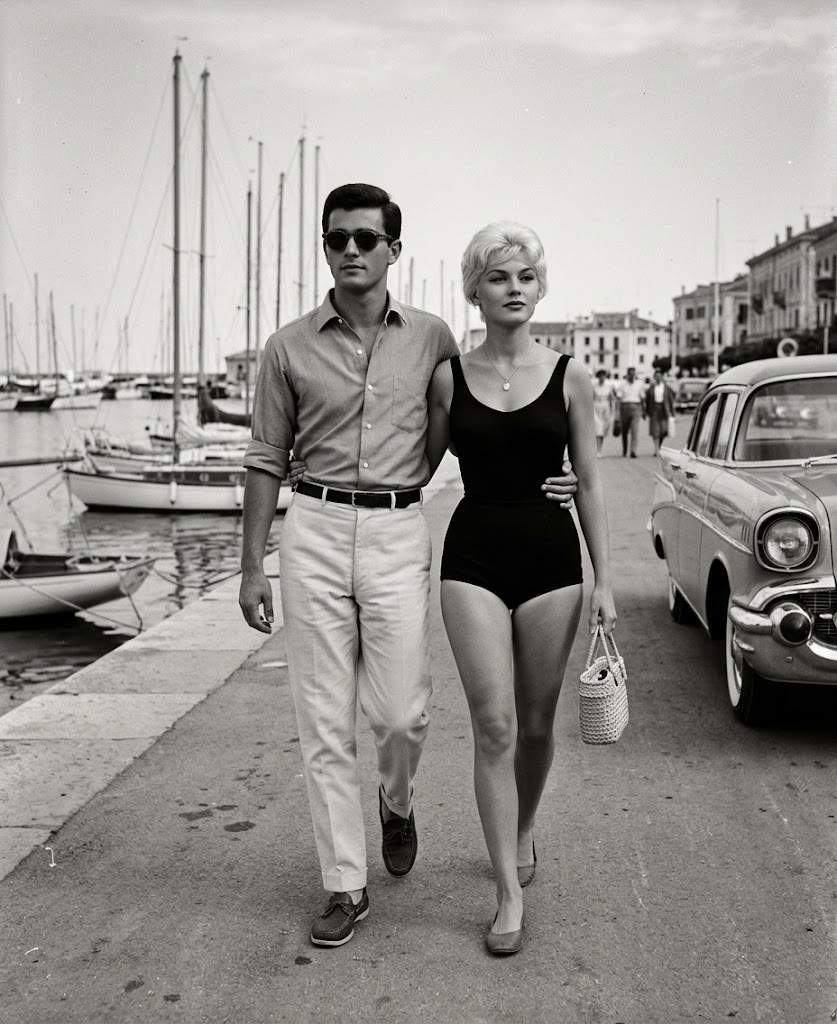
During the summer of 1958, Brigitte Bardot stood for much more than the conventional idea of a film star. She embodied freedom, beauty, defiance, and a new generation beginning to challenge the traditions of earlier decades. With her casually styled blonde hair, captivating eyes, natural sophistication, and distinctive character, Bardot had established herself as one of the world’s most instantly recognizable women. Wherever she went, photographers appeared, fans gathered, and discussions soon centered on her remarkable impact on movies, fashion, and modern culture.
One destination particularly connected to her unforgettable image was Saint-Tropez, a charming town on the French Riviera that was gradually evolving from a peaceful Mediterranean fishing community into a fashionable international retreat for painters, performers, affluent tourists, and prominent social figures. Within this beautiful coastal setting, Bardot and Jacques Charrier became the subjects of a love story that captured widespread attention. Their romance reflected the elegance of postwar French society, the growing public fascination with famous couples, and the difficulties of maintaining a relationship when personal affairs became matters of constant public interest.
A picture showing Bardot alongside Charrier brings this extraordinary era back to life. It captures the period when the French Riviera was becoming associated with relaxed luxury, when the film industry was reshaping society’s understanding of attractiveness, and when Bardot appeared to symbolize a different vision of womanhood: free-thinking, emotionally unpredictable, and unwilling to surrender completely to society’s expectations.
However, beneath the glamorous photographs, stylish appearances, and closely watched public encounters existed a far more complex personal reality. Bardot was not merely a beautiful celebrity living an apparently flawless existence. She was a young woman attempting to manage exceptional fame, relentless public attention, romantic responsibilities, and the challenging separation between her authentic personality and the identity others expected her to represent.
Her connection with Charrier would become a meaningful part of that experience. Their love story developed during a defining stage of her professional journey, uniting two performers at a time when Bardot’s worldwide popularity was growing quickly. Their wedding, the arrival of their child, and their eventual breakup would expose the personal struggles often concealed behind the dazzling exterior of celebrity relationships.
Understanding why photographs of Brigitte Bardot and Jacques Charrier continue to attract interest requires looking beyond their stylish appearance as a couple. Their experiences provide insight into French society during the 1950s, the emergence of contemporary celebrity culture, Saint-Tropez’s lasting appeal, and the emotional sacrifices that can accompany worldwide recognition.
Brigitte Bardot: The Young Woman Who Transformed the Image of French Cinema
Long before Brigitte Bardot achieved international stardom, she was a young woman from Paris whose aspirations reached beyond the traditional roles expected of women during her era. Born in the French capital on September 28, 1934, she was raised in a financially comfortable household and studied classical ballet. Her early dedication to dancing helped shape the graceful posture, expressive movements, and physical confidence that would eventually become essential features of her acting style.
Bardot first attracted public notice through her modeling work. Her striking appearance caught the interest of French fashion magazines, and she slowly developed a reputation for a unique beauty that contrasted with the carefully perfected and highly formal image of many established actresses.
Her charm could not easily be explained by any single physical feature. She had an expressive face, a memorable smile, and a naturally relaxed manner that rarely appeared overly practiced. Her blonde hair, frequently arranged in a soft and intentionally informal style, became one of her most recognizable trademarks. She could appear sophisticated without looking excessively polished and captivating without obeying every traditional standard of elegance.
These characteristics made her particularly appealing to photographers and movie directors seeking performers with a more authentic and spontaneous presence on screen.
Throughout the 1950s, the movie industry was experiencing important transformations. Viewers were becoming increasingly drawn to characters who displayed emotional complexity, questioned social traditions, or resisted the strict moral expectations of earlier generations. Bardot’s appearance and personality suited this developing cultural environment.
Although she was not the first female performer to question traditional definitions of femininity, her worldwide popularity brought those challenges into sharper public focus. Her cinematic identity suggested that women could be attractive, humorous, self-reliant, and unpredictable without remaining confined to the carefully defined roles that had dominated mainstream entertainment for generations.
This portrayal intrigued audiences while troubling certain conservative observers. Bardot was praised by some as an expression of personal liberation, while others criticized her image because they believed it threatened long-established social principles.
That tension became an important aspect of her influence. She represented a vision of independence that excited countless admirers, yet she also faced criticism and expectations that often overlooked her humanity as an ordinary individual.
By the closing years of the 1950s, Bardot ranked among Europe’s most frequently discussed actresses. Her impact reached far beyond movie theaters. Young women imitated her hairstyles, fashion publications examined her clothing choices, and photographers viewed even her everyday activities as moments worthy of public attention.
Her growing fame represented more than the success of an attractive actress. It reflected a society undergoing cultural change and embracing a new public figure through whom it could express developing ideas about youth, sexuality, personal style, and individual freedom.
The Movie That Turned Brigitte Bardot Into a Worldwide Sensation
A defining achievement in Bardot’s professional life came with the release of the 1956 movie And God Created Woman, directed by Roger Vadim.
The production played a major role in establishing her international reputation and reshaped how viewers understood her personality. By presenting a young woman unwilling to accept conventional social restrictions, the story questioned many of the moral beliefs that shaped its historical period.
Bardot portrayed Juliette Hardy, a young woman whose attractiveness, impulsive behavior, and determination to remain independent caused conflict within the conservative community surrounding her. Juliette was not depicted as a typical female protagonist whose actions could be easily justified or admired. Instead, she appeared as a complicated individual whose personal wishes repeatedly clashed with the demands of those around her.
The performance sparked debate, but that very controversy helped bring the movie to the attention of audiences across the world.
Moviegoers were fascinated by Bardot’s screen presence. Her movements appeared unusually natural and unrestricted compared with the more carefully controlled acting styles commonly associated with female performers of that generation. Her character’s resistance to accepted social behavior became one of the central reasons the film attracted so much interest.
The popularity of And God Created Woman helped transform Bardot into an internationally recognized cultural figure. While her acting career had already been progressing, this production introduced her to a much broader audience and reinforced the growing connection between her public image and the French Riviera.
Roger Vadim, Bardot’s first husband, recognized the unusual characteristics that made her such a magnetic performer. His filmmaking approach highlighted her spontaneous movements, youthful vitality, and unconventional appeal.
The movie also drew considerable strength from its southern French surroundings. Bright landscapes, informal gathering places, and Mediterranean scenery contributed to a distinctive visual atmosphere that viewers increasingly connected with Bardot’s identity.
Within the film, the Riviera functioned as something more meaningful than a simple filming location. It suggested an appealing lifestyle defined by warm sunshine, relaxation, physical attraction, and escape from the limitations imposed by traditional society.
This connection continued influencing popular imagination for many years. Even individuals who had never traveled to the French Riviera began picturing the region through scenes associated with Bardot and her cinematic performances.
By 1958, she had progressed far beyond the status of an emerging actress. Bardot had become a cultural symbol whose reach extended well outside the entertainment industry.
Saint-Tropez: How a Fishing Town Became a Worldwide Emblem of Glamour
Although the French Riviera had attracted artists and prosperous vacationers for generations, Saint-Tropez developed a particularly important place in the cultural imagination during the late 1950s.
Located beside the Mediterranean Sea, the town had historically been known for its fishing industry, maritime traditions, and the unhurried lifestyle of a small coastal settlement. Its picturesque harbor, winding streets, softly colored buildings, and nearby beaches created an atmosphere quite different from Parisian sophistication or the elaborate luxury of more established holiday destinations.
Following World War II, however, Saint-Tropez gradually began welcoming increasing numbers of painters, authors, filmmakers, and stylish visitors. Its beautiful natural surroundings and informal atmosphere attracted people searching for an escape from the stricter social customs associated with large urban centers.
The town offered pleasant weather, outdoor cafés, sailing boats anchored in the harbor, and sandy beaches where fashionable vacationers could relax away from their professional responsibilities. Much of its charm came from the feeling that visitors could experience comfort and luxury without being constantly restricted by formal etiquette.
Brigitte Bardot emerged as one of the personalities most strongly connected with this changing identity.
Her appearances helped establish Saint-Tropez as a destination representing a fresh form of French elegance. Rather than the highly structured refinement commonly linked with aristocratic circles, Bardot’s personal style communicated youthfulness, ease, and natural spontaneity.
She could wear uncomplicated summer outfits, leave her hair loosely styled, and appear completely unguarded while still attracting extraordinary public interest. This mixture of relaxed presentation and celebrity fascination became a defining feature of Saint-Tropez’s developing reputation.
The coastal scenery also offered photographers an ideal environment. Sunlight shimmered across the Mediterranean, pale buildings contrasted with the bright sky, and the harbor provided an attractive setting for pictures featuring actors and fashionable travelers.
Yet Saint-Tropez served a purpose beyond providing beautiful scenery. It developed into a location where celebrity identities were photographed, promoted, and shared with the wider world.
Images of well-known personalities enjoying their coastal holidays turned ordinary leisure activities into public entertainment. A celebrity might simply stroll along the waterfront or relax near the marina, but the resulting photograph could appear in magazines and newspapers, allowing readers far away to feel momentarily connected to that person’s private world.
For Bardot, the town became deeply intertwined with her international reputation. Saint-Tropez appeared to embody the characteristics admirers associated with her personality: personal freedom, sensuality, youthful confidence, and resistance to restrictive social traditions.
This relationship between the actress and the destination became so enduring that Bardot eventually emerged as one of Saint-Tropez’s most recognizable cultural symbols.
Jacques Charrier: The Performer Who Became Part of Bardot’s Life
While Brigitte Bardot was already enjoying extraordinary international recognition, Jacques Charrier was establishing his own position within the acting profession.
Born on November 6, 1936, in Metz, France, Charrier followed a different personal path before entering the world of entertainment. He pursued studies at the École nationale supérieure des arts et techniques du théâtre in Paris and began developing his professional career during a period of growing international enthusiasm for French filmmaking.
Charrier had not achieved the same level of worldwide recognition as Bardot, and this imbalance in public fame would become an important element of their relationship.
Becoming romantically involved with someone who already possesses exceptional celebrity status can create circumstances very different from those experienced by most couples. Public outings may attract photographers, private disagreements can inspire rumors, and even routine decisions may be examined and interpreted by curious outsiders.
For Charrier, a relationship with Bardot meant becoming involved in a highly visible environment where his personal achievements and identity could easily receive less attention than hers.
However, this difference in fame did not make his place in her life unimportant. Charrier was a professional actor with individual goals, experiences, and ambitions, and their connection existed between two real people rather than merely between a famous woman and someone who admired her.
Even so, audiences generally interpreted the relationship through Bardot’s extraordinary popularity. Magazine features and photographs naturally emphasized her presence because she was already the celebrity whom readers knew and followed.
Consequently, Charrier became publicly identified with one of the era’s most celebrated women, and his place in popular history became strongly associated with their marriage.
Interest in their relationship also grew because it appeared to offer a rare opportunity to understand Bardot’s private personality during a period when audiences were becoming increasingly curious about the woman beyond her glamorous movie roles.
Who had captured her affection and become her chosen partner? What happened within a relationship constantly exposed to public observation? Was it possible for an internationally famous actress to establish a peaceful and secure personal life?
Questions such as these contributed to the romance becoming a widely followed subject.
Nevertheless, reality proved considerably more complicated than the attractive photographs implied. Their partnership would face pressures unfamiliar to most ordinary couples, while the contrast between public imagination and personal experience would become increasingly important.
A Love Story Under Constant Public Attention
By the time the relationship between Bardot and Charrier became a prominent celebrity story, she had already spent years dealing with public observation.
Her professional success exposed her to relentless attention, while discussions about her looks often treated her appearance as something the public had a right to examine. Although admiration could feel rewarding, it also created circumstances in which maintaining personal privacy became increasingly difficult.
A late-1950s photograph featuring Bardot and Charrier can immediately suggest the romantic charm associated with that generation. They belonged to a period characterized by evolving filmmaking styles, glamorous holiday locations, and changing attitudes toward relationships and marriage.
Their public appearance carried several different meanings. To fans, they represented romance and youthful beauty. To entertainment reporters, they offered an appealing story involving two performers, including one of the most recognizable actresses in the world. To fashion photographers, their outings created opportunities to document the stylish atmosphere of the French Riviera.
However, the image presented by a famous couple rarely captures the full reality of their relationship.
A photograph preserves only one brief moment. It might portray two individuals laughing, standing affectionately together, or enjoying the Mediterranean sunshine. What it cannot communicate is the conversation they shared beforehand, the private concerns occupying their thoughts, or their behavior once the photographers disappeared.
Interpreting celebrity photographs as complete representations of personal relationships remains a familiar tendency within popular entertainment culture.
In Bardot’s case, this habit was particularly noticeable. Her fame depended partly on an impression of honesty, spontaneity, and emotional openness, encouraging viewers to believe they understood her personality simply through her photographs.
Yet looking carefree does not necessarily mean living without difficulties. Someone may appear completely comfortable in front of an audience while privately dealing with anxiety, uncertainty, or competing personal responsibilities.
Bardot’s relationship with Charrier developed against this complicated background. Their romantic connection was genuine, but it simultaneously became a public narrative that journalists, admirers, and observers felt entitled to interpret.
As the fascination surrounding the couple intensified, separating their authentic experience of being together from the version of their romance constructed for public consumption could become increasingly challenging.
The Glamour of 1958: Sunlight, Fashion, and a New Sense of Freedom
The year 1958 holds a special place in the story of postwar popular culture.
Across Europe, societies were continuing to transform in the aftermath of the Second World War. Consumerism was growing, overseas travel was becoming more attainable for certain groups, and films were attracting audiences from different countries around the world.
Fashion was evolving as well. Although conventional ideas of elegance still held considerable influence, a younger generation was increasingly drawn to clothing that felt comfortable, relaxed, and more personal.
Brigitte Bardot reflected many of these changes.
Her fashion choices were distinctive without being overly complicated. She frequently selected simple garments that allowed freedom of movement and emphasized comfort, creating an appearance that felt natural rather than carefully arranged.
Her background in ballet also contributed to her graceful posture. Meanwhile, her signature hairstyles and fondness for informal summer outfits helped create a recognizable personal style.
This effect was especially noticeable in Saint-Tropez. Surrounded by the beauty of the Mediterranean, Bardot demonstrated that true glamour did not always depend on formal dresses, expensive accessories, or perfectly arranged settings.
Sometimes, the magic came from an uncomplicated dress, dark sunglasses, uncovered shoulders, or hair gently moving in the coastal breeze.
Her influence reached well beyond France. Women who admired her began adopting elements of her look, while fashion magazines spread the image of the French actress as an example of a new kind of femininity.
Her impact extended beyond particular outfits and accessories. Bardot helped bring attention to a wider fashion philosophy in which simplicity and informality could themselves communicate sophistication.
That concept continues to resonate today. Modern fashion campaigns frequently promote effortless elegance, suggesting that natural movement and understated styling reflect confidence and individuality.
Although Bardot did not create this aesthetic single-handedly, she became one of its most celebrated symbols.
Whenever she appeared alongside Charrier, their relationship added another layer of romance to the glamorous Riviera image that fascinated the public.
Together, they appeared to inhabit a world where love, cinema, fashionable living, and leisure blended into one captivating picture. However, beneath that polished image were the difficulties of protecting a relationship while living under constant public observation.
What a Photograph Can Tell Us—and What It Cannot
Photographs of Brigitte Bardot and Jacques Charrier continue to attract interest because they offer a glimpse into a distinctive period of cultural history.
Their outfits, facial expressions, body language, and surroundings provide clues about the time in which the images were captured. They help illustrate contemporary fashion, the expanding influence of celebrity photography, and the growing connection between Saint-Tropez and modern sophistication.
Nevertheless, photographs should not be considered conclusive proof of what people were feeling or experiencing within their relationships.
An image showing two people standing close together cannot demonstrate that their relationship was free of difficulties. A smile does not establish that someone remained happy throughout an entire period. Likewise, a casual pose cannot reveal whether the individuals involved were privately dealing with personal struggles.
Recognizing this difference is essential when examining relationships involving celebrities.
Public images generally preserve the most attractive and memorable moments. They seldom document the everyday duties, disagreements, compromises, and uncertainties that make up a large part of ordinary life.
Consequently, historical photographs can lead people to develop an idealized picture of the past.
The late 1950s can seem particularly enchanting when viewed through carefully framed images of film stars enjoying the Mediterranean coast. Bright sunshine, fashionable outfits, and picturesque surroundings create the impression of a world untouched by time.
However, the people appearing in those photographs faced the same fundamental realities as everyone else. They had careers to pursue, families to care for, emotions that changed, and important choices to make.
Bardot’s relationship with Charrier illustrates why the story behind an image deserves attention.
Their marriage became a significant part of both their lives, but its full meaning cannot be understood simply by looking at photographs of them spending time together on the Riviera.
These images remain important historical and cultural records. Their real value, however, may not be in demonstrating that the couple enjoyed constant happiness, but in revealing how celebrity, romantic relationships, and visual culture came together during a period of major transformation in French society.
Marriage in 1959: A New Chapter in Bardot’s Life
Brigitte Bardot and Jacques Charrier were married in June 1959.
Their wedding represented an important turning point in Bardot’s personal life and attracted widespread attention because of her international celebrity. As her acting career continued to advance, she was simultaneously beginning a new stage of life filled with the responsibilities and expectations that accompanied marriage.
To the public, the wedding strengthened the image of Bardot as a glamorous young woman whose romantic experiences were nearly as captivating as her work on screen.
Yet marriage involved much more than an elegant public occasion. It required two individuals to navigate the everyday practicalities and emotional demands of building a shared life.
Bardot faced particular difficulties because her professional identity had become so prominent. Her career required travel, long working hours, and frequent public appearances. At the same time, the intense curiosity surrounding her private affairs made it challenging to keep ordinary personal experiences away from public attention.
Charrier had his own ambitions as an actor and an independent professional identity. Their marriage therefore brought together two careers, two individual personalities, and a relationship continually examined through the public’s fascination with Bardot.
The tension between their personal needs and the pressures of celebrity life gradually became increasingly significant.
A relationship may begin with sincere affection and excitement but still encounter difficulties when circumstances make privacy, independence, and emotional balance challenging to preserve.
For couples working in the entertainment industry, career opportunities can mean spending extended periods apart, managing conflicting schedules, and feeling pressure to maintain a particular public image. These circumstances do not inevitably lead to marital problems, but they can make honest communication and mutual understanding especially necessary.
Bardot and Charrier’s relationship developed within this demanding environment.
Their marriage remains an important part of Bardot’s personal history, but it should not be simplified into the glamorous love story presented by newspapers and magazines.
Like any marriage, theirs involved private circumstances that outsiders could never fully understand.
The Birth of Their Son and the Reality Behind the Headlines
In January 1960, Brigitte Bardot became the mother of her son, Nicolas-Jacques Charrier.
Motherhood brought a significant change to her life at a time when her public image and acting career continued to attract enormous attention.
The birth received extensive media coverage, reflecting the public’s eagerness to learn intimate details about the actress. However, the attention also demonstrated how difficult it could be to experience a deeply personal milestone when the media was eager to transform it into a public spectacle.
For many individuals, welcoming a child involves happiness, uncertainty, physical changes, and unfamiliar responsibilities. Even with privacy and a dependable support network, the transition can be challenging.
Bardot’s situation was made more complicated by the expectations attached to her fame and by the assumptions people held about how a well-known woman should behave or feel.
Society often presents motherhood as though every woman should experience it in the same emotionally fulfilling way. In reality, becoming a parent can bring many different feelings, and no two people’s experiences are necessarily alike.
Bardot later spoke openly about the struggles she encountered during this stage of her life and her complicated emotions regarding motherhood. Her remarks questioned the idealized portrayal of mothers as universally fulfilled and completely happy, an image that featured prominently in public conversations during that period.
Her experiences should be recognized as a reflection of her individual circumstances rather than interpreted as a general judgment about parenthood.
Her story also highlights the limitations of celebrity culture. People may assume that fame, financial resources, and physical beauty shield someone from emotional hardship, but these advantages cannot remove the difficulties and uncertainties that accompany family life.
The arrival of Nicolas-Jacques also meant that Bardot and Charrier now shared the responsibility of raising a child.
Their choices would influence not only their individual lives but also their family, making their relationship considerably more complicated than a romantic story involving two actors.
When reflecting on these events, it is important to distinguish between the public’s curiosity about Bardot’s personal affairs and the respect that the people involved deserve.
A celebrity’s family life may become part of historical discussion, but it should never be reduced to entertainment that ignores the real individuals who experienced those events.
Fame and the Difficult Search for Privacy
One of the defining challenges in Bardot’s life was her struggle to maintain personal privacy while being regarded as a public symbol.
The increasing popularity of illustrated magazines and celebrity photography allowed images of famous individuals to travel across international borders with growing ease. A picture taken during an otherwise peaceful afternoon could be reproduced and shared with readers who had never encountered the person in real life.
This development transformed the relationship between celebrities and their audiences.
People could develop a sense of closeness to a famous star without actually knowing that person. Photographs appeared to offer glimpses into private experiences, while interviews and gossip columns encouraged readers to believe that a celebrity’s personality could be understood through a continuous stream of public information.
Bardot became one of the clearest examples of this growing phenomenon.
Her physical appearance attracted constant discussion, her fashion choices inspired imitation, and her romantic relationships received attention that might otherwise have remained confined to her personal life.
Such public interest could increase her professional influence, but it also introduced substantial pressure into her private world.
The difficulty extended beyond being recognized wherever she went. Public recognition frequently came with expectations. Audiences wanted Bardot to remain the beautiful, independent, carefree woman they admired, even as her personal circumstances and feelings evolved.
Her public persona could become an invisible performance that continued even when the cameras were no longer recording.
This created a striking contradiction. Part of Bardot’s appeal came from the impression that she was natural, independent, and unwilling to be restricted by convention. Yet the more famous she became, the harder it was for her to move freely through everyday life without attracting attention.
Even ordinary personal choices could become the subject of interpretations that had little to do with what she actually intended.
For a couple like Bardot and Charrier, living in such an environment could make it exceptionally challenging to protect their private lives. Their relationship was more than a personal connection between two people; it had also become a matter of widespread public interest.
This difference helps explain why celebrity romances can seem far more glamorous to outsiders than they actually feel to those involved.
The public sees the photographs and reads the headlines. The couple, meanwhile, must deal with the real-life consequences of that attention.
Why Their Marriage Did Not Last
Brigitte Bardot and Jacques Charrier eventually went their separate ways, with their divorce becoming official in 1962.
Although their marriage lasted just a few years, it remained an important part of the public narrative surrounding Bardot.
It might be tempting to identify one straightforward reason for their separation. Celebrity stories often encourage this kind of interpretation because a single dramatic explanation is easier to tell than the complicated mixture of circumstances that can shape a marriage.
In practice, relationships are often influenced by several factors, including differences in personality, changing life situations, unmet hopes, and problems that gradually build over time.
Bardot’s career demanded considerable time and energy, while the intense scrutiny surrounding her life created pressures unfamiliar to most couples. Charrier, too, had professional ambitions and personal priorities of his own.
The demands of marriage and raising a child introduced additional challenges.
Photographs and public reports cannot provide a complete account of every private discussion or emotion that played a role in their separation. It would also be unfair to suggest that their relationship can be explained solely by Bardot’s fame or Charrier’s place in her life.
What is clear is that their marriage unfolded during a period when Bardot’s public image had become extraordinarily influential. Millions of people followed and interpreted her life, and the pressure created by that attention formed part of the circumstances surrounding their relationship.
Their separation also highlights the difference between romantic attraction and lasting compatibility.
Two people may feel deeply attracted to one another, create meaningful memories, and genuinely hope to build a life together without eventually finding that they can remain compatible as husband and wife.
The end of a marriage does not diminish the significance of the relationship or prove that the feelings shared during it were never genuine.
For Bardot and Charrier, their marriage became one stage of two lives that eventually moved along separate paths.
The importance of their relationship lies not in labeling it a straightforward triumph or failure, but in acknowledging the human complexities behind a story that the public frequently viewed through the glamour of celebrity.
Bardot’s Influence on Fashion and the Meaning of Modern Femininity
Brigitte Bardot’s influence on popular culture reached well beyond her romantic life.
She emerged as one of the most influential fashion personalities of the 1950s and 1960s, promoting a style that blended classic femininity with a relaxed and informal spirit.
Her hairstyles became popular among women who wanted to imitate her appearance. Her voluminous blonde hair, soft texture, and distinctive fringe became signature features. The Bardot neckline, which exposes the shoulders, also became strongly linked to her name and fashion identity.
She regularly chose outfits that prioritized comfort and freedom of movement over strict formality. Striped shirts, uncomplicated dresses, tailored trousers, ballet flats, and relaxed summer clothing all helped establish the impression that looking elegant did not require excessive effort.
Her fashion sense seemed especially appropriate for the French Riviera.
In Saint-Tropez, casual outfits, warm sunshine, and the Mediterranean landscape combined to create a version of glamour that felt less formal than the sophistication associated with elaborate evening occasions.
Her appeal was about more than appearance alone. Bardot’s image also became associated with independence.
She appeared to demonstrate that a woman could be attractive without conforming to every social expectation placed upon her. Her public persona conveyed sensuality and self-assurance, along with an unpredictable quality that made her difficult to define within conventional categories.
This helped set her apart from more traditional celebrity images.
Still, her public persona should not be mistaken for a complete picture of her private identity. Her influence on fashion was shaped partly by photographers, filmmakers, designers, and media organizations that selected and circulated particular aspects of her appearance.
The cultural icon emerged through a combination of Bardot’s distinctive personality and the systems that transformed her image into something recognizable around the world.
Even so, her influence was genuine and enduring. Designers and photographers continued drawing inspiration from her style long after she first achieved international recognition.
To many people, Bardot remains an enduring symbol of French Riviera fashion and the distinctive glamour associated with Saint-Tropez.
The French Riviera as a Stage for Celebrity Culture
Bardot’s connection with Saint-Tropez reveals an important aspect of how modern celebrity culture developed.
A place can become internationally famous not simply because of its natural beauty, but also because of the personalities connected to it.
Saint-Tropez provided an appealing backdrop, with its picturesque harbor, sandy beaches, brilliant sunshine, and architecture that suggested a more leisurely pace of life.
Celebrities brought the stories that made the setting memorable.
As actors, artists, and fashionable visitors appeared in Riviera photographs, the location became part of a wider cultural narrative. The town came to symbolize freedom, relaxation, romance, and a glamorous lifestyle that audiences could admire from a distance.
Bardot’s association with Saint-Tropez helped strengthen this image. Her presence contributed to the town’s transformation into a widely recognized emblem of a particular way of living.
The connection between famous personalities and locations remains influential today. Film festivals, fashion gatherings, luxury hotels, and celebrated restaurants frequently become popular destinations partly because of their associations with well-known figures.
During the 1950s, however, this development was becoming particularly noticeable as illustrated magazines and entertainment journalism reached increasingly broad audiences.
Photography made it possible for the atmosphere of a destination to travel far beyond its physical boundaries. Readers could view celebrities enjoying time beside the sea and imagine themselves experiencing the same lifestyle.
This created a compelling combination of real places and imagined possibilities.
Saint-Tropez became more than a Mediterranean town. It developed into a symbol of a life that appeared less restricted, where beauty seemed effortless and the usual divisions between professional responsibilities and leisure could briefly fade away.
Bardot and Charrier were part of this cultural period, although their private relationship was more complicated than the glamorous pictures suggested.
Their photographs continue to capture the attraction of that world while reminding contemporary audiences that celebrity imagery offers only a selective view of reality.
The Difference Between a Public Image and a Private Identity
One of the lasting questions raised by Bardot’s life concerns whether a public persona can ever fully communicate the identity of the person behind it.
Audiences came to know Bardot through her films, photographs, interviews, and stories published by entertainment media. Each source provided a different perspective, but none could disclose every aspect of her character.
Her film performances presented carefully developed fictional personalities. Photographs highlighted specific expressions, outfits, and locations. Interviews recorded what she chose, or was able, to share at a particular time.
Together, these different elements created an image that audiences could easily recognize.
However, no individual can be fully understood through a collection of public representations.
Bardot could appear breathtakingly glamorous in photographs while experiencing the same everyday frustrations as anyone else. She could represent freedom on screen while encountering limitations in her personal life. She could become an emblem of independence while finding it difficult to escape the expectations created by her fame.
These apparent contradictions do not automatically mean her public image was dishonest. Instead, they demonstrate how limited any attempt to turn a real person into a cultural symbol can be.
The same understanding applies to her relationship with Charrier.
Photographs of the couple captured moments chosen for public viewing. They showed what the two looked like together, but they could not explain the emotional experiences that shaped their marriage.
Their relationship is therefore best considered through documented events, alongside an honest recognition of what public images cannot reveal.
The desire to create a complete romantic story from historical photographs is understandable. People naturally search for meaning in images, particularly when those images belong to a period remembered with nostalgia.
Nevertheless, historical understanding becomes more balanced when uncertainty is acknowledged.
Rather than interpreting every smile as proof of lasting happiness or assuming that later difficulties meant the romance was destined to fail, it is more sensible to recognize that relationships involve experiences no photograph can preserve.
The Enduring Appeal of Brigitte Bardot and Jacques Charrier
What explains the continued fascination with photographs of Brigitte Bardot and Jacques Charrier, even decades after they were captured?
One important reason is Bardot’s enduring fame. She became one of the most recognizable personalities in twentieth-century popular culture, and images from her most celebrated years continue to circulate because they reflect a period of significant change in cinema, fashion, and social attitudes.
Their romance provides another source of interest.
Audiences have long been drawn to the relationships of famous actors. Such relationships appear to combine familiar human emotions with extraordinary circumstances, creating stories that feel both relatable and distant.
Bardot and Charrier’s marriage brought these elements together. They were both actors whose lives became intertwined during a period when Bardot was gaining international recognition at an exceptional pace.
Their photographs also preserve the distinctive atmosphere of the French Riviera in the late 1950s. Today’s viewers may associate these images with summer vacations, elegant clothing, Mediterranean sunshine, and the developing culture of celebrity leisure.
Nostalgia plays a role as well. Historical photographs encourage people to imagine what everyday experiences might have been like in an earlier period.
The hairstyles, garments, automobiles, architecture, and social surroundings all help create the impression of stepping into another world. Even viewers unfamiliar with Bardot’s film career may find the images appealing because they convey a recognizable atmosphere.
Perhaps the most compelling feature of these photographs, however, is the contrast between their seemingly simple appearance and the complicated story behind them.
An image of two people together may appear timeless, but the relationship it captures belongs to a particular historical period, shaped by its own social expectations, personal pressures, and uncertainties.
These photographs remain beautiful cultural records, but their significance becomes greater when they are considered alongside the realities of the lives they portray.
Looking Back at 1958 Through a Modern Perspective
People today often view the 1950s through a combination of fascination and nostalgia.
The decade is remembered for its distinctive fashions, celebrated films, stylish automobiles, and photographic traditions that emphasized atmosphere and personality. The French Riviera, especially, has become associated with an idealized vision of leisure, beauty, and sophistication.
Brigitte Bardot is an essential part of that historical image.
Her appearance helped shape the visual identity of the period, while her film performances contributed to evolving discussions about femininity, sexuality, and personal freedom.
However, understanding the past also means recognizing that life was not as uncomplicated as the most attractive photographs might imply.
Social attitudes in the late 1950s differed considerably from those of the present day. Women encountered particular expectations regarding marriage, motherhood, public conduct, and respectability. Female celebrities were frequently praised for their beauty while facing harsh criticism when their decisions challenged traditional social standards.
Bardot experienced these conflicting expectations directly.
She was admired for representing independence, yet her private life was often judged according to conventional ideas about how women should behave. Her romantic relationships became public subjects, while her experiences as a wife and mother attracted intrusive attention.
These contradictions help explain the continuing relevance of her story.
Although the world has changed considerably, public figures still struggle to establish personal boundaries while living under constant observation. Social media has made the circulation of photographs and opinions even faster, further complicating the distinction between a public persona and private experiences.
For this reason, Bardot’s experiences belong not only to the history of French cinema but also to the wider discussion of fame, gender expectations, personal privacy, and the human costs of celebrity.
A Lasting Legacy Beyond Romance
Although Brigitte Bardot’s relationship with Jacques Charrier remains an interesting part of her biography, it represents only one aspect of her much broader legacy.
Her contribution to cinema was considerable. Her performance in And God Created Woman helped establish a portrayal of female independence that challenged many of the conventional expectations of the time.
Her fashion influence also proved remarkably durable. The hairstyles, clothing, and relaxed sophistication associated with her image continued inspiring later generations.
Beyond the entertainment industry, Bardot eventually became widely recognized for her involvement in animal protection. After leaving acting in the early 1970s, she dedicated much of her public life to animal welfare and founded the Brigitte Bardot Foundation in 1986.
This later phase of her life revealed another side of her public identity. The actress once known primarily for her beauty and screen presence became associated with activism and a long-term commitment to protecting animals.
Her later years also included controversial political remarks and public positions that generated criticism. A fair assessment of her legacy must therefore consider both her cultural contributions and the controversies surrounding her public behavior.
Historical personalities seldom fit comfortably into a single description. Bardot’s life encompassed artistic accomplishments, personal struggles, cultural influence, advocacy, and contentious public opinions.
Reducing her identity to a romantic photograph or a symbol of beauty would ignore much of the complexity of her life.
Nevertheless, photographs from her younger years remain significant because they capture the period when her image was helping transform international perceptions of French cinema and the Riviera lifestyle.
Her relationship with Charrier forms part of this wider historical picture. It was an important chapter in her personal life, but it was only one part of her story.
Conclusion: A Romance Preserved in the Sunlight of Saint-Tropez
Brigitte Bardot and Jacques Charrier remain associated with one of the most memorable periods in French popular culture. Their relationship developed as Bardot’s international fame was rapidly increasing, and their public appearances became part of the romantic mythology surrounding the French Riviera.
Saint-Tropez offered an ideal setting for this image. Its Mediterranean scenery, relaxed atmosphere, and growing popularity among artists and celebrities created a place that seemed to represent freedom, beauty, and effortless elegance.
Bardot’s striking appearance and distinctive personality made her a natural symbol of this lifestyle. Her success in And God Created Woman had already established her as a cultural sensation, while her influence reached into fashion, photography, and changing perceptions of femininity.
Charrier became part of her life during this remarkable period. Their marriage, the birth of their son, and their eventual separation revealed the complicated realities that existed beyond the glamorous photographs.
Images of the couple remain captivating because they preserve a moment when romance, cinema, and celebrity culture came together. Their significance, however, extends beyond the visual appeal of two famous people sharing a moment beside the Mediterranean.
They remind us that every public photograph captures only a small portion of a person’s life. Behind the elegance and attention were two individuals managing their ambitions, responsibilities, and changing circumstances.
Ultimately, Bardot’s story reaches far beyond the romance of the late 1950s. She helped transform the image of the modern film actress, influenced generations of fashion, and later became a prominent advocate for animal protection.
Her connection with Saint-Tropez remains one of the most recognizable aspects of her cultural identity, while her relationship with Charrier provides a glimpse into the private life of a woman whose public image was already becoming larger than life.
When we look at their photographs today, we can appreciate the glamour of the period without assuming that the images reveal everything. They preserve the sunshine, fashion, and romantic atmosphere of a particular historical moment, while the events surrounding their lives remind us that even the most celebrated people must navigate the fundamental challenges of love, family, and personal identity.
Ultimately, the story of Brigitte Bardot and Jacques Charrier is more than a tale of French Riviera sophistication. It reminds us that behind every seemingly timeless photograph lies a genuine human experience, shaped by affection, ambition, public scrutiny, and the unpredictable journey of life.