Part 1: The Woman Who Always Stood at the Edge
By noon, our house looked as though a small hurricane wearing water wings had swept through it.
Wet footprints stretched across the kitchen tiles. Half-empty juice boxes crowded the patio table. A pink sandal floated alone near the deep end of the pool, turning slowly in the sunlight.
In the middle of it all stood my daughter, Ariel.
She wore purple swimming goggles, a ruffled bathing suit, and a paper birthday crown that had become soft and crooked from the water. I had tried to persuade her to take it off before swimming, but she had looked at me as though I had suggested something completely unreasonable.
“Queens wear crowns everywhere, Mommy,” she had announced.
Even in the pool, apparently.
It was her third birthday, and nearly everyone we loved had come to celebrate. Children raced across the lawn with water guns. Parents called after them to slow down. My father had fallen asleep beneath a striped umbrella, his lemonade balanced dangerously close to the edge of the table.
My husband, Glen, stood beside the grill under the maple tree. Every few minutes, he raised the lid, stared suspiciously at the smoke, and muttered as though the grill had deliberately chosen to embarrass him.
“You’re burning them again,” I called.
“I’m creating flavor,” he replied.
“You said that about the last batch.”
“The wind is working against me.”
“There is no wind.”
Glen pointed his tongs at me. “Exactly. Very suspicious.”
I was carrying a bowl of sliced watermelon toward the patio when the side gate opened. Clara stepped into the yard.
My stepmother always entered places carefully, as though she needed to make sure her presence would not inconvenience anyone. She paused just inside the gate, wearing a white cover-up over her swimsuit. A neatly wrapped present rested beneath one arm. Her dark hair was pinned back, and her smile carried the same quiet uncertainty it always did around me.
“You’re late,” my father called from beneath the umbrella. His tone was teasing, but Clara still looked apologetic.
“I know,” she said.
She offered no explanation. That was typical of her; Clara rarely defended herself, even when no one was accusing her of anything.
She had married my father two years after my mother passed away. I had been seventeen then—old enough to understand what death meant, but too young to know what to do with the anger it left behind.
When Clara first moved into our house, I watched everything she did. I noticed where she sat, what she touched, which cupboards she opened. I resented her for standing in my mother’s kitchen, even though she moved through it like a visitor.
Clara never sat in Mom’s favorite chair. She never replaced the faded curtains. She asked before rearranging anything, even after she had lived there for years.
At the time, I believed her caution meant she was cold. I thought she kept her distance because she did not care enough to come closer. Eventually, that distance hardened into something permanent. We were polite at holidays, exchanged carefully chosen gifts, and smiled for family photographs while leaving a visible space between us.
Still, she had come to Ariel’s birthday party. I reminded myself that this mattered.
The moment Ariel saw her, she ran across the grass with both arms lifted. “Grandma Clara!”
Clara’s entire face changed. She crouched and wrapped Ariel in a tight embrace, closing her eyes for a moment as if the affection had caught her by surprise.
Then she handed her the present. Ariel tore away the paper and found a wooden tea set painted with tiny red strawberries. Her mouth fell open.
“Can we have tea right now?”
Clara laughed softly. “After your cake.”
Ariel frowned, considering whether this was a personal betrayal. “Right after?”
“Right after.”
Satisfied with the promise, she carried the tea set to her friends.
For the next two hours, the party unfolded in the chaotic way children’s parties often do—joyful, noisy, sticky, and always one small step away from disaster. Preschoolers chased each other around the pool, someone dropped frosting on the patio stones, and Glen burned the first tray of hot dogs while continuing to blame invisible weather conditions.
Clara remained at the edges. She filled empty cups, gathered abandoned plates, and retied a balloon that had come loose from the fence. She was always useful without asking to be noticed.
At one point, I found her arranging napkins near the drink table. “You should get in the pool,” I told her. “It’s too hot to stay out here.”
She glanced toward the water, where six children were splashing as though they were trying to empty the pool one wave at a time. “Maybe later.”
“You came wearing a swimsuit.”
“That doesn’t necessarily mean I’m brave enough to use it.”
I assumed she was joking about the children. Only later did I understand that Clara had spent much of her life afraid to be seen.
After we served the cake, the afternoon heat became unbearable. Even the adults began moving toward the water.
Clara finally slipped off her cover-up. She wore a simple dark one-piece swimsuit with curved openings along the sides. She folded the cover-up neatly over a chair and walked toward the shallow steps. Her movements were slow and deliberate, one hand remaining tightly wrapped around the railing as she lowered herself into the water.
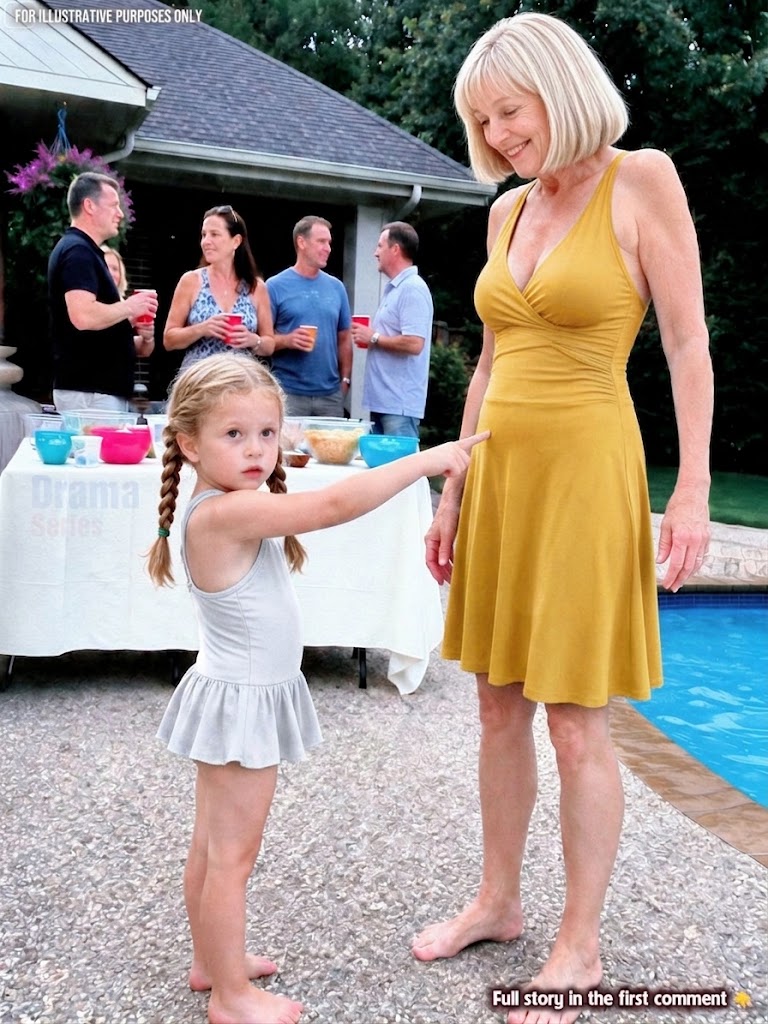
Ariel was running past with two friends when she stopped so abruptly that the children behind her nearly collided with her. She stared at Clara, then pointed directly at her stomach.
“Mommy!” she shouted. “Daddy’s in there!”
For one silent second, no one understood what she meant. Then laughter burst across the patio.
My father nearly spilled his drink. Glen lifted both hands beside the grill. “I would like everyone to know that I am definitely over here.”
I laughed too, embarrassed by the attention. Clara looked down at herself and then at me with a strained smile, as though we should simply accept that three-year-olds said strange things.
I hurried toward Ariel and crouched beside her. “Sweetheart, we don’t point at people’s bodies.”
“But Daddy is in there.” Her voice held no humor.
I pointed toward Glen. “Daddy is standing by the grill.”
He waved his tongs. “Right here, birthday bug.”
Ariel glanced at him, then turned back toward Clara. Her small face collapsed.
“No,” she whispered. “Daddy’s in there.”
Tears filled her eyes. This was not the dramatic crying she used when she wanted another cookie or refused to take a nap. She looked frightened and frustrated, as though she had discovered something important and none of us believed her.
She grabbed my wrist. “Come look, Mommy.”
Clara stepped out of the pool and reached for a towel. “Helen, she’s only three. She’s confused.”
“I’m not confused!” Ariel cried. She pulled me closer. “Look where I’m pointing.”
So I did. And in that moment, the laughter died inside me.
Part 2: The Crooked Sun
At first, I saw only Clara’s swimsuit and the pale skin exposed by the opening near her ribs. Then she shifted as she wrapped the towel around herself.
A faded line of blue-gray ink appeared beneath the edge of the fabric. It was part of an old tattoo.
I stepped closer. The image showed a narrow lighthouse rising above curling waves. Time had softened the ink, but the design was still clear. Beside the lighthouse was a tiny sun—nothing more than a circle with seven uneven rays, two dots for eyes, and a crooked smile.
My breath stopped. I knew that sun.
Glen drew it everywhere. He sketched it in the corners of grocery lists, added it to birthday cards, and drew it on napkins when Ariel became restless at restaurants. Every morning when he packed her lunch for preschool, he placed a small note inside featuring that same smiling sun: seven rays, two eyes, one crooked mouth. I had seen it hundreds—perhaps thousands—of times.
I stood so quickly that Ariel stumbled backward. “Glen.”
Something in my voice silenced the yard. He lowered the grill lid and walked toward me, wiping his hands on a dish towel. “What is it?”
I pointed toward Clara’s side. “Why is your drawing tattooed on her body?”
Glen followed my finger, and the towel slipped from his hand. Clara stared at him as the color vanished from his face.
For one long moment, neither of them spoke. Around us, the party seemed to freeze. My aunt stopped gathering paper plates, my father sat upright beneath the umbrella, and someone turned down the music.
Glen swallowed. “Please let me explain.”
My stomach tightened. “Explain what?”
Clara pulled the towel firmly around her waist. “I don’t know what you’re imagining, Helen, but—”
“What I’m imagining?” My voice sharpened. “My daughter recognized my husband’s personal drawing on your skin.”
Ariel stood beside me, still pointing. “Daddy makes the happy sun.”
Glen knelt and rested a hand gently on her shoulder. “You’re right,” he said.
A murmur moved through the guests as I stared at him. “How could you possibly know about that tattoo?”
Glen looked at Clara, searching her face. “Years before I met you, I volunteered at an arts center downtown.”
“I know about the arts center.” He had told me that part when we were dating, describing painting community murals and teaching weekend art classes. He had never mentioned Clara.
“There was another program there,” he continued. “It was for people recovering from major medical procedures. Local artists helped them design images that could be placed over or around their scars.”
Clara’s expression shifted. “The building on Willow Street?”
Glen looked startled. “You remember it?”
“Not clearly.” She touched the place beneath the towel. “I remember a large community room. Paint-stained tables. The smell of coffee. A young man with blue paint on his hands.”
Glen slowly opened his palms. “I always had paint on my hands back then.”
My father came closer. “You two met before either of you knew Helen?”
Clara shook her head, still looking stunned. “We didn’t know each other. It was one afternoon, almost twenty years ago.”
Glen nodded. “I was twenty-one. People came and went from the program every week. I usually didn’t learn their full names.”
Clara closed her eyes, seeming to disappear into a memory none of us had ever known. “I had recently undergone surgery,” she said, her voice so quiet that we all leaned closer. “The doctors removed a tumor.”
My father’s face changed. “You never told me that.”
“I told you I’d had surgery years before we met.”
“You never told me why.”
Clara looked at him. “I didn’t want the worst chapter of my life to become the first thing people knew about me.” Her words carried no anger, only exhaustion. “The surgery left a scar across my side. I was grateful to be alive, but every time I saw the scar, I remembered the fear—the appointments, the waiting, the possibility that I might not have much time left. I stopped looking at myself in mirrors.”
Glen rubbed his thumb across his palm. “One Saturday, the instructor asked each of us to create an image representing hope. Clara—although I didn’t know her name—asked for something that didn’t pretend the storm had never happened.”
Clara touched the lighthouse. “You drew this.”
“I did.”
“Why a lighthouse?”
Glen looked at the faded image. “Because a lighthouse doesn’t stop the storm. It doesn’t erase the waves or silence the wind. It simply keeps shining through them.”
Clara’s lips trembled. “And the sun?”
Ariel asked the question before anyone else could, and Glen gave her a small, emotional smile. “I drew that little sun on everything, even then. It was my way of saying that darkness doesn’t last forever.”
Clara loosened the towel slightly. Beneath the lighthouse, almost hidden along the edge of her swimsuit, two faded words followed the line of her scar: Still Standing.
My father sat down heavily on the nearest chair.
The truth settled among us piece by piece: Glen had been a young volunteer, and Clara had used her maiden name. Years later, she married my father, long after Glen had moved to another city, changed his appearance, and eventually met me. Neither of them had recognized the other across the two decades that had passed—until a three-year-old noticed a crooked smiling sun.
Ariel reached toward Clara. “Can I touch the lighthouse?”
Clara hesitated, then nodded. Ariel placed one finger carefully on the tattoo. “Daddy made your hurt pretty.”
Tears gathered in Clara’s eyes. “He helped me see it differently.”
“You kept it all this time,” Ariel added.
Clara had kept the reminder that she had survived. Suddenly, I was no longer looking at the woman who had replaced my mother, but at someone who had once been terrified of losing her life—someone who had allowed a stranger to draw hope over the place where fear had left its mark.
Part 3: The Distance Between Us
I looked at Clara across the pool deck. “Then why have you always hated me?”
She flinched as though I had struck her. My father said my name in warning, but Clara raised one hand. “No,” she whispered. “She deserves an answer.”
I folded my arms. “You’ve barely spoken to me for fifteen years. You missed birthdays, left family dinners early, and acted as though being near me made you uncomfortable.”
Clara’s face crumpled. “I never hated you, Helen. I was afraid of you.”
“Afraid of me?”
She nodded. “Not because you were cruel. Because I didn’t know how to love you without making everything worse. Your mother had been gone only two years when I married your father. Her photographs were in every room, her handwriting was on recipe cards in the kitchen, and you wore her green sweater even in warm weather.”
The memory came back so clearly—the heavy wool with sleeves too long, pulled over my hands because it still smelled faintly like my mother.
Clara continued. “I could see how much you loved her and how much you were hurting. I thought that if I tried to become close to you, you would think I was attempting to replace her. But if I stayed away, I was afraid you would believe I didn’t care.”
“So you chose to do nothing.”
“I chose distance because I convinced myself it was respectful. At first, I believed I was giving you room to grieve. Then months became years, and every attempt to reach you felt more awkward than the one before. Eventually, I no longer knew how to cross the space between us.”
Her answer was not an excuse; she was admitting that fear had made her passive.
I began remembering the past differently. Every Christmas, Clara had wrapped my gifts in plain brown paper because that was how my mother had wrapped them. She baked cinnamon rolls using the handwritten recipe taped inside the cabinet, but never called them her cinnamon rolls. My childhood drawings still hung in the upstairs hallway because she had dusted their frames for years without ever replacing them. At my graduation, she had stood at the far edge of every photograph—not out of coldness, but out of fear of taking a place that did not belong to her.
I had interpreted every backward step as rejection, but perhaps they were hesitations. Perhaps I had spent years stepping backward, too.
Ariel wandered over and climbed directly into Clara’s lap. Clara froze, her arms suspended in the air until I gave her a small nod. She wrapped one arm around Ariel, who leaned against her chest and pointed at the tattoo again.
“Does the lighthouse still work?” Ariel asked.
“It isn’t a real lighthouse, sweetheart.”
“I know. I mean, does the hope still work?”
Clara looked at me over Ariel’s head, her eyes filling again. “Yes. I think it does.”
Something inside me gave way—not with a sudden rush of forgiveness, but with a loosening of the anger I had carried. I realized Clara and I had been standing on opposite sides of the same loss, both afraid that moving closer would betray my mother.
The party slowly came back to life. Glen returned to the grill, my father brought Clara a fresh towel, and Ariel spent the rest of the afternoon drawing smiling suns on paper cups, napkins, and my father’s arm. For once, Clara did not stand at the edge.
Part 4: Still Standing
By sunset, the last guests had gone home. Deflated balloons dragged gently against the fence, wrapping paper filled the recycling bin, and the pink sandal had finally been rescued from the pool.
Ariel sat on the patio with a box of sidewalk chalk, humming as she drew. Glen was inside cleaning the kitchen, and my father had gone to gather Clara’s belongings.
I found Clara sitting alone at the side of the pool, her feet in the water as evening light reflected across her face. I sat down beside her.
“I really thought something terrible was happening,” I said softly. “When I saw Glen’s sun, I thought that tattoo was hiding a secret that could destroy my family.”
I reached out, touching the edge of the faint design. “But it was hiding something else—the reason you survived long enough to become part of this family.”
Clara covered my hand with hers, her fingers cool from the water. “I’m sorry I made you feel unwanted.”
“I’m sorry I spent so many years believing the worst without ever asking what you were afraid of.”
She shook her head. “You were young. You had lost your mother.”
“So had Dad. And you walked into a family that was still grieving.”
“I never wanted her place, Helen.”
“I know that now.”
Across the patio, Ariel called out to show us her large chalk drawing: pink waves, a crooked lighthouse with a bright yellow sun, and four figures inside—Mommy, Grandma Clara, Ariel, and Daddy cooking at the grill.
Glen appeared in the doorway. “I hope chalk Daddy is better at grilling.”
“He burned the hot dogs,” Ariel announced, making Clara laugh without hesitation.
For fifteen years, Clara and I had lived inside the same family while guarding ourselves from one another. She had been afraid that stepping closer would erase my mother, and I had been afraid that accepting her would mean letting my mother go.
Neither fear was true. Love was not a chair that only one person could occupy; there was room for memory, room for grief, and room for someone new to stand beside us without replacing anyone who had come before.
As the final sunlight touched the patio, Ariel drew seven crooked rays around the chalk sun, just like Glen always did. Clara leaned her head against my shoulder. The door between us had finally opened—and all it had taken was a little girl pointing at a faded mark and insisting that we look closely enough to understand what it really meant.