Part 2: Forty Minutes
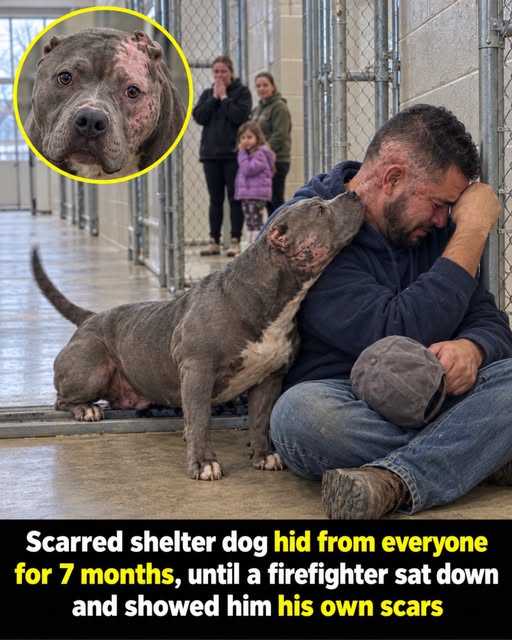
The left side of the man’s head was covered in scars.
They stretched from the top of his scalp, down across the place where his left ear had once been, and continued along the side of his neck before disappearing beneath the collar of his hoodie. The skin was smooth, glossy, and unevenly colored, a mixture of pink and pale patches pulled tight, where no hair would ever grow again. Almost his entire left ear was missing. Only a small, folded remnant of scar tissue remained.
Denise instinctively covered her mouth with her hand before she could stop herself.
The man noticed. His shoulders stiffened. But he didn’t reach for his cap or try to cover his head again.
He simply remained seated on the concrete floor with his back against Kennel 14. He didn’t speak or move. His scarred head hung forward, and his hands rested loosely on his knees.
He didn’t call out to the dog. He didn’t reach through the gate. Not a single sound escaped his lips.
Denise had no idea what she should do. In the end, she quietly stepped away and stood beside the wall.
Five minutes went by.
Then ten.
Ash remained pressed into the corner of his kennel. But Denise noticed a small difference. His eyes were open now. They weren’t squeezed shut as they usually were. They were open, watching the back of the man’s head.
Fifteen minutes passed.
Then twenty.
Other employees gradually gathered at the far end of the hallway. Kev, the kennel technician, appeared, followed by Jasmine from the reception desk. They stood at a distance, whispering among themselves, until Denise raised her hand and signaled for silence.
Mia and her mother had also walked around the corner. Mia held a picture book against her chest. She stopped when she noticed the man sitting on the floor and stared at the scars covering his head and neck.
Her mother rested a hand on her shoulder. Mia remained perfectly still.
Twenty-five minutes.
Thirty.
The man hadn’t moved once. He hadn’t scratched his nose or adjusted his position. He simply sat with his scarred head lowered, as motionless as someone quietly praying in church.
Gradually, Denise began to understand what she was witnessing.
For seven months, everyone who passed Kennel 14 had reacted in exactly the same way. They stopped and stared at Ash’s face. They recoiled. They whispered things like, “Poor thing,” or “He looks frightening,” or “What happened to him?” Then they continued on their way.
Every single person.
Ash hadn’t retreated into the corner because he was aggressive or beyond help. He had turned his face toward the wall because experience had taught him what people did whenever they saw him.
He felt ashamed of himself.
And this man sitting outside his kennel had done something nobody else had ever thought to do.
He had revealed his own face to Ash first. Then he had turned away, allowing the dog to look at him without having to endure someone staring back at him.
Thirty-five minutes passed.
In the far corner of Kennel 14, Ash slowly rose to his feet.
Everyone standing at the end of the hallway held their breath.
The gray dog took a tentative step away from the corner, then stopped. His entire body trembled. The small, scarred remnants of his ears twitched.
He moved forward again.
Then he took another step.
Keeping himself low to the ground, his belly nearly grazing the concrete, Ash cautiously crossed his kennel toward the gate. He was moving toward the man sitting on the other side with his back turned.
He stopped directly in front of the gate.
Denise glanced at the man. He remained still, but she could now see his shoulders trembling ever so slightly.
Exactly forty minutes after sitting down, the man slowly reached behind himself without turning around and carefully released the gate latch.
The gate swung open a few inches.
Ash stared at the opening. Then he looked at the scarred back of the man’s head.
And then the dog nobody had been able to touch in seven months stepped through the gate and approached him from behind.
He gently pressed his nose against the scars on the man’s neck.
Part 3: The Shed
For a long time, Ash continued sniffing the scars along the man’s neck.
His breaths were slow and deep. His nose traced the shiny skin, moved over the damaged edge of the man’s ear, and followed the scars down toward his collar. The man remained completely motionless, his eyes closed, while tears silently rolled down his cheeks.
Then Ash licked him.
Once, softly, directly across the worst of the scars, where the skin beneath his jaw had been pulled tight.
Then he did it again.
At the far end of the hallway, someone suddenly began sobbing. It was Jasmine from the reception desk. Kev wiped his eyes with his sleeve, while Mia’s mother covered her mouth with both hands.
Then Denise noticed something else.
His tail.
Ash’s thin gray tail had hung limply between his legs every day for seven months. Now, it slowly lifted away from the floor.
And began to move.
From side to side. Slowly at first, then with increasing speed.
He was wagging his tail.
Denise Howell had spent nineteen years working with some of the most traumatized dogs in Ohio. She could count on one hand the number of times she had cried at work. Now, she slid down the cinderblock wall and sat on the floor, burying her face in her hands.
At last, the man turned around.
Ash didn’t retreat or recoil. He stood directly in front of him, their scarred left sides almost touching, and gazed straight into the man’s eyes.
For once, he didn’t turn his face away.
“Hey, buddy,” the man whispered, his voice trembling. “Hey. I understand. I understand.”
Ash moved closer and buried his scarred face against the man’s chest.
The man folded his arms around him.
A long time passed before anyone in the hallway found the words to speak.
“Who are you?” Denise finally asked in a quiet voice, still seated on the floor.
The man wiped his tears away. “Luis,” he replied. “Luis Navarro.”
“How did you know to do that?”
Luis looked down at the dog leaning against him.
“Because I’ve spent the last four years doing the same thing,” he answered. “Facing the wall.”
Later, inside her office, Denise closed the door. Ash lay across Luis’s feet beneath the desk as she took the file from the raid out of a drawer.
“I think you should know how he got those burns,” she said softly.
Luis waited for her to continue.
“The dogfighting operation was on an old farm property off Route 16, east of Columbus. Last March, the sheriff’s office obtained a warrant and raided the place.” Denise glanced down at the report. “When the owner saw the deputies approaching, he doused the rear shed where the dogs were kept with gasoline and set it on fire. He wanted to destroy the evidence. He wanted to destroy the dogs, too.”
Luis’s jaw clenched.
“The deputies forced their way through the door. The shed was filled with smoke, and most of the dogs were chained to the walls.” Denise’s voice faltered. “They discovered Ash in the back corner. He wasn’t chained anymore. He had managed to break free and was lying on top of three puppies, shielding them with his body. They weren’t even his puppies. They belonged to a female dog who had died.”
Luis stared at her in disbelief.
“The left side of his face was on fire,” Denise continued. “But he refused to move. All three puppies survived without a single injury.”
Silence filled the office.
Luis lowered his gaze to the gray dog resting across his feet. He looked at the smooth, pink, hairless scars covering the left side of Ash’s face.
Then he touched the scars on the left side of his own neck.
“He went into a fire to save babies that weren’t even his,” Luis whispered.
Denise nodded. “And afterward, he spent seven months hiding in a corner because people believed he looked like a monster.”
Luis covered his face with both hands.
“Mr. Navarro,” Denise asked gently, “what brought you here today?”
Luis drew in a long, unsteady breath.
“My therapist,” he explained. “Dr. Moss. She told me I should try finding a friend who wouldn’t judge me.” He gave a weak, humorless laugh. “I haven’t stepped outside my apartment except for medical appointments in two years. I don’t go to the grocery store or church. I don’t go anywhere. Everything gets delivered to my door. My blinds stay shut.” He shook his head. “Today was the first time I’d entered a room full of strangers in years.”
Denise studied him quietly for a moment.
“Are you thinking about adopting him?” she asked.
Luis remained silent for a long while.
Finally, he stood, and Ash rose beside him.
“I can’t,” Luis said, his voice breaking. “I’m sorry. I just can’t even look after myself.”
He put his cap back on, pulled his hood over his head, and walked out without looking behind him.
In the hallway, Ash hurried to the front window and pressed his scarred face against the glass, watching the man disappear.
And for the first time anyone at the shelter could remember, the silent dog began to cry.
Part 4: Cleveland Avenue
Luis Navarro didn’t get any sleep that night.
He sat alone on his apartment couch in the darkness, with the blinds drawn and the television switched off, unable to stop thinking about a gray dog pressing his face against a window.
Four years earlier, Luis had been a firefighter with the Columbus Division of Fire, assigned to Station 18. He had served for eleven years and loved every part of the job. He loved his fellow firefighters, the trucks, and visiting elementary schools for fire safety programs, where children could try on his helmet.
Then came the night of February 11.
An apartment building on Cleveland Avenue was burning. The three-story structure was old, and thick smoke poured from every window on the second floor. Outside, a woman screamed that her five-year-old daughter was still trapped inside, in the back bedroom.
Luis went in.
He discovered the little girl curled beneath her bed, coughing and terrified, clutching a stuffed rabbit. He wrapped her in his coat and lifted her into his arms. He was halfway down the hallway when the ceiling collapsed.
He remembered twisting his body so that the falling, burning debris struck his back and the left side of his head instead of hitting the little girl.
He remembered the agony.
After that, everything went black.
When he regained consciousness three weeks later in the burn unit at Ohio State, the doctors gave him two pieces of news.
The little girl had survived. She had a minor burn on her hand, but otherwise she was unharmed.
He, however, would need eleven surgeries.
The following year became a blur of skin grafts, pressure garments, physical therapy, and learning how to turn his neck again. The city awarded him a medal, but he never attended the ceremony.
The second year proved even harder.
The first time Luis ventured into a grocery store after his surgeries, a little boy spotted him in the cereal aisle and screamed. The boy’s mother grabbed him and hurried away without saying a word. Other shoppers stared. Some quickly turned their heads. Others whispered to one another.
Luis returned home and never went back.
His fiancée, Cristina, tried her best to help him. She truly did. But he refused to leave the apartment, refused to let her see him without his hood, and refused to let anyone else see him either. After a year, she moved out. He couldn’t blame her.
The fire department placed him on permanent medical leave. They repeatedly offered him desk work, public education duties, and fire safety presentations. Each time, he turned them down.
Two years passed with the blinds closed and his hood pulled up.
Then, the previous Tuesday, his therapist, Dr. Rachel Moss, leaned across her desk and told him, “Luis, you need a friend who won’t look at you the way you imagine everyone else does. Perhaps a dog.”
On Sunday morning, someone knocked on Luis’s apartment door.
He ignored it. He never answered the door.
A second knock followed.
“Mr. Navarro?” a young voice called from the hallway. “It’s Mia. I met you at the shelter yesterday. I’m the girl who had the books.”
Luis froze on the couch.
“My mom is here with me, too,” she continued. “Denise gave us your address. Please, I really need to tell you something.”
Luis slowly rose to his feet. After pulling up his hood, he approached the door and opened it just a few inches.
Mia stood in the hallway wearing a purple coat, holding her mother’s hand. She was nine years old, with dark hair neatly divided into two braids.
She looked up at him without flinching.
“You didn’t recognize me,” Mia said. “And I didn’t recognize you, either. Not until you took your hat off.”
She pulled back the sleeve of her coat and extended her left hand.
A small, faded pink scar marked the back of it.
“You carried me out from under my bed,” Mia told him. “On Cleveland Avenue, when I was five. I was holding my stuffed bunny.”
Luis clutched the doorframe. He struggled to breathe.
Mia’s mother, Grace Chen, was a petite woman with tired eyes, and tears were streaming down her face.
“We’ve spent four years trying to find you,” Grace explained. “We wanted to thank you. The fire department told us you didn’t want visitors. We sent letters, and we even attended the medal ceremony, but you never showed up.” Her voice cracked. “Every February 11, Mia draws a picture of you. We’ve kept all four of them at home.”
Luis slowly slid down the doorframe until he was sitting on the floor of his apartment.
Mia knelt in front of him in the hallway.
“I visit Ash every Saturday to read to him,” she said softly. “He hides his face, just like I used to hide my hand.” She lowered her sleeve, then deliberately pushed it back up again. “I thought that if someone sat beside him without staring at him, maybe he would feel safe enough to come out.”
She lifted her eyes toward Luis.
“He came out for you,” she whispered. “He’s never done that for anyone else.”
Luis buried his face in his hands.
“Mr. Navarro,” Mia continued, “they’re putting him on the bad list this Friday. Denise told me that if nobody adopts him by then, they’ll send him away. Or something worse.” Her chin began to tremble. “Please. You saved me. Could you save him, too?”
Luis looked at the little girl before him. He looked at the small pink scar on her hand and the face of the child he had carried out of a burning building four years earlier, the very child whose rescue had been followed by two years of hiding from the world.
She was looking at him without fear.
“Okay,” he whispered.
Part 5: The Board
But things weren’t going to be that simple.
On Monday morning, Luis returned to Columbus Humane Rescue with his hood pulled up and sunglasses covering his eyes. He filled out the adoption application.
Ash was already waiting beside his kennel gate before Luis had even reached the end of the hallway. His tail spun in excited circles. He no longer tried to hide his face. Instead, he pressed it directly against the chain-link fence.
But Denise looked troubled.
“I need to be completely honest with you, Luis,” she explained in her office. “Ash was rescued from an illegal dogfighting operation. There’s a bite incident in his file. During the raid, he nipped a deputy who was trying to pull him away from the puppies.” She let out a sigh. “According to our policy, dogs with that kind of history can only be placed with experienced handlers. They must pass a behavioral assessment, a home inspection, and receive approval from the entire board.”
“Fine. I’ll go through all of it.”
“The home inspection requires a properly secured, fenced yard,” Denise said softly. “You’re living in an apartment.”
Luis looked at her without speaking.
“And Friday’s board meeting is open to the public,” she continued. “It takes place in the community room. You’ll need to appear in person and explain your application before the board and anyone else who attends.” She paused. “Occasionally, the local news shows up, too.”
Luis felt a tightness spreading through his chest.
A room packed with strangers. All of them watching him.
He returned home and sat alone in the darkness.
He contacted his landlord about getting a yard. The answer was no. He called three rental properties with fenced yards. One refused to accept pit bulls. The other two required a credit check and the first and last months’ rent, money he simply didn’t have.
On Wednesday, the shelter’s behavior specialist conducted her assessment. Ash behaved beautifully around Luis. He was relaxed and affectionate, leaning against his legs without hesitation. But when an unfamiliar person reached toward him, he immediately retreated into the corner and turned his face toward the wall.
“He’s formed a strong attachment to you,” the behaviorist explained. “A very deep one. But he’s still frightened of everybody else.” She made a note on her clipboard. “I’ll need to include that in my report.”
On Thursday evening, Luis sat on his couch, staring at the address of the shelter’s community room on its website.
Seven o’clock the following evening. A public meeting.
He pictured himself entering the room. A dozen strangers seated on folding chairs. Board members gathered behind a long table. Perhaps a television camera waiting nearby. Every person turning toward him as he stepped through the doorway, staring at his face, his neck, and his missing ear.
He remembered the little boy screaming in the cereal aisle.
His hands began trembling. Soon, his entire body was shaking. He struggled to draw breath. Before long, he was lying on the floor with his back against the couch, gasping for air and sweating, his heart pounding so violently that he feared it might burst through his ribs.
Forty minutes passed before the panic attack finally subsided.
When he could think clearly again, he remained on the floor in the darkness, and the truth became impossible to ignore.
He couldn’t face it.
He picked up his phone and sent Denise a message.
I’m sorry. I can’t come tomorrow. I can’t face that room. Please tell Mia I’m sorry.
He switched off his phone and lay down on the floor.
At seven o’clock on Friday evening, the Columbus Humane Rescue board gathered around a long folding table in the shelter’s community room.
The chairman, Harold Gaines, a retired school principal, reviewed the agenda.
“Item four,” he announced. “Kennel 14. Ash. Staff recommendation for unadoptable status and transfer.” He raised his eyes from the page. “I understand someone had applied to adopt him?”
Denise slowly rose from her seat along the side of the room. Her eyes were swollen and red.
“He withdrew his application,” she answered quietly. “This afternoon.”
Harold Gaines gave a solemn nod and picked up his pen.
“In that case, I’ll accept a motion,” he said, “to approve the staff’s recommendation.”
At the far end of the shelter, inside Kennel 14, the gray dog sat beside his gate, gazing down the deserted hallway toward the entrance.
His tail no longer moved.
Part 6: The Door
“I second that motion,” one of the board members said.
“All those in favor?” Harold Gaines asked.
Three hands rose around the table.
Suddenly, the community room door slammed open.
Every person turned toward the entrance.
Mia Chen stepped inside first, wearing her purple coat and struggling to catch her breath. She was pulling someone along by the hand.
Standing behind her in the doorway was Luis Navarro.
His hood was down. His cap was gone. He wasn’t wearing sunglasses.
Under the bright fluorescent lights, his scarred head was completely exposed. His damaged left ear, the taut, glossy skin extending down his neck, every visible mark of the fire—all of it was uncovered in front of a room full of strangers.
Twenty people turned in their folding chairs to stare at him.
Luis’s hands trembled beside his body. His face had turned ashen, and his chest rose and fell rapidly.
But he kept his head up.
“I’m sorry I’m late,” he said, his voice rough and unsteady. “I’m here about Kennel 14.”
Harold Gaines slowly lowered his raised hand.
“She showed up at my door,” Luis explained, gesturing toward Mia. “At six-thirty. She and her mother came over, and she kept knocking until I answered.” He gave a faint, almost disbelieving laugh. “She told me that if Ash could leave his corner for me, then I could leave mine for him.”
The entire room fell silent.
Luis walked toward the front. Each step seemed to require tremendous effort. He stopped before the long folding table, with twenty strangers behind him looking at the scars covering the back of his head.
“My name is Luis Navarro,” he began. “Four years ago, I worked as a firefighter at Station 18. I entered an apartment fire on Cleveland Avenue and carried a five-year-old girl out from beneath her bed.” He glanced over his shoulder at Mia. “That little girl.”
A low murmur spread through the audience.
“The ceiling collapsed on me while I was getting her out,” Luis continued. “These are the injuries it left behind.” He gestured toward his head and neck. “For the next two years, I stayed inside my apartment with the blinds drawn. I couldn’t bear the way people looked at me.”
He drew a trembling breath.
“Last Saturday, I came into this shelter and found a dog sitting in the corner with his face turned toward the wall. He’d learned to do that because of the way people treated him. They made him believe his face frightened them, that he needed to hide it.” His voice cracked. “I understood that dog. I had become that dog myself.”
Harold Gaines placed his pen on the table.
“You have requirements,” Luis continued. “A fenced yard. Experience handling dogs. I understand why those rules exist. I don’t have a yard, and I don’t have much else to offer.” He looked directly at the board members. “But that dog entered a burning shed and shielded three puppies that didn’t belong to him. He allowed the flames to destroy half his face rather than let those puppies get hurt. Then he spent seven months alone in a corner because people couldn’t bear to look at him.”
He swallowed, struggling to steady his voice.
“I did the same thing for a little girl who wasn’t mine. And afterward, I spent two years hiding in my own corner.”
Mia was crying in the front row. Her mother was crying, too. Denise stood nearby with tears running down her cheeks.
“I’m not asking you to hand me a dog,” Luis said softly. “I’m asking you to give us both a chance to stop hiding. Together.”
He remained standing before them, his scarred face uncovered.
Nobody spoke or moved.
Then Mia rose from her folding chair.
“He’s the only person Ash ever came out for,” she said, her voice trembling. “Nobody else. Not once in seven months. I was there. I watched it happen.”
She raised her left hand so everyone could see the small pink scar.
“And he’s the only person who ever carried me out of a fire,” she added.
Harold Gaines studied the little girl’s hand for a long moment. Then he looked at the firefighter standing before him.
He removed his reading glasses.
“Ms. Howell,” he asked quietly, “does our program allow a foster-to-adopt placement under staff supervision while Mr. Navarro works toward meeting the housing requirements?”
Denise wiped her tears away. “Yes, sir. We can arrange that.”
“I’m withdrawing my vote,” Harold announced. “I move that Mr. Navarro be approved as a foster-to-adopt placement for Kennel 14, effective tonight.”
“I second the motion,” the board member beside him said.
“All those in favor?”
Every hand around the table went up.
Twenty strangers rose from their folding chairs and began applauding.
Luis Navarro stood at the front of the room, his scarred face uncovered and wet with tears. For the first time in four years, he looked directly at the people around him without turning away.
Denise returned from the back of the shelter with Ash on a leash.
The gray dog entered a room filled with people and immediately stopped, startled by the crowd.
Then he spotted Luis.
He hurried across the room in three quick strides, his tail spinning wildly, and pressed his scarred face against Luis’s scarred neck in front of everyone.
Neither of them tried to hide.
Later that evening, Luis sat on the shelter steps with Ash’s head resting in his lap. He finally shared something with Mia and her mother that he had never told another person.
“The Thursday before I ever came to this shelter, I’d already written my resignation letter to the fire department,” he admitted quietly. “I planned to mail it on Monday. Walk away for good. Move somewhere nobody knew who I was. Keep the blinds shut for the rest of my life.”
He lowered his eyes toward the dog.
“Everyone will probably say I rescued him,” Luis said. “But he was the one who found the courage to leave his corner first.”
Part 7: Partner
Luis gave him the name Partner.
That was what firefighters called one another. The person who entered the danger zone beside you. The person you never abandoned.
When the rescue’s donors learned their story, they responded. A retired contractor built a six-foot fence around the small yard of a rental house Luis located two weeks later. He did the work without charging a penny. Luis passed the home inspection, and in December, the adoption became official.
Every morning at seven, Luis and Partner walk the same loop around Schiller Park in German Village.
No hood. No cap. No sunglasses.
People still glance at them occasionally. Some continue to stare. But Luis no longer lowers his head, and Partner doesn’t turn his face away either. They simply carry on walking, two scarred faces held high, moving side by side.
In January, Luis contacted the Columbus Division of Fire and asked whether the public education position they had offered him for three years was still available.
They gave him the job the following day.
Today, twice every week, Luis Navarro visits elementary school gymnasiums throughout Columbus for fire safety programs, dressed in his formal uniform. Partner accompanies him, wearing a little red vest bearing the fire department’s name.
The children always fall silent when the pair enter the room.
Luis waits until everyone has settled down. Then he kneels beside the gray dog, whose ears are gone and whose face bears the marks of severe burns, and removes his cap.
And every time, he begins by telling the children the same thing:
“Scars don’t make anyone ugly. They’re simply proof of what someone has survived.”
Afterward, he allows the children to approach one at a time and gently stroke Partner’s fur.
The dog who once spent seven months hiding with his face against a cinderblock wall now sits in the center of a school gymnasium. His face is lifted, his eyes remain open, and his tail sweeps across the polished wooden floor as a long line of second graders reach out their little hands to touch the scars on his face.
Not once does he turn away from them.
Mia joins them whenever she can. She stands beside Luis and Partner at the front of the room, raising her left hand with its small pink scar so the children can see that one, too.
Three faces. Three scars. No one hiding anymore.
Whenever reporters ask Luis how everything began, he gives them the same answer.
He spent a long time sniffing the scar on my neck before gently licking it. I hadn’t appeared in public for two years because I was terrified of people staring at my face. It turned out that all I needed was someone who had survived the fire, too—someone who could look at me without fear.
If this story touched your heart, follow our page for more stories that remind us why dogs are among the best of us. ❤️