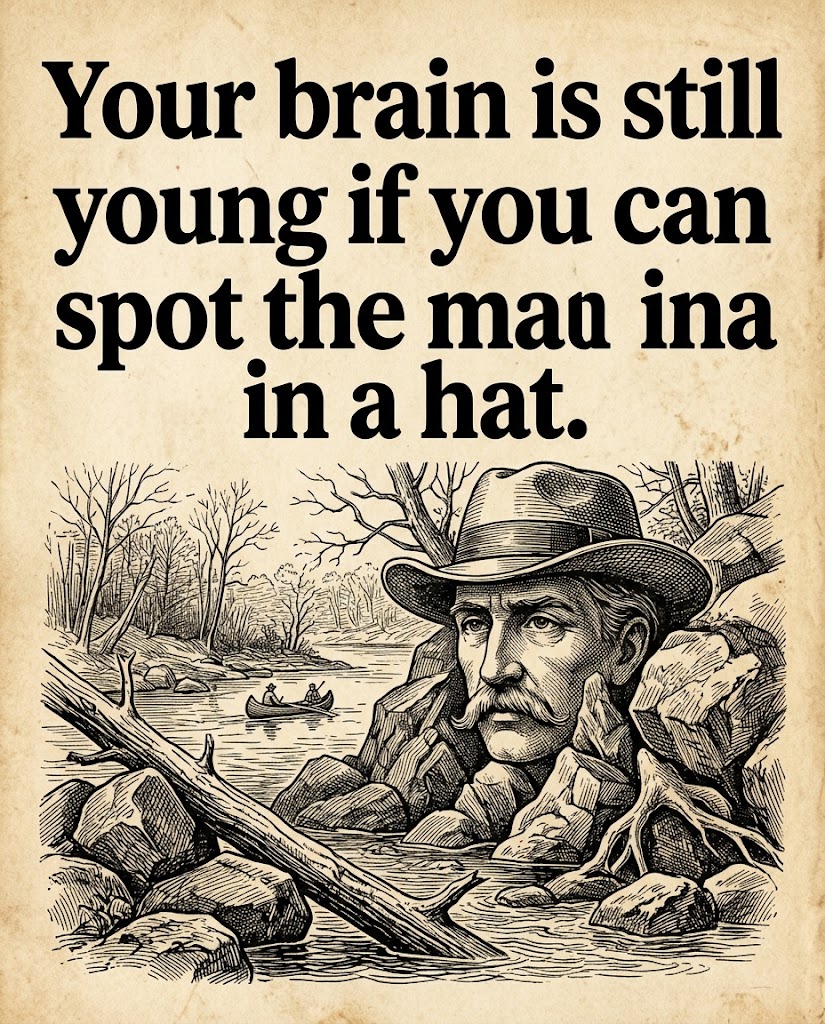
At first glance, this vintage illustration appears to capture a tranquil scene from a bygone era, featuring rugged rocks, fallen tree trunks, scattered trees, and calm water extending into the distance. A small canoe with two people aboard moves gently across the water, making the image look like an ordinary countryside painting. However, an unexpected detail is concealed within the scene, and many people fail to notice it during their first attempt. Hidden among the shadows, rocky contours, and unusual formations is the face of a man wearing a hat. The challenge is to identify his facial features without assuming that the landscape is all there is to see. Some people suggest that finding him quickly indicates a younger brain, but this puzzle is actually a fun exercise in visual perception, not a scientifically established way to measure brain age.
The secret is that the man’s face does not appear as a separate figure positioned among the rocks. Instead, the artist cleverly incorporates elements of the landscape to create the illusion, using shadows and curved shapes to outline a forehead, nose, cheeks, jaw, and hat. At first, your brain focuses on recognizable objects such as trees and stones before considering another possible interpretation. This instinctive tendency to identify familiar forms in unclear images is called pareidolia. It also explains why people sometimes see faces in clouds or discover patterns resembling faces in tree bark. If the hidden figure remains difficult to find, try viewing the illustration from a greater distance. You may realize that the secret does not lie within a single rock but in how multiple shapes combine to create the image.
To increase your chances of finding the face, avoid focusing on every tiny detail and pay attention to the illustration as a whole. Slightly squinting your eyes might help reduce distracting textures and make the larger outlines easier to recognize. Remember to examine the spaces between the rocks as well, since these gaps may contribute essential parts of the man’s facial features. A dark area might resemble an eye socket, whereas a lighter patch could outline his cheek or the bridge of his nose. Another technique is to turn the picture upside down briefly and then return it to its original position. Changing your perspective in this way may disrupt your initial interpretation and help you recognize shapes you previously missed. Nevertheless, this visual puzzle is not a substitute for a professional vision test or medical assessment, and it cannot determine your intelligence, cognitive condition, or biological age.
The greatest sense of satisfaction comes when the concealed face finally becomes visible within the landscape. All at once, the rocks and shadows appear to connect, transforming the picture into something far more intriguing than a peaceful countryside scene. Some people identify the man within seconds, while others require several attempts, but neither outcome should be considered a reflection of mental ability. The real pleasure lies in discovering how the same illustration can look completely different depending on how you interpret it. Take another look, pay close attention to the spaces separating the objects, and challenge yourself to uncover the hidden face. Once you finally recognize it, you might wonder how you could have overlooked something that seems so unmistakable in retrospect.