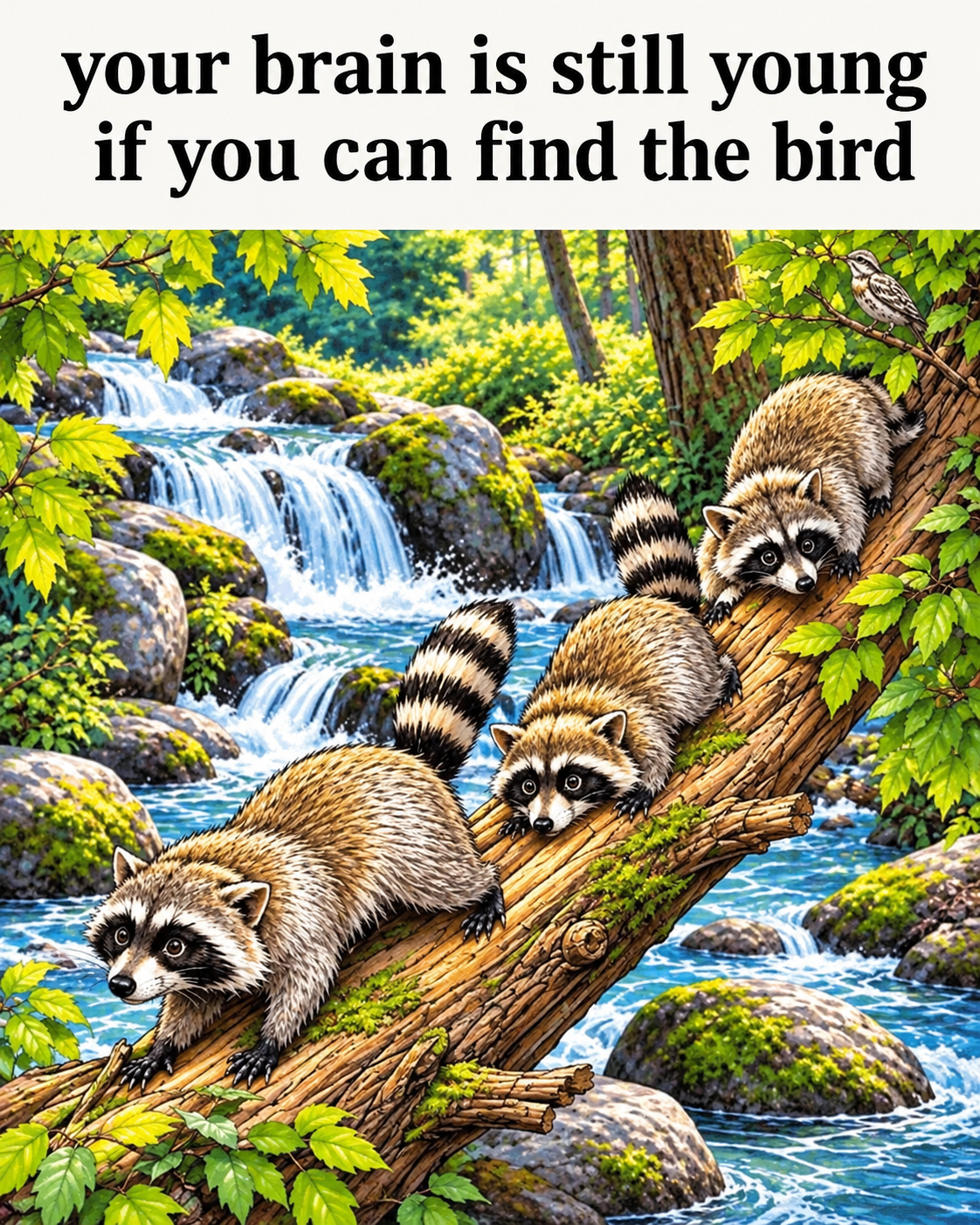
At first sight, this black-and-white woodland illustration appears fairly simple, showing raccoons wandering among trees, rocks, shadows, and a flowing stream. However, a bird has been skillfully hidden somewhere within the detailed scene. It isn’t placed in a clear, open area where you would instantly recognize it. Instead, the artist has carefully merged its shape with the surrounding environment through clever lines, shading, and overlapping patterns. This turns the puzzle into more than a quick visual search; it requires you to notice something that doesn’t quite belong. Even objects you recognize easily can distract you when the hidden figure is cleverly blended into the background.
One of the main reasons this challenge is difficult is that your brain instinctively looks for familiar shapes first. You might concentrate on the raccoons, tree trunks, stones, or flowing water and completely miss the unusual form hidden nearby. To increase your chances of finding it, avoid focusing exclusively on the middle of the image. Instead, examine the picture gradually from top to bottom, then sweep your attention from left to right. Pay special attention to narrow spaces, outlines, shadowy sections, and areas where different elements intersect. Another useful technique is to move away from your screen briefly and then look at the image again from a different distance. Sometimes, changing your perspective makes a concealed shape easier to identify. Just when you believe you have examined every part, a tiny detail might suddenly reveal something unexpected.
The secret is to avoid assuming that the concealed bird will resemble an ordinary bird. Because its form has been woven into the landscape, searching specifically for obvious wings, feathers, or a distinct silhouette might make the task even more challenging. Consider how you would approach a complicated document: a lawyer examining a contract, an insurance policy, a mortgage agreement, an investment statement, or an estate document cannot simply skim the most noticeable information and assume nothing important has been missed. Valuable details can be hidden in sections that initially appear unimportant. This visual puzzle follows a similar idea, rewarding patience and attention instead of speed. Some people might spot the bird within seconds, while others could spend several minutes searching before its hidden shape finally becomes recognizable.
After you discover the bird, the whole illustration may suddenly appear different because your eyes now understand which details matter. That sudden realization is what makes these visual puzzles so enjoyable: the solution may have been in plain sight all along, but your attention was focused elsewhere. Before deciding that you cannot solve it, study the darker sections, trace unusual patterns, and compare shapes that seem to merge into one another. If you still cannot find anything, pause for a moment and return to the image with a refreshed perspective. The purpose is not necessarily to solve the challenge faster than everyone else, but to develop your ability to notice details that might otherwise escape your attention. Take one more look at the forest, temporarily ignore the obvious animals and scenery, and challenge yourself to discover the cleverly hidden bird.