The most powerful form of self-care in 2026
The most powerful form of self-care in 2026 has nothing to do with a wellness app or a face mask.
Research published in the Journal of Happiness Studies found that just one act of kindness per day measurably reduces loneliness, lowers social stress, and improves personal happiness, with the effect growing stronger the longer the habit is maintained.
These real moments are proof that compassion is still the most underrated—and most effective—form of self-care, and that the people who practice it are often the happiest ones in the room.
1. My Teenage Daughter
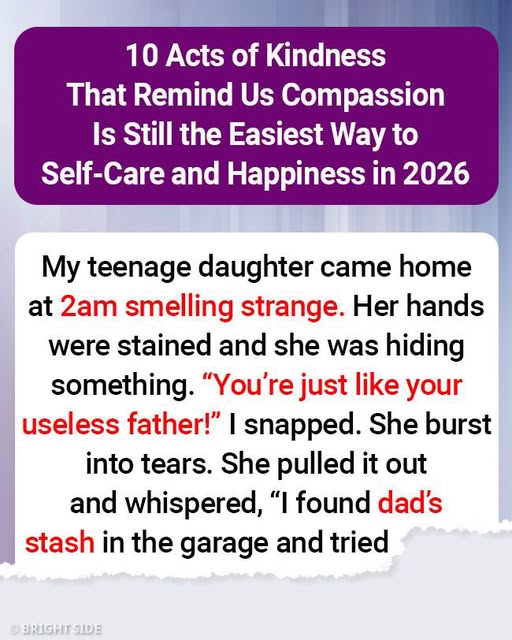
My teenage daughter came home at 2 a.m. smelling strange. Her hands were stained, and she was hiding something behind her back.
I was exhausted and scared, and I just lost it.
“You’re just like your useless father!”
She burst into tears.
Then she pulled her hand out from behind her back and whispered,
“I found Dad’s old tools in the garage. I’ve been selling them to Mr. Scavo next door. I saw the electric bill on the counter last week and tried to get some money.”
She opened her fist.
A small envelope of folded cash.
She had been doing this for weeks without telling me—getting up on weekends, negotiating with a 60-year-old neighbor, carrying something that was mine to carry the whole time.
I had just called her useless.
She put the envelope on the kitchen table, walked to her room, and closed the door.
She didn’t slam it, and that was somehow worse.
I sat at that table for a long time.
The next morning I came into work looking exactly like someone who hadn’t slept.
My colleague Sarah put a coffee on my desk and simply said,
“Whenever you’re ready.”
That was it.
Just that.
I told her everything at lunch.
I went home that evening, sat on my daughter’s bed, and told her she was the bravest person I knew.
2. The Friend Who Texted Every Morning
Going through chemotherapy last year, I had a friend who texted me every single morning.
Not “How are you feeling?” because she knew I was tired of that question.
Instead, she’d send a photo of a dog she had seen, a terrible joke, or a voice note of herself failing at a recipe.
She never asked for anything back.
She just showed up in my phone every morning like a reminder that the world outside my treatment was still turning.
On the day I finished my last round, she sent a voice note of herself crying and laughing at the same time.
She said,
“I’ve been saving this one.”
I still have it.
I listen to it on the hard days.
3. The Spin Class
Three weeks after my husband left, I signed up for a spin class because someone told me exercise would help.
About 15 minutes into class, I suddenly started crying.
The instructor caught my eye in the mirror, gave me the smallest nod, turned the music up louder, and kept teaching like nothing had happened.
She gave me cover.
She had seen me and decided the kindest thing she could do was make sure nobody else did.
I finished the class.
I’ve been going every Tuesday for eight months.
She has never mentioned it.
Neither have I.
4. The Pharmacist
Last year I picked up my anxiety medication.
The pharmacist, someone I’d seen maybe ten times before, handed it over and asked,
“Can I ask you something? How are you actually doing on this medication?”
Not as a clinical question.
As a human one.
I admitted I wasn’t sure it was working anymore.
She spent fifteen minutes asking questions my doctor had never asked.
Then she said,
“I think it’s worth going back to your GP with these specific points. I can write them down if that’s helpful.”
She wrote everything down.
I took that note to my doctor the following week.
My medication was adjusted.
The pharmacist did in fifteen minutes what eight months of appointments had not.
5. Saturday Morning Swims
Six months after my mother passed away, I had stopped doing almost everything that wasn’t strictly necessary.
A friend dragged me to an open-water swim at 6 a.m. because she said she needed company.
I stood at the edge of the freezing water with twenty strangers and jumped in.
The cold knocked every thought out of my head.
For thirty seconds there was no grief.
No guilt.
No replaying old conversations.
Just cold water and breathing.
A woman beside me asked,
“First time?”
I nodded.
She smiled.
“It gets easier after the first minute, and then you never want to stop.”
She was right.
I’ve been going every Saturday since.
For forty-five minutes every week, I’m just a person in cold water.
Nothing else.
6. The Wrong Meeting
Last year I got off the elevator on the wrong floor and accidentally walked into a meeting.
I started backing out.
The senior director smiled and said,
“Come in. Grab a seat. We’re just starting.”
It turned out to be a session about managing burnout.
I wasn’t supposed to be there.
But I sat through the hour and heard exactly what I needed.
At the end she laughed and said,
“Well, you needed to be here. So you were.”
I went back to my desk and booked a week of leave I’d been postponing for six months.
7. The Manager Who Said, “Go.”
I was a single mother with two kids, working the closing shift when my babysitter called.
She had to leave immediately.
I had three hours left and no backup plan.
My manager came over and quietly said,
“Go. I’ll cover your tables.”
I protested.
He replied,
“You didn’t ask. Go.”
That night he texted me,
“Tables are done. Your tips are in an envelope on your section. Good night.”
I’ve never worked harder for anyone since.
8. The Seat on the Train
Last winter I was on a crowded commuter train.
A man got on soaking wet from the rain.
There were no seats.
A woman sitting near the door stood up, placed her bag on the floor, and silently offered him her seat.
He tried to refuse.
She simply kept her hand on the seat and raised her eyebrows.
He finally sat down.
She stood for the next twenty minutes without complaint.
She didn’t make a scene.
She simply saw someone who needed kindness.
9. The Manager Who Took the Blame
My manager gave me incorrect information that caused a major mistake in a client report.
When the error came up during the meeting, she immediately said,
“That’s my fault. I gave incorrect information and should have checked it.”
Afterward she came to my desk and apologized.
She said,
“I’m sorry you were put in that position.”
She didn’t have to.
A lot of managers would have let the confusion remain.
She didn’t.
I’ve worked harder for her ever since.
10. “It’s Going to Be Okay.”
The morning after I was diagnosed with something serious, I went to work because I didn’t know what else to do.
I told nobody.
I sat at my desk staring at my screen.
A woman from another department stopped beside me and quietly said,
“I don’t know what’s going on, but you look like you need someone to tell you it’s going to be okay.”
I insisted I was fine.
She smiled.
“I know. I just wanted to say it anyway.”
Then she walked away.
She had no details.
No explanation.
Yet somehow she said exactly the right thing.
An hour later, I told my closest colleague the truth.
Sometimes all someone needs is for another person to open the door first