My son-in-law placed a sheet of notebook paper on the kitchen table. In the center, he had written a single number and circled it twice.
$800.
“That includes rent, utilities, and your portion of the groceries,” my daughter, Michelle, explained. “You’d also help with the children four days a week. It would make life easier for all of us, Mom.”
I stared at the paper, then looked at my daughter. At sixty-seven, I received $1,640 a month in Social Security benefits. If I paid $800, I would have just $840 remaining for car insurance, medical bills, gasoline, and all my other expenses.
The proposal was supposed to benefit everyone. Michelle and her husband needed financial assistance and childcare, while I needed a place to live. But something about the arrangement didn’t sit right with me. I wanted to be near my grandchildren, but I also wanted a home where I could live according to my own choices.
“Would you mind showing me the basement?” I asked.
Michelle took me downstairs. They had set up a bed, a little lamp, and a rug over the concrete floor. A dehumidifier buzzed quietly in the corner, and the only window was positioned high on the wall. The bathroom was upstairs, thirteen steps away.
“Grandma, are you going to live in the under?” my four-year-old granddaughter, Sadie, asked.
“We’ll see, sweetheart,” I replied with a smile.
Her innocent words stayed in my mind long after I left. I knew Michelle loved me, and I appreciated the effort she and Todd had put into preparing the space. Even so, I couldn’t help wondering whether living in their basement would change our relationship.
For most of my life, I had lived in homes that belonged to someone else. At nineteen, I married Dale, who worked on a farm south of town. His employer, Jim Olson, provided us with a small farmhouse, where we lived for thirty-one years. It wasn’t fancy, but it was where we raised our daughter, grew vegetables, celebrated birthdays, and created countless family memories.
Dale died two years ago. Since his job came with the farmhouse, Jim kindly allowed me to remain there after my husband’s death. Eventually, though, Jim’s son needed the property for his growing family. I understood his circumstances and agreed to find another place to live before November.
I was thankful for the Olsons’ generosity. They had always treated me like one of their own, and I wanted to show them the same consideration they had shown me.
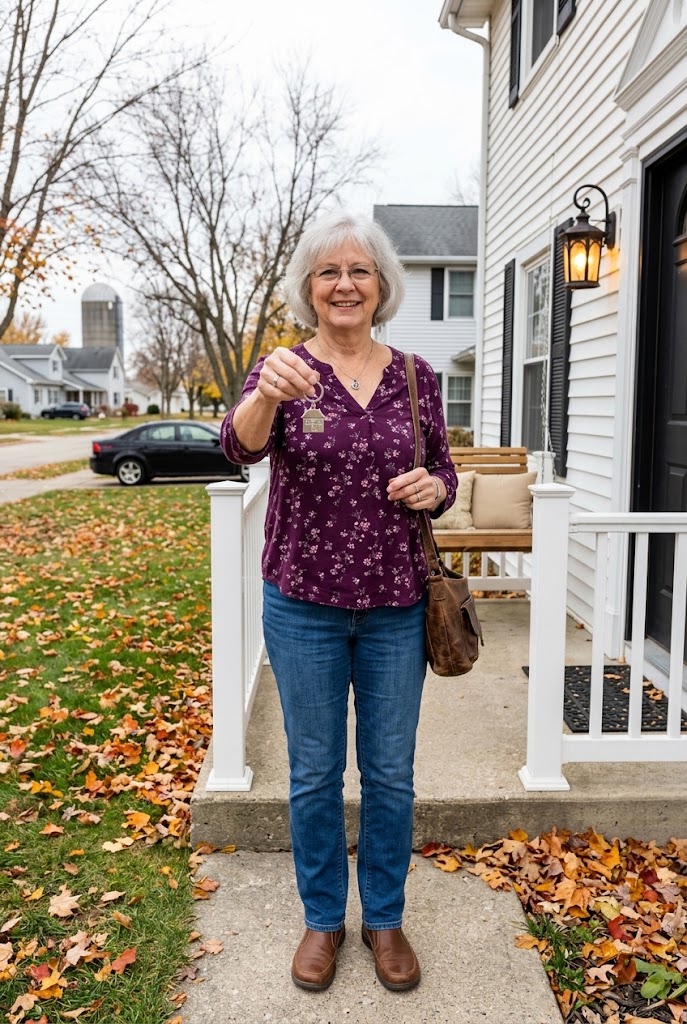
After leaving Michelle’s home, I drove around town, trying to decide what to do. That’s when I spotted a small white house near the grain elevator. It had a green roof, a tiny front porch, and a wooden swing suspended from two strong chains.
The owner, Mr. Brandt, was standing outside when I pulled over.
“Are you searching for a rental?” he asked.
“Possibly,” I answered.
He invited me inside for a look. The house was modest, with a kitchen and living room sharing one space, a single bedroom, and a bathroom with a grab bar beside the bathtub. There was enough room for my furniture, my sewing machine, and the old recliner Dale had always loved.
Through the kitchen window, I could see the grain elevator, where trucks came and went throughout the day. Mr. Brandt warned me that the machinery could get loud during harvest season and that passing trains sometimes made the windows shake at night.
“I’ve lived in a very quiet house for two years,” I told him. “A little noise won’t bother me.”
“What would the rent be?” I asked.
“Five hundred and fifty dollars monthly. You’ll pay for electricity and gas, and I’ll handle the roof and furnace.”
I immediately worked through the numbers in my head. With rent at $550, I would have $1,090 left from my Social Security check before paying utilities and my other bills.
The house was small, but it had its own entrance. More than anything, it offered something I had never really experienced as an adult: a home I had selected for myself.
“I’ll take it,” I told him.
Mr. Brandt placed two brass keys in my hand. I looked down at them, amazed at how meaningful such a simple gesture could feel. For the first time in my life, I had a home I could arrange however I wanted, no matter how small it was.
A few days later, I moved in with help from Jim and his son. Together, we carried my bed, sofa, kitchen table, four chairs, and several boxes of belongings inside. I put up my curtains, arranged my African violets beside the kitchen window, and placed Dale’s recliner near the heating stove.
That evening, I settled onto the porch swing and listened to the familiar sounds of the town. Trucks rumbled around the grain elevator, and a train passed during the night. When I woke the following morning, I felt more at home than I had expected.
There was just one problem: I hadn’t told Michelle that I had rented the house.
When she called to find out whether I had decided about her proposal, I told her I was still thinking it over. I knew I should have been truthful, but I feared that telling her what I had done would start an argument.
A little more than a week later, Todd spotted my Buick parked outside the small house. That evening, Michelle phoned me.
“You rented a house?” she asked.
“Yes,” I replied.
“And you’ve been living there for over a week without telling me?”
“I should have told you. I’m sorry I avoided talking about it.”
She was quiet for a moment before asking how much the rent cost.
“Five hundred and fifty dollars.”
“So you’d rather pay a landlord than live with us?”
“Michelle, I want to be your mother, not someone whose place in the family depends on a financial agreement. I want to spend time with you and the children, but I also need a home where I can live independently.”
She reminded me that she and Todd had prepared the basement and had already discussed childcare plans with their providers. I hadn’t understood how much preparation they had done, and I felt bad that I had left them waiting without a clear answer.
We finished the call without settling our differences.
For the next ten days, we hardly spoke. I missed my grandchildren, especially the little pictures Michelle normally sent me. Many evenings, I sat on my porch swing, wondering if I had made the right choice.
I hadn’t moved away because I wanted to distance myself from my family. I had moved because I wanted our time together to be based on love rather than obligation.
During those days, I started visiting Mr. Brandt’s store more often. One afternoon, I found him surrounded by receipts, invoices, and account books.
“My wife used to take care of all this,” he told me. “She was excellent with numbers. Since she passed away, I’ve had trouble keeping everything organized.”
I had worked as a bookkeeper at a lumber yard for twenty-two years, so I offered to help him sort things out.
Over the next three afternoons, I arranged his paperwork, fixed a few incorrect entries, and discovered several customer payments that hadn’t been entered into the records. By the time I finished, the accounts balanced, and I had uncovered more than $2,000 in outstanding charges that had never been billed.
Mr. Brandt was grateful.
“Would you consider helping me with the books every Friday?” he asked. “I can’t pay you a great deal, but I could lower your rent to $400 a month.”
I accepted. The arrangement worked well for both of us. He needed someone with bookkeeping skills, and I enjoyed having useful work to do again.
For the first time in months, I felt that my experience mattered in a way I had freely chosen.
Then, one Thursday evening, a familiar pickup truck pulled into my driveway. Michelle stepped out in her work clothes, and Todd came around the other side carrying a yellow legal pad.
I invited them inside and began preparing supper.
Todd placed the legal pad on the table in front of me.
“I owe you an apology,” he said. “The $800 amount was my idea. I worked out what an apartment might cost and tried to make the arrangement fit our budget. I should have approached the conversation differently.”
He explained that the overtime hours he worked at the plant had been cut several months earlier. Their household income had decreased, but their expenses had remained almost unchanged. To cover the difference, they had started relying on a credit card.
Their budget listed $5,400 in monthly take-home income and $5,710 in expenses. Every month, they were falling $310 short.
Todd had hoped that moving me into the basement would lower their childcare expenses while bringing in additional money. He had concentrated so much on fixing their financial difficulties that he hadn’t considered how his proposal might make me feel.
“I was worried about our money problems,” he admitted. “I thought I was being practical, but I never stopped to consider how I was asking you to help us. I’m sorry.”
Michelle reached over the table and took my hand.
“I didn’t want to come right out and ask you for help,” she said. “You and Dad always handled everything yourselves. I thought making it a formal arrangement would prevent anyone from feeling indebted to someone else. But now I understand why it hurt you.”
I gently squeezed her hand.
“There’s nothing wrong with asking for help, sweetheart. We just need to be honest with each other.”
We spent the next hour reviewing their finances. I recommended examining their expenses, asking their childcare providers whether they could reduce the schedule, and using any money saved to pay down the credit card balance instead of borrowing more.
Then I offered a solution of my own.
“I can look after Sadie and Eli on Tuesdays and Thursdays,” I said. “I’ll pick Eli up from school, and Sadie can spend the day here. I won’t charge you for it because I want to be with my grandchildren. But we’ll arrange everything around my appointments and other commitments.”
Michelle looked relieved.
“You don’t have to do that, Mom.”
“I know. I’m choosing to do it.”
Together, we calculated how much they might save on childcare. If I cared for the children two days a week and they arranged a reduced schedule with their providers, their monthly childcare expenses could drop from $1,080 to approximately $647, based on the rates they had given me.
That would give them some breathing room instead of leaving them with a monthly deficit. I reminded them that they would still need to review their spending and ensure the new arrangement remained affordable.
Before we finished supper, I explained one important thing.
“I love you both, and I’ll help whenever I can. But I also need you to respect my independence. If you need something from me, please ask directly. I’ll be honest about what I can and cannot do.”
Michelle nodded, and Todd thanked me once more.
We hadn’t fixed every problem that evening, but we had taken the first step toward understanding one another.
The following Tuesday, Sadie arrived at my house with a backpack almost as large as she was.
“Grandma, you have a swing!” she exclaimed.
“I certainly do,” I said. “Would you like to sit on it?”
We spent the morning watching trucks travel past the grain elevator. She wanted to know what every truck was carrying, and I answered as best I could. Later, I walked with her to pick Eli up from school.
When he spotted me waiting near the entrance, he hurried over and threw his arms around me.
That was when I realized my little house had become something precious. It wasn’t big, and it didn’t have an extra bedroom, but it gave my grandchildren a place to spend time with me without anyone feeling that our arrangement was a burden.
A few weeks later, Michelle asked if I would keep the children overnight so she and Todd could enjoy an evening together.
“You can always say no,” she reminded me.
“I know,” I answered. “But I’d be happy to have them.”
I spread quilts across the living room floor, including one my mother had made many years earlier. We had pancakes for supper, played cards, and laughed when Sadie tried to give Eli clues about the cards in her hand.
That night, I slept on the sofa while the children settled into their little nest of quilts nearby.
“Grandma,” Sadie whispered, “is this your whole house?”
“This is all of it,” I told her.
“I like it. I can see you from everywhere.”
Her words made me smile. The house might have been small, but at that moment, it contained everything I needed.
A little later, Eli sleepily asked why I hadn’t moved into their basement.
“I wanted to live close to you,” I explained. “Now you can visit me in my own house. We spend time together because we want to, and that makes it special.”
“I’d visit you anywhere,” he murmured.
“Even if I lived inside the grain elevator?”
He giggled, and before long, both children had fallen asleep.
I listened to their gentle breathing and thought about how much my life had changed in just a few weeks. I had feared that choosing independence would damage my relationship with my daughter. Instead, an honest conversation had helped us discover a healthier way to support one another.
The next morning, Michelle came to collect the children. The previous weekend, Todd had repaired the little step on my porch, making it easier for me to go up and down.
Michelle stopped in the doorway and looked around the room. My curtains hung neatly, my violets rested beside the window, and breakfast plates covered the kitchen table.
She smiled and joined us.
We ate together as the first trucks of the morning rolled up to the grain elevator.
I was sixty-seven years old. I had a modest home, two brass keys, bookkeeping work every Friday, and two grandchildren who visited me each Tuesday and Thursday.
I had discovered that supporting family doesn’t have to require sacrificing independence, and asking for help doesn’t take away anyone’s dignity. Sometimes, the best arrangement is one in which everyone contributes willingly while honoring one another’s boundaries.
My home was simple, but it offered me peace, purpose, and space for the people I loved.
And whenever my family comes to visit, they climb the little step onto my porch and knock at my door.
I always open it and welcome them inside.