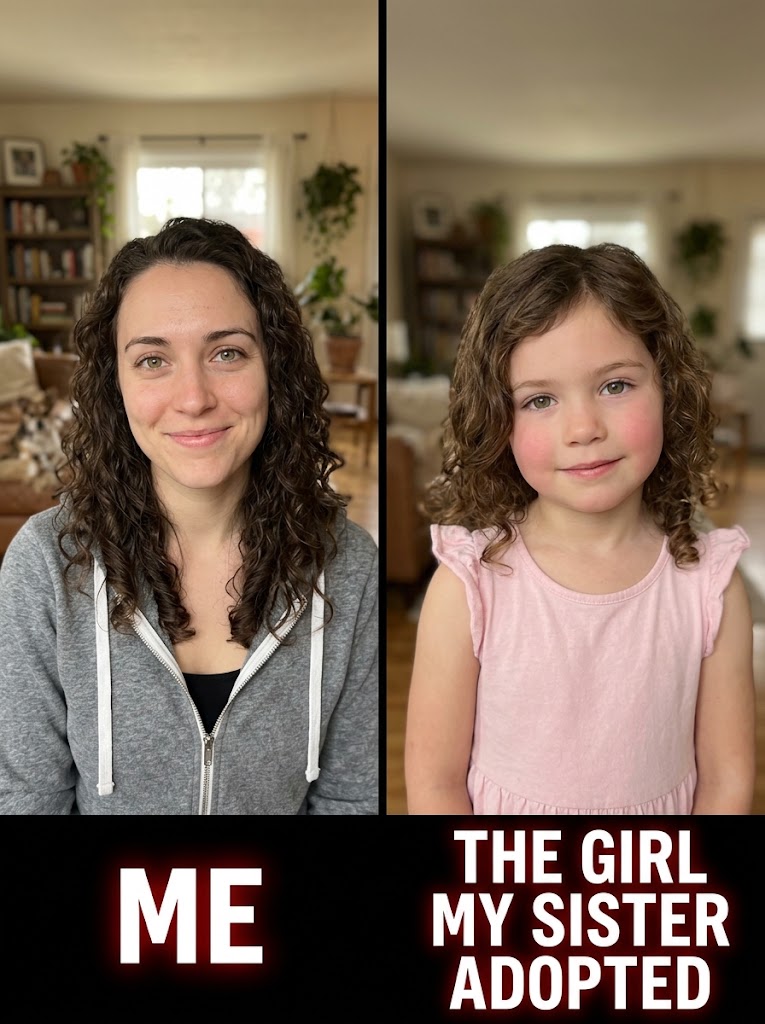
My daughter’s hospital bracelet had rested beside my bed for five long years. Just two weeks after my sister adopted a little girl, she showed up at my house in tears, clutching an envelope. Inside was the name of the hospital where I had given birth, along with a test result she insisted I read for myself. Then she pleaded with me to forgive her.
“Claire, please sit down. I have no idea how to explain this to you.”
My sister, Nora, stood in the doorway, holding a crumpled envelope tightly against her chest.
Her eyes were red and swollen.
“What happened? Where’s Ellie?”
“She’s at home with Tom.”
“I don’t know how to tell you this.”
“Is she hurt?” I asked urgently.
“No, she’s okay.”
Nora stepped inside but refused to take a seat.
She kept running her thumb over the envelope, smoothing its creases.
“Nora, you’re scaring me.”
“Is she hurt?”
“I know. I’m sorry.” She held the envelope out to me. “You won’t believe what I’ve discovered about this little girl.”
At last, she took a seat at my kitchen table.
“Do you remember what the adoption agency told us about Ellie?” she asked.
“They said she was found as a baby,” I answered. “They couldn’t figure out who her parents were.”
“You won’t believe what I discovered about this child.”
Nora nodded slowly.
“That isn’t the truth.”
I pulled out a chair and sat down.
“What are you talking about?”
“They’ve been going through some of her early records. Certain details were missing from her medical history, so Tom and I asked them to investigate.”
“And what did they find?”
“That isn’t the truth.”
“They discovered something.”
She slid the envelope across the table toward me.
I hesitated before opening it.
Just two weeks earlier, I had helped Nora hang pink curtains in Ellie’s new bedroom.
Now, my sister looked as though someone had threatened to take that whole room away from her.
“They discovered something.”
Eight years of struggling to become a mother had almost shattered Nora.
There had been fertility clinic visits, heartbreaking test results, and birthdays she couldn’t bring herself to attend because being around children hurt too much.
When I first brought up adoption, she wasn’t sure she could do it.
“What if I can’t love a child who isn’t biologically mine?” she had asked.
I encouraged her to consider adoption.
I explained that love wasn’t something you could measure with a blood test.
Eventually, she and Tom decided to move forward with the process.
Two weeks before Nora showed up at my door, Ellie’s adoption had been made official, and she came home with Nora and Tom. Nora called me six times on that very first day.
Love wasn’t something you could measure with a blood test.
She asked whether five-year-olds still needed afternoon naps, how to remove paint stains from clothing, and whether it was normal for Ellie to repeat the same question over and over.
More than anything, I had wanted Nora to experience that kind of happiness.
Especially after losing my own little girl.
I had wished that happiness for her more than anything.
Five years earlier, I had given birth to a baby girl.
She arrived prematurely and needed urgent medical care.
I caught a glimpse of her for only a few seconds before the nurses rushed her to intensive care.
I can still picture her tiny hand moving beside her face.
I had only seen her for a brief moment.
I remember asking the nurses if I could hold her.
They explained that they needed to stabilize her condition first.
The next morning, a doctor entered my hospital room.
He told me that my baby had not survived.
Her name was Lucy.
The doctor said my little girl hadn’t made it.
I had chosen her name months before she was born.
I left the hospital without my daughter.
For years afterward, I kept her hospital bracelet tucked inside a little box beside my bed.
I never found the strength to try having another baby.
I returned home with empty arms.
So when Nora first brought Ellie over to meet me, I had no idea how painful the encounter would be.
Ellie had dark, curly hair, big brown eyes, and a small dimple on her left cheek.
When I was little, I had the very same dimple.
I hadn’t expected the meeting to hurt so much.
“Just look at her!” Nora exclaimed with a laugh. “She looks like she belongs to our family!”
I forced a smile.
But once I was alone in my car, I broke down in tears.
I had always pictured Lucy growing up with curls like mine.
I had imagined getting her ready for school each morning.
“She looks like she belongs to our family!”
Ellie reminded me so much of the little girl I had pictured in those dreams.
Before long, Ellie grew attached to me.
She started calling me Auntie Claire.
Whenever I came to visit, she would bring me two hair ribbons and ask me to put her hair into pigtails.
She called me Auntie Claire.
“Not a single braid,” she would insist. “I want two.”
“Yes, ma’am.”
“And be gentle. Don’t pull.”
“I’ll do my best.”
She would perch on a kitchen chair, kicking her little feet while I fixed her hair.
One day, she asked me if I had any children.
“I’ll do my best.”
I explained that I had once had a little girl who passed away when she was a baby.
Ellie grew quiet for a moment.
“That’s sad.”
“It is, sweetheart.”
Then she held out a pink ribbon to me.
“This one goes on the left side.”
I told her that I had once had a little girl who died as a baby.
Children have a remarkable way of bringing you back to the simple things that still need to be done.
Now Nora sat opposite me, her eyes fixed on the envelope.
“What did they discover?” I asked once more.
She opened it.
Several sheets of paper slipped out onto the table.
“What did they discover?”
The first page was an official letter from the adoption agency.
It explained that important details in Ellie’s early placement summary were inaccurate.
I read the sentence twice before looking up.
“What details were wrong?”
I went over the sentence again.
Nora directed my attention to the next page.
It contained a summary of the investigation into Ellie’s records.
Halfway down the page, I spotted the name of a hospital.
I recognized it instantly.
It was the very hospital where I had given birth to Lucy.
I knew that name immediately.
I turned to face Nora.
“Why would they mention this hospital?”
“Keep reading.”
The document described a baby girl whose identity had never been established and who had been placed in emergency protective care five years earlier.
“Why would they mention this hospital?”
It also noted inconsistencies between the hospital records and the documents used when the child was first placed into the care system.
The date on the report fell within the same week Lucy had been born.
I shoved the paper away from me.
“No.”
The date matched the week Lucy had come into the world.
Nora reached across the table and took my hand.
“Claire…”
“No. That proves nothing. Hundreds of babies are born there every day.”
“I understand.”
“Any number of children could have come from that hospital.”
“That proves nothing.”
“Claire…” Her voice cracked. “That’s exactly what I kept telling myself.”
She removed the last few pages from the envelope.
“When I noticed the hospital name and the dates, I asked them if they could investigate whether Ellie might be related to someone in our family.”
I stared at her in disbelief.
“What exactly did you have tested, Nora?”
“I noticed the hospital name and the dates.”
“Tom and I worked with the caseworker. After you agreed to give a cheek swab last week, they arranged a preliminary test to see whether there was a biological family connection. They explained that it might help establish Ellie’s medical background.”
“Tom and I worked with the caseworker.”
I remembered signing the consent paperwork and allowing them to take the swab from inside my cheek. Nora had told me that the records review suggested a possible connection to our family, although no one knew how close that relationship might be.
I had agreed because Ellie deserved to know her true medical history. It had never crossed my mind that the results could reveal something like this.
No one could tell us how close the connection might be.
Nora pushed the report across the table toward me.
I looked at the names.
Mine.
Ellie’s.
Then I reached the conclusion.
The preliminary genetic analysis indicated that a biological parent-child relationship existed between us.
I read the names again.
Then I read the conclusion one more time.
“That can’t be right.”
Nora burst into tears.
“Claire, I think Ellie might be Lucy.”
I shot to my feet so quickly that my chair scraped loudly against the floor.
“No.”
“I know it sounds impossible.”
“That can’t be right.”
“I struggled to believe it myself.”
“My daughter died.”
“I know what they told you.”
“I have her death certificate.”
Nora covered her mouth with her hand.
“My daughter died.”
I crossed the kitchen and grabbed the edge of the sink, holding on tightly.
Outside, a delivery truck pulled up at the neighbor’s house.
Someone was laughing on the sidewalk.
I could hear every ordinary sound around me, yet the words printed on that report made absolutely no sense.
Someone was laughing on the sidewalk.
At last, I turned back toward Nora.
“Does Ellie know about this?”
“No.”
“What about Tom?”
“Yes. He insisted that we wait until the information could be properly verified before telling her anything.”
I walked back to the table.
“Are these results definite?”
“Does Ellie know about this?”
“They’re only preliminary. The agency wants an independent test and a complete examination of the records.”
“Then we still don’t know.”
Nora gave a slow nod.
“There are still things we don’t know.”
“Then we still don’t know.”
I looked down at the hospital’s name once more.
“Who told the agency that the baby had no known identity?”
“That’s one of the questions they’re trying to answer.”
“How could they tell me my baby was dead if she was still alive?”
“Who told the agency that the baby had no known identity?”
Nora shook her head helplessly.
“I don’t have an answer to that.”
I kept staring at the report.
Part of me desperately wanted to believe it.
Another part was terrified of accepting that it could be true.
I wanted to believe it.
Five years was an incredibly long time to grieve the loss of a child.
It was also five years in which someone else might have been raising her.
“Do you hate me?” Nora asked in a whisper.
“What?”
“If Ellie really is Lucy…”
“Nora, you had no idea.”
“But I brought her home.”
“You brought home a little girl who needed a family.”
Tears streamed down her face.
I wasn’t ready to reassure her by pretending that nothing would change.
Everything had already changed.
“But I brought her home.”
“Leave the documents here,” I told her.
She nodded quietly.
Before stepping outside, she paused at the doorway and looked back at me.
“Claire, no matter what happens, I love her.”
“I know.”
“Claire, no matter what happens, I love her.”
After Nora left, I went into my bedroom and retrieved Lucy’s hospital bracelet.
The plastic had turned slightly yellow with age.
Her name was still visible across the front.
I laid it beside the report.
Two documents.
I had taken Lucy’s bracelet from my bedroom.
Two entirely different stories about how the same child had entered the world.
For the first time in five years, I no longer knew which version of the truth I could trust.
In the days that followed, Nora, Tom, and I met with the adoption professionals responsible for examining the records.
I still couldn’t decide which account to believe.
A lawyer explained that even if the genetic relationship was confirmed, it wouldn’t automatically resolve the legal issues surrounding Ellie’s adoption.
For the time being, Ellie would continue living in the home she knew while the adults searched for answers.
Ellie would stay in the home she knew.
Whatever the investigation uncovered, none of us wanted her to believe that loving one person meant she had to lose another.
The last thing I wanted was to frighten her.
We also requested the hospital documents relating to Lucy’s reported death.
An independent genetic test was organized with the appropriate consent.
I couldn’t stand the thought of frightening her.
The wait for the results was unbearable.
I continued going to work.
I shopped for groceries.
I replied to messages.
But whenever my phone rang, I immediately stopped whatever I was doing.
Waiting for the results felt unbearable.
One afternoon, Nora sent me a picture.
Ellie was sitting on the living room floor, stacking brightly colored blocks into a tower.
Her curly hair had been tied into two uneven pigtails.
ELLIE DID THESE HERSELF, Nora wrote.
Nora had sent me a picture.
I zoomed in on the photograph.
Ellie was beaming with pride.
I felt an overwhelming urge to drive straight to Nora’s house.
Instead, I picked up the phone and called her.
“How is she doing?”
I zoomed in on the photograph.
“She’s fine. She keeps asking when you’re coming to see her.”
“Tell her I’ll be there soon.”
A week later, the independent test results arrived.
This time, there was no ambiguity in the report.
The genetic evidence confirmed that Ellie was my biological daughter.
The report left no room for doubt.
I immediately called Nora.
She picked up on the first ring.
“Claire?”
“It’s confirmed.”
I heard her take a sharp breath.
For several seconds, neither of us said a word.
“It’s confirmed.”
Finally, Nora spoke.
“Come over.”
When I reached her house, Tom answered the door.
He looked worn out.
“She’s in the kitchen drawing,” he said softly.
“Does she know?”
He looked worn out.
“No. We’re waiting for professional advice about how to explain everything to her.”
I nodded.
Then Ellie came into view.
“Auntie Claire!”
She raced toward me.
I crouched down, and she wrapped her arms tightly around my neck.
She rushed straight into my arms.
For a moment, I was holding the daughter I had been told I had lost forever.
Ellie stepped back and examined my hair.
“Will you make mine look like yours?”
“Absolutely, sweetheart.”
I held the daughter I had been told was gone forever.
She hurried off to fetch her ribbons.
I sat behind her at the kitchen table and carefully divided her curls into two sections.
My hands were trembling.
“Ouch!” she protested.
“I’m sorry, sweetheart.”
“You’re pulling my hair.”
My hands were trembling.
I relaxed my fingers and tried again.
“Is that better?”
“Yep.”
Nora stood near the kitchen counter, silently watching us.
I tied the first pigtail.
Nora remained beside the counter, watching us.
Then I finished the second one.
Ellie jumped down and hurried to the hallway mirror to check her reflection.
“They’re perfect!”
She raced off to show Tom.
Nora took the chair opposite mine.
Neither of us touched the documents lying on the table.
She hurried off to show Tom.
There was a much more difficult conversation waiting for us.
Nora clasped her hands together on the tabletop.
“Are you going to take her away from me?”
I glanced toward the hallway, where Ellie was proudly showing Tom her new hairstyle.
There was a much more difficult conversation waiting for us.
“I don’t know what the legal process will decide, Nora. But I won’t do anything that frightens her.”
Nora’s eyes filled with tears.
“I’m scared you’ll believe I took your daughter from you.”
“You didn’t.”
Nora started crying.
“I finally have a daughter, Claire.”
“I know you do.”
“And she’s your daughter, too.”
I lowered my eyes to the hairbrush lying between us.
“I’m frightened that every time I look at her, I’ll think about all the years I missed.”
“I finally have a daughter, Claire.”
Nora wiped the tears from her face.
“You did miss those years. And there’s nothing I can do to give them back.”
Her words hurt because they were true.
I would never get back Ellie’s first words or the birthdays I had spent standing beside a grave.
She was telling me the truth.
Two days later, our lawyer called with an update.
The investigation had uncovered two newborns whose hospital identification numbers appeared to have been accidentally switched during a transfer between neonatal units.
One baby had been documented as deceased. The other had entered emergency protective care with incomplete identifying details.
One baby had been documented as deceased.
Ellie’s earliest child-welfare file contained the identification number originally assigned to Lucy. However, the mix-up alone could not explain who had declared Lucy dead, how anyone had confirmed that death, or why the contradictory records had never been questioned. Investigators were looking into each of these failures individually.
Ellie’s earliest child-welfare file contained the number originally assigned to Lucy.
“Does this explain the whole thing?” I asked.
“No,” the lawyer replied. “But it gives the investigators a specific trail of records to follow.”
The hospital had launched an official investigation.
I requested every document connected to Lucy’s reported death.
The hospital had launched an official investigation.
I also demanded to know who had confirmed her identity before the death certificate was issued.
No one had an answer yet.
For the first time, I refused to settle for an explanation that left important questions unanswered.
Tom helped us arrange an appointment with a counselor who specialized in adoption and complicated family histories.
I refused to settle for an unclear explanation.
We agreed that Ellie would continue living with Nora and Tom while the legal investigation proceeded.
With professional guidance, we would explain the truth to her gently instead of allowing her to overhear frightened adults talking about it.
That evening, Nora called me.
“Are you angry with me?”
Ellie would continue living with Nora and Tom.
“Sometimes I feel angry at everyone,” I admitted. “But not because you love her.”
“Will you keep visiting us?”
“Of course I will.”
A few weeks later, we were preparing to go out together as a family.
“Will you keep visiting us?”
Ellie came into the kitchen carrying two pink ribbons.
“Auntie Claire! Can you make two pigtails for me?”
I pulled a chair away from the table.
“Come and sit down, then.”
“Auntie Claire! Can you make two pigtails for me?”
She climbed onto the chair and placed the ribbons in my hand.
Nora appeared with the hairbrush.
“She washed her hair this morning,” she cautioned me.
Ellie let out an exaggerated groan.
“Mommy, my hair isn’t even that tangled!”
Nora held out the hairbrush.
“It certainly was when I tried brushing it.”
“That’s because you did it wrong!”
Tom called out from the hallway.
“Are we going somewhere today or sometime next Tuesday?”
“Tuesday!” Ellie yelled back.
“That’s because you did it wrong!”
I laughed as I began separating her curls.
The first ribbon slipped into place without any trouble.
The second one kept sliding loose.
“You’re pulling too tightly,” Ellie complained.
I loosened the ribbon.
“What about now?”
The first ribbon had gone in easily.
She reached up and touched both pigtails.
“One is higher than the other.”
Nora leaned over to examine them.
“She’s absolutely right.”
“Traitor,” I said under my breath.
Nora laughed and adjusted the ribbon.
“She’s absolutely right.”
Ellie jumped down from the chair and raced toward Tom.
“I’m ready!”
He opened the front door for her.
She hurried outside, already asking whether she could have ice cream later.
Nora picked up Ellie’s sweater from the chair.
“Claire, are you coming?”
Nora picked up Ellie’s sweater.
I set the hairbrush aside.
“I’ll be right behind you.”
Nora waited while I grabbed my purse.
Then the three of us walked outside together.
“I’ll be right behind you.”