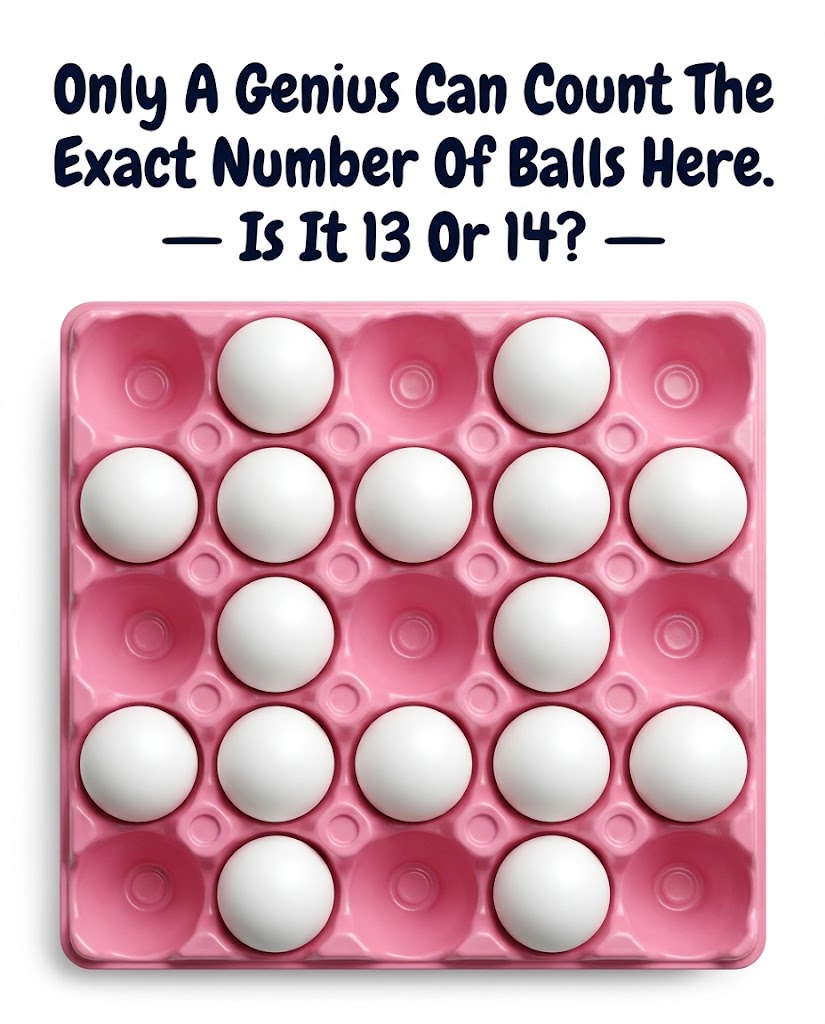
The answer is 16—not 13 or 14. When counted from top to bottom, the five rows contain 2, 5, 2, 5, and 2 balls. Add these figures together, and neither of the suggested answers is correct. The gaps between the balls make the arrangement less straightforward to scan at a glance. A more reliable method is to count each row from left to right, making sure every ball is included before moving to the next row. If your total does not match, begin again instead of trying to make your count fit one of the choices.
That is what makes this puzzle so engaging: the misleading options are just as important as the image itself. When two possible answers are presented, it is natural to assume that one of them must be correct. Selecting either option does not mean you are poor at counting; it simply means the way the question is framed has influenced your attention. The lesson is straightforward: examine the evidence before accepting the available choices. Sometimes, the right answer is not among the options at all.
The best way to solve this picture is to ignore the two suggested answers temporarily. Begin at the top of the arrangement and identify the first complete row. Count its balls before shifting your attention downward. The top row contains two balls, while the row beneath it contains five. Counting each group separately makes the alternating arrangement easier to recognize instead of viewing all the balls as one continuous cluster.
The middle row has two balls, followed by a five-ball row and a final row containing two balls. Expressed mathematically, the arrangement is 2 + 5 + 2 + 5 + 2. You can verify the total another way by adding the two larger rows together first: five plus five equals ten. The three smaller rows contain two balls apiece, contributing another six. Adding ten and six produces a total of sixteen.
This alternative calculation is a helpful way to confirm the result because it avoids relying on precisely the same visual counting process. Looking over the entire picture again can sometimes cause you to overlook the same ball or group a second time. Combining matching rows requires you to consider the arrangement differently by identifying the number of groups and the balls in each one. In this case, both counting methods produce the same answer.
The empty spaces contribute to the visual trick. They create separation between certain balls while making others appear grouped closely together. As your eyes move from one cluster to another, a small group can easily escape your attention. Taking a little more time eliminates much of this confusion. There is no reason to settle on thirteen or fourteen simply because those are the only answers offered in the question.
The correct total is still sixteen. This puzzle rewards close observation and the ability to verify a result independently. Whenever you tackle a visual counting challenge, check that the available choices agree with the answer you can establish directly from the image before making your selection.
An accurate count also requires you to keep track of where each row begins and ends. If you forget your place, return to that particular row instead of trying to recall the number from memory. The arrangement is small enough to examine thoroughly, and its repeating groups make the calculation easy to verify. Every row supports the final total of sixteen, while neither of the two suggested alternatives does.