Part 1 — The Box
My sister-in-law called me at 8:12 on a Monday morning.
She was screaming so loudly that I had to pull the phone away from my ear.
“CLAIRE! WHAT DID YOU DO?!”
Across the kitchen, my husband, Ryan, immediately looked up from his coffee.
He didn’t have to ask who was calling.
There was only one person in his family capable of turning a Monday morning into a full-scale emergency before breakfast.
His sister, Megan.
I leaned against the kitchen counter.
“What are you talking about?”
“You KNOW what I’m talking about!”
Something slammed on her end of the line.
“You had that BOX sent to my house!”
Ryan’s eyebrows went up.
I met his eyes.
So it had arrived.
“Did you open it?” I asked.
There was a pause.
“Yes.”
“And?”
“And you have completely lost your mind!”
Three days earlier, Megan had stood in my driveway laughing while I stared at my brand-new car.
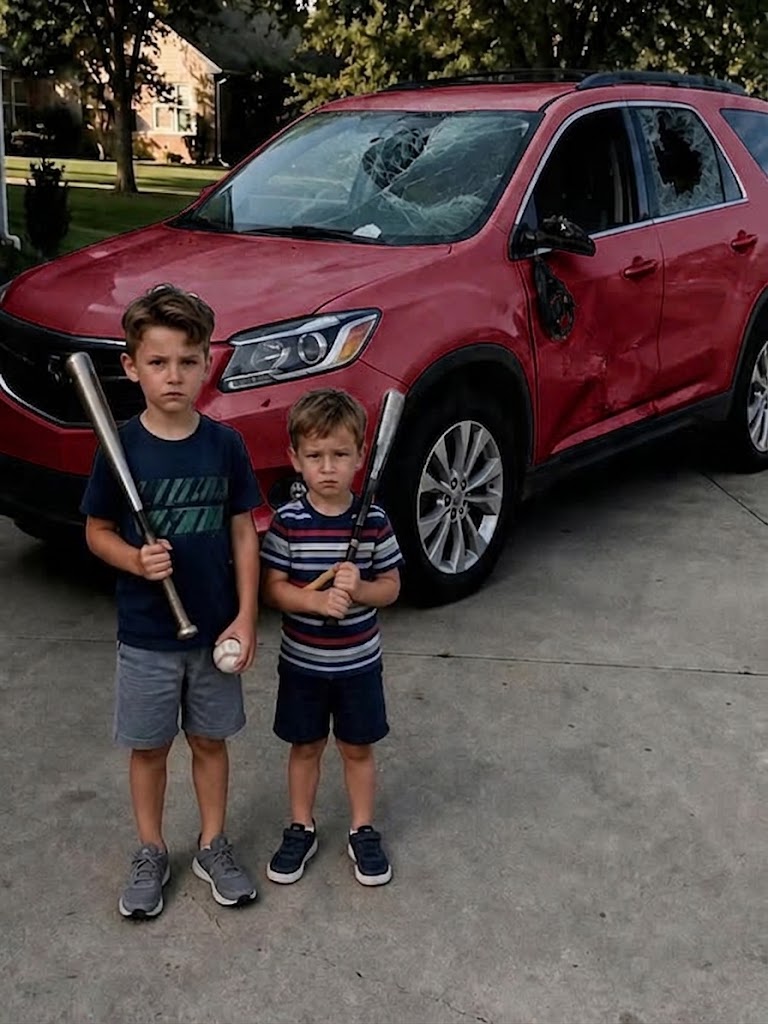
The windshield had been cracked.
The passenger-side mirror was hanging crookedly.
There were dents across one door and several deep scratches in the paint.
Her seven-year-old son had been standing beside it holding a baseball bat.
His five-year-old sister was next to him.
Megan had insisted it was an accident.
Just kids being kids.
Then she had laughed when I told her she would be responsible for the damage.
“THEY’RE CHILDREN!” she’d shouted. “I’m not paying for your precious car. How is that my problem?”
At first, I had been furious at the kids.
For about twenty minutes.
Then I walked past a half-closed bedroom door.
And I heard Megan whispering to them.
What she said changed everything.
Now, three days later, the box I had arranged to be delivered was sitting inside her house.
And judging by the way she was breathing into the phone, she finally understood that I hadn’t forgotten what she had done.
“You can’t do this to me,” Megan said.
Her voice was quieter now.
That was unusual.
Megan didn’t lower her voice when she was angry.
She lowered it when she was scared.
“I didn’t do anything to you,” I replied.
“You know what’s going to happen because of this?”
I looked through the kitchen window.
Our driveway was empty.
The car Ryan and I had spent three years saving for should have been sitting there.
Instead, it was somewhere else because of what happened at Saturday’s barbecue.
“You should have thought about that before,” I said.
“They’re only little kids.”
My stomach tightened.
That sentence again.
The same excuse she had used from the beginning.
But now I knew something she apparently thought I would never find out.
The children weren’t the ones who had decided to attack my car.
“Megan,” I said quietly, “read everything in the box.”
“Claire—”
“And don’t call me again until you do.”
I ended the call.
Ryan stared at me.
“Well?”
“She opened it.”
“All of it?”
“I don’t know.”
He looked toward the empty driveway.
Then back at me.
“Think she still believes this is funny?”
I didn’t answer.
Because none of this had started with the box.
It hadn’t even started with the baseball bat.
It had started years earlier, when Megan decided that because Ryan and I didn’t have children, our time, money, and patience somehow belonged to everyone else.
And for a long time, everyone in the family let her believe it.
Including us.
Until one sunny Saturday afternoon, when I heard glass shatter in my driveway—and discovered exactly how far my sister-in-law was willing to go because she couldn’t stand seeing me happy.
Part 2 — “You Don’t Have Kids”
Megan had always been difficult.
At least, that was the phrase Ryan’s family used.
Difficult.
It was a convenient word.
It covered almost everything.
Megan showing up forty minutes late to dinner without apologizing?
“She’s difficult.”
Megan borrowing money from her parents and conveniently forgetting about it?
“You know how Megan is.”
Megan making rude comments and then accusing people of being too sensitive?
“She doesn’t have a filter.”
But the habit that bothered me most involved her children.
Noah was seven.
Lily was five.
They were good kids—energetic, loud, occasionally exhausting, but sweet.
I loved them.
Unfortunately, Megan knew it.
Which meant she treated me like free, on-demand childcare.
She rarely asked.
She announced.
One Saturday morning, my doorbell rang at 8:30.
I opened it to find Megan standing there with both children wearing backpacks.
“Perfect,” she said.
I looked behind her.
“Perfect for what?”
“I need you to watch them until around four.”
I actually laughed.
“Megan, I have plans.”
“With who?”
I stared at her.
“That doesn’t matter.”
She sighed dramatically.
“Claire, I already told my friends I was coming.”
“Then you should’ve arranged childcare before you told them.”
Her expression hardened.
“You’re home.”
“I’m leaving in twenty minutes.”
“For what?”
Again, as though I had to justify having a life.
“For something I already planned.”
She rolled her eyes.
Then came the sentence she loved most.
“You don’t have kids. It’s not like you have anything else to do.”
The first few times she said that, I tried explaining.
Ryan and I had jobs.
Appointments.
Friends.
Responsibilities.
Marriage.
A home.
Parents.
Lives.
Eventually, I stopped explaining.
“No.”
That one word drove Megan insane.
Most of the family gave in to her because arguing took longer.
Her mother, Linda, watched the kids constantly.
Her father, George, helped with bills whenever Megan claimed money was tight.
Ryan hated confrontation, so he would often say, “It’s only for a few hours.”
I was usually the only person who told her that being a mother did not make everyone else’s schedule less important.
And Megan hated me for it.
She never said, “I hate you.”
She didn’t need to.
Instead, she made little comments.
When I got promoted:
“Must be easy to focus on a career when you don’t have children.”
When Ryan gave me a necklace for our anniversary:
“Must be nice having money for unnecessary things.”
When we took a long weekend at the beach:
“I haven’t had a real vacation in years, but I guess some people have fewer responsibilities.”
Everything good in my life somehow became evidence that I had it easier than she did.
I tried not to let it bother me.
Ryan told me jealousy was “just Megan’s thing.”
Then my mother got sick.
And suddenly, nothing about our life felt easy.
Part 3 — Three Years
My mom was diagnosed with cancer three years before the barbecue.
I still remember sitting in the hospital parking garage afterward, staring straight ahead while Ryan held my hand.
Mom had insurance, but serious illness comes with expenses nobody prepares for.
Travel.
Prescription costs.
Meals near treatment centers.
Missed work.
Extra help around the house.
We contributed whenever we could.
I would do it again without hesitation.
Thankfully, treatment worked.
Slowly, Mom got stronger.
But while that was happening, our twelve-year-old SUV seemed determined to fall apart one piece at a time.
The air conditioner died first.
Then the alternator.
Then one window stopped rolling down.
Then the transmission began slipping.
Every mechanic visit came with the same conversation.
“You could fix it.”
Pause.
“But…”
That “but” became more expensive every time.
Ryan and I knew we needed another vehicle.
We also knew we didn’t want to put ourselves in a financial hole.
So we started saving.
For three years.
We put money aside every month.
Sometimes it was a lot.
Sometimes barely anything.
I brought lunch from home.
Ryan kept his old phone even after the screen cracked.
We skipped an expensive vacation and spent a week visiting local parks instead.
We sold furniture and electronics we no longer used.
One month, the water heater broke and nearly wiped out what we had planned to save.
But we kept going.
The car fund became a symbol of something bigger.
We weren’t just saving for transportation.
We were rebuilding after several emotionally exhausting years.
Mom’s health improved.
Our finances stabilized.
And eventually, we had enough saved for a substantial down payment on a crossover we genuinely loved.
Silver.
Reliable.
Safe.
Nothing flashy.
But brand-new.
The day we picked it up, I stood beside it at the dealership while Ryan took a picture.
“You look happier than on our wedding day,” he joked.
“Don’t ruin the moment.”
He laughed.
I ran my hand over the hood.
For the first time in years, something in our life felt uncomplicated.
We had worked.
We had waited.
We had earned it.
That night, Ryan posted one photo in the family group chat.
His mom sent heart emojis.
His dad wrote:
Finally! You two deserve it.
Scott, Megan’s husband, wrote:
Nice ride! Congrats.
Megan responded six minutes later.
Must be nice.
Ryan stared at the message.
I shook my head.
“Don’t.”
“I wasn’t going to say anything.”
“Good.”
I thought that was the end of it.
Three weeks later, we decided to have a barbecue.
Part 4 — The Sound From the Driveway
The weather that Saturday was perfect.
Warm, sunny, with just enough breeze to keep the afternoon comfortable.
My mom came over.
So did Ryan’s parents.
Megan arrived with Scott, Noah, and Lily.
The moment she stepped out of their minivan, she noticed the crossover.
“So that’s it.”
I smiled politely.
“That’s it.”
She walked around the car.
“What did you pay?”
“Megan,” Scott said.
“What? I’m curious.”
I shrugged.
“Enough.”
She ran a finger lightly over the shiny paint.
“Must be nice having two incomes and no kids.”
I felt the irritation rise.
But Mom was there.
Ryan was grilling.
Everyone was having a good day.
I wasn’t going to let Megan ruin it.
“We saved for it,” I said.
“For three years.”
She gave a little laugh.
“Sure.”
Then she walked away.
About an hour later, Noah found a plastic baseball in our garage.
Ryan had an old lightweight bat.
“Can we play?” Noah asked.
“Sure. But stay away from the cars.”
Megan waved both children toward the side yard.
“Go over there. Away from everybody.”
It was one of the rare moments when I thought:
Wow, Megan is actually being responsible.
Ten minutes later, I heard it.
CRACK!
Every conversation stopped.
A second sound followed.
BANG.
Then—
CRASH.
Glass.
Ryan dropped the barbecue tongs.
I ran.
The moment I turned the corner toward the driveway, my stomach fell.
The passenger side of my new car looked like someone had intentionally beaten it.
The mirror was broken.
The windshield had a long spiderweb crack across one side.
The passenger door had a large dent in it.
There were several smaller impact marks.
Noah stood beside the car.
He was holding the bat.
Lily stood behind him.
Both children were completely still.
I stared at them.
Then the car.
Then back at them.
“Noah…”
His eyes immediately moved toward Megan.
I noticed that.
But I didn’t understand it.
Not yet.
“What happened?”
He didn’t answer.
Megan rushed forward.
“Oh my God! Noah!”
He flinched.
“What were you thinking?”
I turned toward Megan.
“You’re paying for this.”
She looked at me as if I had suggested she hand over her house.
“What?”
“The repairs.”
“No.”
I actually thought I had misheard her.
“What do you mean, no?”
“They’re children!”
“They hit my car with a baseball bat!”
“They were playing.”
Ryan walked around the car, his face turning pale as he saw the windshield.
“Megan, this is serious.”
She threw up her hands.
“Oh, please. This is exactly why I told them to play away from everybody. Kids make mistakes.”
I pointed at the door.
“That isn’t one accidental hit.”
The dent was obvious.
So were the other marks.
“They hit it multiple times.”
Megan shrugged.
“So?”
“So you’re their mother.”
“And?”
I stared at her.
She laughed.
Actually laughed.
“I’m not paying thousands of dollars because two little kids made a mistake. Call your insurance. Isn’t that what insurance is for?”
My mom touched my shoulder.
“Claire.”
It was her quiet warning.
Don’t explode.
I looked at Noah.
He seemed close to tears.
Lily was staring at the grass.
This wasn’t the time to scream in front of them.
“Fine,” I said through clenched teeth.
Megan smiled.
That smile made me angrier than anything else.
She thought she had won.
I should have told her to leave immediately.
Instead, because I wanted to keep the afternoon from becoming even uglier, we moved everyone back toward the house.
Twenty minutes later, I went upstairs to get my charger.
That was when I heard Noah’s voice from behind the guest-room door.
“Mom, are we still getting the toys?”
I stopped walking.
Part 5 — “You Did Exactly What I Told You”
The guest-room door was nearly closed.
I wasn’t trying to listen.
Then Megan whispered:
“Yes. But you two need to stop talking about it.”
My entire body went still.
Lily spoke next.
“But Aunt Claire was sad.”
“She’ll get over it.”
I moved closer without thinking.
Noah asked, “Are we in trouble?”
“No.”
“Because of the car?”
Megan sighed.
“You did exactly what Mommy told you to do.”
My heart stopped.
Then she continued.
“I told you to hit the shiny new car, and you did. So yes, you’ll get your toys.”
I covered my mouth.
For a moment, I honestly thought I had misunderstood.
There was no way.
No way an adult had instructed two little children to destroy someone’s car because she was jealous.
Then Lily asked:
“Why did we have to?”
Megan lowered her voice even further.
“Because Aunt Claire thinks she’s better than everyone because she has expensive things.”
I felt something cold move through me.
“She needed to learn that things can get ruined.”
Noah whispered, “But Dad said we’re supposed to take care of other people’s stuff.”
“He doesn’t need to know.”
My anger disappeared.
What replaced it was worse.
Disbelief.
Disgust.
And, strangely, heartbreak for those two children.
They weren’t little vandals.
They had trusted their mother.
Behind me, the floor creaked.
I turned.
Ryan stood at the other end of the hallway.
His face was white.
He had heard enough.
I motioned for him to follow me.
Inside our bedroom, I closed the door.
For several seconds, neither of us spoke.
Then I whispered:
“Tell me you heard that.”
He nodded.
“She told them to do it.”
“I know.”
“Your sister told a five-year-old and a seven-year-old to destroy our car.”
“I know.”
“And promised them toys.”
Ryan dragged both hands down his face.
“I can’t believe this.”
I could.
That was the sad part.
Not the exact act.
That was beyond anything I had imagined.
But the jealousy?
The entitlement?
The belief that rules didn’t apply to her?
Those were familiar.
“What are you going to do?” I asked.
He looked at me.
For years, Ryan had been the peacemaker.
He was always asking me to ignore comments.
Give Megan another chance.
Not make family gatherings uncomfortable.
But something had changed in his face.
“I’m going to tell her to leave.”
We went downstairs together.
Ryan walked straight toward his sister.
“Megan.”
She looked up.
“What?”
“Take the kids and go.”
Everyone stopped talking.
She laughed nervously.
“What are you talking about?”
“You need to leave.”
“Why?”
Ryan stared at her.
“You know why.”
Her expression shifted.
Only for a second.
But I saw it.
Fear.
Scott looked confused.
“What happened?”
“Not in front of Noah and Lily,” Ryan said.
Megan stood.
“This is ridiculous.”
“Leave.”
“I’m your sister!”
“Yes.”
“You’re seriously throwing me out?”
“Yes.”
She looked at me.
I said nothing.
That seemed to bother her even more.
Ten minutes later, they were gone.
Ryan’s parents asked what happened.
“We’ll explain later,” he said.
That night, after everyone else left, Ryan and I sat at the kitchen table.
Neither of us had much appetite.
Finally, Ryan spoke.
“I owe you an apology.”
“For what?”
“All the times I told you to let things go with Megan.”
I looked at him.
He stared down at his hands.
“I thought I was keeping the peace.”
I waited.
Then he said:
“But I think all I was really doing was asking you to absorb whatever she did so nobody else had to deal with her.”
That was exactly what it had felt like.
For years.
I reached across the table and took his hand.
“We need to decide what happens now.”
Ryan nodded.
“No more pretending this was an accident.”
That night, I made a phone call.
And by Monday morning, a box was on its way to Megan’s house.
Part 6 — Megan’s Version of the Story
Before the box arrived, Megan tried to get ahead of us.
Sunday morning, Ryan’s mother called.
“Sweetheart, what happened yesterday?”
Her voice sounded worried.
“Megan said Claire completely lost it over an accident.”
Ryan closed his eyes.
“Mom, it wasn’t an accident.”
Silence.
“What do you mean?”
“We heard Megan talking to the kids.”
Ryan explained.
His mother didn’t respond for several seconds.
Then:
“She said that?”
“Yes.”
“You both heard it?”
“Yes.”
“And she told the children to damage the car?”
“Yes.”
I could hear Linda breathing on the other end.
Finally, she whispered:
“Oh, Megan.”
By noon, Scott called.
He sounded exhausted.
“Can I ask you something?”
Ryan put the phone on speaker.
“Sure.”
“Did you actually hear Megan tell the kids she ordered them to hit the car?”
“Yes.”
Scott was quiet.
Then he said:
“Noah told me something this morning.”
I leaned closer.
“What?”
“He said Megan promised them toys if they hit Aunt Claire’s new car.”
I shut my eyes.
So Noah was telling the truth.
Scott continued.
“He asked me if he was bad.”
That hurt more than seeing the damage.
“What did you tell him?”
“That he made a bad choice, but adults are responsible for teaching kids right from wrong.”
Scott’s voice cracked slightly.
“I’m furious.”
Not at Noah.
Not at Lily.
At Megan.
“I need time to figure out what I’m doing,” he said. “But I want you to know I’m not pretending this didn’t happen.”
That mattered.
Still, I wasn’t leaving our next move entirely to family discussions.
The damage had been done.
Literally.
I photographed everything.
Every dent.
Every crack.
The broken mirror.
The scratches.
We saved the security-camera footage from our driveway.
The camera didn’t record Megan’s conversation upstairs.
But it did show something useful.
Shortly before the damage, Megan walked toward the side yard with the children.
She crouched beside them.
Then pointed toward our driveway.
A few minutes later, Noah and Lily moved toward the car with the bat.
And Megan remained close enough that she could have stopped them.
She didn’t.
Ryan and I also wrote down the exact conversation we had overheard while it was still fresh.
Then we got a repair estimate.
When I saw the total, my stomach dropped.
Modern cars have cameras and sensors in places I had never thought about.
The windshield was not just glass.
The mirror was not just a mirror.
The damage was going to cost thousands.
That was when I made another call.
And by Monday morning, everything I needed was inside one plain cardboard box.
Part 7 — What Was Inside
Now we were back to Monday.
To Megan screaming into my phone.
After she hung up, Ryan and I waited.
We didn’t call her.
We didn’t argue in the family group chat.
We didn’t post anything online.
We simply waited for her to actually read what had been delivered.
The box contained no prank.
No smashed toy car.
No revenge gift.
Nothing cruel.
It contained something Megan feared far more.
Documentation.
Inside were printed photographs of the damage.
The repair estimate.
Still images from our driveway camera.
Our written account of what we had heard.
Copies of the information we had already provided to our insurance company.
And a formal demand letter prepared after I spoke with a local civil attorney.
The letter gave Megan and Scott a clear opportunity to resolve the cost of the damage without dragging the matter into a longer dispute.
At the very top, I had added one page of my own.
It contained one sentence:
You said they were “just kids.” I agree. That’s why the adult who told them to do it needs to take responsibility.
That was what had made Megan call me screaming.
At 10:30 that morning, another call came.
This one was from Scott.
“I’ve read everything.”
I braced myself.
Then he said:
“I’m going to make sure you’re not left paying for this.”
I exhaled.
“Scott, you didn’t tell them to do it.”
“They’re my kids too. And this is my household. I’ll deal with Megan separately.”
He paused.
“I’m sorry.”
“You don’t owe me an apology for her choices.”
“Maybe not. But I should’ve pushed back harder a long time ago.”
Apparently, I wasn’t the only person who had spent years avoiding conflict with Megan.
That evening, Ryan’s parents came over.
So did Scott.
Megan refused.
We showed Linda and George everything.
The photographs.
The footage.
The estimate.
Then Scott repeated what Noah had told him.
Linda began crying quietly.
George looked furious.
Finally, he said:
“I’m done.”
Ryan looked at him.
“With what?”
“Fixing things for her.”
For years, Ryan’s parents had rushed in every time Megan created a problem.
George lent money.
Linda babysat.
Both apologized on Megan’s behalf.
Not this time.
“She did this because she thought somebody would protect her from the consequences,” George said.
Nobody disagreed.
Part 8 — The Cost Wasn’t Just Money
The repairs took almost three weeks.
Scott covered the amount we needed so we weren’t stuck financially while the adults sorted things out.
But he also made one thing clear to Megan.
She was going to repay the money.
She had been saving for a girls’ trip.
Canceled.
She had planned to replace their living-room furniture.
Postponed.
She picked up additional work at the event-planning company where she worked part-time.
I didn’t ask for any of that.
I didn’t care whether she sold furniture, worked extra shifts, or canceled a vacation.
I only cared that Ryan and I didn’t end up paying for damage she deliberately caused.
But the financial consequences were probably the easiest part for Megan.
The harder consequence was that her family stopped enabling her.
Her parents no longer accepted surprise babysitting drop-offs.
If she wanted help, she had to ask.
In advance.
And accept no as an answer.
Ryan and I did the same.
Two weeks later, Megan came to her parents’ house while we were there.
The room went quiet.
She looked directly at me.
“Are you happy now?”
I didn’t respond.
“You turned my whole family against me.”
Ryan stood.
“No, Megan.”
She looked at him.
“You did that yourself.”
Her face hardened.
“You’re taking her side.”
“This isn’t about sides.”
“I’m your sister!”
“And Claire is my wife.”
Megan’s eyes flashed.
Ryan continued.
“But even if neither of you were related to me, what you did was wrong.”
That stopped her.
She turned toward her parents.
“Seriously? Nobody is going to defend me?”
Linda spoke first.
“I love you.”
“Then say something!”
“I am.”
Her voice was quiet.
“What you did was terrible.”
Megan’s face crumpled.
“So I’m a terrible person now?”
“No,” Linda replied. “There’s a difference between being a terrible person and doing something terrible. But if everybody keeps pretending you didn’t do anything wrong, how are you ever supposed to change?”
Megan stared at her.
Then George said something I think finally reached her.
“The worst thing wasn’t the car.”
She looked at him.
“It wasn’t?”
“No. The worst thing was teaching your children that hurting somebody is okay if you’re angry with them.”
Megan’s face changed.
“They didn’t know what they were doing.”
“Exactly.”
George leaned forward.
“You did.”
Nobody said anything after that.
Megan grabbed her purse and left.
But for the first time, she didn’t slam the door.
Part 9 — The Kids Came Back First
About a month after the barbecue, our doorbell rang.
I checked the camera.
Scott was standing outside with Noah and Lily.
No Megan.
When I opened the door, Noah looked nervous.
Lily hid partly behind her father.
Scott said:
“They asked to come.”
Noah slowly pulled something from behind his back.
A drawing.
It showed a silver car covered in huge cartoon bandages.
Next to it were four stick figures.
Ryan.
Me.
Noah.
Lily.
Across the top, he had written:
SORRY AUNT CLAIRE.
My throat tightened.
“We’re sorry,” Noah said.
Lily nodded.
“Really sorry.”
I crouched so I was closer to them.
“Thank you.”
Noah stared at the floor.
“Mom told us you loved your car more than you loved us.”
That sentence hurt.
I took his hand.
“Look at me.”
He did.
“I was very upset because Ryan and I worked hard for that car. But there is no car in the world that I care about more than either of you.”
Lily blinked.
“Even the new one?”
Despite everything, I laughed.
“Even the new one.”
She threw her arms around me.
I hugged her.
Then Noah.
I didn’t tell them they had done nothing wrong.
They had damaged someone’s property.
Children still need to learn responsibility.
But I also wasn’t going to put an adult-sized burden on their shoulders for something their mother had manipulated them into doing.
“Sometimes we make bad choices,” I told them. “When that happens, we apologize, fix what we can, and try to make a better choice next time.”
Noah nodded seriously.
“I’m never hitting another car.”
Scott smiled.
“That’s a solid policy.”
We put Noah’s drawing on the refrigerator.
It stayed there for months.
Megan, however, remained silent.
No apology.
No text.
Nothing.
Eventually, I stopped expecting one.
Then three months later, my phone buzzed.
Can we talk?
I stared at the message for a long time.
Finally, I wrote:
Okay.
Part 10 — Megan Finally Told the Truth
Megan arrived alone.
She didn’t walk in like she usually did.
No loud greeting.
No immediate complaint.
She sat at our kitchen table and folded her hands together.
For almost a minute, neither of us spoke.
Then she said:
“I was jealous.”
No excuse.
No accusation.
Just that.
I waited.
“When you got the car, I hated how happy you looked.”
That was painful to hear.
But at least it was honest.
“I kept telling myself you had everything easy.”
I almost laughed.
Three years of my mother’s illness.
Three years of saving.
Three years of worrying about money.
Easy?
Megan shook her head before I could answer.
“I know. That’s the stupid part.”
She looked down.
“I didn’t know what you were dealing with because I never asked.”
I stayed quiet.
She continued.
“I saw two people with no kids, a nice house, two jobs, vacations sometimes, and then a new car. And I decided that meant life handed you everything.”
“It didn’t.”
“I know.”
She took a breath.
“And you were the only person who kept telling me no.”
“That made you angry?”
“Yes.”
“Angry enough to tell your children to smash our car?”
Her eyes filled with tears.
“When you say it like that…”
“How else should I say it?”
She nodded.
“You’re right.”
That surprised me.
“I thought they’d hit it once or twice. Maybe leave a small dent. I thought you’d freak out and I could prove how materialistic you were.”
I stared at her.
“That doesn’t make it better.”
“I know.”
“Then why did you laugh when you saw the damage?”
“Because I panicked.”
She wiped her face.
“And when I panic, I get defensive.”
“That’s not an excuse.”
“I know.”
Again.
No argument.
No counterattack.
Then she said:
“I’m sorry, Claire.”
I believed she meant it.
But an apology didn’t erase years of behavior.
“I accept your apology.”
Her shoulders relaxed slightly.
“But things aren’t going back to the way they were.”
“I figured.”
“You ask before bringing the kids over.”
“I will.”
“If I say no, you don’t insult me.”
“I won’t.”
“You never say I have no responsibilities because I don’t have children.”
She nodded.
“And you never use Noah and Lily to fight an adult battle again.”
At that, she broke.
Real tears.
Not angry tears.
Not dramatic tears.
She covered her face.
“Noah asked his school counselor if he was a bad person.”
I hadn’t known that.
Megan cried harder.
“That was when I realized what I did to him.”
I didn’t rush to comfort her.
Some feelings need to be felt.
Eventually, she lowered her hands.
“Scott and I started family counseling.”
That surprised me.
“We’re trying to fix things.”
“Good.”
“I don’t expect you to trust me right away.”
“I don’t.”
She gave a tiny, sad smile.
“Fair.”
And strangely, that was the beginning of something better.
Not perfect.
Better.
Part 11 — What Actually Changed
It has been almost two years since that barbecue.
Our crossover is still running beautifully.
If the sunlight hits the passenger door at exactly the right angle, I can still tell where it was repaired.
Ryan claims I’m imagining it.
Maybe I am.
Either way, I don’t mind.
Because every time I notice it, I remember what changed afterward.
Megan didn’t become a different person overnight.
She still talks too loudly.
She still loves attention.
She still occasionally acts offended when someone tells her no.
But now she stops herself.
She asks before bringing the kids over.
When I say I’m busy, she says:
“Okay, no problem.”
The first time she did that, I almost checked her forehead for a fever.
Ryan’s parents changed too.
They still help.
They love their grandchildren.
But helping is now a choice, not an obligation created by guilt.
Scott became more willing to challenge Megan instead of avoiding arguments.
And Ryan?
He finally understood that “keeping the peace” can become its own kind of unfairness when one person always pays the emotional price.
Our marriage got stronger because of that.
As for Noah and Lily, they’re still two of my favorite people.
Last summer, Noah asked Ryan:
“Uncle Ryan, can we play baseball?”
Ryan looked toward the driveway.
Noah immediately raised both hands.
“In the backyard. Far away from every car.”
We all laughed.
Even Megan.
Scott had replaced the old bat with a foam one.
Probably wise.
People sometimes assume the box I sent Megan was revenge.
It wasn’t.
I’ll admit there was something satisfying about knowing she finally had to face what she had done.
But I didn’t send her something designed to humiliate her.
I didn’t destroy her belongings.
I didn’t involve the children in retaliation.
I didn’t post her behavior online for strangers to attack.
I sent facts.
Photographs.
Evidence.
The repair bill.
And a clear message:
This time, you don’t get to make someone else pay for your choices.
That was all.
And it turned out to be enough.
For years, Megan thought family meant unconditional rescue.
She believed that if she pushed hard enough, complained loudly enough, or made everyone uncomfortable enough, somebody would eventually give in.
We had taught her that.
Not intentionally.
But every time we ignored the behavior to “keep the peace,” we showed her that boundaries were optional.
The car changed that.
And in a strange way, I’m glad the story didn’t end with Megan and me hating each other forever.
She deserved consequences.
But she also deserved the chance to learn from them.
Those are not opposite ideas.
You can forgive someone without pretending they never hurt you.
You can love family members without giving them unlimited access to your time, money, or patience.
And you can set a hard boundary without becoming cruel.
The thing I remember most clearly happened months after everything settled down.
Megan and I were standing in my kitchen while Noah and Lily played outside.
She looked through the window toward the driveway.
Then she said quietly:
“You know what’s embarrassing?”
“What?”
“I used to think you were lucky because you could buy things I couldn’t.”
I waited.
“Now I realize I was mostly angry because you could say no.”
That caught me off guard.
She gave a small laugh.
“You had boundaries. I thought boundaries meant you didn’t care about family.”
“And now?”
She looked toward her kids.
“Now I think boundaries might be why we can still be family.”
I never forgot that.
Because she was right.
The smashed windshield was repaired.
The mirror was replaced.
The dents disappeared.
The money was eventually repaid.
But the bigger repair happened inside our family.
We stopped confusing love with enabling.
We stopped treating Megan like someone too fragile to hear the word no.
And Megan stopped treating everyone else’s kindness like something she was entitled to use.
So when I think back to that Monday morning, to Megan screaming into the phone—
“WHAT DID YOU DO?!”
—I sometimes wish I had answered differently.
I wish I had simply said:
“Nothing, Megan.
I just stopped protecting you from what you did.”
Because sometimes the strongest lesson isn’t revenge.
It isn’t shouting louder.
It isn’t hurting someone back.
Sometimes it’s simply stepping aside—
and letting the consequences they created finally reach their front door.