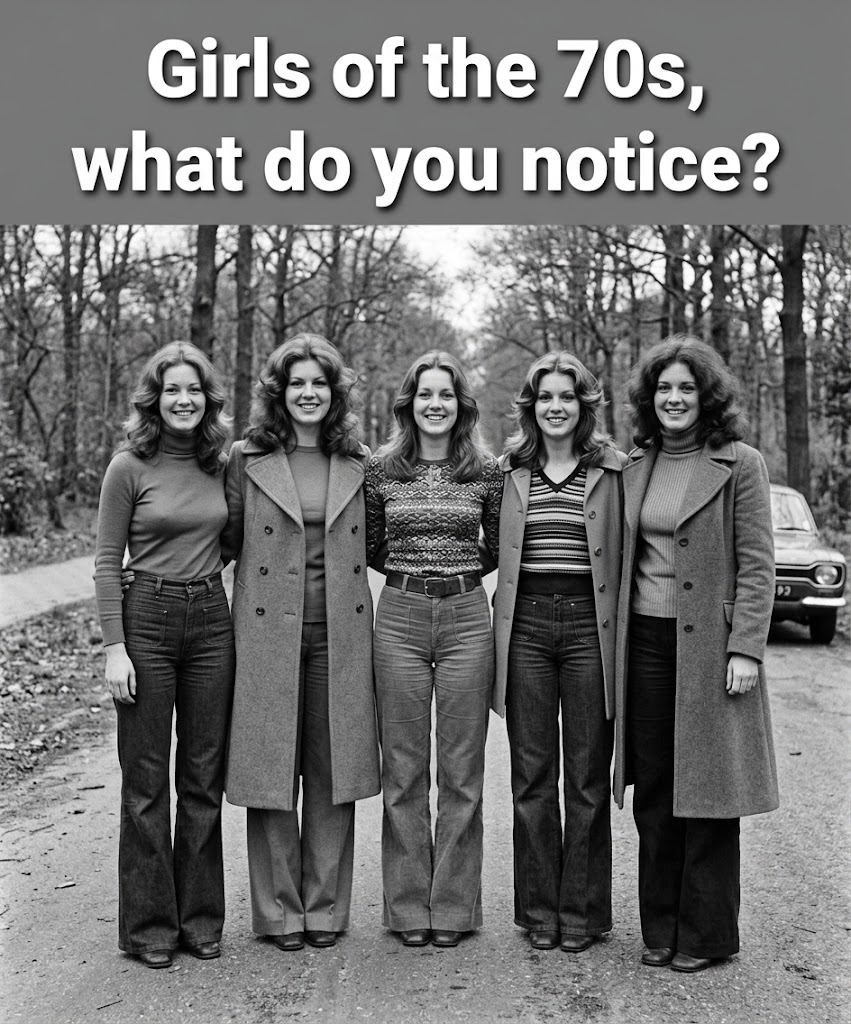
These Ordinary Photos From the 1970s Reveal Something About Life That Many People Have Forgotten
At First Glance, They’re Just Old Photographs Filled With Familiar Faces, Vintage Clothing, and Forgotten Places. But Look a Little Closer, and These Images Reveal How Much Everyday Life Has Changed in Just Fifty Years.
There is something unexpectedly moving about looking at an ordinary photograph taken during the 1970s.
Not a photograph of a legendary musician.
Not an important political moment in history.
Not a celebrity posing on a glamorous red carpet.
Just a simple scene from everyday life.
A family sitting together around the dinner table.
Friends relaxing side by side on a living room couch.
Children playing outdoors in front of a modest suburban house.
Or a young couple posing happily beside a car that would be considered a classic today.
At first, the little details might make us smile.
The oversized collars.
The busy wallpaper patterns.
The hairstyles that seemed to demand impressive quantities of hairspray.
The furniture decorated in shades of orange, brown, and green.
Yet after looking for a little longer, something more meaningful starts to become apparent.
These photographs capture a world that seems both recognizable and far removed from our own.
The people look much like us.
They laugh.
They celebrate birthdays.
They experience love.
They spend time with friends.
Still, countless ordinary aspects of their everyday routines were very different.
There were no smartphones lying next to their plates at dinner.
No social media alerts breaking into their conversations.
No immediate way to capture a moment, edit the image, and share it with hundreds of people.
When someone took out a camera, the people being photographed often had no idea what the finished picture would look like.
They smiled regardless.
And sometimes, many decades afterward, that photograph becomes the only surviving record of an otherwise unremarkable afternoon.
A Photograph Can Make Fifty Years Feel Like Yesterday
One extraordinary quality of old photographs is their ability to make the passage of time feel much less significant.
A photograph from 1975 might capture a family gathered around a Christmas tree.
One person might be wearing a brightly colored sweater.
A child could be sitting on the carpet, playing with a new toy.
An older family member might be smiling comfortably from an armchair.
The image may have faded over the years.
Its edges might be folded or damaged.
Its colors may have changed after spending decades tucked inside a photo album.
Yet the expressions remain familiar.
It is easy to picture the laughter that once filled the room.
Or imagine the conversations that carried on after everyone had finished posing.
Even without knowing the people personally, we can sometimes feel an unexpected connection to their lives.
The World Before Smartphones Was Different
One of the clearest distinctions between the 1970s and modern life is technology.
Smartphones were nonexistent.
Today’s social media platforms had not been created.
There were no group chats delivering messages throughout the day.
No endless streams of short videos to scroll through.
And no expectation that everyone should remain available every minute.
Keeping in touch often required advance planning.
Someone wanting to speak with a friend might call the telephone shared by the household.
If nobody picked up, they would try again later.
Sometimes, the next opportunity to talk would not come until the following day.
For many people, this was simply how life worked.
The Telephone Was Often Shared by the Whole Family
In many homes, the telephone occupied a familiar and permanent spot.
It might rest on a little table in the hallway.
Alternatively, it could be mounted on a kitchen wall.
Some households used rotary telephones with long cords that allowed people to move around while talking.
Whenever the telephone rang, everybody in the house could hear it.
A teenager hoping to have a private conversation might need to wait until other family members were out of the room.
And when somebody else needed to use the telephone, the conversation sometimes had to come to an end.
Privacy and convenience worked differently from what many people are accustomed to today.
Nevertheless, these shared habits became lasting parts of family life and memory.
Making Plans Required a Little More Trust
Picture yourself arranging to meet a friend on a Saturday afternoon.
You might decide to meet outside a cinema at three o’clock.
After leaving home, there was generally no convenient way to send a quick message if something unexpected happened.
If your friend arrived late, you might simply have to wait.
If the arrangements changed, letting the other person know could be difficult.
This did not necessarily make life better.
It could lead to misunderstandings, frustration, and missed meetings.
However, everyday expectations were different.
People often needed to organize their plans beforehand and depend on one another to keep their word without receiving constant updates.
Family Photographs Were Taken More Carefully
Today, taking dozens of photographs in just a few seconds is easy.
People can immediately check how every image looks.
They can remove the pictures they dislike.
And if necessary, they can take another hundred shots.
Photography in the 1970s generally demanded more patience.
Most families relied on cameras that used film.
A roll might contain 12, 24, or 36 exposures.
Every photograph consumed one of those limited opportunities.
As a result, people often considered their shots more carefully before pressing the button.
They brought everyone together.
Asked relatives and friends to move closer.
And hoped nobody closed their eyes at the wrong moment.
Then Came the Wait to See the Pictures
Once a roll of film had been used, it usually needed to be developed before anyone could see the finished photographs.
Families commonly took their film to a photography shop, pharmacy, or another processing service.
Depending on the service, they might have to wait several days before collecting the prints.
When the photographs finally arrived, opening the envelope could feel like a special occasion.
Some images were out of focus.
Others were too dark or poorly exposed.
Someone might have been looking away from the camera.
Despite these imperfections, the pictures often found a place in family albums.
Years later, those little mistakes can become part of their appeal.
Not Every Picture Was Perfect—and That Was Part of Its Appeal
Modern cameras make capturing clear, well-lit photographs easier than ever.
Digital tools can correct lighting and remove unwanted details.
Filters can alter colors and change the appearance of skin tones.
Older family photographs, however, frequently retain their imperfections.
A finger might partially cover the lens.
Someone might be awkwardly cropped out along the edge.
A funny facial expression might go unnoticed until the photographs were developed.
These imperfections can give the pictures a more natural, spontaneous quality.
They remind us that real family memories were rarely as carefully arranged as the images used in advertisements.
Living Rooms Had Their Own Personality
Take a closer look at an ordinary household photograph from the 1970s.
The surroundings can reveal a surprising amount about the period.
Walls covered in wood paneling.
Curtains featuring bold patterns.
Oversized lamps.
Shag carpeting.
And television sets built into large, substantial cabinets.
Some homes embraced vivid colors and geometric designs.
Others had simpler interiors, with useful furniture that remained in the family for many years.
Home decorating differed considerably depending on location, household income, and individual preferences.
Even so, many distinctive design choices from the decade have become instantly recognizable symbols of the era.
The Television Was Often the Center of Attention
During the 1970s, television already played a major role in everyday American households.
Families regularly gathered to enjoy sitcoms, dramas, sporting events, and evening news broadcasts.
Well-known programs included All in the Family, The Mary Tyler Moore Show, Happy Days, and MASH*.
Unlike today’s streaming services, television programming generally followed a set timetable.
If someone enjoyed a particular show that aired on Tuesday evening, they often arranged their schedule around it.
Missing an episode could mean waiting until it was repeated.
That common viewing schedule also gave relatives, friends, and colleagues something to talk about the next day.
Music Filled Homes in a Different Way
Music was another essential part of everyday life.
Record players and stereo systems could be found in many households.
People bought vinyl records and listened to complete albums.
Some households had eight-track players.
Others enjoyed their music through cassette tapes.
Radio also remained an important source of entertainment.
A favorite song might become connected to a summer holiday, a school dance, a long drive, or an evening with friends.
There were fewer convenient ways to play any song whenever someone wanted.
Even so, music remained closely connected to people’s memories and experiences.
Sometimes an Album Was the Entire Evening’s Entertainment
For music enthusiasts, purchasing a new record could be an occasion worth celebrating.
Someone might invite friends over to listen to it together.
They could examine the album artwork.
Read the printed lyrics or information about the musicians.
And enjoy the music from the opening track to the final song.
Of course, people did not all enjoy music in the same way.
Many simply switched on the radio while preparing meals or doing household chores.
Nevertheless, photographs showing record players and music collections remind us that entertainment once had a visible, physical presence in the home.
Music occupied shelves, cupboards, and storage boxes instead of existing entirely within a single electronic device.
Children Played in a World Without Online Games
Photographs of children from the 1970s frequently capture bicycles, playgrounds, backyard activities, and neighborhood streets.
Many youngsters spent hours playing outside.
They played baseball.
Made forts from whatever materials they could find.
Skipped rope.
And created their own games with neighborhood friends.
Other children preferred board games, reading books, watching television, or exploring the early forms of electronic entertainment.
Video games were beginning to appear during this period.
Therefore, it would be incorrect to suggest that children never interacted with screens.
However, childhood recreation followed a different pattern from the digitally connected world children experience today.
A Bicycle Could Represent an Entire Summer
For many youngsters, owning a bicycle meant gaining a new kind of independence.
It made visiting friends more convenient.
It gave them the opportunity to explore local streets and parks.
And it provided a feeling of freedom before they reached driving age.
Old photographs sometimes capture children standing proudly beside bicycles featuring high handlebars, banana-shaped seats, or brightly painted frames.
Their designs might seem unusual to people today.
Yet the pride visible on a child’s face remains instantly recognizable.
They were happy to own something that belonged to them.
Neighborhood Friendships Often Developed Face to Face
Before modern messaging applications became commonplace, children often connected with their friends by visiting their houses.
They knocked on the front door.
Asked whether their friend could come outside.
And waited to find out.
Friendships frequently developed through school, neighborhood activities, sports, and familiar daily routines.
However, childhood was not carefree for everyone.
Local safety, family circumstances, disabilities, discrimination, and financial opportunities all influenced what children experienced.
The past offered freedoms, but it also had its limitations.
Old photographs preserve only a small selection of the experiences people actually lived through.
Clothing Reveals How Fashion Has Changed
Few things identify a photograph from the 1970s as quickly as the clothes people are wearing.
Broad collars.
Bell-bottom trousers.
Platform footwear.
Printed shirts.
Denim jackets.
And carefully arranged hairstyles.
Fashion reflected influences from music, television, youth movements, and changing cultural attitudes.
Disco-inspired clothing became especially recognizable during the latter part of the decade.
Nevertheless, many people continued wearing comfortable, practical outfits that had little connection to major fashion trends.
A photograph taken during a family picnic might feature knitted sweaters and everyday workwear rather than glamorous clothing.
Hairstyles Became Part of the Decade’s Identity
Long hairstyles were fashionable among many young women and men.
Feathered cuts became widely recognizable.
Afros also represented important expressions of personal style, cultural identity, and heritage.
Sideburns, layered hairstyles, and natural hair textures were common throughout the decade.
Looking at these hairstyles today might produce amusement or admiration.
For the people captured in those photographs, however, these styles were simply part of contemporary life.
They were not preparing for a themed party celebrating the 1970s.
They were getting dressed for an ordinary day.
Photographs Reveal the Small Habits We Rarely Think About
Sometimes, the most interesting details in an old photograph have nothing to do with clothing or hairstyles.
Look at how people position their hands.
Notice the way they stand beside one another.
Observe the objects scattered across a table.
Check whether a newspaper rests next to someone’s chair.
Or see whether a handwritten reminder has been attached to the refrigerator.
These small details reveal everyday habits that were once so ordinary that nobody thought they needed an explanation.
This is one reason ordinary photographs are valuable historical records.
They preserve details that formal portraits and major news events frequently overlook.
Handwritten Letters Carried Personal Meaning
Before email and instant messaging became widespread, people relied heavily on handwritten letters to maintain relationships.
Families sent birthday greetings through the mail.
Friends exchanged postcards while traveling.
Couples wrote to each other when they lived far apart.
Relatives sometimes kept letters for decades.
Receiving a handwritten message could feel especially meaningful because someone had taken the time to write it, address the envelope, and send it on its way.
Naturally, letters were slower than electronic communication.
Important news could take several days to reach its destination.
Yet today, a collection of old letters can provide an extraordinary record of family connections and relationships.
Travel Looked Different Without GPS
Long before navigation applications existed, motorists frequently depended on paper maps and road atlases to find their way.
Preparing for a journey could involve studying highways and tracing a route beforehand.
Travelers sometimes stopped at petrol stations or gas stations to ask for directions.
Family members could disagree about which road offered the best route.
And taking a wrong turn could add several unexpected hours to a journey.
Those experiences were not always pleasant when they happened.
Nevertheless, many eventually became stories families enjoyed telling.
Old photographs from road trips often feature cars packed with luggage, roadside attractions, and travelers posing beside scenic viewpoints.
Family Vacations Were Recorded in Small Collections of Pictures
A family taking a modern holiday might return home with thousands of digital photographs.
During the 1970s, some families came back with only a handful of film rolls.
They might take pictures on the first day at the beach.
During a trip to a national park.
At a birthday gathering.
Or beside the car they had used for their holiday.
The resulting photographs would eventually become part of a physical album.
As the years passed, those pictures helped families remember trips that might otherwise have gradually disappeared from memory.
Photo Albums Were Part of Family Life
Many households stored photographs in albums, drawers, or boxes.
Some albums included handwritten dates and the names of the people pictured.
Others contained photographs without any captions.
Years later, relatives might sit together and look through the same collection.
Someone would recognize a familiar face.
“That’s your uncle when he was young.”
Another relative might remember where the photograph was taken.
Someone else could recall an incident from that particular day.
The photograph would become the beginning of a conversation.
Sometimes, it also helped preserve family stories that might otherwise have been forgotten.
Old Photographs Can Also Be Mysterious
Not every photograph comes with a clear explanation.
An old image might show several smiling people whose identities have been forgotten.
Perhaps they are standing outside a restaurant.
Maybe they are gathered around a birthday cake.
Or perhaps they are simply enjoying an afternoon together.
Without captions or living relatives who remember the occasion, reconstructing the story becomes difficult.
We may recognize the clothing and furniture.
We might be able to estimate when the picture was taken.
But we cannot know precisely what the people were thinking.
This uncertainty gives some old photographs an almost haunting quality.
Every Face Once Had a Full Life Beyond the Picture
Imagine an ordinary group photograph taken in 1973.
Everyone appears happy.
One person has an arm resting around a friend.
Someone else is laughing.
Another individual seems distracted by something happening beyond the camera’s view.
It is easy to focus entirely on the captured moment.
Yet every person in that photograph had an entire life outside its boundaries.
They had concerns.
Ambitions.
Responsibilities.
And hopes for the future.
Some would eventually marry or become parents.
Others might relocate to another place.
Friendships could develop or fade.
And over the following decades, some of those individuals would die.
Still, within that photograph, they remain exactly as they appeared during that brief instant.
The 1970s Were Not a Perfect Decade
Nostalgia sometimes encourages people to remember earlier decades as more peaceful than they really were.
However, the 1970s brought considerable political and economic challenges.
Inflation placed pressure on household finances.
Oil crises created shortages, disruption, and uncertainty.
The Vietnam War and the events that followed influenced American society.
Political scandals weakened public trust in government.
And inequality continued to affect many communities.
Women, racial minorities, disabled people, and other groups often faced restrictions and barriers that have changed in many places since then.
Acknowledging these realities does not make old photographs any less emotionally meaningful.
It simply helps us understand the historical circumstances in which those images were created.
Not Everyone Experienced the Same 1970s
Life during the decade depended greatly on where people lived and the circumstances surrounding their families.
A wealthy suburban household might remember spacious homes and family holidays.
A working-class family might recall long working hours and the constant challenge of covering household expenses.
People living in rural areas experienced routines that differed from those of residents in major cities.
Families in different countries also faced distinct political, social, and economic conditions.
There was never one single experience that represented the entire decade.
The photographs that remain today reflect particular individuals, communities, and moments in time.
Yet Ordinary Happiness Was Still Real
Understanding the difficulties of the decade does not mean that the happy moments people remember were somehow less genuine.
People celebrated marriages.
Welcomed newborns.
Formed friendships.
Enjoyed their favorite music.
And discovered happiness in ordinary routines.
Photographs preserve these experiences.
A smiling couple sitting around a kitchen table might have faced serious problems elsewhere in their lives.
Nevertheless, the happiness they experienced in that particular moment could have been completely genuine.
History includes hardship as well as joy.
What Makes These Pictures Feel So Different Today?
One reason old photographs remain fascinating is that they show everyday life before the internet became deeply embedded in people’s routines.
There was no widespread expectation that every social occasion should generate content for an online audience.
Most photographs were taken for personal reasons.
People shared them with relatives and friends.
They placed them in picture frames or stored them in albums.
Many images were never viewed by anyone outside a small circle of family members and acquaintances.
This gives those photographs a different context from pictures created for public social media platforms.
However, it does not mean people in the past were always more genuine or less concerned about their appearance.
Families still posed for photographs.
People still wanted to look attractive in pictures.
And certain moments were deliberately arranged for the camera.
Social Gatherings Often Had a Different Rhythm
Without smartphones, people did not have the same constant access to outside conversations and digital entertainment.
During a gathering, they might spend more time talking to the people sitting around them.
They could also watch television, play records, read magazines, or enjoy games together.
Not having modern digital devices changed the kinds of distractions available.
But it did not automatically make every conversation meaningful.
Someone could still experience loneliness while surrounded by other people.
They could become restless.
They could misunderstand one another.
Life in the past was still human, just as life is today.
Why Some People Miss the Slower Pace
Many adults who remember the 1970s describe having a different relationship with time.
News and information moved more slowly.
Entertainment options were more restricted.
Staying in contact often involved waiting.
That slower pace could certainly be inconvenient.
However, some people also experienced fewer demands to remain constantly available.
Someone could spend an entire afternoon away from the telephone without returning to dozens of notifications.
Work and private life were not always linked through portable electronic devices.
These differences help explain why memories of the decade sometimes carry a feeling of calm and simplicity.
Modern Technology Has Brought Important Benefits
It is equally important to recognize the many improvements that digital technology has introduced.
Families living thousands of miles apart can now see and speak with one another through video calls.
People can contact emergency services and relatives much more quickly.
Navigation applications simplify travel.
Digital cameras allow precious moments to be recorded and shared almost immediately.
Online archives help families preserve their histories.
Accessibility tools have also opened doors that remained closed to many people during the 1970s.
Looking back at the past does not require rejecting everything about modern life.
Instead, it can help us appreciate how everyday routines and opportunities have evolved.
A Single Photograph Can Bring Back an Entire Childhood
For someone who grew up during the 1970s, discovering an old photograph can bring an extraordinary collection of memories rushing back.
The wallpaper in a grandmother’s kitchen.
The sound of a favorite record playing.
The smell of freshly cut grass on a summer afternoon.
The feeling of sitting on a vinyl car seat on a warm day.
Or the anticipation of waiting for birthday pictures to come back from the photo lab.
These things might appear insignificant.
Yet our memories often become connected to ordinary sights, sounds, and feelings.
A single photograph can bring those experiences flooding back.
The People We Miss Are Sometimes Still There in the Album
Perhaps the most touching experience of looking through old photographs is discovering images of people who are no longer alive.
A grandparent seated around the family dinner table.
A parent smiling outside the house.
A childhood friend posing beside a bicycle.
The photograph preserves them from a time when nobody knew what the coming years would bring.
They are simply enjoying an everyday moment.
That can make an old picture both reassuring and heartbreaking.
It gives us an opportunity to see someone again.
At the same time, it reminds us of how many years have gone by.
Sometimes the Smallest Details Hurt the Most
An old photograph might show a parent wearing a watch we remember well.
Or a grandmother holding the coffee mug she used each morning.
Someone might be sitting in a chair that no longer exists.
There is no need for the image to document an extraordinary occasion.
It might simply capture people sharing an ordinary moment in a familiar room.
Years later, however, that everyday scene can become incredibly precious.
Something that once seemed completely ordinary may be impossible to experience again.
Old Pictures Remind Us How Quickly Time Moves
People living during the 1970s did not consider themselves part of a nostalgic period.
They went to their jobs.
Looked after their children.
Managed their household expenses.
Celebrated special occasions.
And made choices about what they wanted from the future.
They had no idea which everyday details would eventually become interesting to later generations.
The same applies to our lives today.
Many things we currently take for granted might seem unusual to people fifty years from now.
Our mobile phones.
Our clothing.
Our vehicles.
And perhaps even the ways we arrange ourselves for photographs.
The Photos We Take Today Will Someday Become History
Imagine someone exploring a collection of family photographs in 2076.
They might be fascinated by objects that seem completely ordinary to us.
They could wonder why people carried small rectangular devices everywhere.
Or why so many photographs were taken in front of mirrors.
They might recognize familiar expressions on people’s faces even if the surroundings look outdated.
Just as we examine photographs from the 1970s, future generations may study the pictures we create today.
Perhaps the details that affect them most deeply will be the simplest ones.
A parent holding a child’s hand.
Friends sharing a laugh.
Or relatives sitting together around a table.
Why Preserving Family Photographs Matters
Old photographs can easily become damaged.
Photographic film and printed images may deteriorate when exposed to excessive moisture, heat, or sunlight.
Albums can disappear during house moves or suffer damage while being stored.
Names and important dates can also be forgotten over time.
Keeping photographs safe helps preserve family history.
Scanning printed pictures creates digital versions that can be stored separately.
Recording names and dates allows future generations to understand who appears in each image.
Conversations with older relatives can also uncover the stories behind photographs before those memories are lost.
Sometimes, a brief five-minute discussion can explain the meaning of a photograph that has puzzled the family for decades.
Ask the People Who Remember
If you have an old family album, consider looking through it with someone who remembers the people pictured.
Find out where the photographs were taken.
Ask who appears in them.
And discover what was happening when each picture was captured.
The answers might surprise you.
A seemingly ordinary photograph could have been taken during a significant family gathering.
An unfamiliar face in the background might belong to a close family friend.
A simple-looking house could have been someone’s very first home.
Every new detail gives the photograph another layer of meaning.
There Is Something Beautiful About Ordinary Moments
The most meaningful photographs are not necessarily those taken during major celebrations or remarkable events.
Sometimes, the pictures we treasure most capture moments when nothing unusual appears to be happening.
A father reading the newspaper.
A mother preparing a meal.
Two brothers or sisters laughing on the front steps.
Friends sitting together around a record player.
Or a family dog sleeping peacefully beside the couch.
At the time, nobody might have thought these moments deserved special attention.
Decades later, however, the photographs preserve parts of a life that can never be reproduced in precisely the same way.
The Hidden Meaning Behind Everyday 1970s Photographs
When people examine photographs from the 1970s, their attention often goes first to the most obvious differences.
The clothing.
The hairstyles.
The household furnishings.
The automobiles.
But the deeper interest comes from recognizing just how much everyday routines have evolved.
People stayed in touch without smartphones.
They frequently arranged meetings without receiving immediate updates.
They watched television according to scheduled broadcasts.
They enjoyed music through physical records and cassette tapes.
And they took pictures without being able to check the results immediately.
These differences do not demonstrate that life was necessarily better back then.
They simply illustrate how people arranged their lives around the opportunities and restrictions of their time.
Technology has evolved.
Our surroundings have changed.
Yet the emotions visible in these photographs remain familiar.
Love.
Friendship.
Excitement.
Uncertainty.
And the quiet pleasure of ordinary experiences.
Look Closely at the Next Old Photograph You Find
The next time you discover a photograph from the 1970s, try looking beyond the clothes people are wearing.
Examine the room.
Notice the furniture.
Look at the expressions on their faces.
Observe the objects in the background.
And pay attention to the little details that might explain how people lived.
Imagine what could have happened just before the photograph was taken.
Perhaps someone had just told a funny story.
A child might have been impatient about having to stand still.
Someone could have been preparing a meal in the next room.
Then the photographer pressed the shutter button.
And a tiny fraction of time became a lasting memory.
We cannot discover every detail about the people whose lives appear in these photographs.
But we can value the memories they have preserved.
A world that existed before many of the technologies we depend on today.
People whose everyday routines differed from our own.
And moments that might otherwise have vanished completely.
The Most Moving Thing About Old Photographs Isn’t What Changed
It is what remained unchanged.
People still wanted affection and companionship.
They still worried about the people they loved.
They continued celebrating birthdays and holidays.
They hoped that the future would bring good things.
And they wanted to hold on to memories of the people who mattered most.
Looking through photographs from the 1970s reminds us that every generation regards its own way of life as normal.
Only as time passes do familiar details become pieces of history.
Clothing becomes vintage.
Cars turn into classics.
Furniture becomes collectible.
And the people in those pictures become younger versions of the parents, grandparents, friends, and relatives we remember.
Some are still here with us.
Others passed away many years ago.
Yet within one moment preserved on a small piece of photographic paper, they remain together.
Smiling.
Laughing.
Enjoying an ordinary day without realizing how meaningful that moment might become in the future.
Perhaps that is the greatest value of looking back.
Not because the world was flawless.
Not because everyone experienced greater happiness.
And not because the past should take the place of the present.
It is because ordinary life deserves to be remembered.
One day, the moments we barely notice today may become the photographs another person carefully holds in their hands.
They might study our faces and wonder what our lives were like.
Just as we wonder about the people who lived half a century before us.
So take photographs.
Record people’s names.
Ask your parents and grandparents to share their memories.
And whenever possible, make time for the people who matter to you.
Because the greatest treasure preserved in those old photographs from the 1970s is not the fashion, the furniture, or the technology.
It is the reminder that time moves quietly, everyday experiences eventually become memories, and the people standing beside us today may one day be the very people we wish we could see in just one more photograph.