The Crying Baby by the Window
The café was crowded that afternoon.
Cups clinked, the espresso machine hissed, and quiet music played beneath the steady hum of conversation. I had stopped for lunch after a difficult morning, hoping for thirty peaceful minutes before returning to work.
That was when I noticed the young woman near the window.
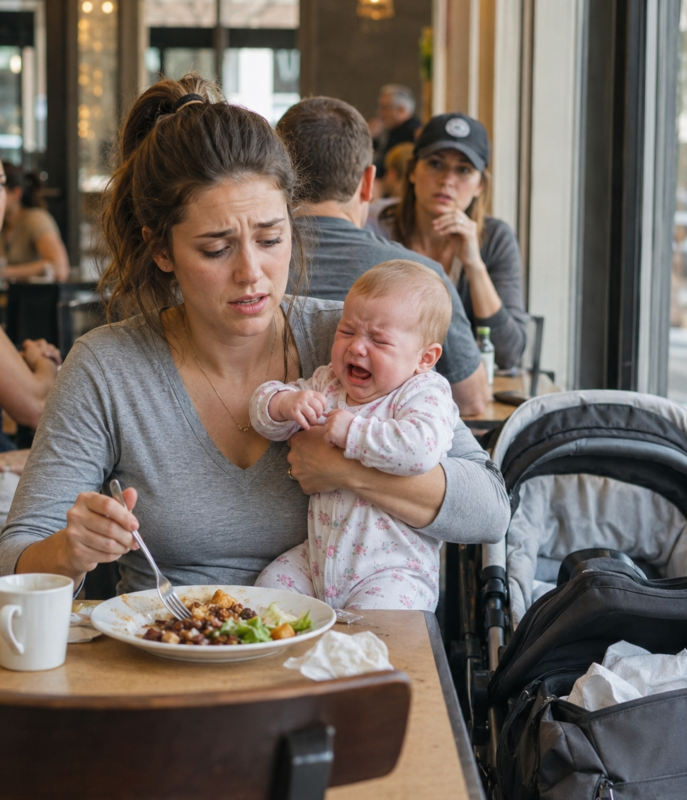
She looked about twenty-eight. Her brown hair was tied in a hurried ponytail, and dark circles rested beneath her eyes. A diaper bag hung from her chair, while a stroller had been squeezed beside the small table.
In one arm, she held a baby who could not have been more than a few months old. With her free hand, she tried to eat a plate of chicken and vegetables.
The moment she lifted her fork, the baby cried.
She immediately set it down, adjusted the blanket, and gently bounced the child against her shoulder.
“It’s okay, sweetheart,” she whispered. “Mommy’s here.”
The crying softened. She reached for her food again.
The baby wailed once more.
This happened again and again.
She checked the diaper, offered a bottle, rubbed the baby’s back, and whispered soothing words. Her lunch sat untouched until the steam disappeared.
The Struggle We All Ignored
People began glancing toward her.
Some looked sympathetic. Others appeared annoyed. Most simply turned away.
I did the same.
I told myself she probably had everything under control. I told myself it might be awkward to offer help to a stranger. Perhaps she would not want anyone near her baby.
But the truth was simpler: I did not want to become involved.
The mother managed one hurried bite before the crying started again. Her shoulders dropped. She closed her eyes for a moment, gathering what little strength she had left.
A server approached.
“Would you like me to warm your meal?”
The woman forced a smile.
“No, thank you. It’s all right.”
It clearly was not.
She looked exhausted in a way that went beyond missing one night of sleep. She looked like someone who had been carrying every responsibility alone for too long.
Then a man at a nearby table shoved back his chair.

The Cruel Outburst
He wore an expensive gray suit and had been working on a laptop while talking loudly into his phone.
He stormed toward the mother.
“Shut down your screaming kid,” he snapped, “or stay home instead of staging this circus!”
The whole café fell silent.
The mother froze.
“I’m sorry,” she whispered.
The man folded his arms.
“Sorry doesn’t make it quieter. Some of us came here to eat in peace.”
His angry voice startled the baby, who cried even harder.
The mother stood quickly, struggling to hold the child while reaching for the diaper bag.
“I’m leaving,” she said, tears spilling down her cheeks. “I’m so sorry.”
She looked around the room, perhaps hoping someone would tell her she did not have to go.
No one did.
Not the older couple beside me. Not the students near the wall. Not the businessman by the door.
Not me.
My chest tightened with shame, yet I remained seated.
Then came a loud bang.
Sarah Drew the Line
A small woman had slammed her fist onto an empty table.
The sound was so sharp that everyone jumped.
She was in her early fifties, barely five feet tall, with silver beginning to show in her dark hair. She wore a black apron over a blue blouse. Her face was calm, but her eyes burned with disappointment.
She slowly looked around the room.
“It’s a shame,” she said, “that my café has become a place for robots without a sign of empathy.”
Then she turned toward the man.
“If you don’t like the sound of a baby, you are free to leave.”
He stared at her.
“Excuse me?”
“You heard me. If you don’t like it, don’t come back. Take your own advice and stay home.”
The man gave a cold laugh.
“You would throw out a paying customer because of this?”
“No,” she replied. “I am asking a cruel customer to leave because he humiliated an exhausted mother in front of an entire room.”
The man looked around, expecting support.
He found none.
A server quietly placed his bill on his table. Red-faced, he grabbed his laptop and walked out.
Only then did I learn that the small woman was Sarah Bennett, the café’s owner.
“You Are Not Leaving”
Sarah’s expression softened as she approached the mother.
“You are not leaving,” she said gently.
“I don’t want to disturb anyone,” the woman replied.
“You are not disturbing me.”
Sarah kept a respectful distance from the baby.
“My name is Sarah. I have four children, and every one of them once screamed in public as if I had personally ruined their lives.”
A few nervous chuckles moved through the café.
The mother’s lips lifted into a faint smile.
Sarah held out her arms.
“May I hold your baby while you eat?”
The mother hesitated. It was the hesitation of someone accustomed to handling everything alone.
Then she nodded.
“This is Emma,” she said. “She hasn’t slept well today.”
Sarah carefully took the baby and rested her against her shoulder.
“Well, Miss Emma, you and I are taking a walk while your mother has lunch.”
She moved slowly through the café, rocking the baby and humming. Within minutes, Emma’s cries softened into tiny hiccups.
The staff removed the cold plate and returned with a fresh, steaming meal, warm bread, and chocolate cake.
“I didn’t order all this,” the mother said.
“It’s from Sarah,” the server replied. “She says mothers need dessert.”
For the first time since I had noticed her, the young woman laughed.
Rachel’s Difficult Morning
Her name was Rachel.
As she ate, an older woman from the next table finally approached.
“I’m sorry I didn’t speak earlier,” she said. “May I sit with you?”
Rachel nodded.
She explained that she had been raising Emma alone since the baby’s father died before the birth. That morning, her refrigerator had stopped working. She had spent hours calling repair companies while carrying a restless baby and had eaten nothing since the previous evening.
“I thought one warm meal might help,” she said quietly. “I didn’t expect to make everyone angry.”
Sarah heard her as she rocked Emma nearby.
“This is exactly why people need public places,” she said. “Not only when they are rested, polished, and perfectly behaved. They need them when they are lonely, overwhelmed, and trying their best.”
Her words landed heavily on me.

My Apology
I had not insulted Rachel or told her to leave.
But I had watched her struggle and decided it was none of my business.
I stood and walked to her table.
“I’m sorry,” I said.
Rachel looked confused.
“For what?”
“For seeing that you needed help and pretending I didn’t.”
Her eyes filled again, but she smiled.
“You don’t have to apologize.”
“Yes,” I replied. “I think I do.”
One by one, other customers came forward.
A student folded the stroller and organized the diaper bag. The older couple offered to pay for the meal, only to learn Sarah had already covered it. A man near the door asked whether Rachel needed a ride home.
The café that had been silent during her humiliation suddenly came alive with kindness.
It should not have taken Sarah’s fist against a table to wake us up.
But it did.
A Table for Anyone Who Needed It
When Emma finally fell asleep, Sarah returned her to Rachel and handed her a card with a phone number written on the back.
“Call me if you ever need someone to hold the baby while you eat, shower, rest, or simply breathe.”
Rachel shook her head.
“I couldn’t ask that.”
“You are not asking,” Sarah said. “I am offering.”
Then Sarah pointed to a large round table near the back.
“Starting next Tuesday, this table will be reserved from noon until two for parents and caregivers. Anyone can come. No purchase required. There will be coffee, changing supplies, and no judgment.”
The customers applauded.
Sarah raised an eyebrow.
“Applause is nice. Showing up is better.”
So we did.
What Happened Next
The following Tuesday, I returned during lunch.
Rachel was there with Emma. So were two grandparents caring for their grandson, a father with twin toddlers, and a nervous new mother who admitted she had barely left home in six weeks.
Sarah warmed bottles, poured coffee, and introduced strangers who soon talked like old friends.
I began volunteering once a week. Sometimes I held a baby. Sometimes I carried trays. Sometimes I simply listened.
Within months, Sarah’s caregiver table became a small community program. Local businesses donated diapers, baby food, and grocery cards. Retired nurses offered practical guidance. Teen volunteers entertained toddlers while parents ate.
Rachel found a new job through another customer at the café. More importantly, she found people who understood the complicated mixture of love, exhaustion, grief, and hope in her life.
She no longer had to carry everything alone.
Kindness Is a Choice
I still remember that afternoon clearly.
I remember Rachel’s trembling hands, the man’s cruel words, and the silence of an entire room.
Most of all, I remember Sarah—a mother of four standing in the middle of her café, refusing to let cruelty become normal.
She taught me that kindness is not always quiet.
Sometimes kindness raises its voice. Sometimes it draws a firm line. Sometimes it tells the cruel person to leave and the hurting person to stay.
I had believed helping required confidence, perfect words, or a special opportunity.
Sarah showed me otherwise.
Sometimes helping means holding a baby so a tired mother can eat.
Sometimes it means warming a cold meal.
Sometimes it means speaking when everyone else is silent.
That day, Sarah did more than defend one exhausted mother.
She reminded an entire room how to be human.
Kindness is not complicated.
You only have to notice.
Then you have to choose it.
Note: This story is a work of fiction inspired by real events. Names, characters, and details have been altered. Any resemblance is coincidental. The author and publisher disclaim accuracy, liability, and responsibility for interpretations or reliance. All images are for illustration purposes only.