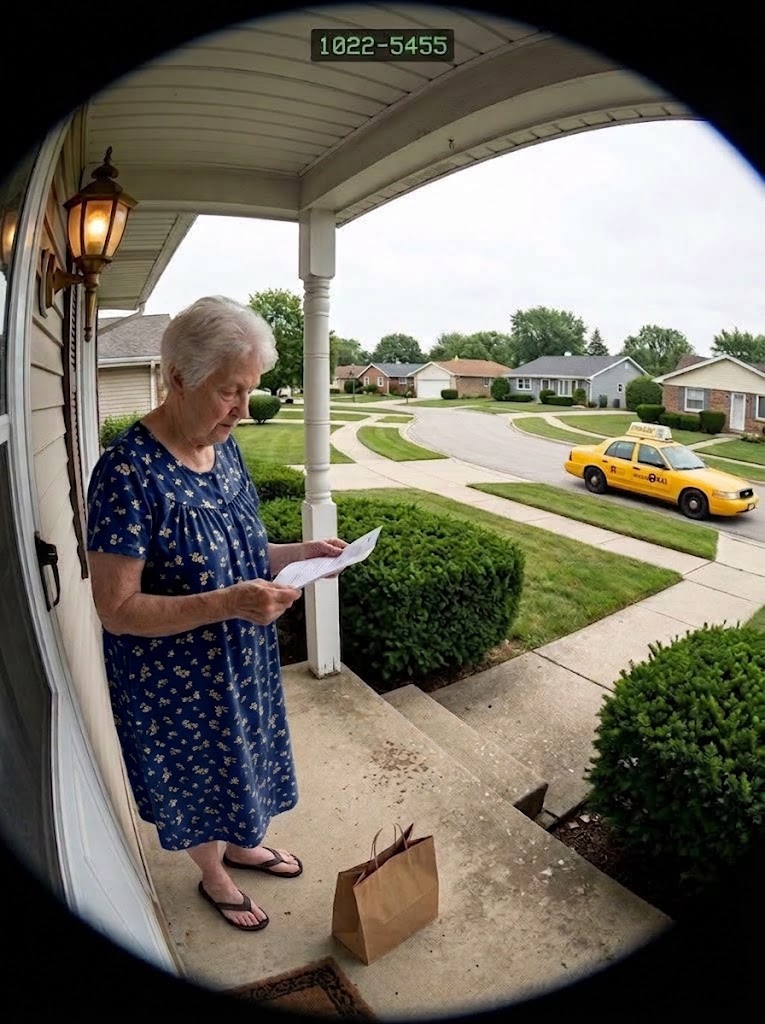
The taxi driver hesitated before pulling away from the curb. He looked in his rearview mirror at the elderly woman standing on the sidewalk, leaning heavily on a cane, a small hospital bag at her feet.
“Are you sure you’re okay, ma’am?”
“It looks like nobody is home.”
Martha forced a smile. “I’m fine, young man. My son… he must have just stepped out. Thank you.”
As the taxi drove away, the smile vanished from Martha’s face.
She was seventy-two years old. She had just spent two weeks in the cardiac ward recovering from a minor heart attack. She had called her son, Kevin, three times to tell him she was being discharged. He hadn’t answered.
Martha turned toward the house.
It was a beautiful, two-story colonial estate that she and her late husband, Arthur, had bought forty years ago. It was where they had raised Kevin, celebrated Christmases, and where Arthur had taken his last breath six months ago.
Martha walked up the path, her legs trembling with weakness.
She reached into her purse for her key and slid it into the lock.
It didn’t turn.
She frowned, jiggling it. It wouldn’t go in.
She stepped back and looked at the brass hardware.
It was new. Shiny, scratch-free, and completely unfamiliar.
Then she saw it.
Taped to the heavy oak door was a piece of printer paper. The corners flapped in the wind.
DO NOT BOTHER KNOCKING. THIS IS MY HOUSE NOW. DAD LEFT IT TO ME.
THERE IS NO ROOM HERE FOR FREELOADERS. GO FIND A NURSING HOME. — KEVIN
The brutality of the words hit Martha harder than her heart attack.
“Freeloader.”
The word echoed in her mind.
She had carried him in her womb. She had paid for his college. She had nursed him through fevers and heartbreaks.
And now, standing on the doorstep of the home she had built, she was a “freeloader.”
A younger Martha might have screamed. A weaker Martha might have collapsed on the porch and wept.
But Martha did neither.
She stared at the note, and a strange, cold clarity washed over her.
The grief for the son she thought she had was replaced by a profound respect for the husband she had lost.
She reached out and touched the cold wood of the door.
“Oh, Arthur,” she whispered. “You were right.
“I defended him for so long. I told you he would step up. But you knew. You always knew.”
She didn’t bang on the door. She didn’t plead with the windows where she could see the faint flicker of the television.
She walked slowly to the garden bench on the porch—a bench Arthur had built—and sat down.
She pulled out her phone.
She didn’t call Kevin.
She dialed a number she had memorized five years ago.
“Hello, Mr. Henderson,” she said when the voice answered. Her tone was steady.
“It has happened. Exactly as Arthur predicted.
“Kevin has changed the locks… Yes. I am on the porch. Please bring the file.
“And bring the locksmith. And perhaps… the sheriff.”
She hung up and wrapped her coat tighter around herself.
She waited.
She wasn’t a victim shivering in the cold. She was waiting for the truth to finally speak for itself.
Inside the warm, well-lit living room, Kevin sprawled on his father’s favorite leather recliner, a glass of expensive scotch in his hand.
Across from him, his wife, Jessica, was flipping through paint swatches.
“I hate this wallpaper,” Jessica said. “We need to gut this whole floor. Open concept.”
Kevin laughed.
“Do whatever you want, babe. It’s ours now. Finally.”
“Are you sure she won’t come back?”
“I changed the locks this morning. Let her try. She’ll see the note and go crying to her sister in Jersey. I’m done carrying her.
“Dad is gone, and the law is the law. I’m the only son. Possession is nine-tenths of the law, right?
“I’m in the house. She’s out.”
He took a long sip.
“I deserve this house.”
They toasted to their new fortune, oblivious to the headlights sweeping across the front window.
Ten minutes later, a loud mechanical drilling sound erupted from the front door.
Kevin jumped up, spilling his scotch.
“What the hell?”
Jessica shrieked, “Is she trying to break in?”
“I’ll handle this,” Kevin growled.
He marched toward the door, ready to intimidate his seventy-two-year-old mother.
But the door swung open before he could reach it.
It wasn’t just Martha.
Standing in the hallway was Martha, looking regal despite her fatigue. Flanking her were two uniformed police officers and Mr. Henderson, the family attorney, holding a thick leather briefcase.
A locksmith stepped aside, packing his drill.
“What is this?” Kevin shouted. “You’re trespassing! Get out! This is my house! Dad left it to me!”
He pointed at the police officers.
“Officers, remove this woman! She doesn’t live here anymore!”
Mr. Henderson stepped forward.
“Mr. Kevin, I suggest you lower your voice. You are currently disturbing the peace in a private residence.”
“My residence!” Kevin yelled. “My father’s house!”
“No,” Mr. Henderson said.
He walked to the dining table and placed the briefcase down with a heavy thud.
The sound silenced the room.
“You are operating under a significant misunderstanding of the facts,” Mr. Henderson continued.
He opened the case and pulled out a document bound in blue legal paper.
“Your father did not leave this house to you, Kevin. In fact, your father did not own this house when he died.”
Kevin froze.
“What? That’s a lie. He built it.”
Martha stepped forward.
She didn’t look at Kevin. She looked at the walls of her home.
“Five years ago,” Mr. Henderson explained, handing a copy of the deed to the police officer to verify, “when Arthur was first diagnosed with his heart condition, he came to my office.
“He executed a Deed of Gift. Five years ago, Arthur transferred the title of this house, the land, and the entirety of his savings accounts into the sole name of Martha Miller.”
Kevin grabbed the paper.
He stared at the date.
It was five years old. It was notarized.
It was ironclad.
“This… this is fake,” Kevin stammered. “Why would he do that? I’m his son!”
“Because he knew you,” Martha said softly.
Mr. Henderson pulled a sealed envelope from the briefcase.
“Arthur left a letter. He instructed me to read it only in the event that Kevin attempted to claim the property against your wishes.”
The lawyer cleared his throat and began to read.
“To Kevin,
If you are hearing this, it means you have done exactly what I feared. It means you have tried to displace your mother from her own home.
I love you, son, but I am not blind. I have watched you for years. I have seen your greed, your laziness, and your entitlement.
I knew that the moment I was gone, you would try to take what you did not earn. So, my final act as a father was not to leave you money. It was to leave your mother protection.
I transferred everything to her years ago to ensure you could never touch it. This house belongs to Martha. The money belongs to Martha.
You have to earn your own way in this world.”
The silence that followed was deafening.
Kevin stood paralyzed. The paper shook in his hands.
The “Dad left it to me” story—the foundation of his arrogance—had crumbled.
He wasn’t the heir.
Jessica, realizing the money was gone, turned on him instantly.
“You said it was yours! You said we were set!”
Martha looked at her son.
“I hoped he was wrong,” Martha said, her voice trembling with tears she refused to shed. “Every day for five years, I prayed that when he died, you would step up. That you would take care of me.
“That this letter would never have to be read.”
She looked at the note Kevin had taped to the door.
“No room for freeloaders.”
“But he was right,” Martha said, her face hardening.
She turned to the police officers.
“Officers, these people are not residents. They have broken into my home and changed my locks without my permission.”
She looked at Kevin.
“I am not a cruel woman, Kevin. I will not press charges, provided you leave. Now.”
“Mom, wait,” Kevin stammered.
“Where do we go? We gave up our apartment lease yesterday! We thought we were moving in!”
“That sounds like a problem for an adult to solve,” Martha said.
She checked the grandfather clock in the hall.
“You have thirty minutes to remove your personal belongings from my house. If you are not out by then, the officers will arrest you for trespassing.
“And Kevin?”
He looked up, tears of self-pity in his eyes.
“Leave the scotch,” she said. “That was your father’s. You didn’t earn that either.”
The next thirty minutes were a blur of frantic packing and humiliation.
Under the watchful eyes of the police, Kevin and Jessica stuffed their clothes into garbage bags.
The victory lap had turned into a walk of shame.
Kevin tried to say something at the door, perhaps a plea, perhaps an apology.
Martha simply closed the heavy oak door in his face.
The sound of the latch clicking shut was the loudest sound in the world.
Mr. Henderson packed his briefcase.
“You did the right thing, Martha. Arthur would be proud.”
“Thank you, Robert,” she said. “Thank you for keeping the secret.”
After the lawyer and police left, Martha was alone.
The smell of Kevin’s cologne and the tension of the confrontation began to fade, replaced by the familiar scent of old wood and memories.
Martha walked to the fireplace mantel and picked up the framed photograph of Arthur.
She traced his face with her thumb.
“You stubborn old man,” she whispered, a tear finally rolling down her cheek. “You saved me.
“You didn’t leave me a fortune to spend. You left me the power to say no.”
But as she stood there in the silence, memories began flooding back.
Kevin had always been their miracle baby, born after years of trying. They had poured everything into him—love, attention, and opportunities.
But somewhere along the way, love had curdled into entitlement.
When Kevin was sixteen, Arthur bought him a used Honda Civic for his birthday.
Kevin had looked at it with barely concealed disgust.
“Everyone at school drives new cars. This is embarrassing.”
Arthur’s face had gone very still.
“Then you can take the bus,” he replied quietly.
Kevin threw a tantrum that lasted three days.
Martha had tried to mediate. She had convinced Arthur to let Kevin keep the car.
That had been the pattern for years.
Arthur would try to teach Kevin responsibility, and Martha would soften the lesson, cushion the fall, and make it easier.
She had thought she was being a good mother.
She hadn’t realized she was creating a monster.
College had been worse.
They paid for everything—tuition at a private university, an apartment off-campus, and a monthly allowance.
Kevin took six years to finish a four-year degree, changing majors three times and failing classes he hadn’t bothered to attend.
Each time Arthur suggested Kevin get a part-time job, Martha defended him.
“He needs to focus on his studies.”
“He’s not studying,” Arthur replied. “He’s partying.”
After graduation, Kevin bounced from job to job.
Nothing was ever good enough.
Arthur offered him a position at his accounting firm—entry level, like everyone else started.
Kevin refused.
“I have a degree. I shouldn’t have to start at the bottom.”
“Everyone starts at the bottom,” Arthur replied. “That’s how you learn the business.”
Kevin eventually found a job at a competitor’s firm, lasted eight months, and was let go for performance issues.
Then came Jessica.
She had expensive tastes, and Kevin spent money he didn’t have. When the bills came due, he came to his parents.
“I need fifty thousand dollars,” he announced one Sunday dinner.
Arthur set down his fork.
“Fifty thousand dollars for what?”
“Debt consolidation. Credit cards. It’s not a big deal. You can afford it.”
“The question isn’t whether I can afford it,” Arthur said quietly. “The question is why you think I should pay for your poor decisions.”
Kevin’s face darkened.
“Because I’m your son. Because that’s what parents do.”
“No,” Arthur said. “Parents teach their children to be responsible. They don’t enable them to be perpetual children.”
The argument that followed was vicious.
Kevin accused Arthur of being cheap and of not loving him.
Martha tried to intervene, but Arthur was immovable.
“No, Martha. Not this time. He needs to fix this himself.”
Kevin and Jessica left in a fury.
They didn’t speak to Arthur for six months.
Then Arthur was diagnosed with a heart condition.
Martha expected Kevin to come around and show concern for his father.
Instead, Kevin’s first question was about Arthur’s life insurance.
“How much is the policy worth?” he asked.
“Kevin, your father is sick. That’s what should matter.”
“I’m just being practical, Mom. We need to know what we’re dealing with.”
That was when Arthur made his decision.
He called Robert Henderson, the family attorney, and arranged a meeting without telling Martha.
When he came home that evening, he was quiet.
“I need to tell you something,” he said.
“I’ve transferred the house and the accounts into your name alone.”
Martha was shocked.
“Why? Arthur, that’s not necessary—”
“It is necessary,” he interrupted gently.
“Martha, I love you. I’ve loved you for forty-five years. But you have a blind spot when it comes to Kevin. You always have.”
“He’s our son—”
“He’s a man in his thirties who has never held a job for more than a year, who spent money we gave him on luxury cars and designer watches while claiming he couldn’t afford rent.
“He’s a man who only calls when he wants something. And I know, the minute I’m gone, he’ll try to take everything.”
“He wouldn’t,” Martha protested weakly.
“He will,” Arthur said with certainty.
“And when he does, you’ll be protected. Everything is in your name. He can’t touch it.
“But Martha, you have to promise me something.”
“What?”
“If he tries—when he tries—you have to be strong. You can’t give in. You can’t make excuses for him anymore.
“Promise me.”
Martha promised, though she didn’t really believe it would come to that.
Arthur’s condition deteriorated over the next year.
He had two heart attacks, spent weeks in the hospital, and underwent multiple procedures.
Through it all, Kevin visited exactly twice.
The second time, he came with Jessica.
As they were leaving, Kevin pulled Martha aside.
“When Dad goes,” he said quietly, “we need to talk about the house. Jessica and I have been thinking about moving. Your place is way too big for just you.”
“Kevin, your father isn’t dead yet,” Martha said, horrified.
“I’m just saying, we should plan ahead. You’ll probably want to downsize anyway.”
That night, Arthur was unusually alert.
“He asked about the house, didn’t he?”
Martha nodded.
“I told you,” Arthur said. “But it’s done. You’re protected.
“When I’m gone, you call Robert Henderson. He has the letter I wrote. Everything is arranged.”
Three weeks later, Arthur died peacefully in his sleep, Martha holding his hand.
At the funeral, Kevin cried, but even through her grief, Martha noticed something off about his tears.
At the reception, she overheard Jessica talking to one of Kevin’s cousins.
“Finally,” Jessica said. “We’ve been waiting for this for years.
“Kevin deserves this house. He’s the only son. It’s basically tradition.”
Martha had felt ice in her veins.
Arthur had been right.
In the days after the funeral, Kevin became suspiciously attentive.
Martha started to hope that maybe Arthur had been wrong.
Then she had her heart attack.
It happened in the garden, two weeks after Arthur’s funeral.
Martha had been planting roses—Arthur’s favorite—when the chest pain started.
She managed to call 911 before collapsing.
She spent two weeks in the hospital.
Kevin didn’t visit once.
She called him three times to let him know she was being discharged.
The first call went to voicemail.
The second time, he answered but said he was busy and would call back.
He never did.
The third time, Jessica answered Kevin’s phone.
“Kevin’s not available,” she said curtly.
“I’m being discharged from the hospital tomorrow,” Martha said. “I was hoping Kevin could pick me up.”
“We’re busy tomorrow. Can’t you take a taxi?”
Martha took a taxi.
And when she arrived home to find the locks changed and the note on the door, she finally understood.
Arthur hadn’t been harsh.
He had been right.
Now, standing in her living room, Martha understood what Arthur had given her.
Not just financial security.
Not just a roof over her head.
He had given her the power to set boundaries. To say no. To refuse to be victimized by her own child.
The grief was profound—not for Arthur, who she knew had loved her until his last breath, but for the son she thought she had.
But along with the grief came something unexpected: relief.
For forty years, she had been the mediator, the peacemaker, the one who made excuses.
Now, she didn’t have to hope anymore.
Kevin had shown exactly who he was.
And Arthur had ensured she didn’t have to sacrifice her security to that truth.
The next morning, Martha woke in Arthur’s leather chair where she had fallen asleep.
Her phone buzzed.
A text from her sister, Carol, read:
“Heard what happened. Kevin called me crying, saying you threw him out. What’s going on?”
Martha replied:
“He changed the locks while I was in the hospital and posted a note calling me a freeloader. Arthur protected me years ago. I’m fine. The house is mine.”
Carol called immediately.
“He did what?!”
Martha explained everything—the note, the confrontation, Arthur’s foresight, and the letter.
“Oh, Martha,” Carol breathed. “Arthur really did know.”
“He did,” Martha agreed. “I just wish I’d listened to him sooner.”
“You wanted to believe the best about your son. That’s not a character flaw.”
“It is when it blinds you to reality,” Martha said. “But I see clearly now.”
Over the next few weeks, Martha received several phone calls from Kevin.
She didn’t answer.
His voicemails progressed from angry to pleading to guilt.
“Mom, it’s me. Look, maybe we got off on the wrong foot. Let’s talk about this like adults.”
“Mom, Jessica left me. She said I promised her the house. This is your fault.”
“Mom, please. I’m your son. Doesn’t that mean anything?”
Martha deleted each one.
She also received calls from relatives who had heard Kevin’s version of events.
To each one, Martha sent a copy of the deed showing the house had been in her name for five years.
“Arthur knew what he was doing. I trust his judgment.”
The relatives stopped calling.
Three months after the confrontation, Martha made a decision.
The house was too big for one person, but she wasn’t going to sell it.
Instead, she converted the upper floor into a rental apartment.
She rented it to Elena, a twenty-four-year-old nursing student who worked night shifts at the hospital while finishing her degree.
Elena reminded Martha of herself at that age—determined, grateful, and willing to sacrifice for her future.
Having Elena in the house changed everything.
The house felt alive again.
Elena began helping Martha with small things—carrying groceries, shoveling snow, and changing lightbulbs she couldn’t reach.
“You don’t have to do this,” Martha told her.
“I know,” Elena said. “But you gave me a chance when I really needed it.”
Martha had to turn away to hide her tears.
This stranger was showing her more kindness than her own son ever had.
Through neighborhood gossip, Martha learned pieces of Kevin’s situation.
Without the house he had promised Jessica, she left him within a week.
He moved into a small apartment and began trying to find work.
Some people suggested Martha should help him.
She thought about that carefully.
Would Arthur want her to help Kevin?
She remembered his letter:
“You have to earn your own way in this world.”
No.
Arthur wouldn’t want her to rescue Kevin.
But Martha wasn’t entirely heartless.
She had Robert Henderson set up a trust—a small one, twenty thousand dollars—that would be available to Kevin under specific conditions: if he held steady employment for a full year, completed a financial management course, and demonstrated that he had changed.
“The money will be there if he earns it,” she told Henderson. “But he has to actually earn it. No shortcuts. No excuses.”
She instructed Henderson not to tell Kevin about the trust.
If Kevin changed, it would be because he wanted to change, not because there was money waiting for him.
A year after the confrontation, Martha was in her garden planting the roses she had been trying to plant when she had her heart attack.
The doorbell rang.
Elena returned a moment later with an uncertain expression.
“Martha? There’s someone here to see you. He says he’s your son.”
Martha’s heart clenched.
Kevin stood on the front porch, but he looked different.
Thinner. Older.
His clothes were clean but worn.
He held a small bouquet of grocery-store flowers.
“Mom,” Kevin said quietly. “Can I talk to you?”
Martha didn’t invite him inside.
Instead, she gestured to the bench Arthur had built—the same bench where she had sat waiting for Henderson that terrible day.
They sat in silence.
“I got a job,” Kevin finally said. “It’s nothing special. I’m managing a shipping department for a wholesale company.
“But I’ve been there eleven months. My boss says if I make it to a year, there might be a promotion.”
Martha said nothing.
“Jessica’s married,” Kevin continued. “To some finance guy.
“She never loved me. She loved what she thought I could give her.”
“You tried to give her my home,” Martha said quietly.
Kevin flinched.
“I know. Mom, I’ve spent the last year thinking about what I did. What I’ve been. And I’m so ashamed.”
“You should be,” Martha said.
“I am,” Kevin agreed.
“I read Dad’s letter over and over. At first, I was angry. I thought he’d betrayed me.
“But then I started really reading it. ‘You have to earn your own way in this world.’ I’d never done that. Everything I had, someone else gave me.
“And I never appreciated any of it.”
He looked at her directly.
“I don’t expect you to forgive me. I don’t expect anything from you anymore.
“I just wanted you to know that Dad’s letter—that final lesson—it worked.
“It took a year of living in a studio apartment and eating ramen and having my car repossessed, but I finally get it.
“Work matters. Earning your own way matters. Being responsible matters.
“And I’m so sorry it took losing you for me to figure it out.”
Martha felt her own eyes fill with tears.
“What do you want, Kevin?”
“I don’t want anything. I’m not here to ask for money or to apologize my way back into your will.
“I just wanted you to know that I’m trying to be the son Dad wished I would be. Even though he’s not here to see it.”
“I see it,” Martha said softly.
Kevin looked at her, surprised.
“I see it,” she repeated. “And Kevin, your father would be proud that you’re finally learning this lesson. It’s late, but it’s not too late.”
“I don’t deserve your kindness,” Kevin said.
“No,” Martha agreed. “You don’t. But that’s the thing about grace. It’s not about deserving.”
She took the flowers from his hand.
“I’m not ready to let you back into my life,” Martha said. “You hurt me deeply, Kevin. And trust takes time to rebuild.”
“I understand.”
“But if you continue on this path—if you keep showing up, keep working, keep being responsible—then maybe, someday, we can have a relationship again.
“A real one. Not the one where I make excuses for you and you take advantage of my love.”
“I’d like that,” Kevin said. “More than anything.”
They sat in silence for a while.
Then Kevin stood.
“I should go. I have a shift in an hour.”
“You have a shift on Sunday?”
“Overtime,” he explained. “I’m saving up. The apartment I’m in now is… well, it’s what I can afford. But I’m working toward something better. Something I earn myself.”
As he started down the walkway, Martha called after him.
“Kevin?”
He turned.
“There’s a trust,” she said. “Your father and I—well, I set it up.
“If you keep working, if you complete a financial management course, if you show sustained responsibility… there’s twenty thousand dollars waiting for you.
“Not a fortune. But maybe enough to help with a down payment on a modest place.
“When you’re ready.”
Kevin’s face worked through several emotions.
“You don’t have to—”
“I don’t have to do anything,” Martha interrupted. “But your father believed in consequences, not cruelty.
“He wanted you to learn to stand on your own. But once you learned that lesson, he wouldn’t want you to struggle forever.”
“Thank you,” Kevin whispered.
“Earn it,” Martha said. “Not for the money. Earn it because that’s who you want to be.”
Kevin nodded and walked away.
Martha watched him get into a beat-up sedan—not the BMW he used to drive, but a reliable used car he had probably saved up for.
Elena appeared at her side.
“That was your son? The one who locked you out?”
“Yes,” Martha said.
“Are you okay?”
Martha thought about the question.
A year ago, her husband had died. Her son had betrayed her in the worst way possible. She had suffered a heart attack. She had been called a freeloader and locked out of her own home.
But she had survived.
More than that, she had prevailed.
She had set boundaries. She had refused to be victimized.
And now, maybe, her son was finally becoming the person he should have been all along.
“Yes,” Martha said.
“I’m okay.”
That evening, Martha sat in Arthur’s leather chair with a cup of tea, looking around the living room.
Elena was upstairs. She could hear the faint sound of her studying.
The house felt warm, lived-in, and safe.
Martha picked up Arthur’s photograph from the mantel.
“He came to see me today,” she told the picture. “Our son.
“And Arthur, I think your letter finally got through to him. I think he’s finally learning.”
She traced his face with her finger.
“You saved me.
“Not just from Kevin, but from myself. From my need to fix everything, to make excuses, to smooth everything over.
“You gave me permission to expect better. To demand better.”
The house settled around her with familiar creaks and groans.
Forty years of memories lived in these walls—birthdays and holidays, arguments and laughter, sickness and health.
“Thank you,” Martha said to Arthur’s photograph.
“Thank you for seeing what I couldn’t see. Thank you for loving me enough to protect me from my own blind spots.
“Thank you for teaching me that sometimes love means saying no.”
She set the photograph back on the mantel and looked around her home—the home Arthur had ensured would always be hers.
“This isn’t just a house,” she said softly.
“It’s the fortress you built around me.
“And I promise you, Arthur, I’ll never apologize for standing strong inside it.”
Outside, spring rain began to fall, gentle and cleansing.
Inside, Martha was warm and safe and whole.
The house that love built stood firm, just as Arthur had intended.
And Martha Miller, once locked out of her own home, now stood taller than she ever had—protected by her husband’s wisdom, strengthened by her own resilience, and finally, finally free.