Part 2: The Dog Who Became His Eyes
Dale raised three fingers six inches in front of his father’s face.
They were sitting inside Dale’s pickup in the sale barn parking lot. The engine was still running, but neither man had spoken since Dale had helped his father out of the auction ring.
“How many fingers, Dad?”
Elmer narrowed his eyes. His gaze drifted slightly to the left of Dale’s hand.
“Two,” he answered.
Dale slowly lowered his hand. “How long has this been happening?”
His father remained silent for a long moment. Outside, the wind scattered dry brown corn leaves across the gravel.
“Three years,” Elmer finally admitted. “The eye doctor in Spencer called it macular degeneration. The center of my vision is gone. I can still make out the edges of things, shapes, light, and darkness. That’s pretty much all I have left.”
“Three years?” Dale tightened his grip on the steering wheel. “You’ve been running a cattle farm by yourself, practically blind, for three years—and you never told me?”
“You would’ve put me in Lakeside Manor,” Elmer replied. “Then you would’ve sold the farm. I’d have been dead within a month, sitting in a chair and staring at a wall I couldn’t even see.”
Dale started to respond, then closed his mouth. His father was right. That was exactly what he would have done.
“Then how?” Dale whispered. “How have you managed all this time?”
For the first time that day, Elmer smiled.
“Kip.”
He spoke slowly, as he always did. During the first summer his eyesight began to fail, he had tripped over a water trough and broken two ribs. The following morning, Kip began walking on his left side, pressed tightly against his knee. He had done it with every step ever since.
“He nudges my leg whenever there’s a step ahead,” Elmer explained. “If there’s a hole, he leans against me. When I get too close to the creek bank, he steps in front of me and refuses to move. If the bull is out in the pasture, he puts himself between us.”
Elmer shook his head, still amazed by it all.
“I never taught him any of those things. He worked it out himself.”
Kip brought the cows toward the gate so Elmer could count them by listening. At dusk, when even the outlines of things became difficult to distinguish, the dog guided him safely back to the house. Whenever Elmer dropped his tractor keys in the grass, Kip would find them.
“A cow can’t round up cattle,” Elmer said softly. “A dog can. But that isn’t what I meant back there, son.”
He stared through the windshield, looking toward a world he could no longer properly see.
“That dog herds me.”
Dale buried his face in his hands.
Then he shifted the truck into gear and drove eleven miles to Lindgren Veterinary Clinic, on the southern edge of Spencer.
Dr. Karen Lindgren met them at the entrance. She was a solidly built woman in her fifties, with reading glasses hanging from a chain around her neck. She had cared for Elmer’s animals for twenty years.
“Your father hasn’t told you what happened when he arrived here Sunday night, has he?” she asked Dale.
Dale shook his head.
“Kip developed bloat. His stomach twisted, something that can happen to deep-chested working dogs. They can’t vomit, their abdomen swells dramatically, and without emergency surgery, they can die within hours.”
She turned toward Elmer.
“He called me at two in the morning. Then he drove here himself. Eleven miles over gravel roads in the dark, moving at fifteen miles an hour with his hazard lights on and following the white line along the road.”
Dale turned toward his father, staring at him in disbelief.
“Kip was dying in the passenger seat,” Elmer said simply. “What else could I do?”
They returned to the recovery room.
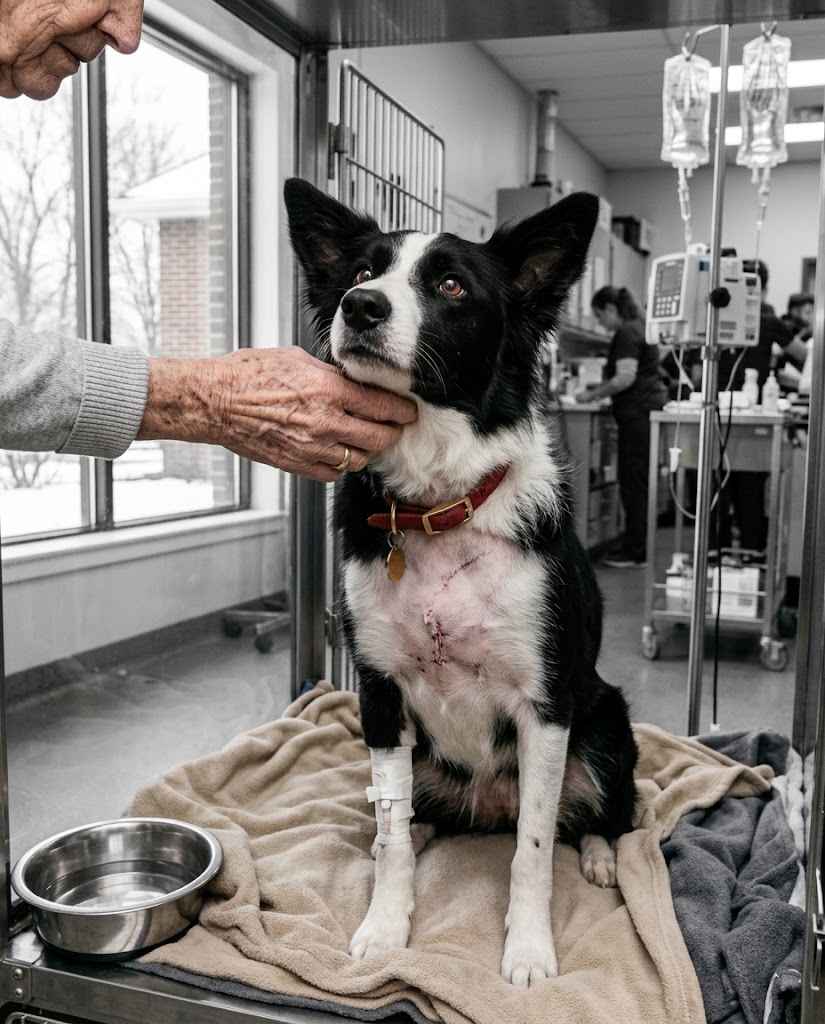
Kip lay on a thick blanket inside a steel kennel. He was a black-and-white border collie with an uneven white blaze running down his face, one black front leg, one white front leg, and a small notch missing from the tip of his left ear. A long line of surgical staples ran down his shaved abdomen.
The instant he recognized Elmer’s footsteps, he lifted his head and tried to stand. His hind legs trembled beneath him.
“Easy, boy. Take it easy.”
Elmer located the kennel door by touch and lowered himself onto the concrete floor. Kip pushed his entire face into the old man’s hand and let out a soft whine.
Dr. Lindgren cleared her throat.
“The surgery went well. I performed it because I trusted you to pay me. The bill comes to forty-eight hundred dollars.”
Elmer nodded.
“You’ll have the money by Friday.”
He reached into the pocket of his overalls, took out Kip’s red leather collar, and carefully fastened it around the dog’s neck again. A battered brass tag dangled from the ring.
Dale glanced at the tag.
All the color drained from his face. Without saying a word, he turned and walked out of the room. A moment later, the clinic’s front door slammed behind him.
The young veterinary technician looked bewildered. She leaned forward and read the tag aloud.
“‘KIP. If found, call Tyler.’”
She raised her eyes.
“Who’s Tyler?”
Elmer gently stroked the notch in the dog’s ear.
“My grandson,” he answered. “Dale’s boy.”
He fell silent for a moment.
“He would’ve turned twenty-eight this spring.”
Part 3: Tyler’s Dog
Tyler Hoyt had always been a boy who felt most at home outside.
He was Dale’s only son, a freckled, lanky teenager with a permanent grin. Ever since he learned to walk, he had begged to visit his grandfather’s farm. By fourteen, he spent nearly every summer there, sleeping in the small upstairs bedroom and waking at five each morning to help feed the cattle.
“He wanted that farm more than anything,” Elmer explained. He sat on a bench in the clinic waiting room while Dr. Lindgren brought him a cup of coffee. “And he had a real gift for the work. Some people are just born knowing what to do.”
When Tyler turned eighteen, he spent all the money he received for graduation on a border collie puppy from a breeder near Sheldon. The pup was skinny and awkward, with long legs, black-and-white fur, and a crooked white blaze. During his first week, he caught his ear on barbed wire, leaving the tip permanently notched.
“Tyler called him Kip,” Elmer said. “He trained him every evening in my north pasture. By the time that dog was a year old, he could bring in forty head of cattle all by himself.”
Dale had imagined a different future for his son. He wanted him to attend college, study engineering, and build a life that didn’t require getting up before dawn and praying for rain.
The two fought about it throughout Tyler’s senior year. Their arguments at the kitchen table were loud, bitter, and painful.
“Dale blamed me,” Elmer admitted. “He said I’d filled his boy’s head with cattle and farm work. Maybe I had.”
That fall, Tyler enrolled at Iowa State University to keep the peace at home. But every weekend, he drove back to the farm. He didn’t head to his parents’ house in town. Instead, he went straight to his grandfather and Kip.
One Sunday night in January, during his freshman year, Tyler was driving back from the farm after dark. A layer of ice covered the gravel road. Near the bend by the old Swanson property, his pickup slid off the shoulder, dropped into the ditch, and rolled over.
Tyler was nineteen.
Kip was riding in the passenger seat.
“Somehow, the dog managed to get out through the broken window,” Elmer said quietly. “He walked two miles through the snow to my farm. He was bleeding from his shoulder. At eleven that night, he scratched at my door.”
Elmer stared down into his coffee.
“That’s how I found out something had happened. Before the sheriff even called, I opened the door and saw Tyler’s dog standing there alone.”
Dr. Lindgren removed her glasses and wiped away tears.
“After the funeral, Dale couldn’t bear to look at Kip,” Elmer continued. “Seeing that dog reminded him of the ditch and the accident. So Kip stayed with me.”
He placed his coffee cup on the table.
“Dale hasn’t touched him in eight years. Not once.”
“And the tag?” the veterinary technician asked gently. “It still has Tyler’s name on it.”
“Tyler put it on him during that first week. I could never bring myself to replace it.”
That was the dog everyone in town believed Elmer was foolish to spend so much money on: a nine-year-old border collie.
But Kip was also the last living thing Tyler Hoyt had ever loved.
When Elmer came outside, Dale was sitting in his pickup. The engine was off, and he stared straight ahead through the windshield.
Elmer felt along the side of the truck until he found the passenger door, then climbed inside.
For several minutes, neither man spoke.
“You should’ve sold that dog eight years ago,” Dale finally said. His voice was cold and expressionless. “You should’ve let him go. Every time I drive out here and see him, I…”
The words failed him.
He started the truck and drove his father home to the farm without saying another word. He didn’t come inside or even say goodbye.
That night, Elmer stood alone in his kitchen, without Kip beside him for the first time in eight years. He couldn’t locate the light switch.
It didn’t matter. He couldn’t see the light anyway.
On Thursday, the telephone rang.
It was Lyle Brandt from the sale barn.
“Elmer, those cows of yours have sold,” Lyle told him. “Both Rosie and Belle.”
“What did they bring?”
“That’s the strange part.” Lyle sounded uneasy. “Twenty-six hundred dollars each. Fifty-two hundred altogether. Almost twice what they’d normally bring on a good day. There was a phone bidder who refused to let anyone else get them.”
Elmer slowly lowered himself into a chair at the kitchen table.
“Who bought them?”
Lyle paused.
“The buyer asked me to keep his identity to myself, Elmer. I promised I wouldn’t tell you.”
Part 4: The Creek Bank
Nine days later, Kip finally returned home.
He was thinner and moved stiffly, with his staples removed and a long pink scar running down his belly. But as soon as Elmer opened the truck door in the farmyard, Kip jumped down, shook himself, and immediately took his familiar place against the old man’s left side, pressing against his knee.
Elmer burst into laughter.
The fifty-two hundred dollars covered the veterinary bill, leaving four hundred dollars to spare. He never learned from Lyle who had purchased the cows.
Three weeks later, however, the truth found him.
It was a damp, gray afternoon in early November. Three consecutive days of rain had swollen Willow Creek, which bordered the southern pasture. Brown water rushed through the channel, running high and fast as it tore at the banks.
Dale was driving along the county road. He hadn’t visited the farm since the day at the veterinary clinic. He told himself he was simply checking to make sure his elderly father hadn’t fallen on the porch steps.
From the road, he spotted Elmer.
His father was walking down the southern pasture slope, heading directly toward the creek. He was approaching the most dangerous section of the bank, where the rain had washed away the soil, leaving a six-foot drop into the rushing water below.
Elmer couldn’t see it.
“Dad!”
Dale slammed on the brakes, jumped out, and shouted again.
“Dad, stop!”
The wind swallowed his voice. Elmer continued walking. Ten feet from the edge. Then eight.
Suddenly, a black-and-white blur came racing across the pasture.
Kip burst from the direction of the barn, his ears flattened and his body low to the ground. He ran faster than Dale had ever seen him run. Reaching Elmer, he cut directly in front of him and planted himself sideways, pressing his entire body against the old man’s shins.
Elmer stopped just two feet from the drop.
He reached down until his hand found Kip’s head and chuckled softly.
“All right, all right. I hear you, boy. We’re going the wrong way.”
Kip leaned against his legs and began guiding him backward, pushing gently and steadily up the slope, away from the dangerous water.
Dale stood frozen by the fence, one hand covering his mouth.
He watched Kip lead his father all the way back to the barn. The dog nudged Elmer’s knee at every uneven patch of ground, stopped him at the fence wire, and guided him safely through the gate.
It was exactly as his father had described in the pickup.
Dale crossed the muddy yard and entered the barn. Elmer turned toward the sound of his approaching boots.
“Who’s there?”
“It’s me, Dad.”
There was a long pause.
“Didn’t expect you.”
“I saw it,” Dale said, his voice cracking. “I saw what Kip did down by the creek.”
Elmer remained silent.
“I was the one who bought the cows,” Dale confessed. “Rosie and Belle. After I left you at the clinic, I called Lyle from the parking lot and made him promise to keep it secret.”
Elmer’s expression slowly changed.
“Why would you do that?”
“Because I knew you’d sell every cow on this farm to save that dog. And I couldn’t let you sacrifice everything by yourself.”
Dale wiped his eyes with his sleeve.
“They’re in my pole barn in town. Every night after work, I go out there to feed them. I even talk to them. Makes me feel like a crazy person.”
He glanced down at Kip, who sat quietly beside Elmer’s left knee, watching Dale with his calm brown eyes.
“I hated him, Dad,” Dale whispered. “For eight years, I hated that dog because he got out of that truck and Tyler didn’t. I know it’s wrong. I know it isn’t fair. But whenever I saw him, I couldn’t stop thinking, why did he survive? Why did God leave me with the dog instead of my son?”
Silence settled over the barn, broken only by the rain striking the tin roof.
“And all this time,” Dale continued, “he’s been keeping you alive. He’s been doing what I should’ve done. What Tyler would’ve wanted someone to do.”
Slowly, his knees aching, Dale lowered himself into the straw.
Then he did something he hadn’t done in years. He put two fingers into his mouth and whistled two short, rising notes.
It was the same whistle he remembered hearing from his son on summer evenings across the north pasture.
Kip’s head immediately turned toward him.
The dog rose and crossed the straw-covered floor. He sniffed Dale’s outstretched hand for several seconds before pushing his entire head into it, just as he had always done with Tyler.
Dale wrapped his arms around the dog and buried his face in his black-and-white fur. He sobbed uncontrollably, like a little boy who had lost everything.
Elmer stood beside them, resting one hand on his son’s shoulder.
That moment marked the beginning of five more years together.
Five years during which Kip continued working every day.
Until one November morning, when he failed to come to the door.
Part 5: The Edge of the North Field
Those five years were the happiest Elmer Hoyt had experienced since his wife, June, died.
Every morning at 6:30, Dale began driving to the farm before the elevator opened. At first, he came only to help with the chores. Soon, he was staying for coffee at the kitchen table. Then he began having breakfast with his father.
Eventually, he simply came because that was where he wanted to be.
Without fail, Kip met Dale’s truck at the end of the lane each morning. He trotted beside the bumper all the way up the driveway, then waited at the porch steps, looking from Dale to the kitchen door until Dale went inside to see his father.
“He’s herding you now,” Elmer joked when he first heard about the routine.
Kip continued working every day. He gathered the cattle, walked the fence lines with Elmer, and kept watch over the farm.
At ninety-one, ninety-two, and ninety-three, Elmer still walked across his land with one hand resting on the black-and-white back beside his left knee. Kip never allowed him to fall.
The years gradually caught up with the dog, too. His muzzle turned gray, and his white front leg grew stiff during cold weather. By fourteen, he spent most afternoons sleeping in a sunny spot on the porch.
But every morning, he still waited at the end of the lane for Dale’s truck. And every evening, he guided Elmer through the pasture.
On the day everything changed, a storm was approaching.
The radio forecast snow by nightfall. The cattle were scattered across the north pasture, half a mile from the barn. At ninety-five, Elmer stood on the porch, listening to the wind.
“Go bring them in, Kip,” he said.
The old dog slowly rose and headed out.
Dale watched from the porch as Kip moved across the brown grass. At first, his pace was slow. Then he picked up speed, circling widely behind the herd just as Tyler had taught him eighteen years earlier.
The cattle gathered together, turned in the direction he wanted, and gradually began moving toward the barn.
Nearly an hour passed before the old dog finished the job.
Every single animal made it home.
Afterward, Kip returned to the porch, found Elmer, and guided him down to the mailbox and back one final time through the fading gray light, nudging his knee whenever they reached a rut.
At dusk, as the first snowflakes began drifting down, Kip did something he had never done before.
He walked away from the house by himself and headed toward the far edge of the north field. He made his way to the old cottonwood standing along the fence, the very tree where a freckled teenage boy had once sat with his puppy on summer evenings, watching the sunset.
Kip lay down beneath its branches.
He never returned.
By morning, snow covered the farmyard, leaving everything white and silent. Elmer stood on the porch, calling into the cold air.
“Kip! Kip!”
There was no answer.
At eight o’clock, Dale found him.
Kip lay peacefully at the foot of the cottonwood, his nose resting against his white paw. Frost covered his black-and-white coat. His body faced the house.
He had worked right up to his final day.
Dale carried him back to the porch in his arms. Kneeling in the snow, Elmer reached out with both hands, searching for the dog. His fingers found the notched ear, the dented brass tag, and finally the still, cold chest.
For a long time, the old man made no sound.
Then he spoke quietly.
“Bury him at the edge of the north field. Under the cottonwood. Put a big stone there.”
Dale nodded, unable to find his voice.
“That’s where I want to be buried, too,” Elmer added. “When my time comes. Right beside him.”
They buried Kip that afternoon in the frozen ground. Dale spent three hours digging the grave himself with a pickax.
After that, Elmer seemed to give up.
He stopped eating. He stopped walking the fence lines. Without Kip beside his left knee, he couldn’t find his way to the barn, the gate, or the creek.
Twice that week, he fell on the porch steps. On another occasion, he became lost between the house and the machine shed. Dale eventually found him standing in the snow, trembling and calling for a dog who would never come back.
Day after day, Elmer sat beside the kitchen window, facing the north field even though his failing eyes could no longer see it.
On the tenth day, Dale drove to Lakeside Manor in Spencer. He returned home carrying a folder filled with admission paperwork.
That evening, while his father sat silently at the kitchen window, Dale took a pen and began completing the forms.
Part 6: Two Jobs
He made it to the second page before stopping.
One question left him staring at the paper: Personal belongings the resident wishes to bring.
He had no idea what his father would choose. How could a single page describe the possessions a man might want to carry from an entire lifetime?
Dale put down the pen and went upstairs to look for an answer.
He hadn’t entered the little upstairs bedroom in thirteen years. It had belonged to Tyler, and Elmer had never changed anything. The narrow bed remained in place. An Iowa State pennant still hung on the wall, and dusty cattle magazines sat on a shelf.
On the nightstand, beneath a layer of dust, Dale discovered a small spiral notebook.
He opened it.
Inside were pages of training notes written in his son’s untidy teenage handwriting.
June 3. Kip learned “come bye.” Brought in 6 head.
July 19. Forty head by himself!!! Grandpa says he’s the best dog in Clay County.
Page after page contained similar entries. Dale sat on the edge of the bed and read every one.
The final entry was dated during the second week of January, just seven days before the icy road accident.
Heading back to Ames tomorrow. Gave Kip his new job: take care of Grandpa while I’m gone. He’s getting old and won’t admit it. Kip understands, I swear he does.
My job: fix things with Dad. I’m going to tell him I’ll finish my degree in ag business. Then I’ll come home and run the farm with Grandpa. Maybe Dad will finally be proud of that. Maybe he’ll start coming out on weekends. All three of us.
Kip’s job: Grandpa. My job: Dad. Deal.
Dale read those lines three times.
Then he went downstairs, sat across from his father at the kitchen table, and read the entry aloud.
Elmer listened with his head bowed. By the time Dale finished, the old man’s shoulders were shaking.
“He did it,” Dale said, his voice thick with emotion. “Dad, that dog did both jobs.”
Elmer slowly raised his head.
“Just think about it,” Dale continued. “Kip looked after you for thirteen years. He protected you from the creek, helped you manage your eyesight, kept you away from the bull, and guided every step you took. That was his job. Tyler gave it to him.”
“I know,” Elmer whispered.
“But Tyler never got the chance to do his own job. He never got to make things right with me.”
Dale’s voice broke completely.
“So Kip did that, too. Every morning for five years, he met my truck at the end of the lane and walked me right to your door. Every single morning, Dad. If it hadn’t been for him, I would’ve dropped off the feed and driven away. I know myself. I would’ve kept hating that dog and avoiding this house until you were gone.”
He covered his face with both hands and wiped away his tears.
“He brought me home,” Dale whispered. “That stubborn old dog herded me home to you.”
Elmer reached across the table, searched for his son’s hand, and held it tightly.
For a long time, the two men sat without speaking.
Finally, Dale picked up the Lakeside Manor papers. He looked at them for a moment, then tore them in half. He tore the pieces in half again.
“What are you doing?” Elmer asked as he heard the paper ripping.
“I’m not sending you anywhere,” Dale answered. “I’ve worked at that elevator for thirty-one years. I can retire in January. I’m moving into Tyler’s room.”
“Dale…”
“You need someone on your left side, Dad,” he said. “I’m not as clever as Kip, but I’m going to learn.”
The old man began laughing through his tears.
There was one more thing Dale needed to bring home.
Part 7: Rosie and Belle
On the first warm Saturday in April, Dale backed a borrowed stock trailer up the long gravel driveway of the Hoyt farm.
Elmer waited on the porch, one hand resting on the railing. He heard the diesel engine, the trailer rattling, and the creaking sound of the tailgate being lowered.
Then came a sound he would have recognized anywhere.
A deep, rough, unmistakable bawl.
“Rosie?” he whispered.
Dale guided the cows down the ramp, one after the other. Rosie and Belle had grown older, with gray beginning to appear around their eyes, but they were still broad and glossy.
Two of their daughters followed them, born while the cows had been living in Dale’s pole barn in town.
Five years earlier, an old man had led two cows into an auction ring because he needed money to save his dog.
Now his son was bringing those same cows back home.
Elmer carefully descended the porch steps with Dale walking beside him on his left. He reached out, and Rosie pressed her enormous, warm nose into his palm.
Elmer laughed until tears ran down his face.
That afternoon, nearly half the regular Tuesday crowd from the Spencer sale barn came out to the farm. Lyle Brandt arrived with a flatbed truck and a winch. Dr. Lindgren brought a casserole.
Together, they placed a large piece of pink granite at the edge of the north field, beneath the old cottonwood where a boy and his puppy had once watched the sun disappear beyond the horizon.
Dale had hired a man in Spencer to carve the inscription.
KIP. Good dog. He did both jobs.
Elmer traced every letter with his fingertips. When he had finished, he turned toward his son.
“Leave some space,” he said. “On his left side.”
“Why on the left?” Dale asked quietly.
“That’s where he always walked.”
They remained there together for a long time in the spring wind: an old man and his son standing at the edge of a field the old man could no longer see.
Behind them, Rosie and Belle slowly grazed across the fresh green grass. Eventually, they stopped beside the fence near the stone, as though they, too, had been brought there for a reason.
When it was time to return to the house, Elmer instinctively reached down beside his left knee, curling his fingers as if expecting to find the dog’s familiar back.
His hand met empty air.
Then another hand reached for his.
It was his son’s hand, resting exactly where Kip used to walk.
Dale guided his father slowly across the north field, gently nudging his knee whenever they reached a rut, just as he had watched the dog do for five years.
He made sure his father never fell.
If this story touched your heart, follow our page for more stories that remind us why dogs are the best of us. ❤️