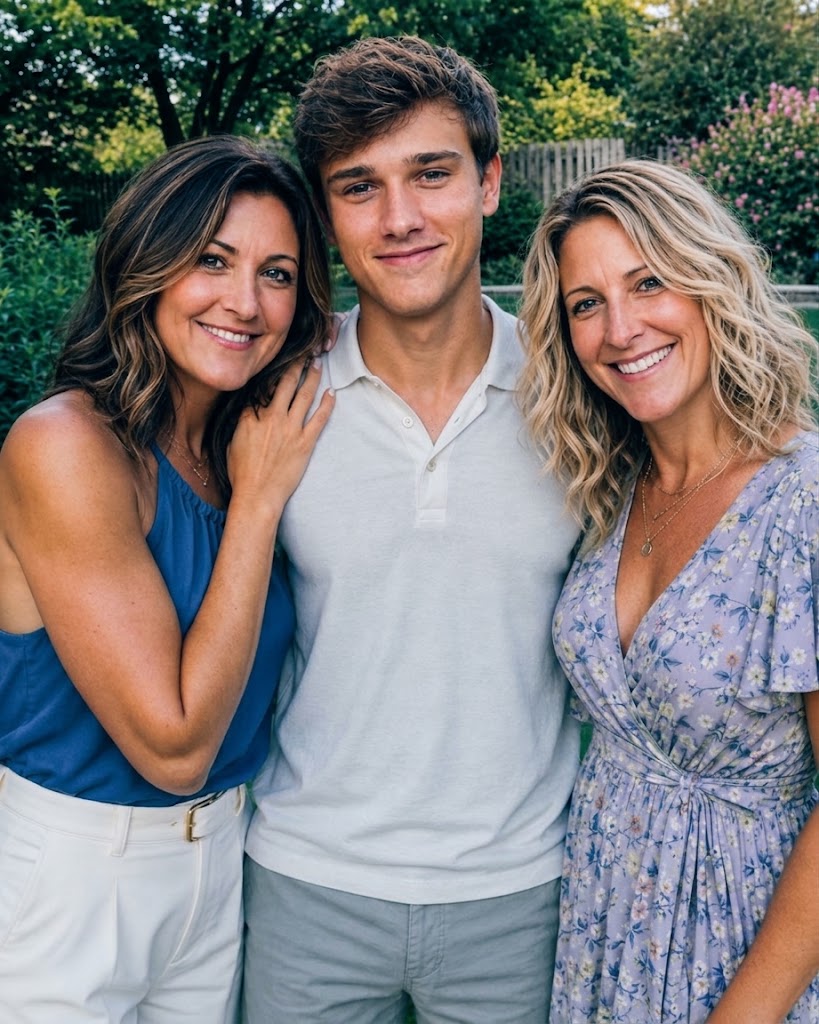
The waitress caught me three steps from the restroom. Her hand gently touched my arm, but her words made my stomach drop.
“You need to know what your son has been doing here all these years,” she whispered.
I glanced toward our booth.
My eighteen-year-old son, Leo, was smiling over a slice of chocolate cake. My husband, Daniel, was telling him a ridiculous story about getting lost in a grocery store. Across from them, my best friend Chloe sat stiffly, twisting a paper napkin between her fingers.
For ten years, I had believed this diner was simply a place where Chloe took Leo whenever he became overwhelmed.
I thought I understood their routine.
I thought I understood my best friend.
But I had no idea that, behind that quiet diner’s blue doors, my son had been building a future one small step at a time.
The Boy Who Needed a Map
Leo was eight when Chloe first offered to take him out by herself.
At that age, he loved maps, numbers, weather patterns, and anything with a clear beginning and ending. He could tell you the exact route between our house and the library, but an unexpected change in plans could leave him frozen.
Busy places were difficult for him. Too many voices could become one loud wall of sound. A blender starting suddenly could make him cover his ears. If strangers asked him several questions in a row, his words sometimes disappeared completely.
Leo was autistic, and he had always experienced the world in his own precise and sensitive way.
He was funny, affectionate, observant, and incredibly bright. He also needed more time than other children to feel comfortable in unfamiliar situations.
By the time he turned eight, our days were filled with school meetings, therapy appointments, schedules, visual reminders, and careful planning.
I loved my son more than anything in the world, but I was exhausted.
I was afraid to admit that.
Then Chloe came to visit one Saturday morning.
She had been my best friend since we were children. We had shared bedrooms during sleepovers, whispered secrets beneath blankets, and survived every awkward phase of adolescence together.
Chloe never treated Leo like a problem to solve.
She didn’t say, “I’ll teach him how to act normal.”
She said, “I’ll learn how he communicates.”
That morning, she stood in our kitchen holding a small backpack filled with snacks, headphones, wet wipes, and a notebook.
“I want to take him out for a few hours,” she said.
I immediately shook my head.
“What if he has a meltdown?”
“Then I’ll bring him home.”
“What if he refuses to leave?”
“Then we’ll sit somewhere quiet until he’s ready.”
“What if—”
She smiled gently. “Then we’ll handle it.”
Leo was sitting at the table, lining up three blue pencils beside his plate. He looked up when Chloe approached.
“Do you want to go with me?” she asked.
“Where?”
“We can choose together.”
She let him pick the place.
He chose a small park near the library, where there were rarely many people. Chloe took him there, and three hours later, they came home with a leaf, a library book, and a paper bag of French fries.
“Where did you get those?” I asked.
“The Maple Street Diner,” Chloe answered.
Leo nodded. “Booth six.”
I laughed. “You went to a diner?”
“Only for fries,” Chloe said quickly. “He got overwhelmed at the park because a dog barked near him. The diner was quiet, so we sat in the back.”
I thanked her, and that was the end of it.
At least, I thought it was.
The Friend Who Never Made Him Pretend
After that, Chloe began visiting once a month.
Sometimes she took Leo to the library. Sometimes they walked through quiet stores or visited a small garden center. She always returned with some little detail about their afternoon.
“He counted all the red flowers.”
“He found a book about trains.”
“He ordered his own drink today.”
And sometimes Leo mentioned the diner.
“Ruth was working.”
“The jukebox was off.”
“I had fries with ketchup on the side.”
Whenever I asked what they had done there, Chloe gave the same answer.
“We just stopped for food when he needed a break.”
I believed her.
Why wouldn’t I?
Chloe was patient with him. She never rushed him or pressured him to make eye contact. If he became quiet, she didn’t fill the silence with nervous questions. If he needed to wear his headphones, she let him.
Those monthly outings gave me a few hours to breathe.
Sometimes I cleaned the house.
Sometimes I went grocery shopping alone.
Sometimes I sat in my car in a parking lot and drank coffee without anyone asking me for anything.
I felt guilty about enjoying that time, but Chloe always reminded me that rest did not make me a bad mother.
“You can love him completely and still need a break,” she would say.
Over the years, the diner became part of Leo’s vocabulary.
At ten, he began asking for Booth Six.
At twelve, he started remembering the waitresses’ names.
At fourteen, he told me that the diner had “the best system for napkins.”
I smiled whenever he mentioned it, assuming it was simply a familiar place where he felt safe.
I never imagined it had become something much more.
The Birthday He Wouldn’t Compromise On
Last week, Leo turned eighteen.
We had talked about having a small celebration at home, but I wanted him to choose.
“Where would you like to go?” I asked him over breakfast.
He didn’t hesitate.
“The Maple Street Diner.”
Chloe, who had come over to help us decorate, nearly dropped the ribbon she was holding.
“Maybe we could try that new Italian restaurant,” she suggested.
Leo frowned.
“No. The diner.”
“There’s a beautiful steakhouse downtown,” Chloe continued.
“The diner.”
“Or we could order from that sushi place you liked.”
“The diner.”
I looked at Chloe.
She was smiling, but it was forced. Her fingers kept picking at the edge of the ribbon.
“Why are you trying so hard to change his mind?” I asked.
“I’m not,” she said too quickly. “I just thought his eighteenth birthday should be somewhere special.”
Leo pushed his plate away.
“The diner is special.”
That ended the discussion.
My husband, Daniel, drove us there that evening. Leo sat in the back seat with his headphones around his neck, watching the familiar streets pass by.
When the blue sign of Maple Street Diner appeared ahead, he leaned forward between the seats.
“There it is.”
Chloe turned around and smiled at him.
“Yes,” she said quietly. “There it is.”
The diner looked exactly as I remembered it from the few times I had stopped there over the years. Chrome trim, red booths, warm yellow lights, and a large glass window covered with hand-painted specials.
We slid into Booth Six.
Leo sat beside Daniel. Chloe and I sat across from them.
At first, everything seemed normal.
Daniel asked Leo what kind of cake he wanted. Leo explained, in great detail, why chocolate cake was superior to vanilla. Chloe laughed, but she kept glancing toward the kitchen.
She looked nervous.
Not a little nervous.
She was constantly shifting in her seat, folding and unfolding her napkin, and avoiding my eyes.
Halfway through the meal, an older waitress approached carrying a slice of chocolate cake with a single candle.
She had silver hair pulled into a bun and a warm smile that immediately softened when she saw Leo.
“Happy birthday, sweetheart,” she said.
Leo’s face lit up.
“Thank you, Ruth.”
The waitress leaned down and gave him a gentle wink.
“For eighteen, we give you two candles next time.”
Leo smiled.
For the first time that evening, Chloe seemed to relax.
I noticed.
I just didn’t understand why.
The Whisper by the Restroom
After dinner, I excused myself to use the restroom.
I had barely stepped into the hallway when Ruth appeared beside me.
She looked toward our booth.
Then she lowered her voice.
“You need to know what your son has been doing here all these years.”
My heart began to pound.
“What do you mean?”
Ruth glanced back again.
“Don’t worry. He isn’t in trouble.”
That was supposed to comfort me, but it didn’t.
“What happened?”
She took a breath.
“Chloe brought him here the first time when he was eight. He sat in that booth and arranged the sugar packets by color. He didn’t speak to anyone.”
I stared at her.
“Leo told me he liked the way everything worked here,” she continued. “The menus, the tables, the orders, the timers. Everything had a place.”
I remembered Leo’s obsession with patterns.
Ruth continued.
“After a few visits, he started asking questions. He wanted to know how we kept track of orders. He wanted to know how we knew which table needed what. He began helping me fold napkins and organize the condiment baskets.”
“You mean he worked here?”
“Not at first,” she said. “He practiced. Chloe asked if we could let him help during quiet hours. We made sure he was supervised. He never went near the grill or anything dangerous. We gave him small tasks, one at a time.”
I looked toward the booth.
Leo was now tracing the edge of his cake plate with one finger while Daniel talked to him.
Ruth smiled.
“At first, he only folded napkins. Then he learned to greet people. Later, he practiced taking simple drink orders. We made a picture menu for him because it helped him feel prepared.”
I felt as if the hallway had tilted beneath me.
“Why didn’t anyone tell me?”
“He asked us not to.”
The answer hurt more than I expected.
Ruth reached into the pocket of her apron and pulled out a small red card.
“What’s that?”
“Leo’s break card. When he was younger, he would become overwhelmed but didn’t know how to explain it. So we helped him create this. If he showed the card, everyone knew he needed ten quiet minutes.”
I touched the edge of it.
“He made this?”
“He designed it. He also helped us change a few things around here.”
“What kind of things?”
Ruth’s expression turned proud.
“He suggested that we turn off the music during the slowest hour on Saturdays. He asked us to warn people before starting the blender. He made visual menus for customers who don’t like being rushed. We now have a quiet seating area near the window.”
I looked past her toward the front of the diner.
There was a small sign near the host stand.
QUIET TABLES AVAILABLE. TAKE YOUR TIME. NO RUSH.
I had seen it before.
I had never wondered who created it.
“Leo did all that?”
“He did it with help,” Ruth said. “But yes, the ideas were his.”
She lowered her voice again.
“He has been preparing to work here since he was twelve. When he turned sixteen, he told us he wanted a real job someday. When he turned seventeen, he asked Mr. Alvarez if there might be a place for him.”
“Mr. Alvarez?”
“The owner.”
I knew the name. Mr. Alvarez had owned the diner for more than thirty years.
“What did he say?”
“He said Leo could have a job when he turned eighteen, as long as Leo still wanted it.”
My eyes began to burn.
Ruth reached for my hand.
“Tonight is his first official shift.”
I looked at her in confusion.
“But he’s sitting at the table.”
“He wanted to have dinner with his family first. Afterward, he plans to show you.”
“Show me what?”
Ruth gave me a sad, tender smile.
“The apron with his name on it.”
Ten Years in Booth Six
Ruth led me to a small office behind the kitchen.
The room was simple, with a desk, a filing cabinet, and a corkboard covered in photographs.
I saw Leo at eight years old, sitting stiffly in Booth Six with a plate of fries.
Another picture showed him at ten, arranging silverware.
At thirteen, he was standing beside Ruth, holding a stack of menus.
At sixteen, he was wearing headphones while entering information into a tablet.
The last photograph had been taken only a few weeks earlier.
Leo stood behind the diner’s host stand, smiling with quiet confidence.
Beside the photographs was a thick black binder.
“May I?” I asked.
Ruth nodded.
The first pages contained simple checklists.
- Count menus.
- Check napkins.
- Review table numbers.
- Ask before clearing plates.
- Take a break when needed.
- Try again tomorrow if today is hard.
The handwriting changed over the years as Leo grew older.
Some pages had short notes.
Today I said hello first.
Today I needed help, and I asked.
Today I took three drink orders.
Today I got overwhelmed and came back after ten minutes.
Today I did not quit just because something was difficult.
I pressed my hand over my mouth.
Ruth stood quietly beside me.
“He wanted you to see this tonight,” she said. “He told me that if he lost his nerve, I should explain.”
“Why would he lose his nerve?”
“Because he loves you very much.”
The words struck me.
Ruth turned to another page.
There was a letter written in Leo’s careful handwriting.
Mom,
I know you worry that my life will be small. I know you try to make everything easier because you love me.
But I am learning that different does not mean small.
I need time. I need plans. I need people to explain things clearly.
But I also need chances to try.
I wanted to show you something I built instead of telling you about every time I was scared.
Love,
Leo
The words blurred as tears filled my eyes.
For ten years, I had thought Chloe was giving me a break while helping Leo pass the time.
I had not realized that Leo was using those hours to practice independence.
Not independence that looked like everyone else’s.
His own kind.
Careful, structured, deliberate, and completely his.
The Truth Chloe Had Been Carrying
When we returned to the booth, Chloe knew immediately that Ruth had told me.
Her shoulders fell.
“You knew,” I said.
She nodded.
“How long?”
“Not everything at first,” she answered. “It started with fries. Then Leo began asking questions. Eventually, he asked if I could help him practice.”
“You let me believe it was just a diner.”
“I know.”
“Why?”
Chloe looked down at her hands.
“Because he asked me not to tell you.”
I felt hurt and angry, but I also knew Chloe well enough to recognize the guilt in her face.
“He was afraid that if you knew, every visit would become a test,” she continued. “He thought you might start asking what he learned, whether he was ready for a job, whether he was improving.”
I opened my mouth, then stopped.
Because she wasn’t completely wrong.
I had spent years tracking Leo’s milestones.
The first time he spoke to a cashier.
The first time he stayed at a birthday party.
The first time he ordered food without my help.
I had celebrated every step, but sometimes my excitement had turned those steps into expectations.
Chloe wiped her eyes.
“I should have told you when it became more serious. I know that now. I was trying to protect his promise, but I should have respected your place as his mother too.”
I looked at her for a long moment.
“You should have.”
“I’m sorry.”
The apology was quiet and sincere.
I reached across the table and took her hand.
“I’m still hurt.”
“I know.”
“But I also know you never did this for attention. You never told anyone because you wanted credit.”
Chloe shook her head.
“I wanted him to have one place where he wasn’t being watched for progress.”
Before I could answer, Leo looked up.
“Ruth told you?”
I nodded.
“You knew she might?”
He nodded back.
“I told her she could tell you if I couldn’t.”
“Why didn’t you tell me yourself?”
He considered the question carefully.
“Because I wanted to give you the good part.”
My chest tightened.
“What good part?”
He pointed toward the kitchen.
The Present Waiting Behind the Counter
A few minutes later, Mr. Alvarez came out from behind the counter.
He was a broad-shouldered man with gray hair, kind eyes, and a white apron tied around his waist.
In his hands was another apron.
It was dark blue, with a small name tag sewn above the pocket.
LEO
He placed it in front of my son.
“Your first official apron,” he said.
Leo touched the name tag.
“It’s exactly right.”
Mr. Alvarez smiled.
“You’re sure you still want the job?”
Leo nodded.
“I’m sure.”
“Then we’re offering you the Saturday afternoon host position. Three hours to start. Paid training, regular breaks, and a schedule posted in advance.”
Leo looked at him seriously.
“I need changes explained before they happen.”
“I know.”
“I may need headphones during the loudest part.”
“That’s fine.”
“I don’t want people touching me from behind.”
“We’ll make sure everyone understands.”
“And if I need to leave early, I will tell you.”
Mr. Alvarez extended his hand.
“Then we have an agreement.”
Leo shook it.
Not dramatically. Not perfectly.
But firmly.
I felt tears slip down my cheeks.
Daniel placed a hand on my shoulder.
Then Leo turned toward me.
“I also applied for the hospitality program at community college,” he said.
I blinked.
“You did?”
“Yes. One class at a time.”
“What do you want to learn?”
“How restaurants work. Maybe food preparation later. But I like the front. I like helping people know what happens next.”
That sentence explained everything.
Leo had never been trying to become someone else.
He had been learning how to help people feel safe because he knew what it felt like when the world became confusing.
Ruth brought out a small stack of cards.
Leo handed one to me.
It said:
PLEASE TAKE YOUR TIME.
NO NEED TO MAKE EYE CONTACT.
ASK BEFORE TOUCHING.
EVERYONE BELONGS AT THE TABLE.
“You made these?” I asked.
“We made them together,” he said. “But I wrote the words.”
A young couple entered the diner just then, followed by a little girl covering her ears.
The blender suddenly started behind the counter.
The girl flinched.
Leo noticed immediately.
He took a breath, put on his apron, and walked toward the front.
He did not rush.
He did not force himself to look directly at anyone.
He simply approached the family and held out a menu.
“Hi,” he said. “Welcome to Maple Street Diner. We have a quiet table by the window if you’d like one.”
The little girl looked at him.
He pointed toward the seating area.
“There’s less noise over there.”
Her mother smiled with relief.
“That would be wonderful.”
Leo led them to the table.
When he returned, he looked at me.
“Well?”
I stood up.
“May I hug you?”
He nodded.
I wrapped my arms around him, and he hugged me back.
For a few seconds, I held the boy he had been and the young man he was becoming at the same time.
What I Had to Learn
After dinner, Chloe and I stood beside the car while Daniel and Leo remained inside talking to Ruth.
The parking lot was quiet. The diner’s blue sign reflected on the wet pavement.
“I’m sorry,” Chloe said again.
“I know.”
“I should have included you.”
“Yes.”
She nodded.
“I also understand why he needed something that belonged only to him.”
I looked through the window.
Leo was standing beside Booth Six, explaining something to Daniel with animated hands.
“I thought I was protecting him by staying close,” I said. “But sometimes I was so focused on preventing disappointment that I forgot he deserved the chance to surprise himself.”
Chloe squeezed my arm.
“You never stopped believing in him.”
“Maybe not. But I was always afraid of the world hurting him.”
“That’s different.”
“It is. But fear can still become a cage if you’re not careful.”
The next Saturday, Leo worked his first official shift.
He dropped a stack of menus.
He forgot one customer’s drink order and had to ask again.
The diner became loud, and he took a break in the office with his headphones on.
When he came back, he started over.
No one treated the difficult moments like disasters.
No one turned the successful moments into a performance.
They simply helped him continue.
That was the kind of support he had needed all along.
Not someone dragging him toward a future.
Someone willing to stand nearby while he built it.
The Waitress Hadn’t Revealed a Secret
A few months later, the quiet seating area became a regular part of the diner.
Families came during the Saturday afternoon quiet hour. Some customers were autistic. Others had migraines, anxiety, hearing difficulties, or simply preferred a calmer place to eat.
Leo helped update the visual menus.
He created a small card that explained how customers could request a quieter table.
He learned every employee’s name and every table number.
He still wore headphones when the diner became too loud.
He still needed plans.
He still had hard days.
But now, when he needed a break, he didn’t see it as failure.
He saw it as part of the plan.
Chloe continued visiting once a month, but now she no longer took him to the diner in secret.
Sometimes I joined them.
Sometimes I stayed home and let them have their own time.
That was part of growing, too—his independence and mine.
On Leo’s nineteenth birthday, we returned to Booth Six.
Ruth brought out a cake with two candles.
“Happy birthday, sweetheart,” she said.
Leo laughed.
“I’m nineteen now.”
“I know,” she replied. “But you’ll always be my sweetheart.”
He looked at me across the table.
“Mom, are you proud?”
I reached for his hand.
“More than you know.”
“Okay,” he said. “But don’t tell everyone all at once.”
I laughed through my tears.
“I’ll try.”
For years, I thought the waitress might one day reveal that something terrible had happened in that diner.
Instead, she revealed a decade of courage.
She showed me the quiet work my son had done when no one was applauding.
One folded napkin.
One greeting.
One order.
One break.
One careful step after another.
Leo had not been waiting for permission to have a future.
He had been building one in Booth Six.
And my best friend had not taken my place in his life.
She had simply made room beside him until he was ready to invite me in.
That night, as we left the diner, Leo paused beneath the blue sign.
“Mom?”
“Yes?”
“Next month, I want to show you how to use the register.”
I smiled.
“I’d love that.”
He took my hand.
Then, together, we walked toward the future he had been quietly preparing for all along.