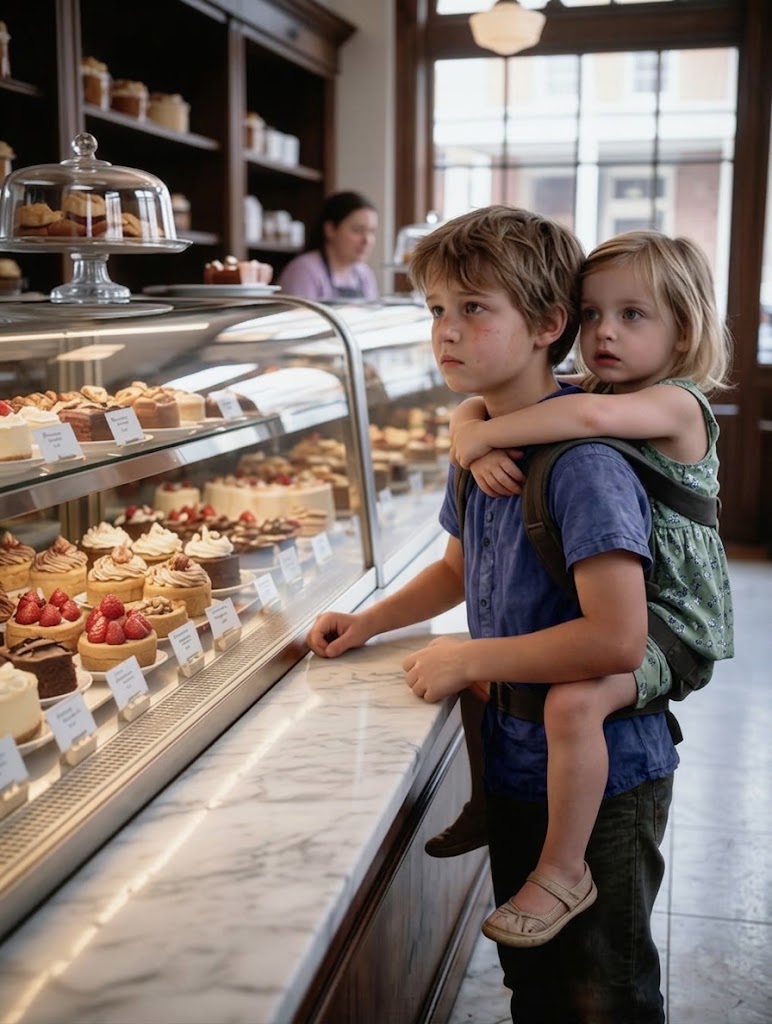
Part 1 — The Boy at the Bakery Door
The eight-year-old boy entered the most expensive bakery in downtown Chicago carrying his little sister on his back—and asked a question so simple that half the room pretended not to hear it.
“Do you have any bread from yesterday that you sell for less?”
The bell above the glass door had barely stopped chiming. Morning sunlight poured across marble counters and silver cake stands. Businesspeople checked their phones over expensive coffee while untouched pastries cooled on china plates.
The boy looked as though he had come from another world.
His name was Evan Hale. His faded blue shirt was clean despite its worn elbows, and one sneaker had begun to split near the toe. On his back, three-year-old Lily slept with her cheek against his shoulder and both arms looped around his neck.
Evan was exhausted, but he stood straight. He did not ask for free food. He only asked whether yesterday’s bread cost less.
The cashier glanced at his shoes.
“We don’t sell leftovers.”
“Do you throw them away?”
Her expression tightened. “You need to leave.”
Evan shifted Lily’s weight and turned, but the security guard was already moving toward him.
“Come on, kid.”
“I’m going.”
The guard caught the back of his shirt. Evan stumbled. Lily woke with a frightened cry and clung so tightly that he nearly fell.
A chair scraped sharply across the floor.
“Let him go.”
Every person in the bakery turned.
Richard Callahan stood beside a corner table, one hand resting on his silver-topped cane. At sixty-five, he was the founder of Callahan Transportation, a national company worth hundreds of millions of dollars. His name appeared on office towers, hospital wings, and charity programs.
But he was not thinking about any of that.
He was remembering himself at nine years old, hungry outside a bakery window, counting coins and pretending he was only looking. He remembered learning that hunger hurt less than the shame people could attach to it.
The guard released Evan.
Richard crossed the room. “Are you hurt?”
Evan shook his head.
Richard ordered bread, sandwiches, milk, fruit, and enough food for several days. Then he pointed at the pastry display.
“Pack those too.”
“All of them?” the cashier asked.
“All of them.”
Yet when the boxes covered the counter, Evan stared only at the bread.
“You don’t want cake?” Richard asked.
“Cake doesn’t keep you full very long.”
The answer struck Richard harder than any speech he had heard in a boardroom.
He crouched.
“Where are your parents?”
Evan’s face changed.
“They’re gone.”
“Who is caring for you?”
The boy looked toward the door, deciding whether truth was more dangerous than silence.
“No one,” he whispered.
Part 2 — The Children Who Disappeared
Richard called emergency services and asked the bakery manager for a private office where the children could eat while they waited.
Evan broke his sandwich into pieces and gave Lily the softest parts. When a paramedic approached, she buried her face against him.
A child welfare worker named Marisol Vega arrived. The moment she mentioned separate temporary placements, Evan stood so quickly his chair tipped backward.
“No. You separated us before.”
The truth came slowly.
Eleven months earlier, Evan and Lily’s parents, Michael and Sarah Hale, had died in a hit-and-run crash on a rainy road outside Chicago. The children had survived in the back seat. With no close relative able to care for them, they entered foster care and were placed in different homes.
Evan spent months asking to see Lily. Visits were delayed or canceled. Then he overheard that she might be moved to another county.
So he ran away.
Using library computers and bus maps, he found the foster home where she was staying. He had taken her two days earlier. Since then, they had slept in a laundromat and beneath a church awning.
“I didn’t steal her,” Evan said. “She’s my sister.”
Marisol knelt beside him. “I understand. But you’re both in danger out there.”
Richard could have written a check and left. Money had always been his fastest way to solve uncomfortable problems. But Evan kept one arm around Lily even while eating, as though the world might separate them between bites.
“They stay together tonight,” Richard said.
Marisol made several calls. Richard contacted a licensed family residence supported by his foundation. By late afternoon, an emergency sibling placement had been approved.
Before entering, Evan turned back.
“Why are you doing this?”
Richard looked at the loaf in the boy’s arms.
“Because someone should have done it sooner.”
Part 3 — The Face on the Staircase
The next morning, Richard returned with clothes, books, and a stuffed rabbit for Lily.
Marisol told him the crash investigation remained open. Evan had recently remembered a black SUV with a broken rear light and a silver bird on the grille.
Richard felt a cold pressure in his chest.
Callahan Transportation’s executive SUVs carried a custom silver eagle emblem.
It could be a coincidence, he told himself.
That afternoon, with Marisol and the foundation director present, Richard invited the children to lunch at his Lake Forest estate. The house had twelve bedrooms, lake views, and more silence than any home needed.
Evan entered cautiously. Lily stared up at the chandelier.
Footsteps sounded on the staircase.
Daniel Callahan stopped halfway down.
Richard’s only son was thirty-five, polished and handsome, an executive in the family company. The moment Daniel saw the children, the color left his face.
“What are they doing here?”
The question came too quickly.
“They’re having lunch,” Richard replied.
Daniel’s gaze locked on Evan. Richard saw recognition before Daniel could hide it.
“Dad, I need to speak with you. Now.”
“You’re frightening them.”
Daniel lowered his voice. “You don’t know who they are.”
“I know exactly who they are. Evan and Lily Hale.”
The name struck Daniel like a blow.
He soon claimed he had an urgent meeting and left through the side entrance.
During lunch, Lily dropped her spoon. As Richard bent to retrieve it, Evan looked through the window. Daniel’s black SUV was pulling away, sunlight flashing across the silver eagle on its grille.
Evan froze.
“That’s it,” he whispered.
Richard straightened. “What is?”
“The bird. The car that hit us had that bird.”
Part 4 — The File Richard Never Questioned
After the children left, Richard locked himself in his study.
Eleven months earlier, Daniel had reported that a company SUV was stolen from a downtown parking garage. It was recovered three days later with damage to the rear passenger side. The legal department handled the police report and insurance claim while Richard focused on a merger.
He pulled the archived file.
The SUV had been reported stolen at 1:20 a.m.
The Hale crash happened at 12:47 a.m.
Thirty-three minutes earlier.
The vehicle’s GPS had stopped transmitting at 12:11 because someone manually disabled it. Daniel knew how to disable that model without triggering an alert.
Richard called the detective listed on the old report.
“I believe my company gave you incomplete information about a vehicle connected to the Hale hit-and-run.”
The detective told him not to contact anyone involved and to bring every record he had.
That evening, Richard turned over fleet logs, repair invoices, security records, and the original theft report. The evidence had not disappeared. It had been scattered where no one had wanted to assemble it.
A mechanic had replaced a damaged rear light before the SUV was reported stolen. Garage footage showed Daniel driving it away before midnight. A former employee recalled that Daniel arrived at work the next morning with a cut on his forehead and ordered the vehicle cleaned.
The investigation was reopened.
Richard returned home near dawn. Daniel was waiting in the study.
“You went to the police.”
“Did you hit their car?” Richard asked.
Daniel looked away.
“It was raining. They stopped suddenly.”
“Did you call for help?”
Silence.
“You disabled the GPS.”
“I knew what it would do to the company.”
“To the company?” Richard stared at him. “Two people died, and you were worried about a stock price?”
“I was protecting everything you built.”
“No,” Richard said. “You were protecting everything I gave you.”
Part 5 — “You Always Fix Things”
Daniel paced the room.
“The collision was an accident. The road was slick. Do you expect me to throw away my whole life?”
“The collision may have been an accident,” Richard replied. “Leaving was a choice. Filing a false theft report was a choice. Letting another family carry the consequences was a choice.”
Daniel’s expression hardened.
“You can fix this. You always fix things.”
The words forced Richard to confront years of excuses.
At seventeen, Daniel wrecked a sports car, and Richard paid to make the problem disappear. At twenty-four, Daniel mistreated an employee, and Richard approved a private settlement without asking enough questions.
Richard had grown up powerless. Once wealthy, he promised his son would never suffer as he had.
But he had confused love with removing consequences.
The doorbell rang.
Two detectives entered with a warrant.
Daniel stared at his father. “Tell them there’s been a mistake.”
Richard said nothing.
“You’re choosing strangers over your own son?”
Richard looked at him for a long moment.
“I’m choosing the truth over another lie.”
As the detectives led Daniel away, he twisted toward the study.
“You’ll regret this!”
Richard’s eyes burned.
“I already regret too much.”
When the front door closed, the house became silent—not because it was empty, but because nothing false remained to fill it.
Part 6 — What Money Could Not Repair
Daniel’s arrest became national news. Richard released the company’s records, removed executives who had ignored inconsistencies, and created an independent ethics office.
But he refused to call those actions redemption.
“You don’t erase harm by announcing a donation,” he told the board. “You begin by admitting where you failed.”
Daniel eventually pleaded guilty to charges connected to the crash, leaving the scene, and the cover-up. His sentence could not return Evan and Lily’s parents or restore the year they had spent separated.
Justice was not the same as repair.
Repair required staying.
Richard began visiting the sibling residence every week. At first, Evan accepted nothing without asking the price.
When Richard brought him a winter coat, Evan asked, “What do I have to do?”
“Wear it when it’s cold.”
“That’s all?”
“That’s all.”
“People say that, and later they want something.”
Richard sat beside him.
“Then I’ll keep showing you I mean it.”
He attended school meetings, sat through Lily’s speech therapy, and learned the ordinary details of their lives. Evan loved mystery novels and slept with the hallway light on. Lily called every yellow flower a sunflower and believed Richard’s cane was magical.
Months later, Marisol asked whether he had considered becoming their foster parent.
“I’m sixty-five,” he said. “I don’t know how to raise small children.”
“Most parents discover they don’t,” she replied.
Richard completed the training, background checks, inspections, and court reviews. Evan chose dark blue walls and shelves for books. Lily chose yellow curtains and stars on the ceiling.
On their first night, Evan stood in Lily’s doorway until she fell asleep.
“She’ll still be here in the morning,” Richard said gently.
“I didn’t know that before.”
“Then check every morning until you do.”
Part 7 — The House Learned to Breathe
Life did not become perfect.
Lily sometimes screamed when tires skidded outside. Evan hid food in his dresser. When Richard found dinner rolls beneath a stack of socks, he did not scold him.
Instead, he placed a basket in the kitchen labeled:
EVAN AND LILY—ALWAYS AVAILABLE
It held bread, fruit, and snacks.
“What if we eat all of it?” Evan asked.
“Then we fill it again.”
“What if we eat that too?”
“Then we fill it again.”
Evan tested the answer for weeks. Richard kept filling the basket.
Slowly, the hidden food disappeared.
The house changed. School papers covered the refrigerator. Fingerprints appeared on polished glass. Lily raced through halls built for dignified silence. Evan built model engines on an antique table and lost tiny screws in the carpet.
Richard had never been happier to see disorder.
Two years after the bakery, the adoption became final.
The judge asked Evan whether he understood what it meant.
“It means we’re legally a family,” he said. “But can Lily and I keep Hale as part of our names?”
“Of course,” Richard answered.
They became Evan Hale Callahan and Lily Hale Callahan—not replacements for the family they had lost, but a continuation of it.
Richard kept photographs of Michael and Sarah in their rooms. He never asked the children to forget one family in order to love another.
Part 8 — Five Years Later
Five years after Evan first entered the bakery, the bell above the same door chimed again.
This time, thirteen-year-old Evan wore sneakers that fit. Eight-year-old Lily hurried ahead with a wrapped box. Richard followed with his cane—still, according to Lily, a magic staff.
The bakery had changed.
After the original incident, its owner apologized but made few lasting improvements. Richard later bought the struggling shop and rebuilt it around one promise.
A sign near the entrance read:
NO ONE LEAVES HUNGRY.
ASK ABOUT THE COMMUNITY SHELF.
Every evening, unsold bread and pastries went to shelters, schools, and local families. Customers could quietly take meal vouchers without explaining themselves.
The bakery had been renamed Yesterday’s Bread.
That afternoon, it was closed for Lily’s birthday. Yellow flowers covered the tables, and a sunflower cake waited near the window. Marisol, teachers, friends, and several families from the community program had gathered.
Before Lily blew out the candles, she handed Richard the box.
“It’s your birthday,” he said.
“I know. Open it.”
Inside was a framed drawing. A small boy stood at a bakery counter with a little girl on his back. Across the room, an older man was rising from his chair.
Above them, Lily had written:
THIS IS WHERE OUR FAMILY STARTED.
Richard’s vision blurred.
Evan stood beside him, taller now and no longer guarded.
“You okay?” he asked.
“I’m better than okay.”
Lily tugged his sleeve. “You have to make a wish with me.”
“I thought only the birthday girl got a wish.”
“I changed the rule.”
Richard placed one hand on Evan’s shoulder and leaned toward the candles beside Lily.
He thought of the morning Evan had asked for yesterday’s bread—not luxury, only something affordable enough to keep his sister fed.
That question had exposed a bakery’s indifference, a company’s silence, a son’s crime, and Richard’s own failures.
But it had also opened a door.
Family, he now understood, was not simply what blood gave you.
It was the brother who crossed a city to find his sister.
It was the adult who admitted the truth even when it broke his heart.
It was making room for grief without allowing grief to become the only thing in the room.
It was filling the basket again and again until a frightened child finally believed there would be enough tomorrow.
“Ready?” Lily asked.
Richard smiled. “Ready.”
Together, they blew out the candles.
Everyone applauded, but Evan leaned close enough that only Richard could hear him.
“Do you remember what you said the first day?”
“That someone should have helped sooner?”
Evan nodded.
“You did more than help.”
Richard looked at him.
“You stayed.”
Those two words meant more than every award Richard had ever received.
Outside, snow began to fall over Chicago. Inside, bread warmed in the ovens, children laughed, and no one wondered whether they belonged.
Because sometimes a life does not change through a grand speech or a perfect plan.
Sometimes it changes when one person notices what everyone else has chosen not to see.
Sometimes it begins when a hungry child asks a simple question.
And someone finally answers with more than bread.