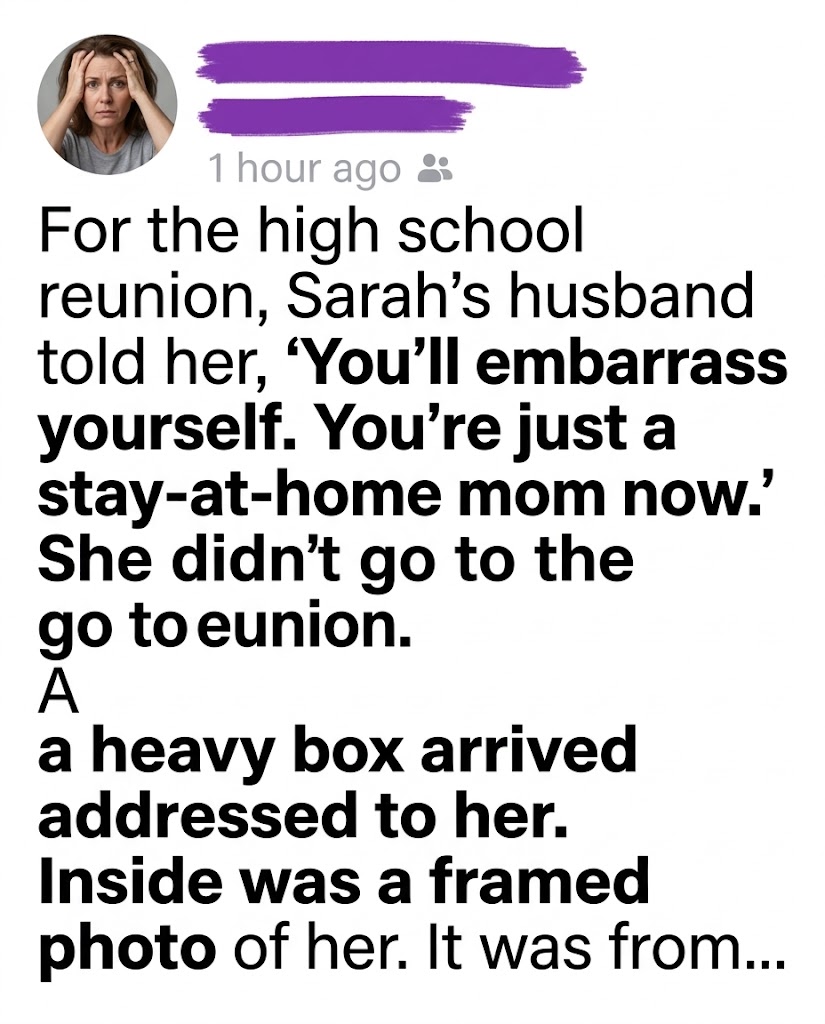
I didn’t give it much thought when my wife, Anna, brought up her high school reunion. She stood at the kitchen counter, pulling her hair back, just as she always did when she wanted to make something seem unimportant. Behind her, our three kids were bickering about homework, a missing sock, and who was allowed to use the blue cup.
That was our life—noisy, chaotic, and full of little distractions.
“They’re having a ten-year reunion next month,” she said in a casual tone. “I was thinking about going.”
I laughed. Not because I found it amusing, but because the answer seemed obvious to me. “Why would you want to go?” I asked.
“So you can tell everyone you spend your days at home wiping runny noses?”
She slowly turned to face me. “What?”
I shrugged, already irritated without fully understanding why. “Seriously, Anna. Everyone else will probably be doctors, lawyers, or executives. You’ll only embarrass yourself. You’re nothing but a stay-at-home mom now.”
The words came out more harshly than I had anticipated.
I noticed the effect immediately. Her shoulders tensed, and she pressed her lips together as though she were struggling to keep something inside. “Oh,” she murmured. “All right.”
That was all she said.
She didn’t argue or cry. Instead, she turned back toward the sink and continued washing the dishes.
She never attended the reunion. For days afterward, she barely spoke to me. Not in any meaningful way.
She responded when I asked about dinner, the children’s schedules, or the bills. But the affection had disappeared. So had her laughter and those little touches she used to give me whenever she walked past in the hallway. At night, she turned her back to me in bed, leaving a silent distance between us that I had no idea how to bridge. I convinced myself that, eventually, she would get over it.
I convinced myself that I had simply been truthful. That I was being realistic. Then, two weeks later, a large, heavy package appeared on our front porch.
There was no return address, only Anna’s name carefully written on the shipping label. She was upstairs settling the baby down when I carried the box inside.
Curiosity won. I told myself I was only opening it to make sure nothing had been damaged during delivery. So I lifted the lid.
And froze.
Inside lay a large photograph in a beautiful, professionally made frame. It showed an entire graduating class, with rows of smiling faces I didn’t recognize, although Anna had mentioned many of those people over the years. They were the people she had once known.
The classmates she had grown up alongside.
Dozens of signatures covered the white border surrounding the photograph. Some were carefully written, others hurried and untidy, but each carried a personal touch. I discovered a folded note taped to the back of the frame and pulled it free.
It said:
“We missed you!
Maria told us what happened. Being a mom IS something to be proud of. You’re raising three kids—that’s harder than any of our jobs.
Please come to the next one. We’ll save you a seat.”
My chest tightened at the mention of Maria.
Anna’s closest friend from high school. The woman who had become a surgeon. The very person I had once held up as an example of “real success” without giving it a second thought.
I stood there, studying the photograph for a long time. My mind drifted back to Anna at twenty-two, expecting our first child while her friends were making career plans and preparing to move away. I remembered all those nights she stayed awake caring for sick children while I slept, telling myself I needed rest because I “had work in the morning.” I thought of every birthday she had organized, every lunch she had packed, and every pair of tiny shoes she carefully arranged beside the door each evening.
I thought about how carelessly I had dismissed everything she did as nothing more than being a mom.
Anna came downstairs and suddenly stopped when she saw me sitting at the table with the photograph propped up in front of me.
“You opened it,” she said. There was no anger in her voice, only exhaustion.
“I’m sorry,” I replied at once. My voice broke as I spoke. “I never should have said those things to you. I was wrong.”
She remained silent for a moment. Then she approached the table and gently traced her fingers over the signatures and the familiar names. Her eyes glistened, but no tears fell.
“They didn’t forget me,” she whispered. “I thought maybe they had.”
Something inside me cracked open. Shame, regret, and understanding washed over me all at once.
“I forgot you,” I confessed. “I forgot who you are and everything you give to this family. I became so focused on job titles and paychecks that I failed to see how our entire life works because of you.”
At last, she raised her eyes to meet mine.
“I didn’t need them to prove my worth,” she said. “I just needed you to stop making me feel small.”
“I understand,” I answered. “And I promise I’ll never treat you that way again.”
She nodded.
It wasn’t forgiveness—not yet. But it was a start.
The photograph now hangs in our hallway. It isn’t there to remind us of the reunion Anna missed, but to remind us of the person she has always been.
And when the next reunion comes around, I won’t be the reason she stays home. I’ll be the one making sure she gets to go.