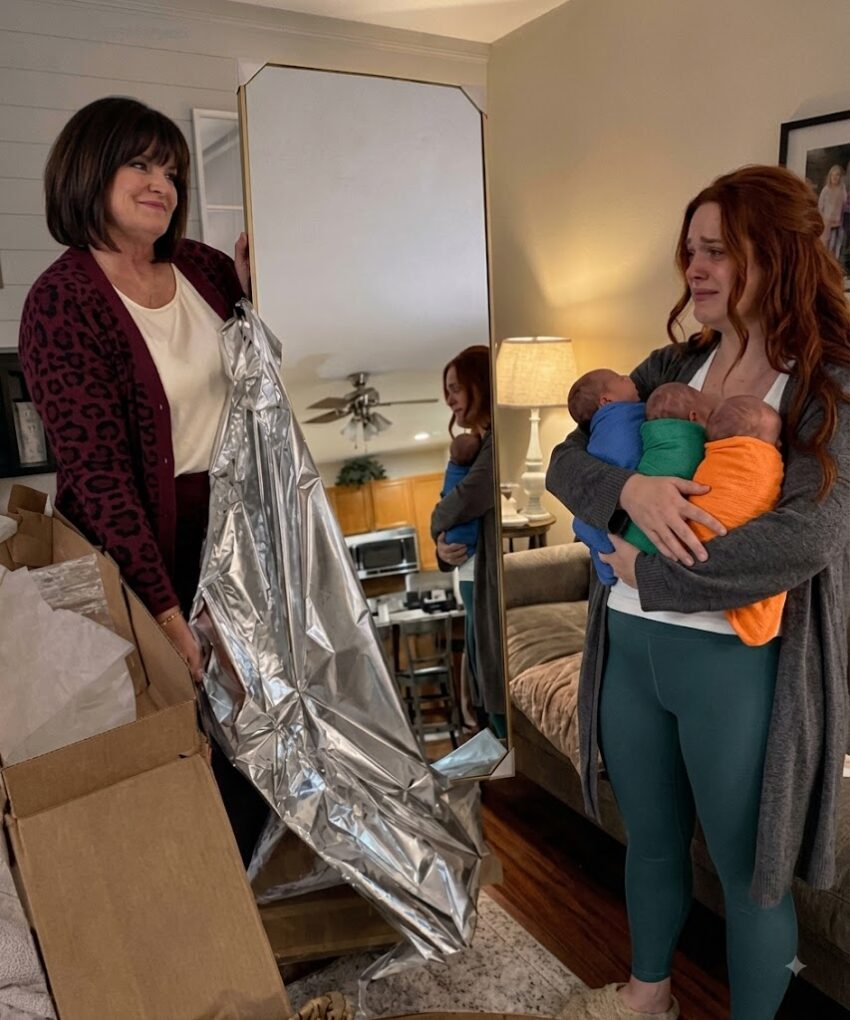
Three weeks after I gave birth to triplets, my mother-in-law arrived at our house carrying an enormous present wrapped in shiny silver paper. For one hopeful second, I thought Patricia had actually brought something for me. Maybe a comfortable robe. Maybe something sentimental. Maybe just one small reminder that beneath the bottles, diapers, laundry, and three newborns, I still existed.
Then Daniel tore away the wrapping.
It was a full-length mirror.
Patricia stood proudly beside it as if she’d just presented me with diamonds.
“Put it somewhere you’ll see yourself every morning.”
Three bassinets occupied most of our living room. Two babies were sleeping, while the third was making those tiny restless noises that usually meant I had less than a minute before the entire room erupted. I stood there wearing maternity leggings and a cardigan I’d already worn twice that week, staring at a reflection I had been doing my best not to examine too closely.
Patricia’s eyes traveled slowly down my body.
“It’ll motivate you to get back in shape faster for my son.”
Without thinking, I pulled the cardigan tighter across my stomach.
Daniel stopped removing the remaining wrapping paper.
“What did you just say, Mom?”
Patricia waved him off.
“Oh, don’t start.”
Then she looked straight at me again.
“You have three children now, Penny, but you’re still Daniel’s wife. He shouldn’t have to feel embarrassed standing beside you.”
Nobody spoke. One of the babies stirred in her bassinet, but Patricia continued as though she’d merely offered ordinary advice.
“Motivation works best when you can see the whole picture. That’s why I bought a full-length mirror.”
My face burned.
“Honestly, Penny, don’t look so hurt. Sometimes women need a little push.”
Then Daniel chuckled.
For one awful second, my heart dropped. I couldn’t even bring myself to look at him. Patricia, however, immediately smiled.
“See? At least my son understands what I mean.”
When I finally turned toward him, Daniel wasn’t looking at me at all. He was staring directly at his mother.
“You know what, Mom? Your timing is actually perfect.”
Patricia’s smile weakened.
“What does that mean?”
“I’ve got something for you too.”
Her expression immediately brightened.
“You bought me a present?”
Daniel gave her a strange smile.
“You could call it that.”
Then he disappeared down the hallway.
I remained beside that mirror wishing I could disappear with him.
Three weeks earlier, the woman in that reflection had done something I still couldn’t fully comprehend: she’d brought three babies into the world. Since then, our lives no longer followed clocks. They followed bottles, diapers, crying, feeding, sleeping, and then the same cycle all over again.
That morning alone, I’d reheated one cup of coffee three times and still hadn’t managed to finish it. At lunch, I’d eaten half a sandwich while standing because one daughter had finally fallen asleep against my shoulder and I was afraid sitting down would wake her.
The night before, I’d slept exactly one hour and forty-seven minutes before someone needed me again. At 2:13 a.m., I’d found myself sitting on the edge of our bed crying quietly while struggling with my nursing bra.
Daniel had woken immediately.
“Penny?”
“I’m fine.”
“You’re crying.”
“Crying doesn’t technically mean I’m not fine.”
He sat up and reached for the baby in my arms.
“Give her to me.”
“You have work tomorrow.”
“And you have organs that are probably still trying to remember where they’re supposed to be.”
I laughed despite myself and let him take her. Looking down at my stomach, I admitted something I’d been thinking for days.
“I hate that none of my clothes fit.”
Daniel glanced at my maternity leggings.
“Those fit.”
“They’re maternity clothes.”
“Penny, you grew three human beings. Those leggings can stay as long as they want.”
That was Daniel. He rarely delivered grand speeches. He simply had a way of making things sound normal when I desperately needed them to feel normal.
Still, there were private moments when fear crept in. Would he eventually notice how different I looked? Would he one day glance at me and quietly miss the woman whose old jeans were still hanging untouched in our closet?
I’d never asked him.
Now Patricia had taken that private insecurity and placed it in the middle of our living room for everyone to see.
One baby started fussing, and Patricia bent over the bassinet.
“Grandma’s here, sweetheart.”
Then, without even looking at me, she added:
“You should really start walking every day, Penny. Even twenty minutes would help.”
“My doctor hasn’t cleared me for exercise yet.”
She shrugged.
“Doctors are far too cautious these days.”
“Mom.”
Daniel’s voice came from the hallway.
Patricia straightened.
Then she saw what he was carrying.
Every trace of confidence disappeared from her face.
It was an old peach-colored robe. Nothing about it looked expensive. The fabric was faded and thin, there was a pale bleach stain near the bottom, one belt loop was missing, and one pocket was stretched so badly that it sagged lower than the other.
Patricia took a step backward.
“What the hell is that?”
Daniel stopped beside the mirror.
“You recognize it?”
“Daniel, where did you find that?”
“Storage.”
“You went through those boxes?”
“They’re my boxes, Mom.”
“I gave them to you years ago.”
“I know.”
Patricia stared at the robe as though Daniel had carried a ghost into the room.
“Throw it away.”
Daniel raised an eyebrow.
“Why?”
“Because it’s garbage.”
He rubbed his thumb across the stretched pocket.
“Funny. Dad didn’t think so.”
Patricia froze.
“Your father isn’t here.”
“No. But apparently he remembered some things better than you do.”
She crossed her arms.
“I have no idea what you’re trying to prove.”
Daniel held the robe toward her.
“Since we’re giving people things they desperately need today, I thought you might need your memory back.”
Patricia’s mouth fell open, but Daniel didn’t immediately explain. Instead, he looked toward the full-length mirror. My reflection was still there: exhausted face, messy hair, maternity clothes, one hand unconsciously gripping my cardigan across my stomach.
Daniel noticed.
“First, let go of that, Penny.”
“What?”
“Your sweater.”
Only then did I realize how tightly I was holding it closed. Slowly, I released the fabric.
Patricia sighed.
“Oh, for heaven’s sake. I wasn’t attacking her.”
Daniel turned toward his mother.
“You told my wife I’d be embarrassed to stand beside her.”
“I said she shouldn’t neglect herself.”
“She gave birth three weeks ago, Mom.”
“So did millions of women before her.”
The words came out effortlessly, as though what my body had just endured was ordinary enough to criticize but not extraordinary enough to respect.
Patricia pointed sharply toward the robe.
“And whatever dramatic performance you’re planning with that thing, I’m not interested.”
Daniel gave her a humorless smile.
“That’s unfortunate.”
He laid the robe across the couch.
Patricia immediately looked away.
That reaction made me examine it more carefully. Why would an old robe frighten her so much?
Daniel touched the sagging pocket.
“Penny, see this?”
I nodded.
“Apparently I did that.”
Patricia snapped her head toward him.
“Don’t.”
Daniel looked at her.
“Why not?”
“Because it happened forty years ago.”
“Exactly.”
Her face reddened.
I stepped closer.
“What happened forty years ago?”
Neither of them answered immediately. Then one of my daughters began crying, followed quickly by another. I instinctively turned toward the bassinets, but Daniel reached the first one before me.
“I’ve got her.”
Patricia moved toward the second.
“Let me.”
I stepped in first.
“No, I’ve got this one.”
For a moment she looked offended. Then her gaze dropped toward my hand, which had once again moved protectively across my stomach.
Her own words had put it there.
She looked away.
Daniel lifted our daughter against his shoulder and returned to the robe.
“Mom, do you remember what Dad used to tell you after I was born?”
Patricia became completely still.
“I don’t know what you’re talking about.”
“I think you do.”
“Daniel.”
“Do you remember crying because none of your clothes fit?”
Her lips parted.
I stared at her. Patricia—the perfectly dressed woman who had just lectured me about appearance—had once stood exactly where I was standing.
“That was different,” she whispered.
“How?”
“It just was.”
Daniel picked up the robe.
“You wore this for months.”
Patricia looked toward the front door.
“You don’t know anything about that time.”
“Dad told me.”
The room fell quiet.
Daniel touched the bleach stain.
“He said you hated having your picture taken.”
Patricia’s eyes flicked toward me.
“He said there were days you cried because you looked in the mirror and didn’t recognize yourself.”
“Stop!”
But Daniel continued.
“He said this robe was one of the few things you could wear without feeling uncomfortable.”
Patricia swallowed hard. The woman who had arrived at my house judging my body suddenly couldn’t even look at me.
Daniel wasn’t finished.
He pushed his fingers into the badly stretched pocket.
“Dad told me how this happened too.”
Patricia’s eyes filled with tears.
“What happened?” I asked quietly.
She shook her head at Daniel, silently warning him not to continue.
He did anyway.
“I used to hold onto it.”
I looked at the pocket.
“Hold onto what?”
“This.”
He pinched the loose fabric.
“Apparently, when I was little, I followed Mom everywhere. If she cooked, I walked behind her holding this pocket. If she folded laundry, my hand was here. If she walked through the house, I grabbed onto it and followed.”
Patricia turned her face away.
Daniel’s voice softened.
“Dad said you once complained that I was going to ruin your robe.”
She closed her eyes.
“And do you remember what he told you?”
Patricia remained silent.
Daniel answered for her.
“He said, ‘One day you’ll miss the weight.’”
Just like that, Patricia sat down.
All the sharpness seemed to drain from her body. She reached toward the robe and ran her fingers along the stretched pocket. For several seconds, she said nothing.
One of my babies gave a tiny hiccup from the bassinet.
Patricia looked toward her granddaughter, then back at the robe.
I understood what Daniel had wanted his mother to remember. Once, long before the polished clothes and cruel advice, Patricia had been an exhausted mother too. She had struggled with her changing body. She had lived in an old robe because nothing else felt comfortable. And a little boy named Daniel had followed her everywhere, holding onto that pocket until he stretched it out of shape.
But Daniel still wasn’t finished.
He walked toward the full-length mirror Patricia had given me—the same mirror that had made me hide my stomach only minutes earlier—and grabbed both sides.
“Help me move this.”
I blinked.
“Where?”
“Nowhere.”
He turned it around.
The reflective surface faced the wall.
The plain wooden backing faced us.
Patricia stared.
“What are you doing?”
Daniel opened a drawer beside the couch and pulled out a black washable marker.
“Daniel, don’t.”
“Why?”
“That’s an expensive mirror.”
Daniel smiled.
“Good.”
He uncapped the marker and leaned toward the wooden backing.
“Because from now on, we’re going to use it to measure something that actually matters.”
He drew three tiny lines and wrote our daughters’ names beside them. Underneath, he added each baby’s birth weight, then drew three ridiculous little stick figures.
I laughed for the first time since Patricia had arrived.
Daniel capped the marker.
“There. Now it’s useful.”
Patricia stared at him.
“I bought that for Penny.”
“I know.”
“She was supposed to use it to track her progress.”
Daniel shook his head.
“No, Mom. You bought it so she could watch herself become smaller.”
Then he pointed toward the three bassinets.
“We’re going to use it to watch them become bigger.”
Patricia frowned.
“I was only trying to motivate her.”
Daniel opened his mouth to answer, but I touched his arm.
“I’ve got this, Dan.”
He immediately stepped back.
I faced Patricia. Three weeks of exhaustion seemed to sit inside every bone in my body. I was sore. None of my old clothes fit. There were mornings when brushing my teeth felt like a major accomplishment.
But suddenly, I didn’t feel ashamed.
“I don’t need motivation to become the woman I was before these babies.”
Patricia said nothing.
I looked toward my three daughters.
“I need time to discover the woman I am after them.”
Her eyes dropped toward the peach robe.
For once, Patricia had no advice to offer.
One of the babies started crying. Patricia instinctively stepped forward, then stopped herself. Instead of simply taking the baby, she looked at me.
“Penny?”
“Yes?”
“Would you like me to hold her?”
That simple question nearly broke me.
“Please.”
Patricia carefully lifted her granddaughter from the bassinet. Within seconds, one tiny fist grabbed a handful of her blouse.
Daniel looked toward the old peach robe.
“Careful, Mom.”
Patricia glanced at him.
“Why?”
He smiled.
“Family tradition.”
Her eyes drifted toward the stretched pocket.
Then she laughed.
It was quiet and shaky, and there were still tears in her eyes, but this time the laugh was genuine.
Later, when Patricia prepared to leave, she paused beside the nursery. The mirror stood backward against the wall. Instead of reflecting anyone’s body, its wooden backing now displayed three names, three birth weights, and three tiny measurement lines.
One day there would be more marks.
First birthdays.
First days of school.
Growth spurts.
Three little girls would stand against that mirror year after year while their mother gradually became whatever version of herself came next.
Patricia picked up the peach robe.
“You should keep this.”
I blinked.
“Really?”
“It’s ugly.”
I smiled.
“It definitely is.”
“And the pocket is ruined.”
“Apparently your son had boundary issues.”
Daniel’s voice came from the hallway.
“I was a baby!”
Patricia almost smiled again.
Then she handed the robe to me.
“It’s soft.”
That was all she said.
That night, I put it on.
The fabric hung loosely around my body, worn thin from another mother’s hardest season. I stood in the nursery rocking one daughter while the other two slept nearby. The damaged pocket hung beside my hand.
Then the baby in my arms reached out.
Her tiny fingers curled around the exact same pocket.
I froze.
Patricia, who had remained near the doorway for a final goodbye, saw it too.
For a second, she wasn’t my polished, judgmental mother-in-law anymore.
She was simply a tired young mother from forty years ago, remembering the weight of her little boy’s hand tugging at the same piece of fabric.
She didn’t mention my stomach.
She didn’t mention walking.
She didn’t mention my clothes.
She simply looked at me and whispered:
“Goodnight, Penny.”
Then she quietly closed the nursery door.
Behind me, the mirror remained turned toward the wall.
Tomorrow, it wouldn’t measure how quickly I could lose weight.
Next week, it wouldn’t measure whether I’d become smaller.
Next month, it still wouldn’t.
Instead, it would wait for three little girls to stand against its wooden back and grow taller.
And for the first time since giving birth, I realized something I desperately needed to understand:
My daughters were allowed to grow.
And so was I.