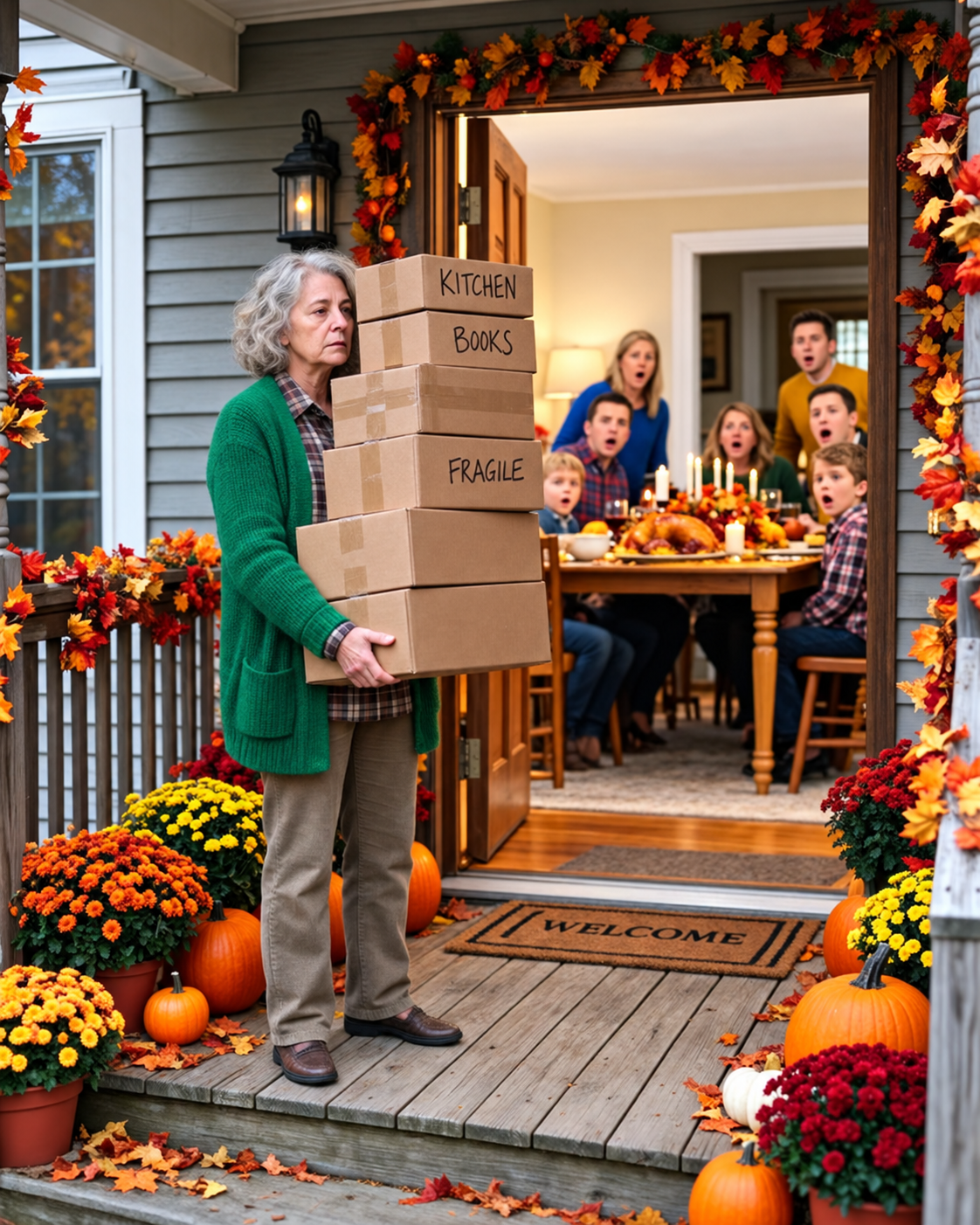
Every November, my daughter-in-law orders Thanksgiving pies from the bakery where I work. She has no idea that I’m the person who bakes them.
For three years, I had seen her familiar, rounded handwriting on the order slips. For three years, I had prepared every crust myself, mixing in butter and nutmeg and giving each pie the attention reserved for food meant for people who should never have needed it delivered.
My name is Dorothy, and I have spent eleven years working in the kitchen at Hartley’s Bakery. I don’t work at the front counter, where customers exchange pleasantries and occasionally reveal more than they intend. I work behind the scenes, surrounded by scorching ovens and physically demanding work. Since Harold passed away, that job has helped me keep going.
The bakery kitchen is a place where women can work without being noticed. For a long time, I found comfort in that.
Perhaps more comfort than I should have.
Hartley’s is a small establishment with four full-time bakers and two part-time counter assistants. Three years ago, the owners, Bill and Carol Hartley, started offering deliveries because customers were ordering more holiday baked goods than they could conveniently carry.
We deliver large orders for Thanksgiving and Christmas in a white van marked with the bakery’s name. Whoever is available handles the deliveries. Sometimes Bill does it, but more often, one of the counter girls takes the job.
This year, I volunteered before anyone else could.
To understand why I made that decision on a Wednesday in November, you need to understand what brought me to that point.
Harold died four years ago, at sixty-seven. He was a good man, and I don’t say that simply because grief makes us remember people kindly. I say it because I spent forty-two years married to him and knew the person he truly was.
Every Thanksgiving, he carved the turkey with his sleeves rolled up and told the same four jokes, laughing at each one as though he had never heard it before. He insisted that the gravy boat was the most essential thing on the table because gravy brought together everything left over from cooking. When the gravy was good, he said, the entire meal was a success.
That gravy boat had belonged to my mother. It was made of white porcelain with a gold rim, and a tiny chip inside the handle dated back to when I dropped it into the sink at twenty-three. I glued the broken piece back together, determined that my mother would never discover what her newly married daughter had done.
The little chip survived for fifty years. My mother either never noticed it or kindly pretended she hadn’t.
Nine years ago, my son Ryan introduced me to Melissa, looking like a man who wanted approval for a major life decision. I gave him my blessing. Melissa was attractive, energetic, and exceptionally organized. She could manage a household, a social calendar, and family obligations with remarkable efficiency.
Ryan had always needed someone to help him stay organized, so I thought they would make a good couple.
On that point, I was right.
On other matters, I was mistaken.
For the first two Thanksgivings of their marriage, the family gathered at my house. Harold was alive during the first, although he was already ill and none of us fully understood it. He carved the turkey, repeated his familiar jokes, and placed the gravy boat in the middle of the table, just as he had throughout Ryan’s childhood.
Melissa brought green bean casserole. It wasn’t as delicious as mine, but I made sure she knew I appreciated her effort. I understood how important it was to contribute something to a family gathering when you were still finding your place in it.
By their second Thanksgiving, Harold was gone.
I won’t linger over that painful holiday. Ryan and Melissa came, and I placed the gravy boat in the center of the table because some traditions deserve to be preserved when grief threatens to take everything else.
Afterward, we had to sort through Harold’s belongings. Sixty-seven years of possessions, including the things we had accumulated over forty-two years in our house and its crowded attic, took considerable effort to organize.
Ryan and Melissa helped me, and Melissa’s organizational abilities proved useful. However, during those three days of sorting, packing, and carrying boxes, my mother’s gravy boat disappeared from its usual place on the shelf.
I didn’t realize it was missing until two weeks later, when I was preparing a meal.
I searched for it and asked Ryan about it. He thought it might have accidentally ended up at his house in one of the boxes. He promised to look for it, discuss it with Melissa, and send it back when he found it.
He never mentioned it again.
I didn’t insist. Asking repeatedly would have sounded like an accusation, and I had no evidence. During that first year of widowhood, my emotional strength was nearly depleted. I had little energy left for arguments.
Then came the third Thanksgiving, the first for which I received no invitation.
Ryan called in early November, as he did every few weeks. Those brief conversations reassured me that he was doing well and still thought of me without forcing either of us into uncomfortable discussions.
He explained that they were planning a quiet celebration, just the two of them, without a large family gathering.
He sounded apologetic. Next year, he promised, things would be different. He asked whether I understood, and I told him I did.
I understood, and during that first November without Harold, confronting him was more than I felt capable of handling.
I roasted a small hen.
I told the women at church that our family was keeping Thanksgiving simple.
The following April, Kylie, a young girl who lived two houses away, showed me how to look at photographs online. She had been helping me with technology for several months and seemed to enjoy teaching someone from another generation how to use modern devices.
She showed me photographs posted by my granddaughter Sophie.
Sophie was eleven, the daughter of Ryan and Melissa. Under an informal visiting arrangement that nobody had clearly defined, I saw her approximately four times a year. She was a lovely child who had inherited Harold’s ears and my stubborn nature.
Like many children who receive phones at a young age, she posted photographs constantly, without considering how much information they might reveal.
Her Thanksgiving photographs had been posted in November.
I didn’t discover them until April.
There was a long dining table.
Fourteen chairs, all occupied.
A magnificent turkey.
Harold’s brother Gerald and his wife.
Melissa’s parents.
People from Ryan’s professional circle, along with several faces I didn’t recognize.
And sitting between the sweet potatoes and cranberry sauce was my mother’s gravy boat.
White porcelain. Gold edging.
Presumably holding gravy prepared from my recipe.
I stared at the photograph for a long time.
My first instinct was to look away. My second, stronger impulse was to study it carefully until I understood what I was seeing.
Fourteen people had attended a Thanksgiving dinner that was supposedly too small for me.
And they had used my mother’s gravy boat.
I made myself a cup of tea and went to bed.
The next morning, I baked ninety pies for other families without telling anyone what I had discovered.
I refused to invite myself. When a mother insists on being included, people may offer her a place out of pity, and pity was something I wasn’t prepared to accept.
Since Harold’s death, I had managed on my own. Sometimes I struggled, but I had always tried to live honestly. I didn’t want charity from my own son.
If there was a place for me at his table, I wanted him to offer it willingly.
I kept the order tickets.
At first, I couldn’t have explained precisely why. I collected the tickets from three Thanksgivings, each showing the date and number of guests, folded them, and placed them inside my recipe tin behind the cards for puff pastry and shortbread.
Sometimes, you hold on to something before you understand exactly what it might prove.
One afternoon, Becca, a counter assistant who had worked at Hartley’s for two years, accidentally revealed something important.
Becca sometimes seemed distracted, but she noticed almost everything. She mentioned that the pleasant woman who placed large Thanksgiving orders always made the same comment when collecting them.
“His mother never comes. We invite her every single year, bless her heart. She prefers to be alone.”
I stood in the kitchen holding a baking sheet, absorbing every word.
Eleven years of working unnoticed had taught me how to remain perfectly still while other people’s conversations unfolded around me.
So that was what had happened.
Ryan believed I turned down his invitations.
I believed he had never invited me.
And Melissa had deliberately allowed that misunderstanding to continue while telling other people she invited me every year.
I said nothing to Becca.
Instead, I returned to my ovens and thought about Harold, his rolled-up sleeves, his four familiar jokes, and the gravy boat.
Then another detail from Sophie’s photograph came back to me.
A man I didn’t recognize had been sitting at the head of the table wearing Harold’s green cardigan.
I had donated Harold’s clothes to the church thrift shop the spring after he died. I couldn’t bear to leave his wardrobe untouched, as though I were expecting him to return. His clothing could still be useful to someone else.
That green cardigan had been his favorite. He wore it to nearly every family gathering after buying it from a department store in 1987.
I had washed it, folded it, and donated it with the same care I gave everything I knew I had to let go.
The man in the photograph wasn’t Harold’s size, yet the cardigan fit him comfortably, as though it had always belonged to him.
I studied his face on Kylie’s phone but couldn’t recognize him.
Perhaps he was a friend of Melissa’s brother, a colleague, or someone neither Ryan nor I knew well. He might have purchased the cardigan at the thrift sale or received it from someone else.
Or perhaps the resemblance meant nothing more than the fact that both sweaters were green.
Eventually, I stopped asking Kylie to enlarge the photograph.
Without more information, looking at it longer wouldn’t give me the answers I needed. Understanding that I was confused wasn’t the same as discovering the truth.
By Wednesday morning of Thanksgiving week, several things had become clear.
For three years, Ryan had believed I preferred spending the holidays alone because Melissa had told him so.
During those same years, Melissa had told other people that she invited me, repeating the claim so casually that she could even add “bless her heart” when speaking to the bakery staff.
My mother’s gravy boat remained on her table.
Melissa had ordered four pies for fourteen guests. Her parents were expected at eight, and Hartley’s offered holiday delivery services.
And I knew how to bake pies.
On Tuesday, I prepared four with particular care.
Apple, finished with a lattice crust.
Pumpkin, dark and generously spiced.
Pecan, Harold’s favorite, made from the same recipe I had used for forty years.
And sweet potato with extra nutmeg, exactly as requested.
That last recipe was mine, passed down by my mother long before Melissa was born.
As I shaped the crusts, I thought about Harold and considered what I would do the following morning.
Then I returned home, draped my good coat over a chair, and slept peacefully.
At five, I went back to the ovens.
The pies were ready by eight.
At eight-thirty, I packed them carefully, arranging tissue paper around the edges, fastening the lids, and stacking the boxes from largest to smallest.
I tucked three years of folded order tickets into the inside pocket of my coat.
I placed this year’s receipt in another pocket.
At nine, I drove Hartley’s white delivery van toward my son’s neighborhood.
I hadn’t visited that street in two years, not since an uncomfortable summer gathering that had felt more like a scheduled appointment than a visit with family.
Ryan’s house was beautifully maintained and bigger than three people needed. Melissa’s talent for organization had helped determine their choice, while Ryan’s salary had paid for it.
Cars occupied the driveway and lined the street.
Melissa’s parents had clearly arrived at eight, and other guests had probably come with them.
I stayed in the van for a few moments.
I wasn’t afraid.
Fear would have been understandable, but what I felt was quieter and more determined.
After three years of holding back, I had finally reached the point where patience needed to become action. There was certainly anger, but more than anything, I felt the clarity of someone who had decided exactly what needed to happen.
I wanted my mother’s gravy boat returned.
And I wanted Ryan to know the truth.
I planned to accomplish both in front of Melissa’s mother, Carol Ann.
From conversations I had overheard at the bakery, I knew Carol Ann was the kind of woman who would understand what four pie boxes, three years of receipts, and a determined woman standing at her daughter’s door could mean.
I climbed out of the van.
Put on my good coat.
Carried the boxes up the steps.
And rang the doorbell.
What happened next wasn’t exactly how I had pictured it.
Real life rarely follows a confrontation we have rehearsed in our minds. Yet the unexpected moments made the experience more meaningful.
Ryan opened the door.
He was wearing a nice shirt and standing with Harold’s familiar slight forward lean, the posture of a tall man who had grown accustomed to compensating for his height.
And, rather surprisingly, he was holding a ladle.
The similarity between the ladle and the gravy boat almost made me laugh.
His expression changed as he tried to make sense of what stood before him.
First, he looked at me.
Then at the boxes.
Finally, he noticed my coat, which he hadn’t seen since Harold’s funeral.
“Mom,” he said.
One word, filled with disbelief.
“Good morning,” I replied. “I’ve brought the pies.”
Behind him, the house was full of noise: conversations overlapping, kitchen utensils clattering, and laughter coming from somewhere farther inside.
“What are you doing here?” he asked.
There was no anger in his voice, only honest confusion.
That told me he really hadn’t known.
It confirmed what I needed to know.
“I work at Hartley’s,” I explained. “I baked the pies, and I volunteered to deliver them.”
He opened his mouth, but no words came out.
“May I come in?” I asked.
He stepped aside without thinking.
I walked inside carrying four pie boxes, three years of order tickets, and the calm determination of a woman who had been working since five that morning and had already decided what she needed to do.
The hallway opened into a dining room prepared for a large gathering.
Almost every seat was occupied.
Melissa was moving between the kitchen and the table.
Her parents, Carol Ann and Franklin, were present, having arrived at eight as the order ticket indicated.
Harold’s brother Gerald and his wife Patricia were there, too.
My granddaughter Sophie looked up from the drawing she was working on.
“Grandma?”
Silence spread gradually through the room.
One conversation stopped, followed by another, until every person was looking in my direction.
Melissa came out of the kitchen carrying a platter.
At first, she was looking toward the kitchen entrance. Then she noticed me standing there with the boxes.
I watched several emotions move across her face.
Surprise came first.
She hadn’t expected me to deliver the pies, nor had she known that I worked at Hartley’s. Two parts of her life that she had carefully kept apart had suddenly collided.
Then I saw fear.
Not fear of me as a person, but fear of what my appearance meant and what everyone might soon learn.
I had expected anger, perhaps defensiveness or an attempt to shift the blame.
I hadn’t expected her to stand frozen with the platter in her hands, looking like someone who had always suspected this day might come but had never prepared for it.
Carol Ann stood up.
She was a petite woman in her early seventies, with the straight posture of someone who had spent decades teaching.
Her eyes moved between Melissa and me. She knew her daughter’s expressions, including the ones Melissa wished she couldn’t recognize.
“Dorothy?” Carol Ann asked. “Dorothy Hartwell?”
We had met at the wedding and at several family occasions over the previous nine years. Carol Ann had a good memory for people.
“Hello, Carol Ann,” I said.
“Melissa,” Carol Ann said, still looking at me. “Isn’t she the pie lady you told us about?”
The room fell silent.
Melissa answered carefully.
“She works at Hartley’s, Mom.”
“I know she works at Hartley’s,” Carol Ann replied. “I mean, isn’t she Ryan’s mother? The one you said prefers to spend the holiday by herself?”
Behind me, Ryan drew a sharp breath.
“Melissa,” he said.
She turned toward him.
I placed the four pie boxes on the sideboard. I had carried them long enough, and I needed both hands free.
Then I straightened and took the three folded tickets out of my pocket.
“I brought something else along with the pies,” I said.
I held the tickets where everyone could see them.
“Three years of orders. The dates are written here, and so are the guest counts. The first year, there were thirty-eight people. From what I understand, it was a wonderful gathering.”
I looked directly at Melissa. To her credit, she held my gaze.
“The following year, there were twenty-two. This year, there are fourteen.”
I paused.
“I’ve been baking these pies for three years. I thought you should have the receipts.”
Nobody spoke.
Ryan whispered, “Mom.”
This time, his voice carried the realization of someone finally connecting facts he had overlooked.
“I’m not here to cause a scene,” I said. “I’m not here to shout or humiliate anyone. Ryan, I want you to understand that I have never been invited to this table, and I have never said I preferred to spend the holidays alone. The girl at Hartley’s told me that I’ve been described as someone who turns down her family’s invitations. I’m telling you this in front of people who care about both of you because you deserve to know the truth. I’m also too old to keep it hidden inside my recipe tin forever.”
At some point, Sophie had moved closer to me.
She stood beside my arm without touching me, quietly taking in a situation she didn’t entirely understand.
I looked around the table.
There it was, exactly where the photographs had shown it: my mother’s gravy boat.
“There is one more thing,” I said.
Carol Ann remained motionless.
“The gravy boat in the middle of your table belongs to my mother,” I explained. “It disappeared from my china cabinet while we were sorting Harold’s belongings, and I haven’t seen it since, except in the photographs from these dinners.”
I paused.
“I would like it returned, please.”
For a moment, nobody moved.
Then Sophie walked over to the table, carefully lifted the gravy boat with both hands, and carried it to me.
“Here you go, Grandma,” she said.
I accepted it with both hands.
The tiny chip inside the handle was still there, fifty years after I had dropped it into the sink at twenty-three.
Holding it, I turned toward Ryan.
He stood in the doorway of his dining room, his mouth slightly open and the ladle still in his hand, trying to process one revelation before another arrived.
“Ryan,” I said.
“Mom,” he answered.
“I’d like to sit down,” I said. “If there’s a chair available.”
Sophie had already gone to find one.
The aftermath wasn’t dramatic.
It was quieter and more difficult, as everyone adjusted to truths they could no longer pretend not to see.
Melissa remained silent for a long time.
Carol Ann joined her. Their conversation consisted of quiet words and small gestures. I recognized the attentive expression of a woman who had taught school for thirty years and understood the difference between an excuse and an explanation.
Ryan sat beside me after taking the ladle back to the kitchen.
He said things I won’t repeat because they belonged between a mother and her son.
What mattered was that his apology was sincere rather than an attempt to look good in front of others.
At sixty-eight, I knew the difference.
Franklin, Melissa’s quiet father, came over and properly introduced himself, almost as though we were meeting for the first time.
In some ways, we were.
Sophie stayed close by.
She eagerly told me about school, her best friend, and a project she was preparing about birds of prey.
I told her about making the pies, preparing the crusts, and adding extra nutmeg to the sweet potato filling.
She told me sweet potato had always been her favorite.
“I know,” I said.
“How do you know?”
“Because it was your grandfather’s favorite, too,” I replied.
She looked at the gravy boat.
“Did that really belong to him?” she asked.
“It belonged to his mother first,” I explained. “Then it belonged to me. After that, it spent some time on the table here. Now it’s going home.”
She thought about that quietly. She was old enough to recognize that the situation was complicated but still young enough to ask about it directly.
“Will you come for Christmas?” she asked.
I looked at her.
“If someone invites me,” I replied.
“I’m inviting you,” she said. “Right now.”
I glanced toward Ryan.
“I’ll need to hear from your father,” I said.
“Dad,” Sophie insisted, with the determination only a child can manage. “Invite Grandma for Christmas.”
Ryan looked from Sophie to me.
“Mom,” he said. “Will you come for Christmas?”
There was no mistaking his sincerity.
That invitation wouldn’t erase three years of distance overnight. We still had difficult conversations ahead, and rebuilding our relationship would require time and effort from both of us.
But it was a start.
“Yes,” I said. “I’ll come for Christmas.”
Lunch began around noon, later than planned because the morning’s events had taken so long.
The pies were removed from their boxes and placed on the sideboard, filling the room with the familiar scent of nutmeg.
Melissa served them herself, cutting every slice with her usual precision.
When she handed me the first piece of sweet potato pie, our eyes met.
Neither of us said anything.
Nothing else needed to be said.
My mother’s gravy boat rested beside my elbow.
I had placed it there myself.
I wish I could tell you that dinner suddenly became effortless, that everyone spoke naturally, and that three years of separation disappeared over a single meal.
That wasn’t what happened.
The gathering was complicated, but it was genuine. Ordinary conversations continued, sometimes interrupted by the unspoken weight of what had happened that morning.
Harold’s brother Gerald told one of Harold’s four familiar jokes.
He got the punchline wrong.
I recognized the joke anyway.
After dinner, everyone helped clear the plates while Sophie showed me her birds-of-prey project on her tablet.
The adults moved between the kitchen and dining room with increasing ease.
Carol Ann came over and sat beside me.
She thought carefully before speaking.
“Dorothy,” she said. “I owe you an apology.”
“You don’t,” I replied.
“I do,” she insisted. “I should have asked you about yourself directly. I should have called you years ago instead of simply believing what I was told. I had my suspicions, but I chose not to act on them because doing nothing was easier.”
She paused.
“That isn’t a good enough excuse.”
I looked at her.
“I’ve spent three years baking pies for this table,” I said. “Not one of those years was particularly easy. So I understand why people choose the easier option. I can sympathize with that.”
She remained quiet for a moment.
“But you came anyway,” she said.
“I came when I finally had what I needed,” I answered. “The tickets. Three years of them. And a delivery route.”
She almost smiled.
“Did you really volunteer for the delivery?”
“I signed the sheet before anyone else was awake,” I said.
This time, she smiled fully, recognizing something familiar in my determination.
“Good,” she replied.
There is another part of the story that deserves its own explanation.
The green cardigan.
Late that afternoon, a man returned from the back porch, where several guests had gone outside for a while.
He was wearing Harold’s green cardigan.
Seeing him up close after three years of emotional distance allowed me to examine him more clearly than I had in Kylie’s enlarged photograph.
His name was Mike. He worked with Melissa’s brother Daniel and had no family gathering of his own, so they had invited him to join them.
He had bought the cardigan at the church thrift sale two winters earlier. He wore it because it was warm and he liked the color green.
He knew nothing about the person who had owned it before him.
He was friendly and modest, enthusiastically praising the pies he had eaten at these gatherings for two years without knowing who had baked them.
When he learned the truth, he looked surprised by the unexpected connection.
“You made these?” he asked.
“Every single one,” I replied.
“They’re the best part of this table,” he said, unaware of how much his words meant.
I thanked him.
I didn’t ask him to return the cardigan.
I had reclaimed one important thing that day, and I needed nothing more. The sweater belonged to Mike now, and it kept him warm.
Harold, who had always been generous, would have wanted it that way.
He probably would have deliberately told Gerald’s joke incorrectly, then laughed harder than everyone else.
At four, I drove home in Hartley’s white van.
My mother’s gravy boat rested on my lap, wrapped in bakery tissue paper. My folded good coat cushioned it on the passenger seat.
I passed the church, the elm trees along Meridian Street, and the hardware store Harold used to visit on Saturday mornings simply because he enjoyed looking around.
Eventually, I reached my small house.
I returned the gravy boat to its original shelf. After three years, a faint outline remained in the dust where it had once stood.
It was an ordinary object. Putting it back didn’t change the room’s size or make the lighting any different.
But its presence meant much more than the porcelain itself.
It held memories of everyone who had touched it and every meal it had been part of.
My mother’s hands.
My own hands.
Three years on Melissa’s table.
And finally, home.
I made myself some tea.
Sitting at my kitchen table, I thought about the days ahead.
Friday had no baking scheduled.
Sunday meant lunch with the women from church.
Christmas was five weeks away, and it appeared I would have a seat at my son’s table.
I remembered Sophie, with Harold’s ears and my stubbornness, carefully carrying the gravy boat toward me.
I remembered Ryan standing in the doorway with a ladle in his hand, managing to say only one word.
I thought about Carol Ann, her teacher’s posture, her sincere apology, and the possibility of developing a new relationship with someone I had previously known only through occasional family gatherings.
And then I thought about Melissa.
Her quiet presence during dinner suggested that rebuilding our relationship would be a long and imperfect process.
There would be no easy resolution.
I would need the same patience that had carried me through three years of baking for a table where I wasn’t welcome.
At sixty-eight, I have spent more time baking than most of the guests at that dinner have been alive.
I’ve pressed enough pastry crusts to understand that the most meaningful work isn’t always dramatic.
People notice the finished pie coming out of the oven and being served.
They rarely see the early mornings, the intense heat, the patient hands, and the attention that goes into shaping every crust.
Yet those unseen efforts determine the final result.
I planned to keep working.
I planned to attend Christmas.
I would bring my family’s sweet potato pie, prepared from my mother’s recipe with extra nutmeg.
And I would place the gravy boat in the center of Ryan’s table, where a family heirloom belonged.
For the first time in three years, I would be sitting there, too.
Harold would have appreciated that.
He would pour the gravy.
Tell his jokes in the wrong order.
And laugh louder than anyone else.
I washed my teacup and prepared to press the crusts for the following day.
The ovens began heating at five, no matter how dramatic life became.
The work continued.
That was what mattered.
Life went on.
There are a few things that happened afterward that deserve to be told, because my story didn’t end when I left Ryan’s house.
Ryan called on Sunday evening, two days after Thanksgiving.
He phoned at his usual time, during the early-evening check-in we had maintained every couple of weeks for years.
The familiar routine was still there, but our pauses felt different.
Neither of us pretended otherwise.
He apologized again, this time clearly explaining what he had done wrong.
He hadn’t checked whether I had actually received any invitations.
He had accepted Melissa’s explanation without asking me directly.
For three years, he had believed I preferred to be alone when a single straightforward question could have revealed the truth.
His apologies showed that he had spent two days thinking seriously about what happened instead of offering vague expressions of regret.
I accepted each one.
I also admitted where I had made mistakes.
I could have spoken up about my suspicions much earlier.
Instead, I chose patience because confrontation seemed unbearable during those difficult years after Harold’s death.
That decision wasn’t entirely unreasonable. Protecting what little emotional strength I had helped me survive.
But patience can turn into avoidance, and somewhere during the second year, mine had crossed that boundary.
I told Ryan the truth.
He was silent for a moment.
Then he said, “You volunteered for the delivery route.”
“I signed the sheet first thing Wednesday morning,” I replied.
“Because you knew exactly what you were planning to do.”
“I had thought it through carefully,” I said.
There was another pause.
“You brought three years of order tickets,” he said.
“I kept them in my recipe tin.”
“Mom.”
“Yes?”
“That is,” he paused, “so incredibly you.”
For the first time in months, I laughed from the heart.
It was the laughter of being understood by someone who had known me long enough to recognize my character.
We talked for forty-five minutes, much longer than our usual calls.
Ryan explained things about the previous three years that I couldn’t have known.
I had observed events from behind the bakery counter. He had experienced them from inside his marriage. Neither of us had understood the complete picture.
Melissa had told him early on that she had called me and discovered that I wanted quiet, private holidays. She insisted that they should respect my wishes.
He believed her.
However, he admitted that he had sometimes questioned the explanation. He avoided examining those doubts because doing so would have meant confronting his wife.
At thirty-eight, he wasn’t proud of that choice.
I told him that most people sometimes ignore suspicions they don’t want to face, myself included.
“You’re being very fair about this,” he said.
“I am,” I replied. “But I’m still keeping the order tickets.”
“I figured you would,” he said.
“Good,” I answered.
Melissa called on Monday.
Her conversation was short and clearly prepared in advance.
She seemed to understand that explaining her motives wouldn’t be a substitute for admitting what she had done.
She acknowledged that she had mishandled my place in their lives.
She knew she had misled Ryan and allowed me to believe something that wasn’t true.
She apologized directly.
She offered no further excuses.
I accepted her apology without attaching conditions.
At sixty-eight, I had learned that accepting an apology freely gives it room to mean something. Demands and conditions can turn the whole exchange into a negotiation.
“Thank you for calling,” I said.
“Thank you for the pies,” she replied.
A pause followed. It wasn’t entirely uncomfortable.
“The sweet potato pie tasted different this year,” she said.
“Extra nutmeg,” I answered.
“More than you usually use?”
“Perhaps a little,” I said.
Another silence followed.
“It was the best one yet,” she said.
Carol Ann called the following Tuesday morning.
She had initially tried to reach me through the bakery. Becca explained that I was working and suggested she try again at eleven.
She called at eleven.
We talked for an hour.
Some of that conversation remains private, as it should between two older women who discovered they had more in common than their children’s marriage had suggested.
What I can share is that Carol Ann was genuinely warm and straightforward.
She had taught middle school for thirty years and developed a deep understanding of how people deceive themselves and others to preserve comfortable arrangements.
She admitted that she had noticed signs of Melissa’s behavior.
However, she hadn’t fully understood the situation until I appeared at Thanksgiving.
That realization forced her to face her own passive acceptance of a story she had never properly questioned.
“I should have called you years ago,” she said. “Not only for your sake, but for hers.”
“What would you have said?” I asked.
“I would have asked how you were doing,” she replied. “And I would have listened to your answer.”
I thought that was what most situations really needed.
Sophie called on Thursday, entirely on her own.
I could tell that neither parent was prompting her because the conversation lacked that unmistakable feeling of an adult listening nearby.
She wanted to tell me about her birds-of-prey project.
She had submitted it, received an excellent grade, and proudly described her teacher’s comments in careful detail.
Then, changing the subject as children naturally do, she asked:
“Grandma, how do you make sweet potato pie?”
I explained the process.
She asked thoughtful questions about nutmeg, how to tell when a pie was ready, and whether I needed to use a particular kind of sweet potato.
These were the questions of someone who genuinely intended to bake.
I answered each one.
Then I asked, “Sophie, would you like to visit the bakery sometime and help me press the crusts?”
She paused, considering the invitation seriously.
“Would I really be allowed to?” she asked.
“Call your parents and ask,” I said. “If they agree, I’ll teach you how to press a crust properly. That’s the first thing you need to learn.”
She promised she would ask.
And she did.
They agreed.
On the first Saturday of December, before the Christmas rush began, Sophie arrived at Hartley’s at eight-thirty wearing her winter coat.
She entered the bakery’s back kitchen with the careful curiosity of a child discovering an important new place.
The ovens.
The flour.
The special glow of a professional kitchen before full daylight.
She stood beside me while I tied our smallest apron around her waist.
It was still too large for an eleven-year-old.
I showed her the pastry board, rolling pin, and the proper texture of dough.
Then I demonstrated how to press a crust.
The heel of the hand.
The edge of the thumb.
She watched closely, eager to learn a practical skill.
For two hours, we worked side by side in the kitchen where women who often went unnoticed prepared their pies.
We talked about Harold, whom she barely remembered because she had been so young when he died.
We discussed my mother, whom she had never met but knew through the gravy boat, the sweet potato pie, and the handwritten recipe I kept in my tin.
I explained the gravy boat’s history.
The damaged handle.
Fifty years of Thanksgiving dinners.
And three years on Melissa’s table.
Sophie listened attentively.
Then she said, “I never knew it belonged to you. I just thought it was always there.”
“Sometimes,” I told her, “you only realize how important something is after it’s gone.”
She continued pressing her crust, using the heel of her hand exactly as I had shown her.
“Is that why you kept the tickets?” she asked.
I looked at my granddaughter.
“That is exactly why,” I answered.
She nodded solemnly, determined to remember.
When we finished, we washed our hands.
Becca brought us hot chocolate, understanding that a cold December morning called for something warm and comforting.
Sophie wrapped both hands around her cup.
“Grandma,” she said.
“Yes?”
“You kept those tickets for three years without telling anyone.”
“That’s right.”
“How did you know when it was time to use them?”
I thought about her question.
“When I finally had enough,” I replied. “When the tickets, the delivery route, and three years of thinking all came together at the same moment.”
She considered my answer.
“That’s a long time to wait,” she said.
“Some things,” I told her, “need to bake slowly over a low heat.”
A smile gradually appeared on her face, carrying traces of both her grandparents.
“Like sweet potato pie,” she said.
“Exactly like sweet potato pie,” I replied.
At noon, we drove home.
Sophie held a small practice pie she had pressed, filled, and baked herself.
One side was a little uneven, but it was an impressive first attempt.
She protected it in her lap just as carefully as she had carried the gravy boat.
At Christmas, I returned to Ryan’s house wearing my good coat and carrying the gravy boat and a sweet potato pie made with extra nutmeg.
I arrived at noon, just as Ryan had requested.
The house was already full when the door opened.
Before I had even taken off my coat, Sophie was calling down from the top of the stairs.
I placed the gravy boat in the center of the dining table.
Then I sat in a chair that had been offered specifically to me.
That was the only kind of seat I had ever wanted.
Ryan carved the roast with his sleeves rolled up, exactly as Harold used to do.
I thought about my husband and the way traditions survive through the people who choose to preserve them.
Through familiar gestures.
Through hands repeating learned skills.
Through a granddaughter learning to shape pastry beside a grandmother who had spent eleven years working quietly in a bakery.
There are countless invisible women in this world who know exactly what they are doing.
Some bake pies.
Some save order tickets.
Some volunteer for deliveries.
And some wait until everything is ready—the dough properly pressed, the ovens heated, and the evidence gathered—before ringing a doorbell with four boxes in their arms.
Then they watch an entire room fall silent, one fork at a time.
Harold would have laughed.
At ten that Christmas night, I drove home with the gravy boat on the passenger seat.
I felt the satisfying exhaustion that comes after a meaningful, complete day.
The good kind of tiredness.
The very best kind.
I returned the gravy boat to its shelf.
Then I went to bed.
Tomorrow, the ovens would start at five.