The Girl Beside the School Steps
For nearly three years after my wife passed away, I convinced myself that being a good father meant making sure my daughter would never have to face another unexpected hardship.
My name is Nathan Whitmore. At forty-two, I ran a commercial architecture firm in Boston that had grown successful enough for others to admire my achievements, even though I had gradually lost sight of what success was supposed to mean.
I owned a beautiful house outside Lexington, employed people who handled problems before they reached my desk, had a driver whenever my schedule became overwhelming, and possessed enough money to provide my nine-year-old daughter, Claire, with almost anything she could reasonably ask for.
But there was one thing I could never give her: the person she missed more than anyone else.
So I tried to make up for that loss by organizing every part of her life.
Claire attended school, took piano lessons, learned to swim, worked with a reading tutor, participated in weekend activities, ate carefully planned meals, and met regularly with a counselor I trusted completely.
I knew where she was supposed to be during nearly every hour of the day. Although I told myself that our routine made her feel safe, I was hiding from a truth buried beneath those color-coded calendars.
I had failed to understand that grief could not be managed like a business.
My wife, Margaret, had been the person who understood Claire without needing an explanation. She could recognize the difference between ordinary tiredness and sadness, knew when to encourage our daughter to talk and when to let her sit quietly, and could turn an uneventful afternoon into something memorable.
After Margaret died, I became very good at keeping our household running.
What I struggled to do was make it feel like home.
Claire rarely complained. She completed her assignments, followed instructions, and smiled whenever adults asked how she was doing.
That worried me more than tears would have.
Then, on a cold November afternoon, I arrived at her school earlier than usual.
My final meeting had been canceled, and I decided to collect Claire myself instead of sending our driver.
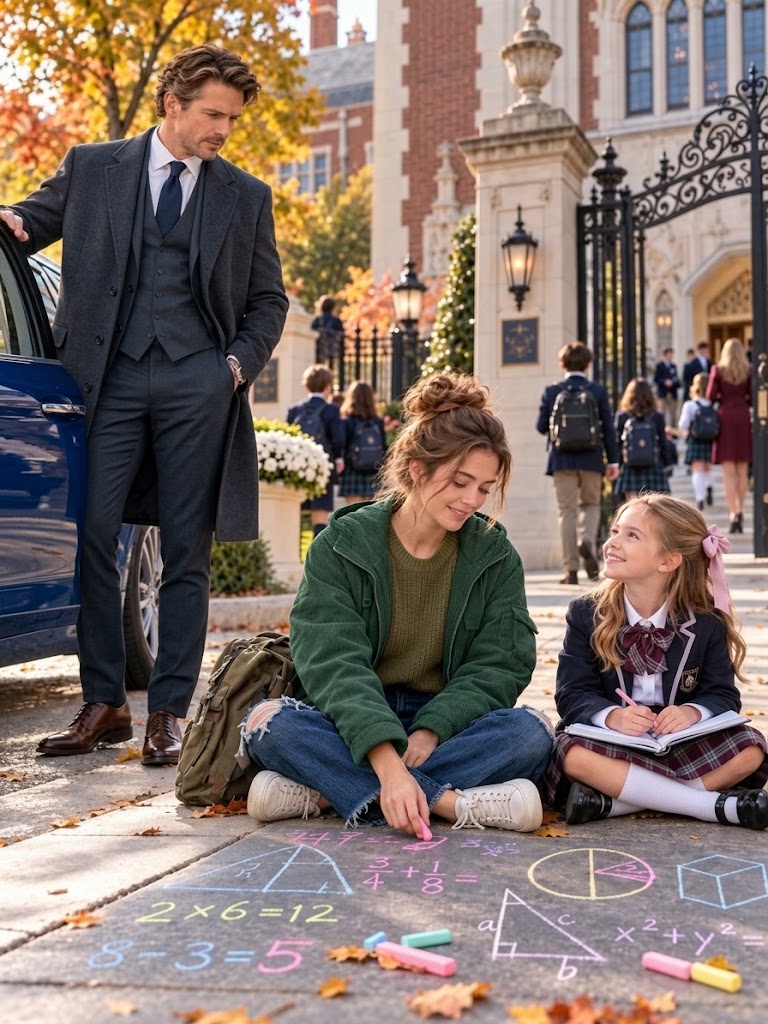
As I approached the school entrance, I noticed my daughter sitting on the stone steps beside an older girl wearing an oversized coat.
The girl looked about sixteen. Her clothes were worn, her shoes appeared to have been repaired several times, and a battered backpack rested beside her.
Claire was drawing numbers on the pavement with a piece of chalk.
The older girl was studying them.
I stopped a short distance away, curious about what had captured my daughter’s attention so completely.
Claire was explaining a mathematics problem. The teenager listened carefully before pointing to one of the numbers and suggesting a different way to solve it.
Claire immediately began erasing her work.
Then she laughed.
It was a genuine, carefree laugh I had not heard from her in months.
I stood there longer than I intended, watching two children who seemed to have forgotten that the rest of the world existed.
When Claire finally noticed me, she jumped to her feet.
“Dad! You’re early!”
“I finished work ahead of schedule.”
She ran toward me, then turned back to the teenager.
“Riley, this is my dad.”
The girl stood slowly, pulling her coat closer around herself.
“Hello, sir.”
Her voice was quiet, but her eyes were remarkably steady.
“Hello, Riley,” I replied. “Are you a friend of Claire’s?”
She glanced at my daughter.
“Something like that.”
Claire immediately objected.
“She helped me solve a problem nobody else could figure out.”
Riley shrugged as if the accomplishment meant very little.
“It wasn’t that difficult.”
“It was difficult!” Claire protested.
For the first time, I noticed something unusual about the teenager’s expression. She looked tired, but not confused or uncertain. There was a sharpness in her eyes that suggested she was paying attention to things most people overlooked.
I thanked her for helping Claire and asked whether her parents were waiting nearby.
The change in her face was subtle, but I saw it.
“No,” she said. “I’m on my own.”
Before I could ask anything else, Claire took my hand.
“Can Riley come with us?”
I looked at the girl, then at my daughter.
“Where?”
“Somewhere to eat. She hasn’t had lunch.”
Riley immediately shook her head.
“I don’t need anything.”
Claire frowned.
“You said you hadn’t eaten.”
“I said I wasn’t hungry.”
“You said your stomach hurt.”
Riley gave her a look that made it clear the conversation was over.
I had spent years making decisions based on schedules, budgets, and carefully evaluated risks. Inviting a stranger to lunch was not something I normally did without thinking it through.
But I could see that Claire genuinely cared about this girl.
And for reasons I couldn’t yet explain, I didn’t want to walk away.
So I asked Riley whether she would join us for a meal.
She hesitated before finally agreeing.
The restaurant was a small distance from the school, a place Claire loved because of its warm lighting and excellent chocolate cake.
Riley stopped outside.
“This place looks expensive.”
“It isn’t a palace,” I said.
She glanced toward the valet stand.
“There’s literally a person whose job is to park your car.”
Claire giggled.
Riley ordered soup and water.
I ordered enough food for the table and told her she could have whatever she wanted.
She studied me suspiciously.
“Why?”
“Why what?”
“Why are you being nice?”
I almost gave her the automatic adult response—because it’s the right thing to do—but something about Riley made rehearsed answers seem dishonest.
“I’m not sure yet.”
She lifted an eyebrow.
“That’s a weird answer.”
“It’s the truthful one.”
For several seconds she watched me.
Then she reached for a piece of bread.
Later, over chocolate cake, Claire mentioned her mother.
Riley became quiet.
“Mine used to make chocolate cake,” she said.
“Mine made terrible pancakes,” Claire replied.
I stared at her.
Claire hadn’t voluntarily shared a story about her mother in months.
“They were terrible,” she insisted, looking at me.
I smiled despite myself.
“They were remarkably bad.”
Riley laughed.
Claire did too.
And suddenly we were talking about two women who were no longer sitting at our tables, not as tragedies we were afraid to mention, but as people who had cooked badly, sung too loudly, misplaced keys, told jokes, and been loved.
Something loosened inside me that evening.
The Girl Who Saw Too Much
Before we parted ways, I gave Riley my business card.
“If you need anything, call me.”
She examined it.
“I don’t want money.”
“I didn’t offer you money.”
“People like you usually do.”
“People like me?”
She glanced at my coat and then toward the car waiting outside.
“You know.”
I nearly laughed.
“Call anyway.”
She tucked the card into her backpack.
Before leaving, she turned toward me.
“Claire notices people.”
“What does that mean?”
“Most people looked right past me today. She didn’t.”
Her eyes moved toward my daughter.
“Don’t teach her to stop doing that.”
Her words stayed with me long after I returned home.
The next morning, Claire confronted me over breakfast.
“Are we going to find Riley?”
“I’m going to see what I can do.”
“Today?”
“Claire, I have meetings.”
She placed her spoon on the table.
“You always have meetings.”
I began explaining that my work provided the life she enjoyed, but she interrupted me.
“You make yourself busy when you’re sad.”
I stared at her.
Children have an unsettling ability to walk directly into rooms adults have spent years keeping locked.
“Why would you say that?”
“Because when Mom was here, you came home earlier.”
She lowered her eyes toward the table.
“And after she was gone, you started planning everything.”
I had no defense.
For almost three years, I had tried to help Claire work through her grief while carefully avoiding my own.
Instead of correcting her, I pulled a chair beside hers.
“I miss her too.”
Claire leaned against me and began to cry.
I held her.
No advice. No appointment. No plan.
Eventually, she whispered, “Can we please help Riley?”
This time, the answer came without hesitation.
“Yes.”
A Name Buried in an Old File
With Riley’s permission, I contacted a youth advocate and began investigating what arrangements might be available to provide her with a stable place to live.
What we learned was difficult to understand.
Riley had once been an outstanding student at a public school north of Boston.
When she was thirteen, she scored among the highest students in her district in mathematics and received a recommendation for an advanced summer program at MIT.
Her teachers described her as exceptionally analytical, self-reliant, and talented.
Then her attendance began to suffer as her mother’s health deteriorated.
Eventually, Riley disappeared from the school system entirely.
Three days later, she called me.
Not because she wanted food or money.
Claire had accidentally left her mathematics notebook with her.
Riley was at a public library in Somerville.
When I arrived, I found her surrounded by textbooks that were far more advanced than I would have expected a sixteen-year-old to be studying.
“Calculus?” I asked.
She shrugged.
“It’s interesting.”
I took the seat across from her.
“Riley, would you allow me to help you find somewhere stable to stay?”
Her posture immediately stiffened.
“I can take care of myself.”
“I’m starting to understand that.”
“Then why do you keep trying to help?”
I thought about her question.
“Because being capable shouldn’t mean you have to handle everything alone.”
She lowered her eyes toward the book.
After a moment, she said, “You’re scared all the time.”
I frowned. “Excuse me?”
“Around Claire.”
“I’m her father. Of course I worry.”
“That’s not what I mean.”
She tapped her pencil against the table.
“When she laughs, you watch her like you’re checking whether it’s safe.”
I remained silent.
Riley continued in a softer voice.
“My mom used to do that when things started getting difficult. She thought that if she watched everything closely enough, nothing else could go wrong.”
Her observation was so accurate that I felt as though she had seen straight through me.
I changed the subject.
“What did your mother do for work?”
“She worked as an accountant for a while.”
“Where?”
“Several companies.”
Then she mentioned the name of one firm.
Whitmore & Vale Development.
My father’s company.
The company where I had spent summers working during college.
The company that eventually became part of my own architecture and property-development group.
“Your mother worked there?”
Riley quickly looked up.
“You know it?”
“My father founded it.”
The pencil slipped from her fingers.
For several seconds, neither of us said anything.
Then Riley reached into her worn backpack and took out a faded photograph protected by a plastic sleeve.
A young woman stood outside an office building beside three executives.
I recognized one of them immediately.
My father.
The woman standing beside him had Riley’s eyes.
“That’s my mom,” Riley said.
I turned the photograph over.
Someone had written a sentence on the back.
Nathan deserves to know someday.
I felt as though the room had shifted beneath my feet.
Sixteen Missing Years
My father’s former company had digitized its archives years earlier. That evening, I asked our legal department to locate every surviving record associated with Elise Bennett.
Most of the documents concerned ordinary employment matters.
Then we uncovered a restricted personnel folder.
Elise had worked as a senior financial analyst on several major development projects. Apparently, she had discovered accounting irregularities involving a collection of properties my father had been financing during a difficult period for the business.
But another document changed everything.
It was a handwritten note from my father.
Elise says Nathan is the baby’s father.
I read the sentence three times.
Then I sat there without moving.
Sixteen years earlier, shortly before I met the woman who would eventually become my wife, I had known Elise.
Not well, I had always told myself.
We were young. I traveled constantly for projects and was determined to prove that I could succeed without my father’s assistance. Whatever relationship Elise and I had shared ended suddenly when she resigned and supposedly moved west.
I never heard from her again.
Now a sixteen-year-old girl with gray-green eyes was sitting in a library teaching my daughter mathematics.
I arranged a paternity test only after speaking with Riley and explaining why I believed it was necessary.
She stared at me for a long moment.
“You think you’re my father?”
“I think it’s possible.”
She turned away.
“My mom said my father didn’t choose us.”
Her words hurt more deeply than anger could have.
“If I’m your father, Riley, I need you to understand something before we learn anything else.”
She looked at me.
“I didn’t know about you.”
“That’s convenient.”
“I understand how that sounds.”
“Do you?”
I let her question hang between us.
Four days later, the results arrived.
The probability of paternity was effectively certain.
Riley Bennett was my daughter.
I had another child.
Sixteen years of birthdays, school mornings, scraped knees, report cards, holidays, disappointments, and ordinary Tuesdays had passed without me.
I remained alone in my office for a very long time.
Money had always made it possible for me to solve practical problems quickly.
For the first time, I fully understood that some things could never be purchased after the fact.
You cannot buy back Tuesday afternoons from twelve years earlier.
You cannot purchase the first moment your child learned to read.
You cannot send a check backward through time and become the father she needed when she was six.
When I finally found Riley, she was standing outside a temporary youth residence her advocate had arranged.
“You got the results,” she said.
I nodded.
She seemed to understand before I spoke.
“I’m your father.”
Riley looked past me toward the street.
“So Mom was telling the truth.”
“Yes.”
“And you really didn’t know?”
“No.”
Her jaw tightened.
“I spent years believing you knew exactly where we were.”
I didn’t try to defend myself.
She had lived with that belief for far longer than I had lived with the truth.
“I’m sorry,” I said.
“You can’t apologize for something you didn’t know.”
“Maybe not. But I can be sorry you had to spend those years believing it.”
That was when she started crying.
At first, the tears came quietly.
Then she sat on the low brick wall behind her, and I sat several feet away because I hadn’t yet earned the right to assume she wanted me any closer.
After a long silence, she said, “There’s something else my mom left.”
The Box Elise Kept
The box had been stored with several of Elise’s remaining belongings.
Inside, we found letters, old financial records, photographs, a flash drive, and several pages bearing my father’s signature.
Piece by piece, the truth emerged. It was uglier and more heartbreaking than anything I had imagined.
Years earlier, several development projects had suffered enormous losses. My father and two senior executives had moved money between accounts to prevent the company from collapsing while they searched for additional financing. What may initially have been an attempt to buy time gradually developed into a system of concealed transfers and misleading reports.
Elise discovered the irregularities.
She refused to approve them.
Then she learned she was expecting my child.
My father saw both developments as threats to the future he had planned for me.
He persuaded Elise to leave the company and offered her financial security on the condition that she stay away from Boston and not involve me. He established a private trust for Riley, but much of the arrangement later became caught up in legal and administrative complications after his own health deteriorated.
One letter was addressed directly to me.
I recognized my father’s handwriting before I read a single word.
Nathan,
If this ever reaches you, then the truth has probably found you first.
I told myself I was protecting you.
That was easier than admitting I was protecting the life I had created.
Elise deserved better from me, and so did her child.
Your child.
If you ever find her, don’t try to replace the missing years with money. You can’t.
Give her what I was too afraid to give either of you.
The truth.
And then stay.
I lowered the letter.
For years, I had admired my father as a man who could control almost any situation.
Now I understood the cost of that obsession.
And with uncomfortable clarity, I recognized how easily I had begun turning into him.
Two Sisters
When I explained what I had discovered to Riley, she listened without interrupting.
Finally, she asked, “What happens now?”
For once, I had no answer ready.
“I don’t know.”
A faint smile crossed her face.
“That’s new.”
I laughed.
“Claire would agree with you.”
Riley hesitated.
“Does she know?”
“Not yet.”
“What are you going to tell her?”
“The truth.”
That evening, I brought Riley to our house.
Claire came running out of the living room, then stopped when she noticed our expressions.
“What’s wrong?”
I knelt beside her.
“Nothing is wrong, sweetheart. But something important has changed.”
She looked from me to Riley.
“What?”
I took a breath.
“Riley is your sister.”
Claire blinked.
Then she looked at Riley again.
“My actual sister?”
Riley nodded nervously.
Claire stared at her for perhaps three seconds.
Then she threw both arms around her.
Riley stood completely still, overwhelmed by how quickly a nine-year-old had accepted something the adults had needed weeks to understand.
Slowly, she returned Claire’s embrace.
Claire stepped back.
“Does this mean you can help me with math whenever I want?”
Riley laughed through her tears.
“Apparently, that’s the important part.”
“It’s very important.”
That night, our house sounded different.
Not healed. Not perfect.
Just alive.
And I began to understand the difference.
Learning to Stay
Riley didn’t immediately feel comfortable living with us.
Why would she?
She had spent too many years learning that stability could vanish without warning.
During her first few weeks in our home, she kept most of her belongings inside her backpack. She saved food after dinner even though the refrigerator was full. She asked permission before using ordinary household items. She never left her shoes or books lying around because some part of her still acted like a guest who might be told to leave.
One night, at around two in the morning, I found her sitting at the kitchen island drinking water.
“Can’t sleep?”
She shrugged.
I sat across from her.
After several minutes, she said, “This doesn’t feel real.”
“What doesn’t?”
She gestured around the house.
“Any of it.”
I nearly told her that she would always have a home with us.
Then I remembered my father’s letter.
Don’t repair the missing years with promises.
Stay.
So I said, “You don’t have to believe in forever tonight.”
She looked at me.
“Then what am I supposed to believe?”
“That you’re welcome here tonight.”
“And tomorrow?”
“Ask me tomorrow.”
The following evening, she did.
“Am I still welcome?”
“Yes.”
The evening after that, she asked again.
Eventually, she stopped asking.
Several months later, she entered my office carrying an advertisement for a laptop.
“Dad?”
I looked up so quickly that she laughed.
It was the first time she had called me that without hesitation or uncertainty.
“What?” she asked.
“Nothing.”
“You’re staring.”
“I’m listening.”
She placed the paper on my desk.
“I need a computer that’s faster than the one at school.”
“Why?”
She handed me another document.
It was an application for a national mathematics program.
She had qualified for the final competition.
“I want to try.”
I studied the page, then looked at her.
“Then we’ll get you a fast computer.”
She pointed a finger at me.
“Not some ridiculous luxury thing.”
I smiled.
“You really are my daughter.”
The Problem on the Board
The competition took place the following spring in Washington, D.C.
Claire and I sat together in the audience while Riley joined students from across the country.
She was nervous.
I could tell because her fingers tapped lightly against the desk.
I did the same thing whenever I was concentrating.
By then, I had noticed dozens of similarities between us. Some were genetic, while others might have been coincidences, but I no longer needed those details as evidence.
The paperwork had established our biological relationship.
The months that followed had taught me what being her father actually meant.
When Riley stepped onto the stage for the final round, Claire stood on her seat and shouted, “YOU’VE GOT THIS, RILEY!”
Several hundred people turned to look at us.
I sank lower into my chair.
Riley covered her face and laughed.
Then she sat down and began.
The final problem took her nearly fifteen minutes to solve.
I watched her study the board, tap her fingers, erase half a page, and begin again.
Then her expression changed.
I recognized that look.
I had seen it on a cold sidewalk outside Claire’s school.
She had found the pattern.
When the results appeared, Riley had finished first.
Claire screamed.
I didn’t try to stop her.
Riley looked toward us from the stage, and for one extraordinary moment, I saw both versions of her at once: the teenager in the oversized coat carrying everything she owned in a battered backpack, and the young woman standing beneath the bright auditorium lights as an entire room applauded the talent she had always possessed.
For months, people had told me how fortunate Riley was that Claire had noticed her.
They had it backward.
What the Sidewalk Taught Me
A year after the afternoon we first met, Claire’s school invited Riley to speak to students about mathematics, education, and second chances.
After the event, the three of us walked past the side entrance.
Riley stopped.
One section of the pavement had been replaced, but the old stone steps remained.
She spotted a piece of chalk beside a child’s drawing and crouched down.
Three circles appeared on the pavement.
Claire groaned.
“Not that problem again.”
“You still haven’t found the fastest solution.”
“I have a calculator now.”
“That’s cheating.”
I sat down beside them.
Riley glanced at my expensive coat touching the pavement and smiled.
“You’ve done this before.”
“I’ve become very adaptable.”
Claire laughed.
“Dad, you still don’t understand the problem.”
“Then teach me.”
Riley began explaining.
I listened, even though I barely understood the mathematics.
That no longer mattered.
For most of my adult life, I had believed that loving someone meant providing answers.
Build the right house. Choose the right school. Earn enough money. Hire the right experts. Eliminate uncertainty wherever possible.
But the people I loved had never needed me to design a perfect life for them.
Claire needed permission to miss her mother without being treated as though something inside her needed to be repaired.
Riley needed something even simpler and far more difficult: a father who wouldn’t disappear when life became uncomfortable.
And I needed both of them to teach me that love and control were not the same thing.
I couldn’t recover Riley’s childhood. I couldn’t undo what my father had concealed. I couldn’t return the years Claire should have spent with her mother, and I couldn’t promise either daughter that life would never change unexpectedly again.
But I could be there when it did.
The investigation into my father’s former company eventually required us to repay several clients and publicly acknowledge decisions I would once have done almost anything to keep separate from the Whitmore name. We lost money, reputation, and more than a few business relationships.
Strangely, I slept better afterward.
Secrets require constant maintenance.
Once accepted, the truth mostly asks you to live with it.
Years later, when people asked how I discovered that I had another daughter, they expected a dramatic explanation involving old documents, financial records, lawyers, and a family secret hidden for sixteen years.
Technically, that was the story.
But it was never the first thing I remembered.
I remembered a cold November afternoon.
A child sitting on stone steps.
A teenage girl wearing an oversized coat.
A few numbers drawn in chalk.
And Claire laughing.
That day, I had arrived early believing I was there to collect my daughter and take her safely home according to the carefully planned schedule I had created.
Instead, I met another daughter I had never known existed. Somewhere between those chalk marks and the truth that followed, I finally understood something my father had realized too late.
You cannot protect a family by concealing every difficult truth.
You cannot love someone by controlling every hour of her life.
You cannot make up for the years you missed by making grand promises about the years ahead.
Sometimes love is much less impressive than that. Sometimes it means sitting beside someone when you have no idea what to say. Sometimes it means answering the same uncertain question night after night. Sometimes it means admitting that you have no plan.
And sometimes, the most important promise you can make to a child isn’t that nothing difficult will ever happen again.
It’s simply this:
“Whatever happens next, I’m still here.”