Part 1 — The Moment Everything Changed
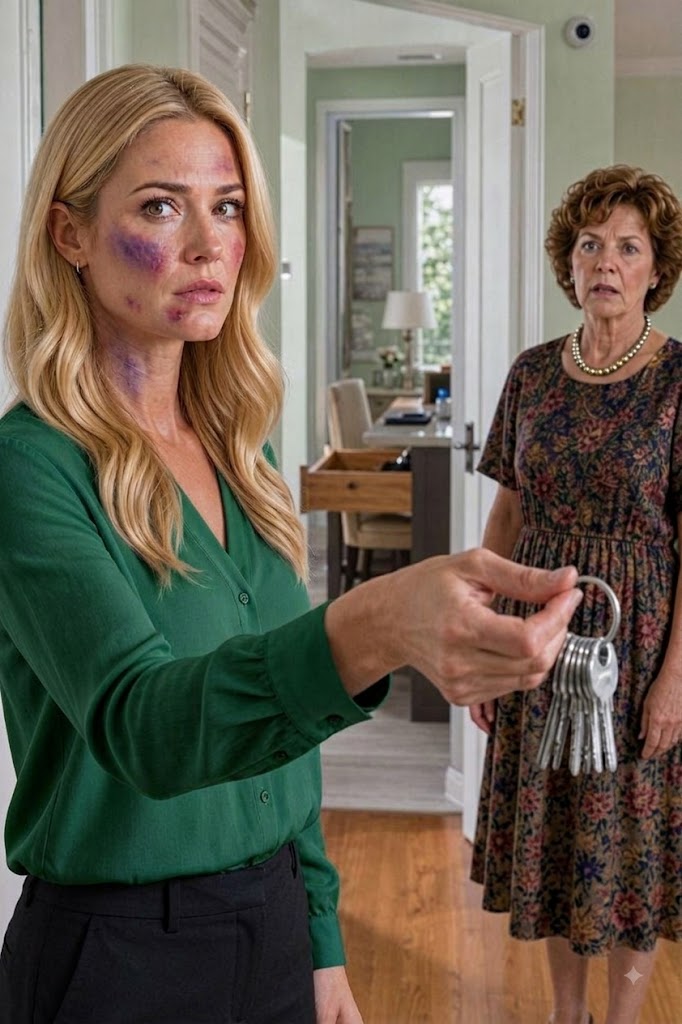
The keys struck the side of my face before I had time to move.
For a second, I simply stood there in the hallway, stunned by the sharp impact and the metallic clatter that followed when they hit the hardwood floor.
My eye immediately began to water.
Across from me stood my mother-in-law, Diane, her chest rising and falling with anger.
She had thrown the keys after I confronted her for coming out of my bedroom.
Again.
This time, one of the drawers in my desk had been left partially open.
A drawer where I kept personal paperwork.
A drawer she had absolutely no reason to touch.
“This is my son’s house,” Diane snapped. “You don’t get to tell me where I’m allowed to go.”
Her words were almost more shocking than the keys.
I slowly raised my hand to my cheek. The skin beside my eye was already beginning to sting.
Then I bent down and picked up the heavy brass key ring.
For several seconds, I stared at it.
Those keys had once represented trust.
Now they felt like proof of how badly that trust had been abused.
I held them out toward Diane.
“Then I suppose you won’t need these anymore.”
She stared at me.
And then she laughed.
Not nervously.
Not apologetically.
She genuinely believed I was bluffing.
That had become one of Diane’s favorite assumptions about me.
She believed that because I usually avoided arguments, I would never draw a real boundary.
She was wrong.
The house had been mine long before I married her son, Mark.
Three years before our wedding, my grandmother passed away and left me an inheritance.
She had raised me after I lost my parents, and nearly everything I understood about stability, responsibility, and home came from her.
I used part of the money she left me to buy the house.
The deed was in my name.
The mortgage was in my name.
The insurance policy was in my name.
Mark had always known that.
When we first got married, it had never seemed important.
He used to joke that he had married me, not my property.
Back then, I believed him.
But six months before Diane threw those keys, something began changing.
Her condominium suffered serious water damage, and Mark asked whether she could stay with us while repairs were being completed.
“Two weeks,” he promised.
I agreed without hesitation.
She was his mother.
Of course she could stay.
Two weeks became a month.
A month became two.
Eventually, nobody even discussed when she might leave.
Diane simply settled into our guest room as though she had always belonged there.
At first, the changes were small.
She began moving things around in the kitchen.
Then she reorganized cabinets without asking.
Soon she started commenting on how I decorated the house, how I cooked, and even how I arranged furniture.
I tried to ignore it.
Then she began entering our bedroom.
The first time, she said she was looking for Mark.
The second time, she claimed she needed towels.
Then I came home one afternoon and discovered that half my closet had been rearranged.
When I asked her about it, she shrugged.
“It looked messy.”
I was furious, but Mark asked me not to turn it into a confrontation.
“She’s just trying to help,” he said.
So I explained the boundary again.
Our bedroom was private.
She needed to knock.
More importantly, she needed permission before entering.
Diane rolled her eyes.
After that, I noticed papers on my desk being moved.
Twice.
Financial statements.
Insurance records.
Property documents.
Nothing appeared to be missing, but I knew exactly how I had left them.
When I confronted her, Diane called me territorial.
Mark defended her.
“She’s family,” he said.
That sentence became his answer to almost everything.
She entered our room because she was family.
She criticized me because she was family.
She moved my belongings because she was family.
Apparently, family meant Diane could ignore every boundary I set.
One week before the keys incident, I installed two security cameras in the common hallways.
I didn’t hide them.
I showed Mark where they were.
I showed Diane too.
Mark stared at me as though I had lost my mind.
“Cameras? Seriously?”
“Yes.”
“This is dramatic.”
I shook my head.
“No. This is documentation.”
Neither of them understood why the house mattered so much to me.
Or perhaps Mark once had and had simply forgotten.
My grandmother had been the person who gave me a sense of safety when my childhood had lost most of it.
The inheritance wasn’t just money.
Buying that house had been the last tangible thing her care had made possible for me.
It represented security.
It represented independence.
It represented the home I had built from the final gift she was able to leave behind.
And now someone was walking through it as though I were the guest.
The afternoon Diane threw the keys, I finally stopped negotiating.
I called a locksmith.
Every exterior lock was changed.
The front door.
The side entrance.
The garden door.
The keypad code was reset too.
When the locksmith finished, he held up the new set.
“How many copies?”
“Two,” I answered.
“One for me. One for my husband.”
None for Diane.
She had been watching from the driveway.
Her arms were folded tightly across her chest.
“Mark will just give me his.”
I looked at her.
“Then Mark will be making a choice.”
Her confident expression slipped for half a second.
Mark arrived home before dinner.
The first thing he noticed was the locksmith’s van leaving.
The second thing he noticed was the mark beside my eye.
He looked at me.
Then at his mother.
For one brief moment, I expected him to become furious on my behalf.
Instead, he sighed.
“She shouldn’t have thrown anything.”
I waited.
“But changing every lock seems a little extreme.”
Something inside me went strangely quiet.
Six years together.
And after seeing the mark on my face, his first instinct was to debate whether my response had been excessive.
He hadn’t even asked if I was all right.
I took the new key from my pocket and placed it in his hand.
“This key lets you into your home,” I told him. “It doesn’t give your mother permission to enter our bedroom. And it doesn’t give you permission to make her a copy.”
Diane stared at the key.
So did Mark.
Then his fingers slowly closed around it.
That tiny movement should not have meant much.
But somehow, standing there in our hallway, I felt as though I had just watched my marriage arrive at a crossroads.
And Mark had already started choosing a direction.
Part 2 — The Key He Wasn’t Supposed to Give Away
For the next three days, Diane behaved like an offended hotel guest who believed she would eventually inherit the building.
Cabinet doors slammed.
Drawers closed harder than necessary.
Conversations stopped whenever I entered a room.
She and Mark whispered behind closed doors.
Then relatives began calling.
Apparently, Diane had told several family members that I was financially controlling her son because I refused to put his name on the house.
Six months earlier, those calls might have upset me.
Now I was tired.
I stopped defending myself.
Instead, I photographed the mark on my cheek.
I backed up the hallway camera footage.
And I scheduled an appointment with a family-law attorney named Rachel Kim.
Rachel had the calm, measured manner of someone who had heard every possible version of a family dispute.
I gave her the deed first.
Then the purchase records.
Then I explained where the original money had come from.
Finally, I showed her the video.
She watched Diane throw the keys.
Her expression barely changed.
When it finished, she folded her hands on the desk.
“The property issue appears fairly straightforward based on what you’ve shown me,” she said. “The house is yours.”
Then she paused.
“The marriage is a different question.”
I looked down at my hands.
By then, I already knew the answer.
I simply hadn’t admitted it aloud.
What surprised me was how quickly Mark helped me accept it.
That Friday afternoon, I was sitting at work when my phone vibrated.
Motion alert.
Front hallway.
I opened the security-camera app.
Diane walked through the front door.
Alone.
For a second, I wondered how she had gotten inside.
Then I saw what she was holding.
Mark’s new key.
I felt my stomach drop.
She didn’t go to the kitchen.
She didn’t even take off her coat.
She walked directly upstairs.
Straight toward our bedroom.
After the key-throwing incident, I had installed a separate lock on the bedroom door.
Diane grabbed the handle.
It didn’t move.
She pulled harder.
Then she rattled it repeatedly.
Finally, she took out her phone and called someone.
A moment later, Mark’s voice came through the speaker.
“She locked me out again,” Diane complained.
There was a short pause.
Then my husband’s voice said something that changed everything.
“Just wait. I know where she keeps the documents. We’ll deal with it tonight.”
I replayed the recording.
Once.
Then again.
Documents.
That was what they were after.
Not a sweater Diane thought she’d left upstairs.
Not photographs.
Not some household item she needed.
Documents.
For months, I had wondered whether I was imagining the pattern.
The moved folders.
The questions about the house.
The constant remarks about Mark not being on the deed.
Now I wasn’t wondering anymore.
That evening, I came home carrying more than my work bag.
I had Rachel’s legal advice.
And I had an incident number from the report I had filed after Diane threw the keys.
When I entered the dining room, Mark and Diane were waiting.
A folder sat on the table.
Mark pushed it toward me.
“Sign it.”
I opened the folder.
Inside was a quitclaim deed from an online legal-document service.
I looked at him.
“What is this?”
“You know what it is.”
I did.
He wanted me to add him to the deed.
“Sign it,” he repeated. “Put my name on the house and all this fighting ends.”
Across the table, Diane smiled.
“A wife who trusts her husband shouldn’t need everything in her own name.”
I didn’t answer her.
I kept my eyes on Mark.
“Did you give your mother your key?”
His jaw tightened.
“She’s my mother.”
“That wasn’t my question.”
He looked away.
I continued.
“Did you tell her where I keep the property documents?”
Something passed over his face.
That was enough.
Diane slapped her palm against the table.
“Stop interrogating him and sign the paper.”
I closed the folder.
“No.”
Mark pushed his chair back so quickly that the legs scraped loudly against the floor.
“You’re actually willing to destroy our marriage over a house?”
I remained seated.
My hands were surprisingly steady.
“No, Mark.”
I looked directly at him.
“You’re destroying our marriage because the house isn’t yours.”
The room went silent.
Then I stood and walked upstairs.
I pulled a suitcase from the closet.
Not for me.
For Mark.
I placed it on the bed and packed several days of clothes.
But Rachel had already warned me not to make impulsive decisions involving marital occupancy rights.
So I wasn’t going to physically force my husband from the property or pretend I understood legal questions better than my attorney.
I brought the suitcase downstairs and set it beside him.
“I want a divorce.”
Mark stared at me.
For once, he had nothing to say.
“Anything involving your right to remain here can go through our attorneys,” I continued.
Then I turned toward Diane.
“But you are leaving tonight.”
She laughed.
That same dismissive laugh she’d given me after throwing the keys.
Before she could answer, the doorbell rang.
Two police officers were standing outside.
I recognized one of them.
He had taken my earlier report.
They weren’t there by coincidence.
Earlier that evening, I had provided the additional security footage.
And Diane’s smile disappeared.
Part 3 — What the Cameras Revealed
The officers asked everyone to remain calm.
Then they requested Diane’s identification.
I opened my phone.
First, I showed them the new recording.
Diane entering with Mark’s key.
Diane immediately going upstairs.
Diane trying my locked bedroom door.
Then her phone call with Mark.
The documents.
The plan to “deal with it” that night.
When that clip ended, I opened the earlier video.
The hallway appeared on screen.
There was Diane.
There was me.
Then the movement of her arm.
The keys leaving her hand.
The impact.
The keys hitting the floor.
Mark’s face lost its color.
He stared at his mother.
“You told me the camera didn’t catch that.”
For several seconds, nobody spoke.
I turned toward him.
So that was what Diane had told him.
Not that it hadn’t happened.
Only that there was no proof.
One of the officers looked at Mark.
“You knew she threw the keys?”
He hesitated.
Before he could answer, Diane jumped in.
“It was an accident.”
I touched the fading mark beside my eye.
“Then why did you tell Mark the camera didn’t record it?”
She had no answer.
The officers separated us and took statements.
They reviewed the footage carefully.
They photographed the remaining mark on my face.
Afterward, Diane was informed that because I had withdrawn permission for her to remain in the home, she needed to leave.
For the first time in six months, she packed her belongings because someone had finally made it clear that the guest room did not belong to her.
Mark went with her.
Before he walked out, he turned toward me.
“I hope you’re happy. You chose a house over your family.”
His words hurt.
But not in the way he intended.
Because by then I understood something he still didn’t.
I had never asked him to choose between me and his mother.
I had asked him to respect one simple boundary.
Our bedroom was private.
Instead of supporting that boundary, he gave Diane the key I had specifically asked him not to give her.
Then he helped her search for documents concerning property that had belonged to me before our marriage.
I hadn’t chosen a house over my family.
I had simply stopped calling disrespect “family.”
The following morning, Rachel filed the divorce petition.
At first, Mark’s attorney took a softer approach.
He suggested that perhaps Mark and I could reconcile.
There was only one strange condition attached.
I should add Mark to the deed.
Rachel listened quietly.
Then she placed the quitclaim document on the conference table beside a transcript of the security recording.
“So reconciliation requires ownership of her real estate?”
Nobody answered.
That proposal vanished quickly.
I hoped Diane would finally understand that the situation was serious.
Instead, several weeks later, she returned.
I was at work when another camera notification appeared.
There she was at the front door.
She inserted one of the old keys into the lock.
It didn’t work.
She tried again.
Then again.
When she realized the locks had truly been changed, she began pounding on the door.
A neighbor later told me Diane demanded that someone let her through the side gate.
The police were contacted again.
By then, everything had become part of a pattern.
The original key-throwing incident.
The unauthorized return.
Her repeated attempts to enter private areas of the house.
And the messages she continued sending in which she referred to the property as “Mark’s house.”
Those events later helped support a protective order requiring her to stay away from me.
Meanwhile, the divorce moved forward.
Mark attempted to argue that he had financially contributed to the house during our marriage.
Fortunately, finances leave records.
The original purchase funds were clearly traced to my inheritance.
The mortgage payments came from my accounts.
So did the property taxes and the major renovation expenses.
The money Mark had contributed during our marriage reflected normal shared household costs.
There was no secret transfer of ownership.
No forgotten agreement.
No document magically making the property his.
The house remained where it had always been.
In my name.
Mark kept his car.
He kept his retirement account.
And he moved into an apartment across town.
What he couldn’t keep was the marriage he had treated as secondary to his mother’s sense of entitlement.
Eventually, Diane’s case regarding the key-throwing incident was resolved, and she was required to stay away from me.
The divorce became final.
And after everything was finished, I learned something almost absurd.
There had never been some secret fortune hidden inside my bedroom desk.
No mysterious investment account.
No second inheritance.
Nothing.
The folders Diane had been so determined to reach contained ordinary property records, insurance paperwork, tax documents, and personal financial information.
That was the strangest part.
They had risked an entire marriage because they had convinced themselves that something I owned should eventually belong to them.
Six months after the divorce, I decided to repaint the bedroom.
I chose pale blue.
For years, I had avoided that color because Mark said it was too cold.
Standing in the finished room, I realized it didn’t feel cold at all.
It felt peaceful.
My desk remained beside the window exactly where I wanted it.
My folders remained inside the drawers exactly where I left them.
No one moved my clothes.
No one entered without knocking.
No one told me that protecting my own space made me selfish.
That spring, on the first truly warm Saturday of the year, I called the locksmith again.
There was no emergency this time.
No argument.
No police report.
I simply wanted a new smart lock installed on the garden entrance.
When the locksmith arrived, he recognized me.
“You’re the lady from the big lock change.”
I smiled.
“That would be me.”
He finished the installation and tested the lock twice.
Then he stood near the door with his equipment packed away.
“How many keys do you need this time?”
I looked around the house.
Sunlight was spilling through the windows.
The hallway where Diane had once stood shouting at me was quiet.
The room where Mark had pushed a quitclaim deed across the table was peaceful.
And the home my grandmother’s final gift had allowed me to build finally felt like mine again.
Not because of the deed.
Not because of the locks.
Because I no longer had to defend my right to feel safe inside it.
“One,” I said.
The locksmith raised an eyebrow.
“For now?”
I looked down the hallway, remembering how everything had begun with one set of keys hitting the floor.
Then I smiled.
“For now, one is perfect.”