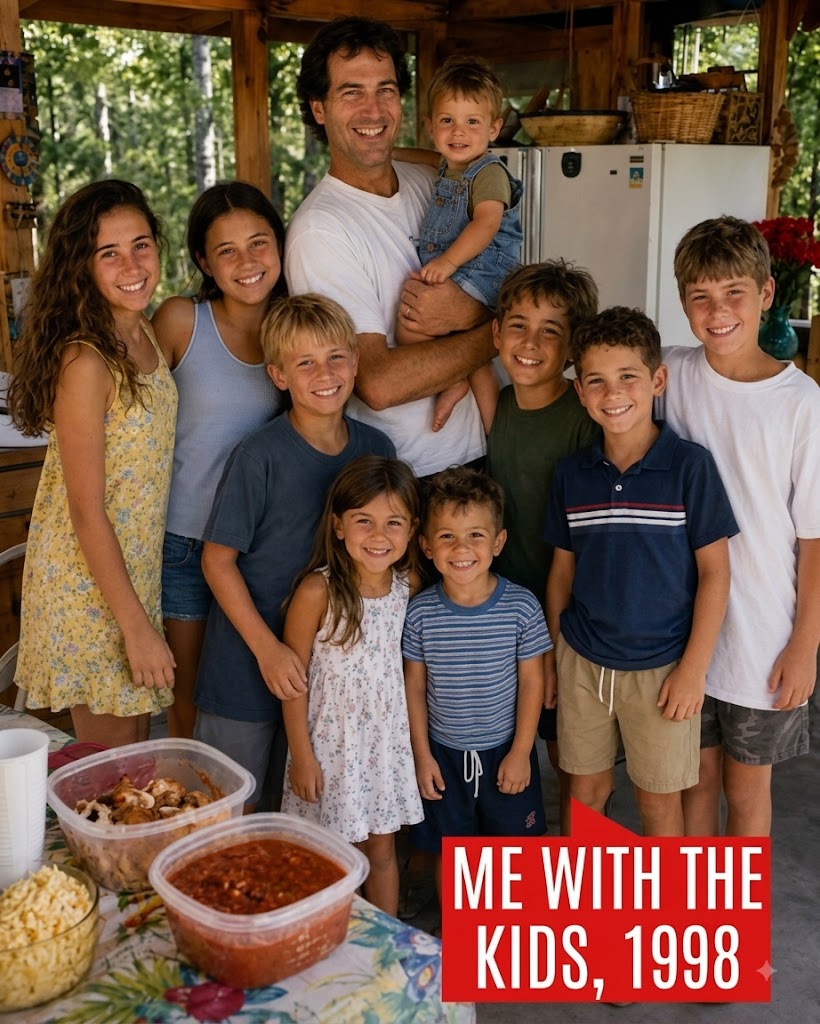
Part One — The Box at the Cemetery
“Dad, please don’t open this yet.”
Sarah was standing beside my car, holding a battered shoebox against the front of her black dress. The funeral had ended only minutes earlier, but the other eight children were still gathered near the cemetery road, watching us from a distance. Their spouses and children stood with them, quiet and uncertain.
Sarah was forty-two now. Still, when she looked at me, I could see flashes of the fourteen-year-old girl she had been—the child who once asked me, with a trembling voice, whether I intended to leave her too.
“What’s in the box?” I asked.
Her thumb moved nervously along the cracked cardboard lid.
“The truth about Mom.”
My hand froze on the car door.
For twenty-eight years, I had lived with one explanation for Rebecca’s disappearance. A week after our wedding, she had packed a suitcase, left nine children behind, and written a note saying she wanted a different life. I had never understood how a mother could walk away from nine small faces, but eventually I learned to live with the question.
Or so I thought.
Sarah took a shallow breath.
“She didn’t leave because she wanted something better than us.”
The words moved through me like a sudden chill.
“Then why did she leave?”
“Because she was afraid.”
I looked past Sarah at my children. Maisie was holding Lucy’s hand. Jonathan and Jonah stood together, just as they had when they were boys. May had her arm around June, while Malcolm stared at the gravel. Hailey, the youngest, kept glancing toward the box.
“Afraid of what?” I asked.
Sarah lowered her eyes.
“Dad… I met her.”
The cemetery seemed to fall silent around us.
“When?”
“Twelve years ago.”
“You knew where she was all that time?”
“Yes.”
“And you never told me?”
Her eyes filled with tears.
“I thought I was protecting you.”
I stepped away when she reached for my hand.
“You watched me believe her note for another twelve years?”
“I thought I was protecting you.”
“That’s what your mother believed she was doing too.”
And suddenly, the past I had buried began to open.
Part Two — The Family I Chose
Twenty-eight years earlier, Rebecca was a widow raising nine children alone.
Sarah was fourteen. Maisie was twelve. The twins, Jonathan and Jonah, were ten. May and June were seven. Malcolm was five. Lucy was three, and Hailey had barely turned two. Their father had been gone for two years when I met them.
Everyone who knew me advised me to walk away.
“You’re still young,” my aunt told me. “You don’t need to take on nine children.”
Rebecca never said it that bluntly, but I could see the same fear in her eyes. She expected me to disappear as soon as the reality of her life became inconvenient.
One evening, I found her scrubbing a kitchen counter that was already spotless. From the next room came the sound of the twins arguing over a television program, followed by Lucy’s cries and Malcolm’s running footsteps.
“You don’t have to stay, Brian,” Rebecca said without looking at me. “I know this is more than you expected.”
“I know.”
She stopped moving the cloth.
“Then why are you still standing there?”
“Because you cooked dinner, and I’m washing the dishes.”
She gave me a tired smile.
“You know what I mean.”
I did.
“Nine children,” she continued. “Nine different needs. Nine reasons to be exhausted. Why would you choose this?”
Before I could answer, her younger sister Marianne walked in carrying Hailey. The little girl reached for me, and Marianne placed her in my arms.
“Are you certain about him?” Marianne asked her sister.
I settled Hailey against my shoulder. She immediately rested her cheek beneath my chin.
“It isn’t a burden,” I said.
Rebecca looked at me.
“What isn’t?”
I nodded toward the noise coming from the living room.
“All of this. It’s not baggage, Rebecca. It’s a family.”
The twins began shouting again. Rebecca closed her eyes, but I could see the faintest smile at the corner of her mouth.
“You see?” she whispered. “It never ends.”
“Good,” I told her. “I don’t want it to.”
We married a few weeks later in a small ceremony. There were grocery-store flowers, borrowed shoes, and nine children who could not remain clean long enough for a proper photograph.
Before the ceremony began, Malcolm tugged at my sleeve.
“Are you our real dad now?”
I knelt in front of him and fixed his crooked collar.
“A wedding doesn’t make me your father by itself. I become your dad by being here every day.”
He considered that carefully.
“Every day?”
“Every day.”
Sarah stood behind him, listening.
“Thank you for staying,” she said quietly.
After the ceremony, all nine children began calling me Dad. I understood the weight of that word, and I promised myself I would never treat it casually.
For six days, I believed our hardest days were behind us. I was wrong, but I was happy enough not to notice.
Part Three — The Note on the Table
On the sixth night, I sat at the kitchen table sorting bills after a double shift. The washing machine had stopped working, one of the twins had spilled juice into my work boots, and I was too tired to remember which school form needed signing first.
Across from me, Rebecca kept folding and refolding a paper napkin.
“Do you ever wish you had met me before the children?” she asked.
I looked up.
“Why would you ask that?”
“Just answer.”
“I can’t picture you without them.”
Her fingers tightened around the napkin.
“What if I become another person you have to care for? What if I get sick? What if you wake up one morning and realize you gave your entire life away?”
I reached across the table and covered her hand.
“Then you’ll finally allow me to care for you too.”
She glanced at the bills spread before me.
“You’re already exhausted.”
“This is one difficult week. Let me be the husband and father I promised to be.”
She looked at me for a long moment, as if she were trying to memorize my face.
Then she leaned across the table and kissed my forehead.
“I love you,” she whispered.
“I love you too.”
I fell asleep in the chair.
The next morning, Sarah woke me before sunrise.
“Dad?”
Something in her voice made me sit upright.
“What happened?”
“Mom is gone.”
I was still half asleep.
“She probably went to the store.”
“Her suitcase is gone.”
I ran upstairs.
Rebecca’s side of the closet was almost empty. Her coat was missing. So were her shoes, her handbag, and the small photograph of us she kept beside the bed.
On the kitchen table lay a folded sheet of paper.
Sarah had already read it. Her face was drained of color.
I unfolded the note.
I can’t continue living this way. Please don’t search for me. I want another kind of life.
There was no explanation, no address, and no goodbye.
Malcolm wandered into the kitchen rubbing his eyes.
“Where’s Mom?”
I opened my mouth, but no answer came.
Sarah grabbed the note from my hand.
“Does she mean us?”
“I don’t know.”
“She left us?”
“I don’t know.”
Her voice cracked.
“You keep saying that!”
I pulled her against me as Malcolm began to cry. Within minutes, the other children came downstairs. Nine children gathered around me, waiting for an explanation I did not have.
I called Marianne. She did not answer. I called again. Then I called every relative whose number I could find.
No one knew where Rebecca had gone—or no one was willing to tell me.
By noon, my aunt arrived and looked around the kitchen with the expression of someone already calculating the damage.
“You need legal advice,” she said. “They aren’t legally yours.”
“They’re my children.”
“You’ve been married for one week, Brian. Their relatives may want to take them in.”
Sarah stood in the hallway with Hailey on her hip.
“No,” I said. “I’ll learn whatever I need to learn, but no one is separating them.”
After my aunt left, Sarah came to me.
“Are they going to split us up?”
“No.”
“You don’t know that.”
She was right. I knew nothing about custody law. I had no savings large enough to make the situation easy, and no guarantee that a court would care about a promise made by a frightened man in a crowded kitchen.
But Sarah needed certainty more than she needed my fear.
“Nobody is taking you away from one another,” I told her.
“Can you promise?”
I looked directly into her eyes.
“Yes.”
Once I gave my word, I no longer belonged only to myself.
Part Four — The Promise Became a Life
The lawyer explained that marriage did not automatically give me parental rights. I would need temporary guardianship, background checks, proof of income, a childcare plan, and a home the court considered suitable for nine children.
Rebecca’s cousin argued that the children should be divided among relatives. He called it practical. He said nine children were too much responsibility for one man who had known them for only a week.
At the hearing, I did not pretend he was wrong about the difficulty. Instead, I brought my work schedule, my budget, my plan for childcare, and a list of people willing to help.
The judge asked Sarah whether she felt safe with me.
She glanced at the others before answering.
“He’s afraid,” she said. “But he hasn’t run away. He said we would stay together, and I believe him.”
The judge granted temporary guardianship.
It was not adoption. It was not a promise that the arrangement would last. But that evening, all nine children came home with me.
The first year was a storm we learned to walk through one day at a time.
I worked extra shifts. I forgot school forms. Once, I attended the wrong twin’s parent-teacher meeting and spent ten minutes praising the wrong child’s handwriting.
Jonathan and Jonah thought it was the funniest thing that had ever happened.
One morning, Lucy held up a blouse I had taken from the dryer.
“This used to be white,” she announced.
I examined the bright pink fabric.
“It has more character now.”
“You turned six shirts pink.”
“Then pink is our official family color.”
She tried to look offended, but laughter won.
I also learned that love required more than feeding children and paying bills. It required noticing what they were carrying.
At a school event, another parent touched Sarah’s shoulder.
“It’s wonderful how much you help with the younger ones,” the woman said. “You’re practically their second mother.”
I stopped walking.
“Sarah is their sister,” I said gently. “She deserves to be a child too.”
Later, in the car, Sarah admitted she had been waking before everyone else to prepare lunches.
“I can help,” she said. “You can’t do everything.”
“You’re right,” I told her. “I can’t. That’s why I’ll ask adults for help. You don’t have to become the mother your mother left behind.”
The legal process continued for years. There were home visits, hearings, background checks, and unanswered attempts to locate Rebecca. Eventually, the court granted me permanent custody. Later, the adoptions were completed in stages because of the children’s ages.
At the final hearing, Hailey tugged my sleeve.
“Does this paper mean you can’t leave us?”
I looked down at the decree.
“It says I can’t.”
Sarah nudged my arm.
“You said that before the paper.”
She was right. The document did not create the promise. It only put a legal seal on something we had already become.
Part Five — The Years That Stayed
The children grew up in stages, and so did I.
There were driving lessons, school dances, graduations, weddings, and grandchildren who left toys beneath every piece of furniture. One by one, the children moved into homes of their own, but they never moved far from one another.
Most weekends, my house became noisy again. Someone was always arriving with groceries, a forgotten jacket, a new baby, or a problem that needed solving.
I stopped searching for Rebecca. Not because I had stopped wondering about her, but because I had built a life that could no longer be placed on hold.
Then, twenty-eight years after she disappeared, Marianne called me.
“Brian?”
I knew her voice immediately.
“Marianne. It’s been a long time.”
“Rebecca died this morning.”
I gripped the phone until my knuckles hurt.
“She wanted all of you at the funeral,” Marianne continued. “She asked before she became too ill to speak.”
I looked at the photographs on my wall. Nine children at different ages. One family changing from year to year.
“She had twenty-eight years to ask for us,” I said.
“Please come, Brian.”
“I’ll ask the children.”
“You should come for her.”
“If we go, it won’t be for her. It will be because the children choose to.”
All nine chose to attend.
At the service, relatives described Rebecca’s loneliness and suffering. Their words were not false, but they were incomplete. Behind us, a woman whispered that Rebecca had always loved her children.
I turned toward her.
“Love that remains hidden can still leave people alone.”
The woman said nothing after that.
Part Six — What Was Inside the Box
After the burial, Sarah found me near the edge of the cemetery.
She was holding the same shoebox.
“I need to tell you everything,” she said.
We sat in my car while the others waited nearby.
Sarah placed the box on her lap and lifted the lid.
Inside were medical letters, old photographs, notes about the family’s health, and birthday cards sealed with years-old tape.
She handed me the first letter.
“Mom received the diagnosis three days after your wedding,” Sarah said. “The doctors confirmed it wasn’t a condition the children could inherit. But they couldn’t tell her how quickly it would progress.”
I read the letter once. Then again.
It described a degenerative neurological illness. The words were clinical, but the future they outlined felt brutal: increasing weakness, unpredictable symptoms, and the gradual loss of independence.
“Why didn’t she tell me?”
Sarah’s voice trembled.
“She overheard you talking to Aunt Marianne.”
A memory surfaced—the kitchen, the bills, my tired voice after a long shift.
“I told Marianne I was afraid I would fail your mother,” I said. “I was scared I wouldn’t be enough for nine children. That was the truth.”
Sarah nodded.
“Mom heard that part. She didn’t hear you say that you loved her.”
I closed my eyes.
“She thought her illness would turn your kindness into a prison,” Sarah said. “She believed you would spend the rest of your life caring for her out of obligation.”
“So she abandoned me with nine children to set me free?”
“She thought you would let relatives take us. She believed you would eventually realize you had no choice.”
I looked at my daughter.
“She believed I would allow you to be separated?”
“She was terrified, Dad.”
“She could have asked me. She could have trusted me.”
“I know.”
I touched one of the sealed cards.
“When did you see her?”
“Twelve years ago. She contacted me after her symptoms became worse.”
“And you agreed to keep her secret?”
“I told her to come home. She refused.”
The anger I had held toward Rebecca suddenly found a second place to land.
“Then you should have told me,” I said. “When did we decide that my heart was something everyone else could manage?”
Sarah began to cry.
“She said you would abandon everything to care for her.”
“I was her husband. I would have chosen that life.”
“That’s why she said you couldn’t know.”
I looked at the woman my frightened fourteen-year-old had become.
“You don’t get to make my choices for me.”
“I thought I was protecting the family we built.”
The words struck me because they echoed Rebecca’s decision exactly.
“That’s what she thought she was doing too.”
Part Seven — The People Who Knew
I carried the box back to the reception room. Marianne saw it in my hands and went pale.
“You knew,” I said.
She did not ask what I meant.
“Yes.”
“From when?”
“From the beginning.”
“You knew where she was?”
“Yes.”
Marianne lowered her head.
“I was beside Rebecca when you called that morning. She begged me not to tell you.”
My fingers tightened around the box.
“And you let nine children grow up believing their mother simply wanted a life without them?”
“She was frightened.”
“She was their mother.”
“She was sick, Brian.”
“She was sick when she left. She was ashamed afterward. Those are explanations—not the same thing as repairing the damage.”
Tears gathered in her eyes.
“She made me promise.”
“You protected her secret. Who protected the children?”
There was no answer.
There had not been one twenty-eight years earlier, either.
Part Eight — The Life That Stayed
I gathered the children in a quiet room and placed the box on the table.
They were adults now, with families and responsibilities of their own, but for a moment I saw the nine children who had once stood in our kitchen waiting for me to explain their mother’s empty closet.
“Your mother loved you,” I told them. “But love does not erase the fact that she left. Both things can be true at the same time.”
Malcolm looked at the letters.
“What are we supposed to do with all of this?”
“Whatever helps you heal,” I answered. “Read the letters. Keep them. Burn them. Leave the box closed forever. You don’t owe anyone forgiveness before you’re ready—or at all.”
Sarah handed me Rebecca’s final letter.
I read it aloud.
I believed leaving would release you. I believed your love would become a chain, and that one day you would resent me for needing you.
When I finished, I sat with the paper in my hands.
“She was wrong,” I said.
Sarah’s chin trembled.
“Are you still angry?”
“Yes.”
No one moved.
“I’m angry that she decided I wouldn’t choose her. I’m angry that she assumed I would let you be scattered among relatives. And I’m angry that she spent twenty-eight years protecting herself from a choice I would willingly have made, while all of you carried the consequences.”
Maisie reached across the table and took my hand.
“But now you know.”
I looked around the room. At my children. At their children playing near the open doorway. At the life that had been built from one promise made to a little boy with a crooked collar.
“Yes,” I said. “Now I know.”
“Does that make it better?” Maisie asked.
I considered the question.
“It doesn’t change what happened. But it ends the part of my life spent wondering.”
Sarah wiped her cheeks.
“Can you forgive me?”
I took the box from her and rested my hand over hers.
“I can forgive you. But you can never decide what I’m allowed to feel or what I’m willing to do.”
She nodded through her tears.
“Never again.”
I folded Rebecca’s letter and placed it back in the box.
“I won’t spend the rest of my life punishing someone who is already gone,” I said. “And I won’t let her fear steal another day from this family.”
The back door opened. The grandchildren ran into the yard, their voices rising into the afternoon.
Sarah slipped her arm through mine.
Rebecca had left us with a wound and, twenty-eight years later, returned with an explanation. The explanation did not excuse her. It did not restore the years we lost.
But it finally gave the silence a name.
I left the shoebox inside, beside the photographs and the life we had built. Then I walked outside with the daughter who had once been afraid I would leave—and toward the family that had stayed.