Part 2 — The Two Dogs Beside the Drainage Ditch
My name is Abigail Turner, and I was forty-six when Otis and Mabel arrived at our Savannah shelter.
A county road worker found them shortly after sunrise in early March. Otis was standing beside a drainage ditch while Mabel remained beneath an abandoned picnic table.
The temperature had fallen into the forties overnight, and both dogs were damp from rain.
Otis approached the worker first.
His long nose remained low, and his rear legs moved with visible stiffness. When the man stepped toward Mabel, Otis turned and walked back to the table.
Mabel emerged only after hearing him.
She was an eight-year-old Beagle mix with a tri-colored coat, a white blaze down her face, a black saddle across her back, a folded right ear, and two cloudy pale eyes.
She kept her nose near Otis’s left shoulder.
Animal-control officers used separate slip leads and two secured transport compartments. Otis entered first, then stood at the divider while Mabel followed the sound and scent of him.
No microchips were found. Neither dog wore identification.
Found-dog notices produced no confirmed owner.
During intake, Otis weighed ninety-two pounds. His coat was dull but intact, and his nails showed uneven wear consistent with altered rear-leg movement.
We observed reduced muscle across both hindquarters, lowered hips, and difficulty rising. He could walk on all four legs, but slick flooring caused his rear paws to spread.
Radiographs later confirmed osteoarthritis in both hips and age-related changes in his knees. His treatment plan included pain management, controlled activity, weight monitoring, nonslip flooring, and gradual strengthening.
Mabel’s blindness required a different assessment.
Her pupils did not respond normally to light, and she could not visually track movement. Additional examination indicated longstanding retinal degeneration accompanied by mature cataracts.
The eyes were not acutely painful. Surgery was unlikely to restore useful sight because the retinal disease affected the structures needed for vision.
Mabel would remain blind.
The diagnosis did not make her incapable of a good life. It meant her environment needed predictable pathways, stable furniture, textured surfaces near steps, and people who announced themselves before contact.
During their first week, the dogs remained in adjacent medical kennels.
Otis slept beside the divider.
Mabel slept with her back against the same wall.
When separated for examinations, each remained functional. Otis accepted food without Mabel present. Mabel could follow a technician’s voice and locate a water bowl using scent.
Those observations mattered.
Otis and Mabel showed attachment, but both could engage independently.
We believed separate adoption remained possible.
What we underestimated was how much of Mabel’s confidence had been built around Otis’s pace.
In the courtyard, Otis walked slowly enough for her to follow. He paused at curbs before she reached them. When the gate opened, his collar tags gave her a destination.
A volunteer began taking them into the quiet yard together every Sunday. That schedule developed by accident because Sunday mornings had fewer visitors.
Otis learned the route from his kennel to the yard.
Mabel learned to wait for his collar.
When Mabel entered a medical hold for eye testing, their Sunday outings stopped. Otis continued going outside alone, but at each turn he looked back.
Then Karen and Daniel submitted an application.
Their home appeared well suited to an arthritic senior dog. They had no resident animals, few stairs, a fenced yard, and enough time for short daily walks.
After four meetings, Otis left with them.
We sent his blanket and medical plan.
We did not send Mabel because we had not yet understood that Sunday itself had become part of their bond.
Part 3 — The Route Stored in His Nose
Karen and Daniel lived a little over a mile from the shelter. Their home sat near a walking path that eventually joined the riverside district.
For the first week, Otis explored only the yard and neighboring block. His arthritis required controlled exercise rather than long walks immediately after adoption.
He ate normally, slept on a low orthopedic bed, and followed Karen from room to room.
The first Sunday, Daniel suggested driving to the riverside trail.
They parked near a bakery three blocks from the shelter. Otis stepped from the vehicle, smelled the pavement, and changed direction.
The route likely contained familiar information: shelter cleaning products, dogs, staff clothing, delivery vehicles, and Mabel’s path through the courtyard.
What Karen observed was simple.
Otis became more focused with every block.
His pace increased despite the stiffness in his hips. His nose remained near the ground, and he ignored food offered during rest stops.
When they reached our lobby, Otis searched the walls and lower door seams. He rested after ten minutes and then returned home without resisting.
We believed he had revisited a familiar location.
The second Sunday changed that interpretation.
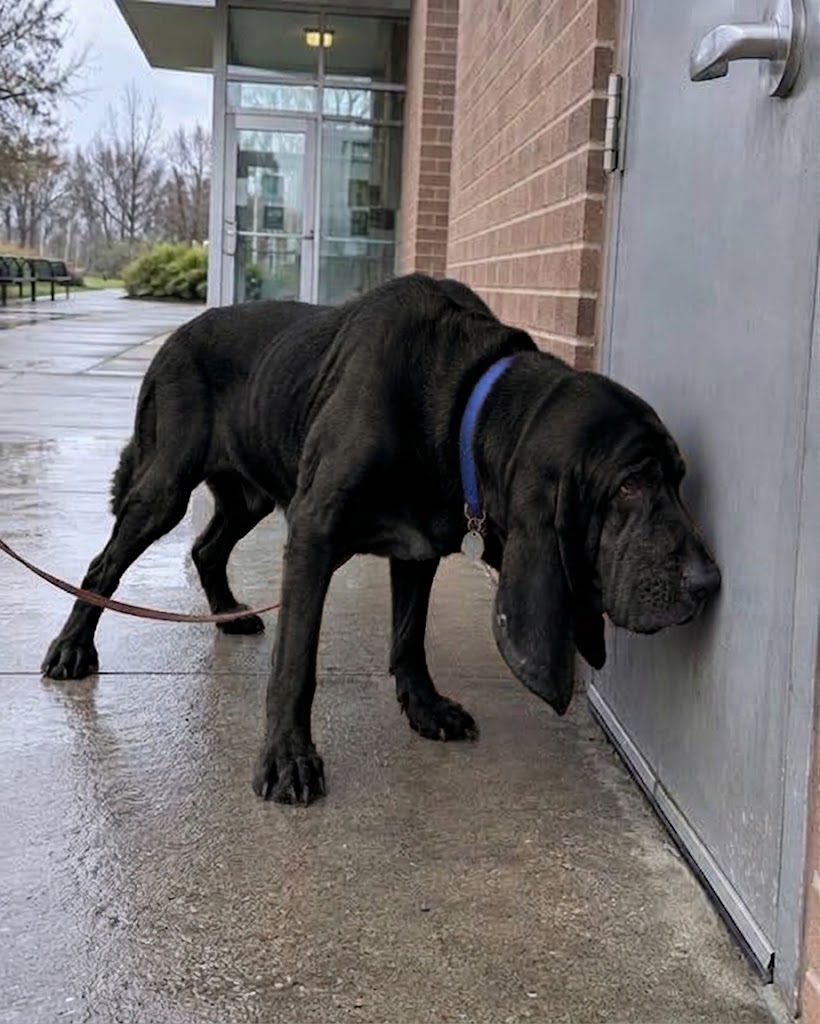
Otis entered the lobby, bypassed former caregivers, and moved toward the medical corridor. He stopped at the gray door separating the public wing from treatment kennels.
Mabel’s kennel stood beyond it.
Karen guided him away because the corridor was closed.
At home, he stood beside the front door for nearly an hour.
The third Sunday, Daniel parked closer so Otis walked only one block. That reduced exertion but did not change the destination.
Otis reached the gray door and lay across it.
When he bayed, Mabel answered.
The reunion through the secured gate confirmed the connection.
Mabel entered the quiet courtyard first. Otis followed on a loose leash with his support harness.
Mabel turned toward the sound of his tags. She approached in a curved path, smelled his shoulder, and stood beside him.
Otis’s rear legs trembled.
Mabel moved toward his front half rather than leaning against his hips.
That adjustment suggested familiarity with his limits.
During the session, both dogs explored independently and returned to one another repeatedly.
The interaction supported a joint placement.
They needed separate feeding areas, more runners, barriers near steps, a predictable furniture layout, and an emergency plan for transporting two older dogs with different disabilities.
There was also Otis’s health.
His weekly pulling had aggravated his hips. His medication timing was adjusted, and exercise was temporarily reduced.
Otis could not become Mabel’s constant physical guide.
He should not support her weight, block every obstacle, or walk extra distances each time she became disoriented.
Mabel needed independent navigation skills.
The adoption plan therefore included helping them live together without asking Otis’s aging body to do all the work.
Karen and Daniel began visiting Mabel without him. They taught her to follow a consistent verbal cue and locate a textured mat placed before doorways.
During their first solo meeting, Mabel searched for Otis for six minutes.
Then she followed Karen’s voice across the room.
On later visits, she located a water bowl without assistance and walked beside Daniel through a short obstacle-free corridor.
Mabel was not abandoning Otis.
She was building a second map made from human voices, floor textures, and repeated routes.
Only after that map began forming did we schedule a home visit.
Part 4 — Preparing One House for Two Older Dogs
The Brooks home already accommodated Otis’s arthritis. Rubber-backed runners connected his bed, water, yard door, and kitchen. A low ramp covered the single exterior step.
Mabel required additional changes.
Karen placed textured squares several feet before each doorway. A rough mat identified the back door, a ribbed runner led toward water, and a soft circular rug marked Mabel’s sleeping area.
Furniture remained against walls, leaving broad pathways.
Baby gates blocked the basement stairs.
Daniel added foam guards to sharp table corners but avoided filling the home with obstacles intended to help. Too many new textures could confuse rather than guide.
The first home meeting lasted forty minutes.
Mabel entered wearing a harness. Otis waited in the yard so she could explore without immediately following him.
Karen guided Mabel by voice.
“Step,” she said before the ramp.
“Door,” she said at the threshold.
Mabel paused, smelled the frame, and entered.
She mapped the living room through short arcs. Her whiskers touched the sofa. Her paws found the circular rug. She located the water bowl after following the ribbed runner.
Only then did Otis come inside.
Mabel turned toward his collar.
She crossed the room and touched her nose beneath his ear.
Otis began circling, but one rear paw slid from the runner. Daniel steadied the support handle.
We ended the reunion before fatigue became pain.
The second visit lasted one hour. The third included a meal in separate spaces. The fourth allowed both dogs to rest.
Otis chose his orthopedic bed near the window.
Mabel chose the circular rug six feet away.
They did not need to touch constantly.
That became the strongest evidence that the home could work.
Mabel’s final medical clearance arrived two weeks later. Her blindness was permanent, but her eyes remained comfortable.
Karen and Daniel completed the second application, updated their emergency plan, and arranged a vehicle barrier with two secured areas.
On adoption morning, Otis accompanied them to the shelter.
Mabel emerged wearing a red collar with identification.
Otis wore blue.
They met in the courtyard before approaching the vehicle. Mabel explored the ramp first while it rested flat on the pavement.
Otis waited beside the open rear door.
Mabel placed her front paws on the ramp, withdrew, and listened.
Otis shifted inside the vehicle.
His tags moved.
Mabel tried again.
She climbed slowly until her nose touched the edge of his blanket. Karen guided her into the separate secured space beside him.
The car door remained open while both dogs settled.
Otis smelled Mabel through the divider.
Mabel lay down.
Daniel looked at me before closing the door.
“We thought he wanted to come back here,” he said.
Otis had wanted to return.
But returning to the shelter and returning to a kennel had never been the same request.
The family drove away with both dogs.
The hopeful image did not show what happened that first night.
At 1:13 a.m., Mabel became disoriented in the hallway. Otis tried to reach her, slipped from his bed, and could not stand again without help.
Part 5 — The Night Their Old System Failed
Karen woke when Mabel’s nails tapped repeatedly against the wall.
A storm had interrupted power, silencing the small household sounds Mabel had begun using as landmarks.
Mabel left her circular rug and entered the hallway.
She turned twice, lost the textured runner, and stopped between two doorways.
Otis heard her.
He pushed himself from the orthopedic bed before his hips were ready. One rear foot landed on the exposed wood beside the rug.
He slipped onto his hip.
Karen reached him within seconds. Otis remained alert but could not rise without the support harness.
Daniel turned on battery lanterns while Karen steadied Otis.
Mabel remained against the hallway wall, breathing rapidly.
The old system—Mabel following Otis and Otis returning whenever she became uncertain—had reached a physical limit.
Karen used the verbal cues practiced during shelter visits.
“Mabel. Here.”
The dog lifted her head.
Karen tapped the ribbed runner and repeated the cue. Mabel followed the sound until her front paw found the texture.
She walked toward Karen without Otis leading.
Once Mabel reached the living room, she smelled Otis and lay nearby.
Otis stood with assistance, took several steps, and rested.
The incident could have ended the adoption.
Instead, it clarified what needed changing.
Additional textured mats covered the exposed sections of hallway. Otis’s bed received a wider nonslip border.
Most importantly, Karen and Daniel continued teaching Mabel routes without Otis.
They practiced when the house was calm.
Otis watched from his bed.
At first, he tried to rise whenever Mabel hesitated.
When Mabel completed the route, Otis settled.
He was learning that another person could answer her uncertainty.
Mabel also adapted to Otis’s limited movement. She stopped approaching from behind while he stood. She waited during his slow rises and followed at a distance that did not crowd his rear legs.
Within three weeks, Otis returned to short walks.
Both dogs traveled together, but Karen held Mabel’s harness while Daniel managed Otis’s pace.
On Sundays, the family drove to a quiet trail.
The first Sunday at home, Otis waited beside the front door at 9:00.
Karen offered his leash.
He looked toward Mabel.
She approached using the hallway runner.
Once both harnesses were attached, Otis stopped watching the door.
The routine he had repeated at the shelter now existed inside the house.
Still, one final question remained.
If Otis’s mobility declined further, could Mabel remain confident without him?
The family began preparing for a future they hoped was distant but refused to ignore.
Part 6 — Two Maps of the Same Home
Months passed.
Otis’s arthritis remained chronic. Controlled movement, weight management, and rehabilitation improved comfort but did not make his hips young again.
He had good mornings and difficult ones.
On good days, he crossed the yard with his nose low and ears swinging. On difficult days, Daniel supported him while Otis found his balance.
Mabel learned every room.
She knew the rough mat before the back door, the ribbed runner leading to water, and the circular rug beside her bed.
Her cloudy eyes remained unchanged.
Blindness was part of her life, not the end of it.
The dogs continued sleeping near each other. Sometimes Mabel touched Otis’s bed before settling. Other nights, she chose a cushion across the room.
Their progress appeared in the growing distance they could tolerate without distress.
The setback arrived when Otis needed a dental procedure. He would remain at the clinic for most of the day.
Mabel stayed home.
For the first hour, she searched the rooms and returned repeatedly to Otis’s empty bed.
Breakfast arrived at the normal time.
Mabel hesitated.
Karen tapped the ribbed mat once.
Mabel ate.
At noon, she walked to the yard using verbal cues.
She rested alone on the circular rug.
When Otis returned that evening, Mabel approached cautiously. Otis was tired and needed space.
Later, she crossed the room and touched her nose to his front paw.
She had managed an entire day without him.
Otis had received medical care without worrying his body through repeated searching.
That ordinary success reassured everyone.
The family resumed monthly visits to the shelter, but they entered through the volunteer courtyard rather than the former medical corridor.
Otis greeted staff, rested on a mat, and watched Mabel participate in scent games.
He no longer pulled toward the gray door.
The first time he passed it, his nose slowed.
Mabel’s red collar moved beside him.
Otis continued walking.
Karen began volunteering with adopters of senior and visually impaired dogs.
She explained the work: veterinary bills, runners, transport plans, repeated training, interrupted sleep, and the need to change expectations.
She also described the quiet advantages no adoption photograph could capture.
Mabel’s nose finding Otis’s blanket.
Otis resting while she navigated alone.
Two food bowls emptying in separate corners.
A Sunday morning when neither dog stood at the front door waiting to return somewhere else.
On the first anniversary of Otis’s adoption, Karen and Daniel drove both dogs to the shelter courtyard.
Otis stepped from the vehicle using his ramp.
Mabel followed Karen’s voice.
The gray staff door stood twenty feet away.
Otis smelled the air.
Then Mabel brushed her shoulder against his chest.
He turned toward the car.
This time, the route stored in his nose ended where both dogs had arrived together.
Part 7 — The Sunday He Did Not Look Back
Otis was eleven when the family marked one full year with both dogs.
His muzzle had lightened, and his rear-leg muscles remained reduced. Some mornings required longer warm-up periods, but he still enjoyed short walks and scent games.
Mabel continued navigating the house independently.
Her cloudy eyes never cleared, and no one needed them to.
On Sunday mornings, Daniel opened the rear vehicle door while Karen prepared both harnesses.
Otis entered the left secured compartment.
Mabel climbed into the right.
They visited a flat park, the veterinary clinic when required, and occasionally the shelter courtyard where their story had changed.
During one visit, a new volunteer asked whether Otis had rescued Mabel.
Karen answered carefully.
“He helped her find her way,” she said. “Then she gave him a reason to keep finding his.”
Otis had guided Mabel through unfamiliar spaces.
Mabel’s presence had motivated him to return despite stiff hips.
The family had eventually taken responsibility for what neither dog could manage alone.
Before leaving, they walked past the medical corridor.
Otis stopped near the gray door.
Mabel stood beside him, nose lifted toward the familiar shelter scents.
For several seconds, the old Bloodhound remained still.
Then Daniel opened the exit.
Mabel followed Karen’s voice toward the parking lot.
Otis turned after her and walked away from the kennel door without pulling.
At the vehicle, Karen opened both compartments.
Mabel waited for the ramp.
Otis rested his long chin against the edge of his blanket.
Once she climbed inside, Mabel settled with one paw touching the divider between them.
Daniel closed the rear door.
The family drove home.
That afternoon, Otis slept on his orthopedic bed near the window.
Mabel occupied the circular rug six feet away, surrounded by the textures and familiar sounds she had learned for herself.
No one needed to guide anyone across the room.
Yet when evening rain began tapping against the glass, Mabel rose and crossed to Otis.
She lay beside his front paws.
His long ear fell across her shoulder.
Every Sunday, Otis had once returned to the shelter because one part of his life remained behind a closed door.
Now the door was open.
The car had room.
And both dogs knew the route home.