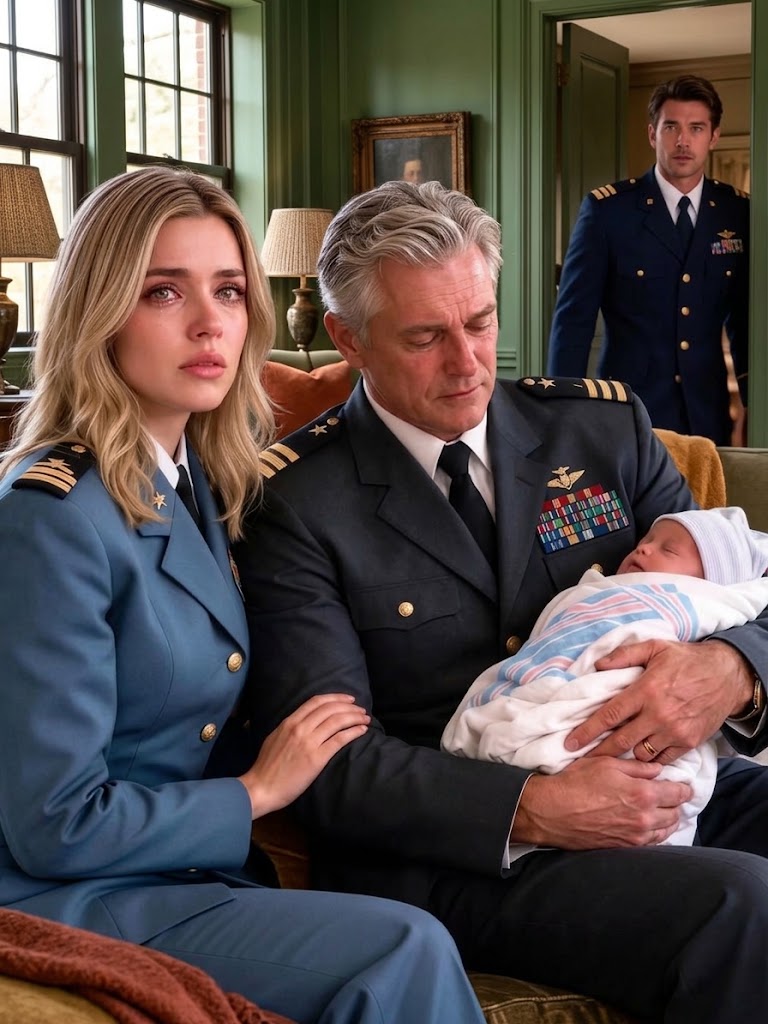
My husband left me alone while I was in labor because his mother’s birthday dinner mattered more to him than the birth of our son. “Handle it yourself. Stop being so dramatic,” he snapped, and hung up on me. Three days later, he walked through our front door and went completely white at the sight of the man cradling his newborn son.
PART 1
The contraction hit so hard my knees buckled against the hospital wall.
“Handle it yourself, Vivian. Stop being so dramatic.”
Then the line went dead.
I stood there holding a phone that had gone dark and cold in my hand, and for a few seconds, I honestly couldn’t make sense of what had just happened.
This was Grant.
My husband.
The man who had sat through four birthing classes taking notes like the instructor was going to test him on it.
The man who had promised me — out loud, more than once — that he would be in that room no matter what.
Another contraction rolled through me before I could finish the thought.
A nurse hurried over with a wheelchair, her hand already reaching for my elbow.
“Is someone coming to be with you?” she asked gently, the way you’d ask a question you already suspected the answer to.
I looked down at my silent phone.
“Not my husband.”
Thirty-eight weeks pregnant, standing outside the maternity ward with warm fluid soaking through my dress, and the man I married was forty minutes away at a dinner table, listening to his mother blow out sixty candles.
Colette had called it a “once-in-a-lifetime family event” back in March, when she chose the date.
Somehow, in the six months since, nobody had ever circled back to ask what would happen if our son decided to arrive that same week.
I don’t think it occurred to Grant that there would ever be a competition.
I don’t think it occurred to me either — not really.
Not until I was gripping a hospital corridor rail with both hands and realizing that a sixtieth birthday had somehow outranked a first breath.
I called him one more time.
I told myself it was only to update him.
If I’m honest, it was one last audition — one final chance for him to be the man I’d married instead of the man his mother had raised.
He picked up on the fourth ring.
I could hear music behind him.
Laughter.
The clink of glasses being raised for a toast.
“Grant, my water broke.” Another contraction cut the sentence in half. “The contractions are four minutes apart.”
Before he could answer, I heard Colette’s voice cut in over his shoulder, bright and dismissive:
“Tell her women have been giving birth for thousands of years.”
And Grant laughed.
“See? Mom gets it,” he said. “Call a cab.”
Something inside me went very still.
Not calm — nothing about that hallway was calm — but still, the way water goes still right before it freezes.
The fear didn’t leave.
The pain certainly didn’t leave.
But the part of me that had spent the last five minutes silently begging him to choose me finally, quietly, gave up.
“All right,” I said. “Enjoy the cake.”
I hung up.
Then I called the one person I had spent almost two years deliberately not calling.
My father.
He answered before the second ring finished.
I only managed to say “Dad” before my voice broke, and apparently, that was all he needed.
“Where are you?”
Twenty minutes later, Desmond Ashworth walked into that hospital wearing an old gray overcoat.
No driver trailing him.
No assistant clearing a path.
Nothing about him announced that his photograph regularly appeared in financial papers beneath words like founder and chairman and, more than once, billionaire.
Grant knew exactly who Desmond Ashworth was.
He had opinions about “men like that” — opinions he’d shared freely more than once over dinner.
He simply had no idea Desmond Ashworth was my father.
When Grant and I met, I was using my mother’s maiden name.
I wanted one relationship in my life that had nothing to do with my father’s money.
When Grant mocked “trust-fund parasites” at a dinner party, I laughed along.
When Colette referred to my father, sight unseen, as “some retired salesman who probably can’t remember his own grandkids,” I let her believe it because the alternative felt like handing her a weapon.
That night, my father held my hand through fourteen hours of labor Grant should have shared.
Grant never called back.
At 4:17 in the morning, our son arrived.
My father held him first — carefully, like he’d forgotten just how small a person could be.
And I watched tears slide silently down a face magazine profiles liked to describe as “unreadable.”
“He’s perfect,” my father whispered.
Watching him cradle my sleeping son, I felt the last fragile thread holding my marriage together finally give way.
My phone lit up on the tray beside the bed.
Mom loved the watch I bought her. Home Monday. Don’t start another fight.
My hands, which had been shaking for six hours, went completely still.
I took a screenshot.
Grant still believed I was the wife who would cry, forgive, and be exactly where he’d left me whenever he finally decided to come home.
He had forgotten one detail about the woman he married.
I was a forensic accountant.
I had spent my entire career noticing the things people hoped would go unnoticed.
Three days later, Grant finally walked through our front door, suitcase still in hand and a gift bag from his mother’s party swinging from his wrist.
Desmond Ashworth was sitting in our living room.
Our son was asleep against his chest.
Every trace of color drained from Grant’s face.
“Vivian,” he said, so quietly I almost didn’t hear it. “Why is Desmond Ashworth holding my son?”
My father lifted his eyes slowly, the way he did in board meetings right before he said the thing nobody else in the room wanted to hear.
Before I could answer, he said six words that froze Grant exactly where he stood.
PART 2
“Perhaps you should ask your wife.”
Grant looked at my father.
Then at me.
Then at the baby.
His suitcase was still in one hand, jacket creased from three days of travel he hadn’t needed to take.
“Vivian,” he said slowly. “What is going on?”
I was sitting at the far end of the sofa with a blanket over my legs.
Three days postpartum, every movement still hurt in ways nobody warns you about, but for the first time since I’d walked into that hospital, I felt strangely, dangerously calm.
“Close the door,” I said.
He did.
His eyes stayed on my father.
“I know who that is.”
Dad adjusted the baby against his shoulder and said nothing.
“Everybody knows who that is,” Grant said, like repeating it might change the answer.
“I’m sure not everybody does,” my father said, mild as ever.
On a normal day, Grant would have caught the dry humor in that.
This was not a normal day.
“Why is Desmond Ashworth in our house?”
“Our house,” I repeated.
Something in the way I said it made him go quiet.
I hadn’t planned for the words to land that way, but once they were out, I understood exactly what I meant.
Nothing in that room felt like ours anymore — not the sofa, not the walls, not the five years we’d built inside them.
“He’s my father,” I said.
The silence that followed wasn’t ordinary surprise.
It was the kind of silence that reaches backward and rearranges everything that came before it.
I could watch Grant doing the math behind his eyes — five years, recalculated in real time.
“My father’s name is Ashworth,” I said. “My mother’s maiden name was Faulkner. I used hers after she died.”
“You told me your father was retired.”
“I told you he’d stepped back from day-to-day operations.”
“You said he traveled.”
“He does.”
“You said he was bad with birthdays.”
My father looked faintly wounded.
“I have improved.”
I almost smiled.
Almost.
Grant’s gaze moved slowly around the room — the secondhand oak table we’d bought together at an estate sale, the bookshelf I’d refinished one August, the photo from our honeymoon in Lisbon still crooked on its nail.
Nothing had physically changed.
He looked at all of it like it belonged to strangers.
“You’re Desmond Ashworth’s daughter.”
“Yes.”
“And you never told me.”
“No.”
“Why?”
It was a fair question.
Maybe the first fair one he’d asked since he walked in.
I glanced at my father.
He read the room instantly.
“Micah and I will go inspect the garden,” he announced.
“He’s three days old.”
“Then I imagine his standards are forgiving.”
My father stood, carefully cradling our son.
Grant moved before he seemed to decide to.
“I can take him.”
My father paused.
So did I.
It was the first time since the birth that Grant had actually offered to hold his own son, and I watched the realization land on his face at the same moment it landed on mine.
My father looked at me.
I nodded.
He passed Micah gently into Grant’s arms.
Something in my husband’s expression shifted.
The anger was still there.
So was the confusion.
But underneath both, unmistakably, was wonder.
Micah stirred and made a small, complaining sound, and Grant looked down at him and went completely soft.
“Hey,” he whispered.
It was so tender it actually hurt to watch, because there — for exactly one second — was the man I had expected to walk into that delivery room.
The same man who’d spent an entire Sunday reassembling a crib twice because one rail sat a half-inch crooked.
The same man who used to press his ear to my stomach at night and laugh out loud every time our son kicked.
People are rarely only one thing.
That’s what made this so much harder than if he had simply been cruel every day of our marriage.
If he had, leaving would have been simple arithmetic.
But he hadn’t been cruel.
He’d been funny and attentive and ambitious and, underneath all of it, hungry — starving, really — for one woman’s approval.
Too willing to shrink himself down to whatever size his mother’s expectations required.
And at the single most important moment of our marriage, that hunger had cost us both.
My father slipped out of the room.
Grant sat across from me, our son still curled against his chest, and for a long minute neither of us said anything at all.
Finally he asked, “Why didn’t you tell me?”
I folded my hands in my lap.
“Because when we met, every person I’d ever known had an opinion about my father’s money.”
“That doesn’t explain why you didn’t tell your husband.”
“No. That explains why I didn’t tell the man I’d just met.”
“And after we got married?”
I looked at him.
“That part is more complicated.”
His jaw tightened.
“I’m listening.”
So I told him.
Not dramatically.
Not as a weapon.
Just honestly, the way you’d finally set down something you’d been carrying too long.
PART 3
My childhood had been comfortable in ways most people can barely picture.
Private schools.
Drivers.
Houses with entire rooms nobody ever used.
And money, I’d learned early, complicates nearly every relationship it touches.
At university, two friends discovered who my father was and suddenly developed a passionate interest in “business opportunities.”
A boyfriend before Grant once borrowed four hundred dollars without asking because, as he explained afterward, I “wouldn’t even notice.”
After my mother died, I wanted a smaller life — one where I could find out who I was without anybody already knowing my last name.
Then I met Grant at a professional seminar.
He spilled coffee across my notes.
I laughed instead of getting annoyed.
He bought me another cup to apologize, and for six straight months, everything about us felt wonderfully, blessedly ordinary.
“You remember our third date?” I asked him now.
He looked down at our sleeping son.
“The Italian place with the terrible chairs.”
“You spent twenty minutes complaining about the CEO whose company your firm was auditing.”
“I remember.”
“You said rich kids usually turn out useless because they never learn consequences.”
His expression changed.
“I was speaking generally.”
“I know.”
“Vivian —”
“I almost told you that night.”
He looked up.
“Why didn’t you?”
“Because I liked the way you looked at me before you knew.”
That landed harder than I expected it to.
Grant went quiet.
Micah briefly opened his eyes, then drifted back to sleep, entirely unbothered by the fact that his parents’ marriage was being taken apart six feet above his head.
“After that, waiting just got harder,” I said. “And then your mother started making comments about women marrying above themselves, and every time I thought about telling you, it felt like dropping a bomb into something I was trying to keep simple.”
“So you lied.”
“Yes.”
He clearly hadn’t expected such a direct answer.
“Yes,” I said again. “I withheld something important about myself, and I understand why that hurts. But it doesn’t erase what happened three days ago.”
His eyes dropped.
“I know.”
It was the closest thing to an apology he’d offered yet.
So I asked the question that actually mattered.
“Why didn’t you come?”
His fingers tightened around the blanket wrapped around Micah.
“I thought there was time.”
“I told you the contractions were four minutes apart.”
“Mom said first babies take forever.”
“You laughed.”
His face tightened.
“I know.”
“You told me to call a cab.”
“I know.”
“You stayed two more nights after that.”
That was the part I still couldn’t make sense of.
The dinner itself had been bad enough.
But after our son was born, while I slept, my father had texted Grant: Micah arrived safely. Mother and baby doing well.
Four hours passed before Grant answered.
Great. Tell Vivian I’ll call.
He didn’t actually call until that evening.
“I should have come home,” he said now.
“Yes.”
“I should have left before the dinner even started.”
“Yes.”
He rubbed both hands over his face.
“I don’t know what I was thinking.”
I did.
That was the whole problem.
“You were thinking your mother would be upset,” I said. “And somewhere along the way, keeping her from being disappointed became more important to you than keeping me from being alone.”
His eyes met mine.
Neither of us said anything else.
My father came back into the room ten minutes later, and the conversation ended without resolving anything.
That night, Grant slept in the guest room.
I didn’t ask him to.
He didn’t ask to stay in ours.
For the two days that followed, we settled into something quiet and careful and entirely new to us — an arrangement neither of us had a name for yet.
Grant changed diapers.
He learned to warm bottles of expressed milk without scalding them.
At two in the morning on the third night, I found him standing beside the bassinet, just watching our son breathe.
“You don’t have to stare at him,” I whispered.
He glanced over.
“I keep thinking he’ll stop breathing if nobody’s watching.”
“Welcome to parenthood.”
He gave me a tired half-smile, and for one brief, disorienting second we were ourselves again.
Then the hospital came back into my head.
The phone call.
His empty chair beside me.
The smile disappeared.
PART 4
The next morning, Colette called.
I nearly let it ring out.
Curiosity won.
“Hello?”
“Vivian.”
Her voice was unusually controlled.
“Colette.”
“I understand your father is visiting.”
Of course that was where she started.
“Yes.”
A pause.
“Grant explained who he is.”
“I imagine that was an interesting conversation.”
“I had no idea.”
“No.”
Another pause, longer this time.
“I think perhaps we should meet.”
“No.”
The word came out so fast it surprised even me.
She exhaled slowly.
“I’d like to apologize.”
“You can do that over the phone.”
Silence.
“I shouldn’t have said what I said while you were in labor.”
“No.”
“And Grant should have left the dinner.”
“Yes.”
“I was upset. It was my sixtieth birthday. It felt important.”
“My son’s birth felt important too.”
“I realize that now.”
Her tone softened in a way I hadn’t expected.
“I never meant for all this to happen, Vivian.”
“All what?”
“The distance. Between you and Grant.”
“You’ve been encouraging that distance for years.”
“That isn’t fair.”
“I think it is.”
“You don’t know everything.”
My accountant’s brain woke up instantly, the way it always did when a number didn’t reconcile.
“What don’t I know?”
She changed the subject.
Classic Colette.
“I hope I can meet Micah when you’re ready.”
“That will be Grant’s and my decision.”
“Of course.”
After I hung up, I stood in the kitchen holding a phone gone dark again, turning her sentence over and over.
You don’t know everything.
Not because I expected some tidy, dramatic secret.
Real life rarely arranges itself that neatly.
But there had been a low hum of tension for months that I’d chosen, deliberately, not to examine too closely.
Grant taking calls out on the porch, out of earshot.
An argument with Colette at Christmas that stopped dead the instant I walked into the room.
A loan application that arrived at our house in January, which Grant explained away as a colleague’s mail sent to the wrong address.
At the time, I’d believed him without a second thought.
Now I remembered the name printed at the top of that envelope.
Fairview Commercial Bank.
I am a forensic accountant.
Suspicious paperwork is practically an engraved invitation.
That afternoon, while Micah slept and Grant was out at the pharmacy, I opened the filing cabinet in our home office.
We kept our tax returns there, our mortgage statements, our insurance papers — nothing either of us had ever treated as private.
Or so I’d thought.
The bank letter itself was gone.
I checked the desk.
Nothing.
Then I noticed a folder marked HOUSE — CURRENT YEAR had been shifted out of order.
I opened it.
The first several pages were ordinary.
The last page wasn’t.
Personal Guarantee Agreement.
Borrower: Harlow & Finch Hospitality Group.
Guarantor: Grant Sutter.
Amount: $480,000.
I read it twice.
My husband worked in financial compliance.
He did not own, and had never once mentioned owning any stake in, a hospitality company.
Then I saw the date at the top of the page.
Seven months earlier — the exact same week Grant had told me we should hold off renovating the nursery because he wanted us to “be more careful with money for a while.”
My hands went cold.
Not because of the number, though the number was staggering enough.
Because I had never once heard the name Harlow & Finch in five years of marriage.
I ran it through the state business registry from my laptop.
The company existed.
Managing member: Colette Sutter.
I sat back slowly.
So that was the Christmas argument.
That was the mysterious bank letter that had vanished from our own filing cabinet.
Colette’s words sounded very different now.
You don’t know everything.
When Grant came back from the pharmacy an hour later, I was already waiting at the dining table, our son asleep in his bassinet beside me, the photocopied guarantee lying face-up between us.
He stopped in the doorway the second he saw it.
His face gave me the answer before he’d said a single word.
“Where did you find that?”
“In our own filing cabinet.”
He closed his eyes.
“How much money have you guaranteed for your mother?” I asked.
“Vivian —”
“How much?”
He pulled out a chair and sat slowly.
“It’s complicated.”
“That phrase has never once improved an accounting problem.”
He almost smiled.
I didn’t.
“How much?”
“Four hundred eighty thousand.”
“And Harlow and Finch?”
“A restaurant project. Mom and two friends were opening an event venue with a restaurant attached.”
“Were?”
His silence answered for him.
“Grant.”
“The financing fell apart.”
“When?”
“January.”
“What does that mean for the guarantee?”
He looked suddenly, entirely exhausted.
“It means there may be exposure.”
“How much exposure?”
“I don’t know yet.”
“You work in compliance.”
“I know.”
“You understand personal guarantees better than almost anyone I know.”
“I know.”
“And you signed one without telling your wife.”
His voice dropped almost to nothing.
“I thought it would be temporary.”
There it was.
Not some cinematic betrayal.
No secret second family.
No criminal scheme.
Something far more ordinary and, in its own way, far sadder — a husband trying to rescue his mother from her own financial mistake and hiding it because he already knew exactly how his wife would react.
I looked back down at the document.
“Does this touch our house?”
“No.”
“Our joint accounts?”
“No.”
“How can you be sure?”
“Because the guarantee is mine alone.”
“We’re married, Grant.”
“I protected you legally.”
I looked up sharply.
That phrase snagged on something.
“Protected me how?”
He reached into his laptop bag and, after a long moment, pulled out a second folder.
“I was going to tell you.”
“When?”
“I don’t know.”
Inside was a legal draft, six months old.
Postnuptial Financial Separation Agreement.
Unsigned.
My name printed neatly across the first page.
“You were going to ask me to sign a postnup?”
“To separate my potential liability from you.”
“But you never did.”
“No.”
“Why not?”
“Because every time I tried, I couldn’t figure out how to explain needing one without telling you everything.”
For the first time since he’d walked through our front door, I saw real fear on his face.
Not fear of my father.
Not fear of the money.
Fear of losing me.
“You should have told me,” I said.
“I know.”
“You keep saying that.”
“Because I do know it.”
“After the fact.”
He looked down at the table.
“Yes.”
Micah stirred softly in his bassinet.
We both turned toward him at once, some instinct older than either of us.
He stretched, made a small sound, and settled again.
When I looked back at Grant, his eyes were wet.
“I thought I could fix everything,” he said. “Mom’s business. The guarantee. Your pregnancy stress. Work. All of it.”
“By keeping me in the dark?”
“By carrying it myself.”
“That isn’t the same thing as protecting me, Grant.”
“I understand that now.”
“Do you?”
For once, he didn’t rush to defend himself.
“I’m not sure,” he admitted.
And somehow that surprised me more than anything else he’d said all day.
Maybe because it was the first thing all day that sounded completely honest.
I closed the folder.
“Is there anything else?”
He hesitated.
Too long.
My stomach tightened.
“Grant.”
“There’s one more thing.”
He dragged both hands down his face.
“Mom didn’t insist I stay at the dinner just because it was her birthday.”
I frowned.
“What are you talking about?”
“The bank called her that afternoon.”
“And?”
“They were accelerating the business debt.”
I stared at him.
“She knew? That day?”
“Yes.”
“And you stayed because she was scared.”
He nodded.
I sat very still.
It didn’t excuse anything.
It couldn’t hand back those fourteen hours I’d spent alone.
But it did change the shape of the memory.
Underneath the flowers and the cake and the toasts, there had been a woman genuinely terrified that two years of work were collapsing out from under her.
And Grant had tried to keep her calm.
Badly.
Dishonestly.
At my expense, and at our son’s.
“Why didn’t she just tell me that on the phone?”
“Pride.”
“That sounds like her.”
“She also knew you’d tell me to get a lawyer instead of promising her I’d handle it.”
“I would have.”
“I know.”
He laughed tiredly.
“So would I, if it had been anyone but her.”
There it was again.
The pattern.
Around his mother, Grant stopped being the sharp, competent man he was everywhere else in his life and became, instead, a son still trying to fix everything before she could be disappointed in him.
“Why can’t you tell her no?” I asked.
He didn’t answer.
PART 5
That evening, my father brought dinner from a small Greek place two streets over.
Once Micah was asleep, I showed him the documents.
He read every page carefully, then set them down.
“This is unfortunate.”
I stared at him.
“That’s your entire reaction?”
“What reaction would you prefer?”
“I don’t know. Outrage?”
“I retired from theatrical outrage sometime around 2008.”
“Dad.”
His mouth twitched before he composed himself again.
“Do you want my attorneys involved?”
“I don’t know yet.”
“Good.”
I blinked.
“Good?”
“You’re thinking instead of reacting.”
“I’m exhausted.”
“Often the same expression, in my experience.”
I leaned back in my chair.
“What would you do?”
He studied me for a moment.
“If this were a business question, I’d tell you exactly what to do.”
“And because it’s my marriage?”
“I’d be suspicious of anyone who claimed to know.”
I hated how sensible that was.
Then he picked the guarantee back up and looked at it again, more slowly this time.
“There’s something here you should look into.”
He tapped the signature block near the bottom.
“The witness.”
I read the name.
Priya Nash.
It sounded familiar, and after a second I placed it.
Priya had worked with Colette years earlier, and she was also the woman who’d left Grant three unreturned messages while I was still in the hospital.
“This was signed seven months ago,” I said.
“Yes.”
“And the financing collapsed in January.”
“Yes.”
“So why has this witness called Grant three times in the last two weeks?”
I stared at the name for a long moment.
“Maybe it wasn’t about the guarantee at all,” I said.
My father nodded slowly.
“Maybe.”
The next morning, I searched my professional contacts.
Priya Nash — former bookkeeper, current administrator for Harlow & Finch Hospitality Group.
Her profile carried a company update posted only two weeks before, a photo of Colette standing between two business partners inside a freshly renovated dining room beneath a polished brass sign.
The caption read:
FINAL INSPECTIONS COMPLETE. OPENING SOON.
My pulse picked up.
The project hadn’t collapsed.
Not entirely.
Not anymore.
I zoomed in.
Behind Colette, taped to the glass of the front door, was a permit notice.
Below it, in small print, was the name of the property owner.
Ashworth Urban Holdings.
My father’s company.
I turned my laptop around slowly and set it in front of him.
His expression changed instantly.
“Dad?”
He took the screen and studied it.
For the first time since he’d walked into my life again at that hospital, Desmond Ashworth looked genuinely, unmistakably surprised.
“I didn’t know about this.”
That was entirely plausible — his company held hundreds of commercial properties through a maze of subsidiaries he barely tracked personally anymore.
But if Colette’s struggling restaurant sat inside a building my father owned, then our two families had crossed paths long before Grant ever learned who I really was.
He handed the laptop back.
“Vivian.”
“Yes?”
“You should find out who approved that lease.”
I looked again at the photograph — Colette smiling under a brass sign in a building my father’s company owned without even knowing it.
And for the first time, I wondered whether the secret about my identity had ever really been the biggest one sitting inside our marriage.