PART 1
When I agreed to marry Adrian Kessler, I honestly didn’t care whether he was innocent.
That is the ugliest sentence I have ever had to put on paper, so I’m starting with it. I need you to understand exactly who I was when all of this began, because none of what happened afterward makes sense unless you know how little faith I had in anything at that point.
I was twenty-seven years old. I worked the breakfast shift at a diner on Route 9 and cleaned downtown office buildings four nights a week. My mother had passed away two winters earlier, and my father had stopped truly being part of our lives long before that, leaving me and my little brother, Danny, in a one-bedroom apartment with a radiator that clattered like a ghost dragging chains and a landlord who stuck bright orange notices to our door.
FINAL WARNING. PAST DUE.
Danny was fourteen. He slept on the pullout couch and did his schoolwork at the kitchen table beneath a lamp we had found abandoned on the curb. He was smarter than I was, and he suffered from asthma that became worse whenever the weather changed. His inhalers cost sixty-two dollars apiece. I knew that amount as well as I knew my own birthday.
One of the buildings I cleaned after dark belonged to the Kessler Family Foundation. It was thirty floors of glass and polished stone, with a lobby that always smelled faintly of lilies. Every Tuesday and Thursday, I vacuumed the executive suite, and that was how Margaret Kessler noticed me.
She was standing inside her office at nine that night when I arrived with my cleaning cart. Her silver hair was cut sharply at the jaw, and she wore a cream-colored suit with reading glasses hanging from a thin gold chain. I apologized and began backing toward the door. She told me not to leave.
For ten full minutes, she watched me work. Then she asked my name, my age, whether I was married, and whether I had anyone in my family depending on me.
I assumed I was about to lose my job over something. Instead, one week later, I found myself sitting across from her in that same office, staring at a cup of tea I was far too nervous to drink while she explained the most unbelievable proposition anyone had ever offered me.
“My son is in prison,” she said, clasping her hands together on the desk. “Perhaps you remember the news from three years ago.”
I did. Everyone did. Adrian Kessler, thirty-one years old, heir to one of the oldest fortunes in the state, had been convicted of stealing four million dollars from his own family’s charity. The newspapers had adored the story. The Prince Who Robbed the Poor. He had received a twelve-year sentence.
“His lawyers are preparing a petition to have his sentence reduced,” Margaret continued. “Judges respond favorably to stability. To family connections. To a man who has someone waiting for him.” She pushed a folder toward me. “I need him to have a wife.”
I actually laughed. I couldn’t stop myself.
She remained completely serious.
“Two thousand dollars every month,” she said. “Deposited on the first day. You visit him twice each month. You exchange letters with him. You attend hearings whenever his attorneys request it. You sign a prenuptial agreement giving up any claim to his assets. And once he is released, whenever that happens, you file for divorce within thirty days, and I give you a final payment of fifty thousand dollars.”
“Why me?” I asked.
She peered at me over her reading glasses. “Because you need the money. People who need things tend to be dependable.”
There was another condition. She delivered it casually, as though she were simply explaining where I should park.
“I also want you to tell me what he discusses. His state of mind. His plans. Whether he continues dwelling on his case. My son has never dealt well with disappointment, and I’m concerned about him.”
I should have recognized what she was actually asking me to do. Maybe some part of me understood. But two thousand dollars a month meant rent, food, Danny’s inhalers, the electricity bill, and a little money left over. It meant the difference between barely staying afloat and going under.
I accepted before the shame had time to catch up with me.
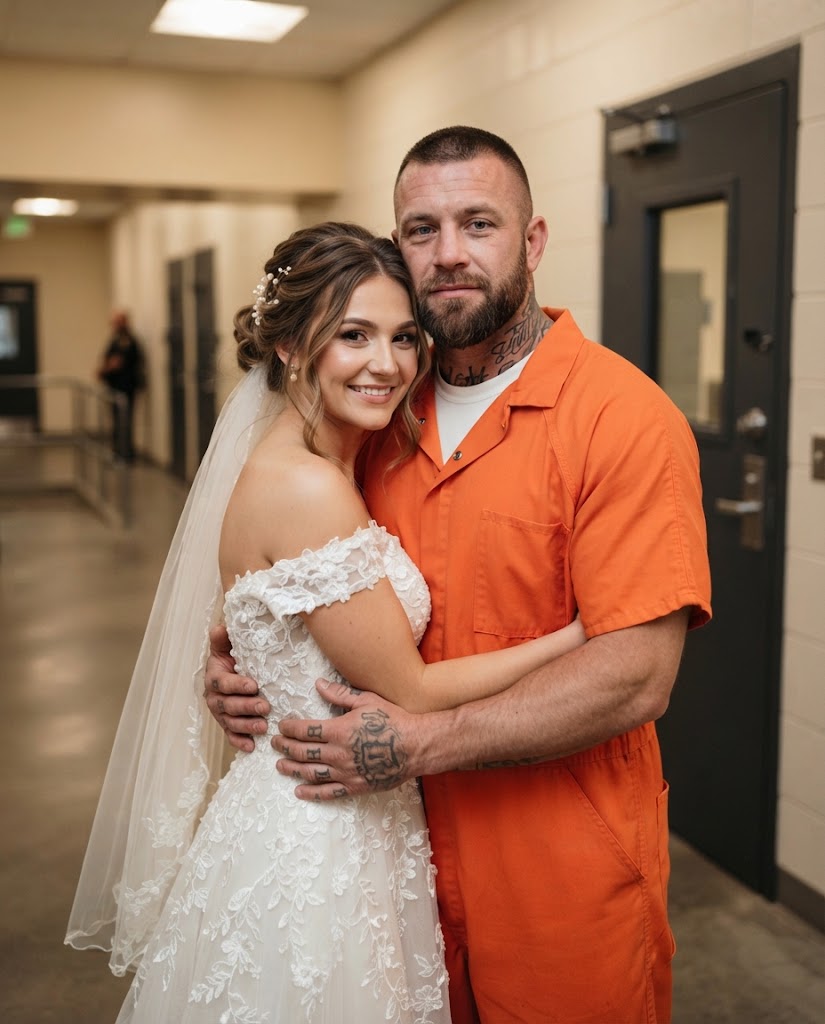
Our wedding happened on a Wednesday afternoon inside the visiting room of the state correctional facility, separated by a sheet of scratched plexiglass, while a chaplain read from a laminated card and a guard repeatedly glanced at his watch.
I wore a blue dress I had bought at a thrift store. Margaret’s attorney, a thin man named Mr. Weller, passed a simple gold band through the opening in the partition, and I placed it on my own finger because we were not permitted to touch.
I had prepared myself to meet the man I had seen in the newspapers. Cold. Privileged. Angry. Maybe even cruel.
Adrian Kessler was nothing like that.
He was tall and noticeably thin beneath his prison khakis, with dark hair cut close and gray eyes that seemed to notice everything around him. When the chaplain asked whether he accepted me as his wife, Adrian stared at me for several seconds. He didn’t look at the chaplain or the guard. He looked directly at me.
“I do,” he answered. Then, so softly that only I could hear through the speaker, he added, “I’m sorry it’s like this. You deserve a real one someday.”
That was the first thing that surprised me.
The second happened two weeks later, when his first letter arrived.
It filled three pages, written in tidy, slanted handwriting. He said almost nothing about his case. Instead, he asked about Danny. He wanted to know whether the diner had been busy. He told me about the single tree he could see from the prison yard, a crooked maple whose leaves had just begun turning red. Along the margins, he had drawn tiny pencil sketches: the maple tree, a coffee cup, and a little cartoon of a radiator blowing angry steam, because I had mentioned ours during my first visit.
I laughed aloud at the kitchen table. Danny lifted his head from his homework and asked me what was so funny.
“Nothing,” I told him. Then I folded the letter and slipped it into my coat pocket, where I could feel it throughout the day.
[image]
For illustrative purposes only
At first, I pretended I cared.
I visited him on the first and third Saturdays. I answered his letters every week. Each month, I met Margaret at a coffee shop near her office and gave her my report. He seems peaceful. He’s reading a lot. He asked about the appeal process once, but he didn’t seem to be pushing it.
She would nod, jot something into her notes, and give me nothing more than a chilly smile.
Then, sometime around the sixth month, I stopped pretending.
I can’t pinpoint the exact day. Maybe it was the visit after Danny suffered a severe asthma attack the night before, when I arrived without makeup and with swollen eyes, and Adrian spent the entire hour asking about Danny’s medication, his doctor, and whether the school nurse knew what triggered his attacks, as though nothing else mattered to him. Maybe it was the letter in which he wrote, You don’t have to pretend you’re happy when you come here. I’d rather see you exhausted and honest than smiling and somewhere else.
Maybe it was simply because no one had asked me whether I had eaten in two years, while Adrian asked me every single time.
All I know is that one night, after finishing my cleaning shift at the Kessler building, I came home, sat at the kitchen table, and opened Adrian’s case file for the first time.
Mr. Weller had given me a copy months earlier, “for appearances,” in case a reporter ever approached me with questions. I had stuffed it into a drawer and never bothered to open it.
That night, I opened it at one in the morning and kept reading until daylight.
I’m not an attorney. I never even completed community college. But I have spent my entire life going through bills, notices, and fine print, searching for the hidden detail that might cost me money, and I know when numbers don’t make sense.
These numbers didn’t.
There were transfer authorizations bearing Adrian’s signature on dates when the hospital records included with his sentencing report showed that he had been recovering in a hospital ward after a serious car accident. There was an accountant from the foundation who had testified against him, only to leave the state two weeks after the trial. Several signatures on the documents had different loops and patterns from one another, yet apparently no one had questioned them.
In the margin of one page, someone had scribbled a bank routing number in pencil, then rubbed part of it away.
I stared at that half-erased number for what felt like forever. Then I stood up, found Adrian’s most recent letter, and studied the tiny drawing in the margin: a row of birds perched along a telephone wire. Nine birds altogether. Some had their heads raised, while others had them lowered.
I told myself I was seeing connections that weren’t there.
I wasn’t.
For the following two years, I fought for my husband with everything I had.
I carried the case file to every legal aid clinic I could find in the county. I spent hours sitting in waiting rooms. I stood outside the courthouse with a folder clutched against my chest, stopping attorneys on the courthouse steps until a security guard finally ordered me to move along. I spent money I couldn’t afford on photocopies, postage, and bus tickets to the state archives.
Most people laughed at me. One public defender even told me, gently, that every wife believes her husband is innocent.
Then I met Harold Price.
Harold was seventy-three, had retired after thirty-five years working in appellate law, and was apparently bored nearly to death. He read through the file at his kitchen table while I sat across from him drinking awful instant coffee. When he reached the hospital records, he removed his glasses and placed them on the table.
“Who else has looked at this?” he asked.
“No one seems interested.”
“Well,” Harold replied, “I’m interested now.”
He agreed to handle the case without charging me. It took fourteen months, three motions, and a subpoena demanding bank records that Adrian’s original attorneys had never bothered to seek. When those records finally arrived, they revealed exactly where the four million dollars had gone.
It hadn’t gone to Adrian.
It had gone to his cousin, Grant Kessler, the foundation’s chief financial officer. Grant had routed the money through several consulting companies, forged Adrian’s signature on the transfer authorizations while Adrian was hospitalized, and then allowed Adrian to receive the blame.
Grant was arrested in March. The accountant who had disappeared from the state was located in Arizona and withdrew her testimony within a day.
On a gray April morning, three years after our wedding behind the glass, a judge overturned Adrian’s conviction and ordered that he be released immediately.
There was something else that happened before that day, and it matters more than anything else in this story.
Two weeks before the hearing, I sat across from Adrian in the visiting room and finally told him the truth.
I told him that his mother had paid me. Two thousand dollars every month. I told him about the reports I had been giving her. I told him about the fifty-thousand-dollar payment she promised if I divorced him within thirty days after his release. I admitted that I had stopped giving her anything truthful more than two years earlier, that every report since then had been made up, but I had continued accepting her money every month because Danny needed it.
I cried so hard that the guard approached and asked whether I was okay.
Adrian didn’t appear angry. He didn’t even seem shocked.
He simply placed his hand flat against the glass, and after a few seconds, I put my hand against the other side.
“I know,” he said quietly.
“How long have you known?”
He remained silent for a moment. “Thank you for telling me,” he finally said. “That took courage. I won’t forget it.”
On the day Adrian walked out of the facility, Danny, Harold, and I were waiting near the gate. I expected him to rush straight toward me. I imagined some dramatic movie-like reunion.
Instead, he stopped just beyond the doors and stood motionless in the cold April wind. His expression tightened, almost as though freedom itself had hurt him. As though the enormous open sky was simply too much to take in.
Then he came toward me, took my hand for the first time throughout our entire marriage, and said, “Come home with me.”
He wasn’t talking about the Kessler estate. He had already made it clear that he would never return there. He meant my tiny apartment, where Danny voluntarily surrendered the pullout couch and slept on an air mattress in the hallway as if we were all on some strange camping adventure.
For seven days, I thought we had finally made it through the worst.
Adrian cooked pancakes every morning, and he was terrible at it. He walked Danny to the bus stop. He repaired the radiator using a wrench and a YouTube tutorial. At night, we sat together on the couch with our knees touching and talked until two in the morning. Whenever I fell asleep against his shoulder, he stayed perfectly still for hours.
Margaret called me three times that week. I ignored every call.
On the eighth evening, after Danny went downstairs to spend the night at his friend Marcus’s apartment, Adrian walked out of the bedroom carrying something I had never seen before.
It was a matte-black box, heavy in appearance and roughly the size of a shoebox, with a small brass combination lock attached to the front. He placed it in the center of the kitchen table with a quiet, weighty thunk.
“Where did you get that?” I asked.
“Harold’s safe. I picked it up this afternoon.”
“What’s inside?”
He sat opposite me and rested both hands over the lid. For the first time since returning home, he looked exactly like the man I had known behind the glass. Controlled. Deliberate. Like someone who had been preparing for this conversation for a very long time.
“Two weeks ago, you told me your secret,” he said. “Now it’s my turn to tell you the truth.”
I tried to smile. “Adrian, you’re frightening me.”
He didn’t smile.
“I know,” he said quietly. “But I have to tell you. Because when you married me, Tessa, you agreed to something much bigger than a name written on a marriage certificate. And my mother is about to discover just how big it really is.”
PART 2
The apartment became so silent that I could hear the refrigerator running and the faint sound of a truck changing gears somewhere on the street below.
Adrian rotated the brass numbers on the lock. Four digits. I watched his hands and recognized the date just before the lid sprang open.
It was the date of our wedding.
Inside, resting on top of everything else, was a slim bundle of papers secured by a binder clip. Without saying anything, he lifted it out and placed it before me.
I looked down, and it felt as though the floor suddenly vanished beneath me.
They were my reports.
Every monthly update I had handed Margaret in that coffee shop. They weren’t my handwritten notes; they were typed copies printed on Kessler Foundation letterhead, each marked with a date and bearing a looping M.K. in the corner. There were thirty-four of them.
Subject remains calm. Subject asked about the appeal process but did not press. Subject’s wife reports no contact with outside attorneys.
That final sentence came from the report I had given her during the same month I first met Harold Price in his kitchen.
“Where did you get these?” I asked, my voice barely audible.
“They were part of the discovery Harold subpoenaed,” Adrian explained. “When the court ordered the foundation to hand over its internal records, Grant’s lawyers gave us everything they had, probably hoping we’d become buried under it. Forty thousand pages. These were stored in a folder marked Personal – A.K. on my mother’s assistant’s drive. My mother had been sending your reports to Grant every month.”
I covered my mouth with my hand.
“She wasn’t concerned about me, Tessa,” he said softly. “She was monitoring how close I was getting.”
“You knew,” I whispered. “When I confessed, you said you already knew. Did you know from the beginning?”
“I knew the moment she told me she had found me a wife.” There was no anger in his voice. “My mother has never handed anyone anything without having a reason. A stranger suddenly wanting to visit me twice a month, selected by her and paid by her? I would have been an idiot not to suspect something.”
“So you never trusted me.”
“Not in the beginning.” He kept his eyes on mine. “I’m not going to lie to you tonight. That’s why this box exists.”
He reached inside again and removed a worn manila folder with softened edges. Inside were photocopies of every letter I had ever received from him, dozens upon dozens of pages. He spread them across the table. The crooked maple. The radiator. The coffee cups. The birds perched along the telephone wire.
“Every letter I sent from that prison was read,” he said. “First by the mailroom, then, I assumed, by you, and then by my mother if you were reporting to her. I couldn’t write the dates on the transfer forms match my hospital stay. I couldn’t write find the accountant who left the state. If my mother discovered that, the evidence would have vanished before anyone had a chance to use it.”
He touched the drawing of the birds. “Nine birds. Their heads are up for odd numbers and down for even numbers. It was the routing number someone partially erased in pencil on page two hundred and twelve of my case file. The bank Grant used.” His finger moved to another letter. “The coffee cup with steam forming an S. Sheila Marsh, the accountant. The calendar I drew during spring with three dates circled. Those were the three days I was in surgery.”
A chill ran through me, followed by a sudden wave of heat.
“I planted the clues and waited,” he said quietly. “If you were nothing more than my mother’s spy, you wouldn’t notice them, or you’d report them to her and nothing would change. But if you were more than that, if you were the woman I hoped you were after our first visit, you would notice. And you would start searching.”
“And I did,” I said, my voice breaking. “I stayed awake night after night for two years. I thought I was uncovering everything on my own. I thought I was saving you.”
“You were.”
“You manipulated me, Adrian!” I pushed the chair backward and rose so quickly that its legs scraped against the floor. “You made me into a puzzle you were working out from inside a prison cell! Do you have any idea how many nights I cried over that case file? How many times I stood outside the courthouse in the rain while attorneys walked right past me as though I were a beggar?”
“Yes,” he replied. He remained seated and never raised his voice. “I know every one of them. You told me about them in your letters. I read each letter maybe fifty times.”
“Then why didn’t you simply tell me? Once I stopped reporting to her? You had to realize.”
“I did,” he said. “Month eight. Your report told her I had been quiet and depressed, while that same week you sent me four pages filled with questions about the hospital records. That was when I realized you had chosen me.” He swallowed hard. “And that was precisely why I couldn’t tell you. If my mother ever discovered that you had changed sides, you and Danny would have been the easiest targets in the world for her. A cleaning job. An apartment already facing an eviction notice. A boy with asthma whose inhalers you could barely afford. She could have gotten you fired and thrown you out within a week. Maybe worse. As long as she believed you were still her spy, you were protected.”
I remained beside the counter, holding my arms tightly around myself, and said nothing. Inside me, anger collided with something far more frightening than anger.
“I gave you a map,” Adrian said. “That much is true, and I’m sorry for every night it cost you. But I couldn’t travel that road myself. You did that part. No one else in my life would have.”
He waited until I lowered myself back into the chair. Then he reached inside the box for a third time.
This time, he pulled out a bound legal document, its pages old enough to have taken on a faint yellow tint. The cover was labeled: The Walter Kessler Irrevocable Family Trust. Executed June 1996.
“My grandfather,” Adrian said. “He built everything—the foundation, the real estate company, all of it. Before he passed away, he placed his controlling shares into this trust and divided the beneficial interest between his two children: my father and my uncle. When my father died, his share came to me.”
He turned to a page marked with a yellow tab and rotated the document so I could see the highlighted section.
I read it twice before the meaning finally sank in.
Should a beneficiary be convicted of a felony offense against the Trust or any entity it controls, his interest shall be suspended, and its voting rights exercised by the nearest adult family member, until such conviction is overturned or the beneficiary’s death.
“The nearest adult family member,” I said slowly. “Your mother.”
“For the past three years, my mother has controlled my entire portion of the trust,” Adrian said. “Forty-one percent of the voting power in a company worth roughly two hundred million dollars. She’s been controlling the board. Approving contracts. Moving money.” He paused. “And the moment my conviction was overturned, everything returned to me.”
He turned two additional pages until he reached another highlighted passage.
Upon the death of a beneficiary, his interest shall pass to his lawful spouse, or, if none, to his issue. If the beneficiary leaves neither spouse nor issue, his interest shall revert to the nearest adult family member.
I raised my eyes to him.
“My grandfather was a traditional man,” Adrian said quietly. “He wanted the money to remain within the family. Not ex-wives who had divorced out. Not girlfriends. Lawful spouses and children.”
And suddenly, the fifty thousand dollars made sense.
I understood why Margaret had required me to sign an agreement promising that I would divorce Adrian within thirty days of his release. I understood why she had been calling me every day for the past week.
“When she hired me,” I said, barely above a whisper, “she believed you’d remain in prison for twelve years. A marriage on paper wouldn’t matter. She could make sure I disappeared long before it ever became important.”
“She never expected me to leave prison,” Adrian said. “But I did. And right now, tonight, if something happened to me—a car accident, a fall, even an overdose from the pain medication I was given after surgery—my share of the trust wouldn’t return to my mother.” He looked directly at me. “It would belong to you.”
The kitchen seemed to shift beneath me.
“That’s what you agreed to,” he said gently. “You thought you were agreeing to be a name on a visitor list. Instead, you became the one person standing between my mother and everything she’s been taking for years.”
“Taking,” I repeated.
He reached into the box for the final time and held up a small silver flash drive between his fingers.
“Grant didn’t come up with the embezzlement himself,” Adrian said. “Grant has never had an original thought in his life. Harold discovered another series of transfers in those bank records. They were smaller and much older, dating back three years before my arrest, long before Grant had access to everything. They lead to a Delaware account owned by a company called Larchmont Holdings.” He placed the drive on top of the trust papers. “Larchmont Holdings belongs to my mother.”
“She framed you,” I whispered.
“She needed the voting rights. The board was preparing to approve an audit my father had requested before his death, and I intended to make sure it happened. So she and Grant arranged for me to sit behind bars instead of sitting in the boardroom. Grant took the money. My mother took control of the company.”
“Why didn’t Harold present this at your hearing?”
“Because the hearing was focused on one question: whether I had stolen four million dollars. I hadn’t. That alone was enough to get me released. If we had accused my mother during the hearing, her attorneys would have buried us under motions for another two years, and every document in that box could have vanished.” His jaw clenched. “Harold has been quietly communicating with a federal prosecutor for the past month. They need more than financial records to prosecute her. They need evidence of her intent. They need to hear it from her own mouth.”
“And the box?”
“It contains everything I know,” he said. “Once I was free, I didn’t want to hide a single thing from you. You have the right to know exactly what you’ve been pulled into. You can still leave, Tessa. I mean that. If you want the divorce, I’ll sign the papers tonight, and I’ll make certain you and Danny never have to worry about money again. You don’t owe me anything.”
I opened my mouth to respond.
Then my phone, sitting on the counter behind me, suddenly lit up and began vibrating.
I turned toward it.
The screen displayed a photograph I didn’t recognize at first. A white tablecloth. A silver bread basket. A boy wearing a gray hoodie, sitting awkwardly with a menu spread open in front of him and smiling at whoever had taken the picture.
It was Danny.
My little brother—the same brother who had hugged me at the door just two hours earlier, backpack hanging from his shoulder, and told me he was going to Marcus’s apartment to play video games until midnight. The same brother who was supposed to be two floors below me, not sitting at some unfamiliar table.
Beneath the photograph was a message from a number I knew by heart.
Your brother is having a wonderful dinner with me at the club. Such a polite young man. Come get him, Tessa. Come alone. Bring the box. — M.