Part One: The Secrets Grief Leaves Behind
The house felt unusually quiet that morning.
I stood at the foot of our bed, folding Leo’s tiny shirts into neat squares while sunlight filtered weakly through the curtains. The familiar rhythm of the task should have calmed me, but my attention kept drifting toward the dresser.
My mother’s silk scarf rested beside the jewelry box.
It had been three months since we buried her, yet the pale fabric still carried the faintest trace of jasmine—the perfume she had worn for as long as I could remember.
I picked it up and pressed it gently against my face.
For one brief second, I was no longer standing in my bedroom. I was a child again, leaning into my mother’s arms while she brushed my hair away from my forehead.
“Mommy?”
I lowered the scarf quickly.
Leo stood in the doorway wearing mismatched socks. One was blue, and the other had orange stripes. He held a juice box in both hands as though it were something precious.
“Are you crying again?” he asked.
I forced a smile. “No, sweetheart. I was just smelling Grandma’s scarf.”
He walked closer and sniffed it solemnly.
“Grandma smells like flowers.”
“She always did.”
He climbed onto the bed and began bouncing on his knees. As he reached for one of his shirts, I noticed a streak of silver on the side of his thumb.
There was another dried patch near his elbow.
I frowned.
“Leo, what’s that?”
He looked at his hand. “Paint.”
“I can see that. Where did you get it?”
Before he could answer, Mark appeared in the doorway holding a mug of coffee and his phone.
“Art class,” he said casually. “They’re doing some kind of space project at school. Planets, stars, galaxies—something like that.”
He smiled, but there was something different about it.
It was a restrained, private smile, as if he knew a joke he was not ready to share.
I rubbed Leo’s thumb with mine. “This paint must be strong. It didn’t come off in the bath.”
Mark laughed. “You know what bath time is like with him. The walls get cleaner than he does.”
“I washed!” Leo protested.
He jumped off the bed and raced into the hallway.
Mark leaned toward me and kissed my forehead.
“You look exhausted, Kate.”
“I’m all right.”
“You always say that.”
“I’m managing.”
His expression softened.
“Our anniversary is in three days,” he reminded me. “Ten years.”
“I remember.”
“I was starting to think you’d forgotten.”
“I haven’t.”
His phone lit up in his hand. He glanced at the screen, and that same quiet smile appeared again.
Before I could see who had messaged him, he slipped the phone into his back pocket.
“I need to go out for a while,” he said.
“Now? It’s Wednesday morning.”
“Just an errand.”
“Don’t you have work?”
“I’ll be back in an hour.”
“What kind of errand?”
“A boring one.”
He kissed me again and walked away before I could ask anything else.
I watched him leave and immediately felt guilty for being suspicious.
Grief had changed me.
It had made me restless and overly alert, as though losing one person meant I had to prepare myself to lose everyone else.
My mother used to say that fear could turn even the smallest shadow into a monster.
At the time, I had laughed.
That morning, I understood what she meant.
Part Two: The Locked Door
That evening, I carried a basket of clean towels upstairs.
The guest room had become a place where we stored things we did not use often—extra blankets, old books, holiday decorations, and several boxes that had belonged to my mother.
I balanced the towels against my hip and reached for the handle.
The door would not open.
I tried again.
It was locked.
“Mark?” I called.
His voice came from the kitchen. “Yeah?”
“Why is the guest room locked?”
There was a pause.
“Is it?”
“Yes.”
“The lock probably caught. That door has always been temperamental.”
“It’s never locked before.”
“I’ll look at it later.”
“Where’s the key?”
“Somewhere in my office, probably.”
His answer sounded careless, but something inside me tightened.
“Why would the key be in your office?”
“I don’t know, Kate. I’ll deal with it.”
I stood in the hallway with my hand wrapped around the knob.
I could have gone downstairs and demanded an explanation. I could have searched his desk or checked his work bag.
Instead, I walked away.
A reasonable wife trusted her husband.
A reasonable wife did not turn a locked door into proof of betrayal.
That was what I told myself.
By the following afternoon, I had almost succeeded in believing it.
Part Three: The Woman in Green
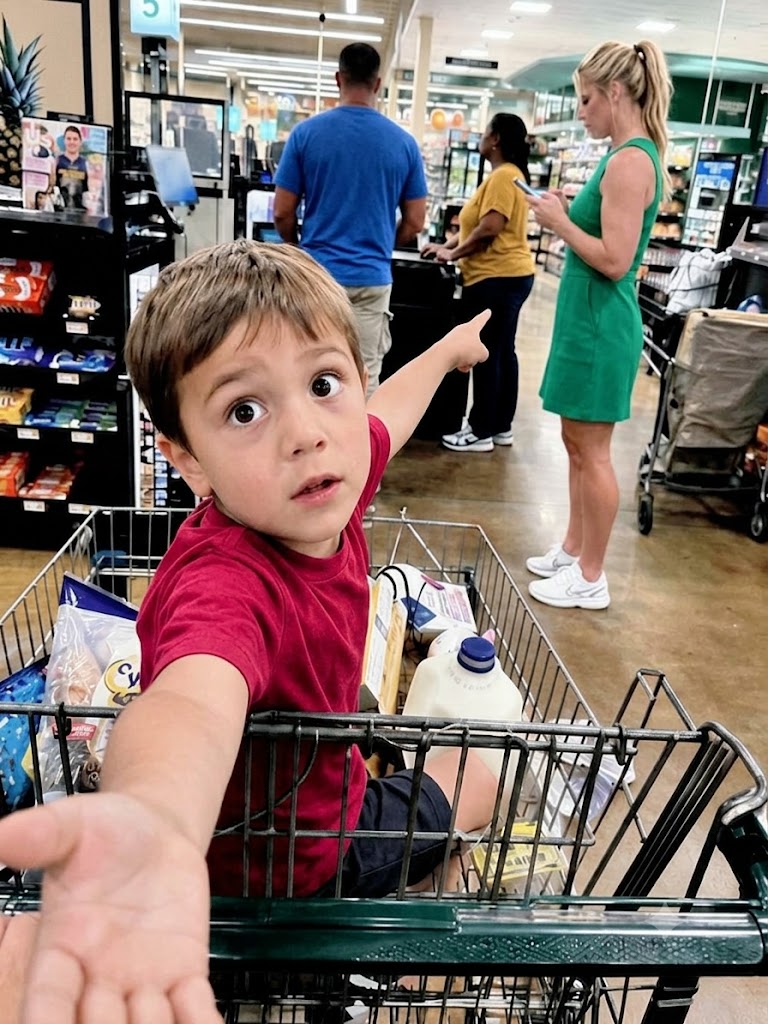
Leo sat in the child seat of the shopping cart, kicking his legs while I pushed him through the supermarket.
“Milk, apples, bread, and something for dinner,” I said. “Can you help me remember?”
“Milk, apples, bread,” he sang.
“And dinner.”
“Cookies?”
“Cookies are not dinner.”
“They can be.”
I laughed despite myself.
The supermarket was filled with the harmless noises of an ordinary afternoon—wheels squeaking against the floor, a baby crying near the frozen foods, scanners beeping at the registers, and cheerful music playing through the ceiling speakers.
For the first time in weeks, the pressure in my chest seemed to ease.
I placed a carton of milk in the cart and joined the checkout line. Leo hummed to himself while I mentally planned our anniversary dinner.
Perhaps Mark and I needed an evening alone.
Perhaps ten years of marriage deserved more than takeout and an exhausted conversation after Leo went to bed.
I was reaching into my bag for my wallet when Leo suddenly stopped moving.
“Mommy.”
I barely heard him.
“Mommy, look.”
He pulled hard on my sleeve.
“What is it?”
He pointed toward the bakery section.
A woman stood beside a display of fresh bread. She looked about thirty, with dark hair loosely pinned behind her head. She wore a green dress and carried a large canvas bag over one shoulder.
“I see her,” I said. “Please don’t point.”
“But that’s the lady.”
“What lady?”
“The lady who comes to our house when you’re at work.”
The supermarket seemed to fall silent around me.
“What did you say?”
“She comes to our house,” he repeated. “She plays in the room upstairs.”
My fingers tightened around the milk carton until the cardboard bent beneath them.
I placed it on the conveyor belt before I crushed it.
The woman had not noticed us.
At least, I did not think she had.
I crouched slightly so my face was closer to Leo’s.
“What do you mean by ‘plays’?”
“Games.”
“What kind of games?”
He frowned, thinking.
“I’m not supposed to tell.”
“Why not?”
“Daddy said it’s a secret.”
My heart gave one hard, painful beat.
“A secret from me?”
Leo’s eyes widened. He seemed to realize that he had said too much.
“I wasn’t supposed to tell you.”
“You’re not in trouble.”
“But Daddy said the surprise would be ruined.”
“What surprise?”
He covered his mouth with both hands.
The cashier spoke to me, but her words did not register.
“Ma’am?”
I stared at her blankly.
“Your total is forty-two dollars and eighteen cents.”
“Oh.”
I dropped my card.
When I bent to retrieve it, my hands were trembling so badly that I struggled to insert it into the machine.
Ten years of marriage passed through my mind in scattered images.
Mark making pancakes on Sunday mornings.
Mark holding my hand at my mother’s funeral.
Mark sleeping beside me while I lay awake, staring into the dark.
Mark looking at his phone with that secret smile.
The locked guest room.
The unexplained trips.
The silver paint on Leo’s fingers.
“Mommy, are you angry?” Leo asked.
“No.”
“You look angry.”
“I’m not angry with you.”
The truth was that anger would have been easier.
Instead, I felt cold.
Every loving memory I had of my husband was shifting into a new shape. Innocent moments suddenly looked suspicious. Kind gestures felt rehearsed. Unanswered questions became evidence.
I looked toward the bakery again.
The woman in green was holding a loaf of bread and studying the label.
“Leo,” I whispered, “how many times has she come to the house?”
He counted on his fingers, reached five, and started over.
“A lot.”
“Does she only come when I’m working?”
He nodded.
“What does she bring?”
“The tall bag.”
“What’s inside it?”
“Long sticks.”
Brushes, I thought.
Or tools.
Or perhaps something my frightened mind could not name.
The woman placed the bread beneath her arm.
I could leave.
I could take Leo home and confront Mark in private.
I could pretend I had not heard the sentence that had just cracked my marriage open.
But my mother’s voice came back to me.
If something is worth knowing, it is worth knowing now.
I turned the shopping cart around.
Part Four: The Confrontation
Each step toward the bakery felt heavier than the last.
Leo became quiet, sensing my tension.
When I was only a few feet away, I stopped.
“Excuse me.”
The woman did not turn.
“Excuse me,” I repeated more firmly.
She looked up.
Her gaze moved first to me and then to Leo.
Recognition flickered across her face.
It was not the startled look of someone seeing a stranger. It was the gentle familiarity of someone seeing a child she already knew.
Then she looked back at me.
Her expression changed immediately.
“Oh,” she said softly.
“Do you know my son?”
She lowered the bread.
“I think you should speak to Mark.”
“I’m speaking to you.”
She pressed her lips together.
Something inside me began to break.
“My son says you visit my house while I’m at work,” I continued. “He says you spend time in the upstairs room.”
Her eyes moved toward Leo again.
I stepped between them.
“Who are you?”
“My name is Nora.”
“And why are you coming into my home?”
“I’ve been helping Mark with something.”
“What?”
“It’s private.”
The word struck me harder than I expected.
“Private?”
“He asked me not to discuss it.”
“He asked you to keep secrets from his wife?”
Her face tightened.
“I gave him my word.”
I stared at the paint beneath her fingernails.
There was a thin silver mark near her thumb.
The same shade I had seen on Leo’s skin.
“You have been in my bedroom?”
“No.”
“The upstairs room.”
“I can’t explain here.”
“You can explain perfectly well.”
“Kate—”
The sound of my name in her voice stopped me.
I had never introduced myself.
She knew who I was.
She had seen photographs, heard stories, or been told enough about me to recognize me instantly.
Leo’s feet had stopped swinging.
“Mommy?” he whispered.
I looked at his frightened face and felt ashamed that he was witnessing this.
I turned the cart sharply and walked away.
Behind me, Nora did not call out.
Part Five: A House Full of Questions
I buckled Leo into his car seat with trembling fingers.
Once I was in the driver’s seat, I called Mark.
The call went directly to voicemail.
I tried again.
Voicemail.
On the third attempt, I could not bring myself to leave a message.
Where could I even begin?
Who is she?
How long has this been happening?
Why did you bring our child into it?
“Where’s Daddy?” Leo asked from the back seat.
“I don’t know.”
“Is he in trouble?”
I met his eyes in the mirror.
“Why would you think that?”
Leo bit the inside of his cheek—the same nervous habit Mark had.
“Because I told you about the lady.”
“You didn’t do anything wrong.”
“But Daddy said it was a surprise.”
My hands tightened around the steering wheel.
“What surprise?”
“If I tell, it won’t be a surprise anymore.”
The drive home lasted seven minutes, but it felt endless.
I pictured Mark and Nora in the locked guest room.
I imagined whispered conversations and hurried footsteps. I imagined them laughing at how easily I had believed his excuses.
By the time we arrived, I had convinced myself that the worst possible explanation was the only one.
I left the groceries in the car and carried Leo inside.
“Stay downstairs,” I told him. “Watch television for a few minutes.”
“Where are you going?”
“I need to look at something.”
I climbed the stairs quickly and went straight to the guest room.
Still locked.
I twisted the handle until my palm hurt.
“Mark,” I whispered, resting my forehead against the door. “What have you done?”
Small footsteps sounded behind me.
Leo stood at the top of the stairs.
“I told you to stay downstairs.”
“I’m not supposed to say,” he whispered loudly.
“Say what?”
“There’s a surprise inside.”
My stomach twisted.
“Who has the key?”
“Daddy.”
“Where does he keep it?”
“In his work bag.”
Of course he did.
“He said only he and the lady can open the door because it isn’t finished yet.”
I lowered myself onto the top step.
The locked room.
The hidden key.
The woman who visited only when I was away.
The secrets Mark had asked our five-year-old to keep.
It all seemed to fit together.
Leo sat beside me and rested his head against my arm.
“Are you mad at me?”
“Never.”
“Are you mad at Daddy?”
I could not answer.
Downstairs, I sat on the bottom step and tried to prepare myself for the conversation ahead.
You need to leave.
I cannot live with someone who lies to me.
You involved our son in this.
Our anniversary was only three days away. I had bought Mark a watch and paid extra to have a message engraved on the back.
For ten wonderful years.
Now the words felt cruel.
Leo walked over carrying his stuffed rabbit. Without speaking, he climbed into my lap and placed it against my chest.
That was what finally brought tears to my eyes.
He knew I was hurting, and he was trying to heal me with the most valuable thing he owned.
Then my phone buzzed.
Part Six: The Photograph
The message was from Mark.
There was no greeting.
Only a photograph.
I opened it with shaking hands.
It showed the inside of the guest room.
One wall had been transformed by layers of unfinished paint. Swirls of warm brown, cream, soft blue, and silver surrounded the beginnings of a woman’s face.
I enlarged the image.
Her eyes were unfinished, but I knew them.
I would have known them anywhere.
They were my mother’s eyes.
Beneath the photograph were four short messages.
I took this yesterday.
I wasn’t ready to show you yet.
Please go upstairs.
I love you.
I read them twice.
Then a third time.
The silver paint on Leo’s thumb.
The locked guest room.
Nora’s paint-covered hands.
The long bag filled with brushes.
Mark’s secret errands.
Every detail I had arranged into proof of betrayal suddenly broke apart and reassembled itself into something completely different.
I covered my mouth.
“Oh, God.”
Leo looked up from the couch.
“Mommy?”
I stared at him.
My frightened little boy had not been helping his father hide an affair.
He had been helping create a gift.
A gift for me.
I knelt beside him.
“Leo, we need to go back to the supermarket.”
His eyebrows rose.
“To see the paint lady?”
“Yes.”
“Am I in trouble?”
“No, sweetheart.”
I wiped my cheeks.
“But I think Mommy owes her an apology.”
Part Seven: Nora’s Promise
We found Nora in the parking lot.
She stood behind a small blue car, folding paint-stained cloths into the trunk. Her canvas bag rested beside her, and several long brushes protruded from the top.
When she saw me approaching, her posture stiffened.
“I’m sorry,” I said before she could speak.
She waited.
“I was frightened, and I assumed the worst. I spoke to you terribly.”
Understanding softened her face.
“You didn’t know.”
“I should have listened.”
“You asked me a direct question, and I refused to answer it. I can understand how that looked.”
“Why didn’t you tell me?”
“Because Mark wanted the room to be finished for your anniversary.”
She closed the trunk and leaned against the car.
“He contacted me four months ago. He had seen a mural I painted for a family nearby.”
“Four months ago?”
Nora nodded.
“He brought me a shoebox filled with photographs of your mother. Some were old and faded. Others were recent. He told me she had passed away and that you had barely spoken about it.”
My throat tightened.
“He said you were still sleeping with her scarf beside you,” Nora continued. “He wanted to give you a place where you could feel close to her without having to hide your grief.”
I looked away, blinking back tears.
“He asked you to paint her?”
“He asked me to paint the way he believed you remembered her. Not as she looked in the hospital. Not as she looked near the end. He wanted her to look warm and alive.”
Nora crouched in front of Leo.
“And this young artist has been helping.”
She reached into her bag and pulled out a thin paintbrush.
“The stars were his idea.”
“Grandma liked stars,” Leo said proudly.
Nora placed the brush in his hand.
“Your daddy told me she used to take you outside when the sky was clear.”
“She said every star was a light somebody left on,” Leo explained.
My mother had said those exact words.
I closed my eyes.
For the first time that afternoon, my tears did not come from fear.
“I truly am sorry,” I told Nora.
She smiled.
“You love your family. Fear sometimes borrows love’s voice.”
It sounded like something my mother might have said.
Leo studied the brush in his hand.
“I told the secret,” he whispered.
“You only told part of it,” Nora said. “You saved the most important part.”
Part Eight: Behind the Locked Door
Mark was standing on the front porch when we returned.
His face was pale, and his hands were buried in his pockets.
“I called you,” I said.
“My phone died during a meeting. When I turned it on, I saw your calls. Then Nora messaged me.”
“I confronted her in the supermarket.”
“I know.”
“She wouldn’t tell me anything.”
“I asked her not to.”
“You also asked our five-year-old to keep secrets from me.”
Mark closed his eyes.
“That was a mistake.”
“Yes, it was.”
“I wanted everything to be perfect.”
“It nearly convinced me that my marriage was over.”
His face crumpled.
“Kate, I would never—”
“I know that now.”
He stepped closer, but hesitated before touching me.
“I’m sorry.”
I looked toward the upstairs window.
“Take me to the room.”
He nodded.
We climbed the stairs together, with Leo following behind us.
Mark pulled a small key from his pocket and placed it in the lock.
The door opened.
The air smelled of paint, wood, and something faintly floral.
For a moment, I could not move.
The bed and furniture had been covered with protective sheets. Jars of paint stood in neat rows along the floor. Several lamps had been positioned near the wall.
And there she was.
My mother.
Her portrait filled the space from floor to ceiling.
Nora had painted her standing near a garden gate, one hand resting gently against the wood. Her brown hair was lifted by an imagined breeze. Her expression was peaceful and amused, as though someone she loved had just said something ridiculous.
Her eyes held the warmth I had missed every day since she died.
Above her, dozens of silver stars stretched across the wall and continued onto the ceiling.
Some were carefully painted.
Others were crooked.
One was little more than a silver blob.
I knew immediately which ones belonged to Leo.
I sank onto the floor.
The grief I had been holding inside for three months finally broke free.
I cried for my mother.
I cried for the empty chair in her kitchen.
For the phone calls I could no longer make.
For the scarf I kept smelling when no one was watching.
For the fear that if I allowed myself to grieve properly, I might never find my way back.
Mark knelt beside me.
“I didn’t know how to help you,” he said.
I leaned my head against his shoulder.
“You could have talked to me.”
“I tried.”
“I know.”
“You kept saying you were fine.”
“I wasn’t.”
“I knew that too.”
I looked at the mural again.
“You remembered the garden gate.”
“It was in one of the photographs.”
“She loved that garden.”
“I know.”
“How?”
“You told me during our first year of marriage. You said it was the only place where she could grow roses.”
I gave a tearful laugh.
“She could never grow roses. They died every summer.”
“Then perhaps I misunderstood.”
“No.” I touched his hand. “You remembered the important part.”
Leo climbed onto the covered bed.
A small jar of silver paint sat near the wall.
“There’s one star left,” he announced.
He dipped his brush carefully into the paint.
Mark started to stand.
“Leo, wait. We need to put something beneath—”
But Leo looked at me.
“Mommy, will you finish it with me?”
I wiped my face and joined him.
He wrapped his little fingers around the bottom of the brush while I held the top.
Together, we painted the final star above my mother’s head.
It was uneven.
One side was too long, and silver paint dripped beneath it.
It was perfect.
Part Nine: Our Anniversary
On Saturday evening, Mark prepared dinner while Leo drew pictures at the kitchen table.
I wore my mother’s scarf around my shoulders.
The mural upstairs was still not completely dry, and the guest room remained filled with paint jars and covered furniture. Nora would return the following week to finish the smallest details.
But the door was no longer locked.
After dinner, I gave Mark the watch.
He read the engraving on the back and ran his thumb over the words.
“For ten wonderful years,” he said quietly.
“I ordered it before the supermarket incident.”
“Do you want me to return it?”
I shook my head.
“No. They were wonderful years.”
He looked at me carefully.
“Even after what happened?”
“What happened reminded me that fear can be convincing. It can take half a truth and build an entire tragedy around it.”
“I should never have involved Leo in keeping the room secret.”
“No, you shouldn’t have.”
“I thought calling it a surprise would be harmless.”
“He’s five. To him, a secret and a surprise are the same thing.”
Mark glanced toward Leo, who was now drawing silver stars over a picture of our house.
“I’ll do better.”
“So will I.”
He fastened the watch around his wrist.
“Do you forgive me?”
“For the locked door, yes.”
“And for the mysterious errands?”
“Yes.”
“And for asking an attractive mural artist to visit our house while you were away?”
I gave him a look.
“That part may take another ten years.”
He laughed.
It was the first real laugh we had shared since my mother’s funeral.
Later that night, we stood together in the guest room.
The lamps were off. Only the soft glow from the hallway reached the mural.
Leo had fallen asleep on the bed beneath the painted stars, still holding the brush Nora had given him.
Mark wrapped an arm around my shoulders.
“I was afraid the mural might upset you,” he said.
“It does.”
His body tensed.
“But not in a bad way,” I added. “It hurts because I love her.”
He kissed my temple.
“I thought you needed somewhere to remember her.”
“I think I needed permission to miss her.”
“You never needed permission.”
“I know that now.”
I looked at my mother’s painted face.
Grief had convinced me that healing meant leaving her behind.
But standing beneath those imperfect silver stars, I finally understood that moving forward did not require forgetting.
Love did not vanish when a person was gone.
It changed shape.
Sometimes it became a scarf resting on a dresser.
Sometimes it became a story told to a child.
Sometimes it became a mural hidden behind a locked door.
And sometimes it became a five-year-old boy pointing at a stranger in a supermarket and accidentally revealing the greatest gift his father had ever given his mother.