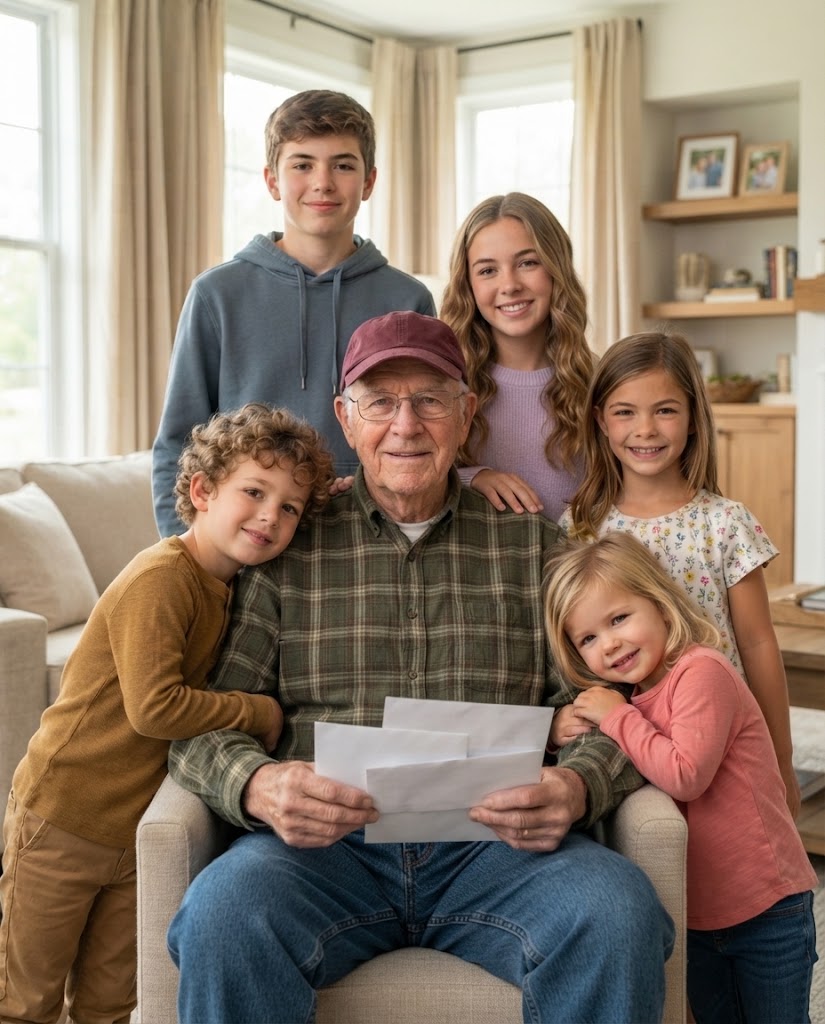
I was raised in foster homes, moving from one place to another with my belongings stuffed into trash bags, always wondering why no one had ever come looking for me. So when the kind elderly man next door slowly became part of our family, I wanted to make it official. I imagined the adoption papers would bring tears of happiness to his eyes. Instead, he stared at them as though they could explode. Then he revealed the truth he had been keeping from me for two years, right there at my own kitchen table.
Part One: The Man Who Came for Coffee and Never Really Left
Walter’s face went pale the moment he saw the adoption papers.
I had imagined that moment so many times. I pictured his eyes filling with tears and that gentle, awkward laugh he always gave whenever the kids hugged him a little too tightly.
But he wasn’t emotional.
He wasn’t shocked.
He was terrified.
He placed the blue folder on our dining room table with such slow, deliberate care that, for a strange moment, I wondered whether something dangerous was hidden inside. Something that might actually go off if he put it down too hard.
“There’s something I need to tell you,” he said, his voice barely above a whisper. “I was going to tell you anyway. I want you to know that. I’ve just waited too long.”
Then he glanced toward my five children, who were still happily eating his birthday cake, frosting smeared across their chins and chocolate covering their fingers.
“Could they finish eating in the other room?”
That was the moment I realized something was seriously wrong.
To understand why his reaction affected me so deeply, you need to know how Walter became part of our lives in the first place.
Two years earlier, a small moving truck stopped outside the gray house next door. Boxes came out first, followed by a recliner, a little table with two chairs, and an old upright piano that required four men and plenty of swearing to carry inside.
The man overseeing everything stood in the yard wearing a cardigan, leaning heavily on a cane he obviously hated having to use.
He was 86 at the time and had been widowed the previous year after 41 years of marriage. Later, he told me that the quiet inside that little house was harder than the silence he had known while living with Margaret, because at least that earlier silence still carried the feeling of her presence.
Our home, meanwhile, had never experienced much silence.
My husband, Daniel, and I had five children, ranging from a nine-year-old who acted like she was thirty to a five-year-old who firmly believed the moon followed our car wherever we went. There was always a missing shoe, someone shouting upstairs, something sticky left on the counter, and a grocery bill that made me wonder if every person in the house really needed to eat every single day.
My first reaction was guilt. That poor man. He’s going to hate living next to us.
He didn’t.
He began appearing by the fence whenever the children were outside playing. Then, one afternoon, my middle son, Eli, hit a baseball that flew straight over the fence and landed among Walter’s flowers. Instead of getting upset, Walter picked it up, examined it briefly, and threw it back with an arm that was surprisingly strong.
“Your elbow is dropping,” he told Eli. “Keep it raised. Imagine you’re reaching for something on a high shelf.”
Eli gave it another try. The next ball flew straight and fast.
From that point on, the kids wanted Walter at every game.
Within a month, he was pitching to the younger children and repairing bicycle chains with pliers he carried inside his cardigan pocket. Within two months, he was sitting at my kitchen table most mornings with a cup of coffee, listening while I complained about permission slips and wondered aloud where all our spoons kept disappearing.
At first, I invited him over for dinner.
Eventually, I stopped asking because an invitation suggested he might actually say no. He simply came. Every evening, he sat in the same chair, the one closest to the bread basket.
The children began calling him Grandpa.
No one told them to. It simply happened, the way genuine family connections often do. One night, my youngest, Rosie, climbed onto his lap while we were watching a movie and said, “Grandpa, can you hold my juice?” And Walter held her juice. And somehow, that was all it took.
I still remember the expression on Walter’s face that evening. At the time, I assumed he was simply touched. Now I understand there was something much more complicated behind it.
Part Two: The Waiting Room
Daniel’s parents had died when he was in his twenties. I had never really had parents myself, at least not the kind who stayed. Our children had grown up without grandparents, and I had convinced myself that you couldn’t long for something you had never truly experienced.
But watching Walter with the kids made me realize just how wrong I had been. And I realized how much I had been missing as well.
Then, that spring, Walter became ill.
A cough he had stubbornly ignored eventually developed into pneumonia. It wasn’t life-threatening, but I drove him to the hospital myself because there was nobody else available to take him.
I spent six hours sitting in that waiting room.
And every person who walked through those double doors asked me essentially the same question, just phrased a little differently.
“Are you family?”
“What is your relationship to the patient?”
“I’m sorry, are you his daughter?”
“Abby,” Daniel said softly, “do you need a moment? We can stop.”
“No.”
Because there was one question that mattered more than everything else, a question I had carried inside me for over forty years.
I turned toward Walter.
“Where were you when I was eight?”
For a moment, he seemed to stop breathing. I saw it happen.
“Where were you when I was being moved again?” I asked. “Where were you when I carried my clothes to a stranger’s car in a trash bag? Where was Kate?”
Walter shut his eyes.
“We didn’t know.”
I laughed again, but there was no humor behind it.
“You knew I existed.”
“Yes. But we believed you were with your family.”
“I didn’t have a family.”
“We thought you did,” he said, his voice cracking. “Abby, we truly believed you did.”
Then he told me about Kate.
She was nineteen when she became pregnant, frightened and only halfway through her first year at community college. My biological father vanished before I was born, and she never heard from him again.
Walter and Margaret had pleaded with her to reconsider. They offered to help her raise me, even offering to take me themselves if she couldn’t handle it.
But Kate had grown up watching her parents work double shifts just to keep the electricity on. She believed that a couple who were prepared for a baby, with a house and a nursery already waiting, could give me a better life than she or her parents could.
So she chose adoption.
“She believed she was giving you something she couldn’t,” Walter said. “Two parents. A real home. Stability.”
“Well,” I replied. “That worked out wonderfully.”
He recoiled as though my words had physically struck him.
I regretted saying it almost immediately. But I didn’t withdraw it. At that moment, I simply couldn’t take anything back.
“She didn’t know,” Walter said quietly. “Neither did we. We believed you left that hospital with the family who was going to raise you. That’s what we were told. That’s what we believed for forty years.”
I stared at him.
“You never knew I went into foster care?”
“No,” he answered. “Not until you told me. Over that fence.”
Something inside me shifted.
It didn’t erase anything. But the story I had carried my entire life had always seemed so simple: someone gave me away, and nobody came back. I had built so much of myself around those two sentences.
Now Walter was giving me another version of what happened.
“Did she ever search for me?” I asked. My voice sounded small, almost like a child’s.
Walter nodded. “Yes.”
“When?”
“More than once.”
“Then how could she not find me?”
“The adoption was closed. We never knew where the family lived. When you turned eighteen, Kate registered with every reunion database she could find. At one point, she even hired an investigator using money she could barely afford. Margaret tried again later. Phone calls, letters, every possible lead.” He shook his head. “Nothing ever led anywhere.”
“Then where is Kate now?”
That was the question that finally broke him.
Walter lowered his gaze toward his hands.
“She died nine years ago.”
I sat down.
For over forty years, my biological mother had been a question mark. I never knew whether she was alive or dead, whether she thought about me or had forgotten me completely. I had imagined her as a hundred different women, depending on how much I needed to despise her or forgive her.
Now she had a name.
Kate.
And she had been gone for nine years.
When she died, I was pregnant with my first child and living perhaps two hours away, close enough that I could have driven there.
“You expect me to believe she searched for me?” I finally asked.
“No,” Walter said. “I expect you to ask me to prove it.”
I looked up at him.
Using both hands against the table, he slowly pushed himself out of the chair.
“I have something at my house.”
Part Five: The Box and the Letters
Daniel started to rise as well, but I shook my head. “I need to handle this myself.”
Walter and I walked next door in silence. I had been inside his house hundreds of times before.
Yet suddenly, it felt completely unfamiliar.
He returned from his bedroom carrying an old, faded cardboard box. Its corners had become soft from years of being handled. He placed it carefully on the coffee table.
Inside were documents. Old photographs. Envelopes in every possible size and color. And tucked into one corner was a tiny plastic hospital bracelet.
He handed me a photograph first.
A young woman sat upright in a hospital bed, holding a newborn wrapped in a striped blanket. She wasn’t smiling at the camera. Instead, she was looking down at the baby with an expression I recognized from my own reflection after each of my children was born.
I knew before Walter even spoke.
Kate had my chin.
Or maybe I had hers.
“That’s you,” Walter said quietly. “She had you for about two hours. Margaret took that photograph.”
I brushed one finger over the photograph’s corner, barely touching it, as if it could somehow vanish.
Beneath it were the letters. Some were addressed simply to “My Daughter.” Others only said “Abby,” the name Kate had whispered to me in the hospital. My adoptive family had kept that name. It was one of the few things anyone had preserved.
“She couldn’t mail them,” Walter explained. “She had nowhere to send them. But for years, she kept writing anyway. Every birthday. Sometimes between birthdays.”
“Did you read them?”
“Not all of them. Some felt like they weren’t mine to read.”
I picked one at random and opened it.
Kate had written it when I would have been six. Her handwriting was looping and hurried, as though she needed to put every thought onto the page before she lost her courage.
She wondered if I enjoyed reading. She hoped I did because she had loved books when she was my age.
She wondered what color my bedroom might be and whether I slept with a night-light, because she herself had been afraid of the dark until she was ten.
She hoped my parents celebrated my birthdays and made them special. She hoped our family had silly little traditions that were slowly becoming mine, like pancakes shaped like my age or a special song that belonged only to us.
More than anything, she wrote, she hoped there was always someone waiting at the door whenever I came home.
I stopped reading.
By the time I was six, I had already left the home that was supposed to be permanent. I was sleeping on a bottom bunk in a house where the refrigerator was locked every night.
At eight, I kept my belongings packed more carefully than other children because I had already learned that a move could happen within a single afternoon.
Kate hadn’t known.
She had pictured me safe. She had imagined night-lights and birthday pancakes. Meanwhile, I had spent those same years convincing myself she simply didn’t care.
It didn’t erase what she had done. Nothing could.
But for the first time in my life, she gave me away and she didn’t want me no longer felt like they meant exactly the same thing.
“Margaret tried as well,” Walter said.
He passed me a spiral notebook filled with my grandmother’s neat handwriting. There were names, dates, crossed-out addresses, and notes beside every failed lead. Called agency again, no records released. Woman in Ohio, wrong Abby, very kind.
“After Kate died, Margaret kept saying someone had to find you. She said we owed Kate at least that much. She repeated it right until the end. Then she became sick.”
“And then she died,” I said.
He nodded.
“So you finally took the test.”
“Yes. It was the last thing on her list. She had been asking me for years, and I always told her it was nonsense. Spit into a tube and somehow find a person. After she was gone, I took it during the week of her funeral.” His voice trembled. “Three months later, there you were.”
I looked toward the framed photograph of Margaret on the side table, a picture I had dusted countless times without ever truly studying it. She had gentle eyes and a determined mouth.
“Why did you move next door?” I asked. “Why didn’t you simply contact me?”
“I didn’t know how.”
“You could have called.”
“I know.”
“You could have sent a message through that website. There’s literally a button right there.”
“I know.”
“You could have knocked on my door and said, ‘Hi, I’m your grandfather.’”
“I know.”
His refusal to defend himself somehow made me even angrier. I wanted him to argue. I wanted an excuse I could rip apart.
“Then why didn’t you?”
Part Six: “Sit Down, Grandpa”
Walter lowered himself into the chair across from me, moving slowly as his knees cracked.
“I intended to,” he said. “The house next door went up for sale, and I took it as a sign. I practiced what I would say while standing in the bathroom mirror. Margaret would have laughed at me.”
“So what changed?”
“I met you.”
I stared at him. “That sounds ridiculous.”
“It is ridiculous.” He rubbed his hands together. “During that first week, you were pulling weeds along the fence, and I was outside pretending to be interested in my roses. You casually told me, the same way someone might talk about the weather, that you had grown up in foster homes. You were explaining why you wanted your children to have one house they could always return to. One home that never changed.”
I remembered that conversation. At the time, I had simply thought he was a kind old man who knew how to listen.
“I went home that night,” Walter continued, “and sat in the darkness for hours. Because everything we had believed was wrong. Kate died believing she had given you a stable home. Margaret died believing you had parents somewhere who loved you. And there you were, telling me you had been passed around like a package nobody wanted to claim.”
His voice cracked.
“How do you tell someone they belong to the family that lost them? How do you knock on their door and say, ‘Hello, we’re the reason’?”
“So you said nothing.”
“That first day, yes. Then I told myself I would tell you tomorrow. And then tomorrow came, and I said it again.”
“And then?”
“Then your kids started coming over.”
I turned toward the window.
“Then you invited me inside for coffee. Then dinner. Then your little one climbed into my lap and called me Grandpa.”
He smiled briefly. Then the smile disappeared.
“That should have been when I told you. I knew it even then. Instead, I became afraid.”
“Afraid of what?”
“That I would lose every one of you.” He glanced down at the box. “That you would look at me the way you’re looking at me now and close the door. And I’d be alone in that house again, only this time I would know exactly what I had lost.”
I got up and walked toward the window.
Through the glass, I could see the light glowing in my own kitchen and Daniel standing at the sink.
Two houses.
One fence.
Two years.
“You found me,” I said without turning around. “Do you understand that? I spent my entire childhood wondering why nobody came. Why no one ever came. And when you finally found me, you let me spend another two years without knowing. Two years I could have had with the truth.”
“I know.”
“No. I don’t think you do.”
“I do, Abby,” he said softly.
I turned back toward him.
“Finding you so late wasn’t my decision,” he said. “That part, I can live with. We all tried. But keeping the truth from you after I found you? That was my decision. Every day I stayed silent, I chose it.”
That made me stop.
“I was a coward,” he admitted. “Every week I waited made everything worse. And every week, I loved all of you more, which only made me more frightened. There’s no excuse for it. I won’t insult you by pretending there is.”
I looked at Kate’s letter, still resting in my hand.
“Why now?” I asked. “Why tonight?”
“I decided I would tell you after I became sick. Lying in that hospital bed, I thought, if I die before telling her, then that will be the last thing I ever do to this family. Leave her with one more piece of the story missing.”
“But you still didn’t tell me.”
“No. I came home, and you made me soup, and I lost my courage again.” He gave a quiet, sad laugh. “Then tonight you handed me those papers. They had a ribbon around them. And there you were, asking me if I would officially become your family, when I had been lying to you about the fact that I already was.”
I went home carrying the box.
I didn’t forgive Walter that night. But I didn’t tell him to go away, either. I didn’t ask him to stop coming over. I simply walked back across the wet grass with the box pressed against my chest. He remained in his doorway, watching me leave, and neither of us said goodbye.
Daniel was still awake, waiting for me. He didn’t ask what happened. He simply sat beside me while I cried in a way I hadn’t cried since childhood.
For the next several days, I read.
I read while sitting in the car during school pickup and at two in the morning at the kitchen table. Kate had written about ordinary pieces of her life. Songs playing on the radio. Jobs she couldn’t stand. A cat named Pickles. Every birthday, without exception, she wondered what kind of cake I might like. She guessed chocolate. Or perhaps I was a strawberry girl. She hoped I wasn’t a coconut girl because, if I was, we would have to have a serious conversation.
That one made me laugh out loud by myself in the kitchen, and then I started crying again.
None of those letters could return the things I had lost. Not a single night-light. Not one birthday.
But they gave me something I hadn’t realized I still needed, something I had stopped allowing myself to want years ago.
They proved that I had existed in someone’s thoughts. That during all those years when I believed I was invisible, someone, somewhere, had been thinking about me.
On the fourth evening, I looked through the window and saw Walter sitting by himself on his porch. He hadn’t joined us for dinner since his birthday. The kids kept asking about Grandpa, and I kept telling them he was tired.
I walked across and sat beside him on the step.
For a long while, neither of us spoke.
“I would have wanted to meet her,” I finally said.
“I know.”
“I’m angry that I never can.”
“I know.”
“And I’m still angry with you.”
“You have every right to be.”
I turned toward him and looked closely. His white hair, his cardigan, his hands resting together over his cane. Then I noticed the chin I suddenly recognized, an older, softer version of my own.
“But I’m glad you found me,” I said.
Walter covered his face with both hands.
And that was when he finally broke down and cried.
We told the children the following day, all five of them sitting together in a row on the couch.
For about four seconds, nobody said anything. Then my eight-year-old, Eli, suddenly threw both arms into the air and declared that this proved he had been right to call Walter Grandpa from the beginning, and everyone owed him a dollar.
“Actually,” Daniel said, “he’s your great-grandpa.”
Walter groaned. “Absolutely not. I just turned eighty-eight. There’s no reason to make me sound older.”
The kids burst out laughing.
A few days later, I noticed the blue adoption folder still resting on the sideboard where Walter had left it on his birthday. The ribbon remained tied around it, although it was slightly crushed now.
I picked it up and carried it into the kitchen.
Walter was already there, helping my nine-year-old work through long division.
He noticed the folder in my hand and immediately fell silent.
“We’ll figure out whether any of this paperwork still matters,” I told him. “Maybe we’ll need different documents. Maybe we won’t need any at all. But that isn’t what matters most anymore.”
He studied me for a long moment before nodding.
I placed the folder inside a drawer. I didn’t throw it away. I think I’ll keep it for the rest of my life.
For most of my life, I thought there were only two choices.
Either someone kept you, or they didn’t want you.
Kate’s letters didn’t make my childhood any less painful. Walter being my grandfather didn’t erase a single house I had lived in, the trash bags, or the lonely Christmases. And sharing blood didn’t excuse the two years he spent keeping the truth from me. I still think about those two years. I probably always will.
But at last, I understood something I had never understood before.
I hadn’t been forgotten.
I had been lost.
There is a difference. I didn’t discover that difference until I was forty-three years old.
My family had spent decades trying to find me without ever managing to reach me. My mother. My grandmother. And finally, one stubborn and frightened old man who bought the house next door because he couldn’t figure out any other way to get close to me.
That evening, once dinner was ready, Walter came over for the first time in a week. He stood beside the table with one hand resting on the back of his usual chair.
For two years, he had pulled out that same chair without asking and without even thinking about it.
Now, for the first time, he looked uncertain about whether he still belonged there.
I placed a plate in front of the chair. Pot roast, with far too many carrots.
“Sit down, Grandpa,” I said. “Dinner’s getting cold.”
Walter looked at me. Then he looked at the chair. Then he glanced toward the five children at the opposite end of the table, already arguing loudly over who should get the last dinner roll.
He sat down.
The house was noisy. Nobody was bored, and nobody was alone.
And this time, every person at the table understood exactly why he was there.