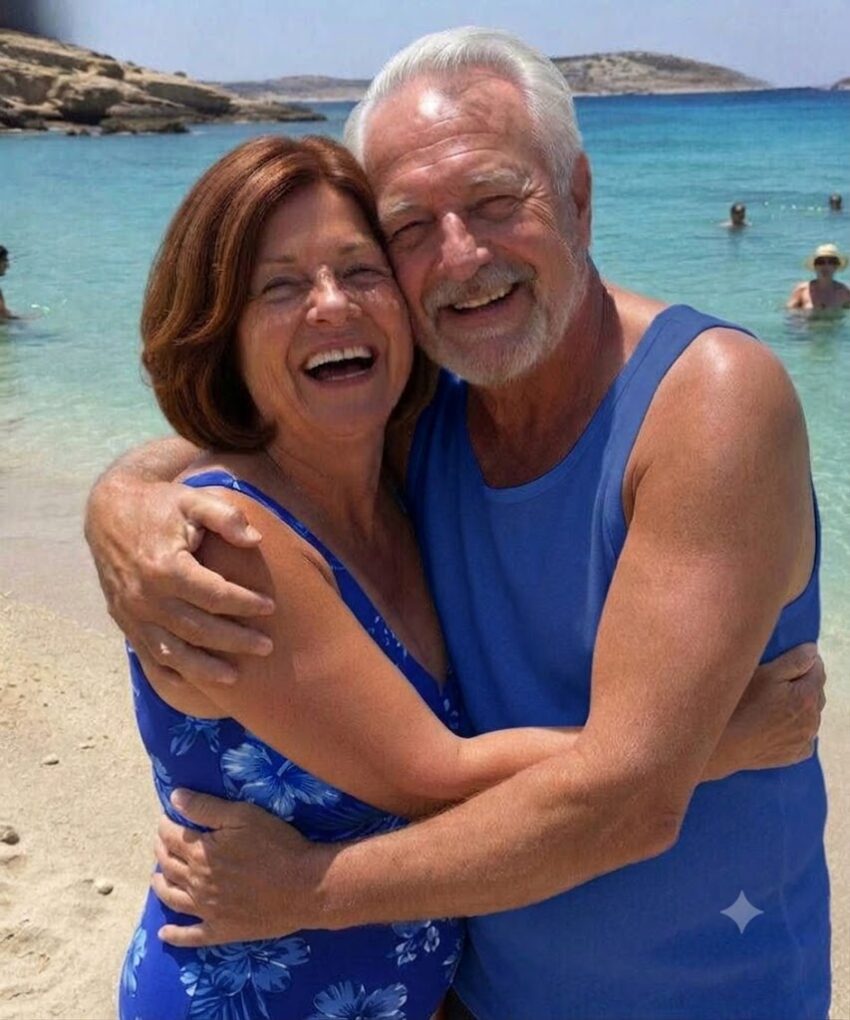
Part 1: The Meeting That Was Never an Accident
At sixty-seven, I took my first solo trip to Malta.
After four years of mourning my husband, Michael, I had forgotten what it felt like to make decisions for myself. My daughter, Rebecca, finally asked me a question I could not ignore:
“When was the last time you did something simply because it made you happy?”
I could not remember.
So I booked the trip and made myself a promise: for one week, I would say yes to every new experience.
That promise led me to unfamiliar food, crowded streets, a ferry to Gozo, and a man named David.
We met when he saw me struggling with an upside-down map in Valletta. Instead of feeling embarrassed, I laughed at myself. David laughed too, then offered to help.
Coffee became breakfast. Breakfast became a day of sightseeing. Soon, we were taking boat rides, walking beside the sea, and talking about the lives we had shared with our late spouses. David was seventy, widowed, gentle, and quietly funny. He never pressured me or treated me as though age had made me invisible.
For the first time since Michael died, I felt noticed.
On my final evening in Malta, David brought me to a restaurant overlooking the harbor. The waiter greeted him by name, but David quickly changed the subject. I should have questioned it, but instead, I allowed myself to believe the evening was simply another unexpected gift.
During dinner, David received a message and excused himself. Several minutes passed. When he did not return, I went looking for him.
I followed a narrow passage into a courtyard illuminated by strings of yellow lights. David stood beneath them with a woman in her forties who shared his gray-blue eyes.
“You have to tell her tonight,” the woman said.
“I know,” David replied.
“You should have told her as soon as you recognized her.”
I froze behind the stone doorway. Recognized me?
David lowered his voice. “I didn’t expect to fall in love with her.”
“That doesn’t make the lie smaller.”
David glanced toward the restaurant. “She leaves tomorrow.”
“Exactly. If you wait any longer, she’ll believe everything between you was planned.”
“Wasn’t it?” the woman asked.
David said nothing. His silence answered for him.
I stepped into the courtyard. “Planned?”
David turned, and the color drained from his face. “Eleanor.”
I looked at the woman. “Who are you?”
“My daughter,” David said. “Her name is Clara.”
Clara gave me an apologetic look. “No more help from me, Dad. You tell her.”
David suddenly appeared much older. “My wife knew your husband.”
I stared at him. “What?”
“Ruth knew Michael.”
Hearing my husband’s name from David’s mouth made my stomach tighten. Michael had been dead for four years. We had been married for thirty-nine, and he had never mentioned a woman named Ruth.
“How did they know each other?”
“They met here in Malta thirty-two years ago.”
“That’s impossible. Michael never came to Malta.”
David did not answer.
I remembered Michael’s business trips, conferences, and delayed flights. I remembered the two weeks he had spent traveling through Europe when Rebecca was nine. He had returned with a glass dolphin for her and a silver bracelet for me—a bracelet I still owned.
“You told me you had never been to this restaurant,” I said.
“I lied.”
“How many times have you been here?”
“Seven.”
I felt as though the ground had shifted beneath me. “Why?”
David reached into his jacket, but I moved away. He placed an envelope on a nearby table with my name written across the front. The handwriting belonged to Michael—I recognized every hurried curve and the oversized final letter of my name. My knees weakened, and Clara pulled out a chair for me.
“Where did you get this?”
David sat across from me. “After Ruth died, I kept one of her old suitcases. Last year, I discovered a hidden compartment behind the lining containing more than forty letters from Michael.”
“How long did they write to each other?”
“Almost eleven years.”
I pushed the envelope away. “No. Michael was not unfaithful to me for eleven years.”
David did not argue, and for a moment, I hated him for that. He explained that they had met at a conference in Valletta when Michael worked for a shipping company. They later arranged to see each other in Malta, London, Paris, and Boston.
Boston. I remembered the red scarf Michael had brought home after that trip, claiming he had bought it during a layover because he missed me. I had worn it for twenty years.
“Did they love each other?” I asked.
David hesitated. “Yes.”
The answer didn’t shatter my life with a dramatic sound—something simply collapsed inside me. On his final morning in hospice, Michael had squeezed my hand and whispered, “You were the best part of my life.” I had believed him, and the cruelest part was that some part of me still did.
“Why did the affair end?”
“Ruth said they chose their families. They ended it twenty-one years ago.”
I looked at the envelope. “And this?”
“Michael wrote it to you. I think he gave it to Ruth because he was afraid of losing you.”
I laughed bitterly. “He risked losing me for eleven years.”
David admitted that Ruth had followed our family online, and photographs of Michael and me were hidden in the suitcase with the letters.
“That’s how you recognized me,” I said. “You saw me struggling with my map and knew exactly who I was. You pretended we were strangers.”
“I intended to introduce myself and give you the envelope,” David said. “But then you smiled at me. I told myself it would only be coffee.”
“Every memory from this week was calculated,” I said. “You used me.”
“At first, I wanted to know whether Michael had destroyed your life the way Ruth’s secret destroyed mine.”
“Did I look destroyed?”
“No.”
“Did that disappoint you?”
“At first, perhaps.”
Part 2: The Letter
David explained that after finding the letters, he searched for answers in Malta. Clara had seen a social media post from Rebecca celebrating my first solo trip, which revealed I was coming.
“Meeting you in the street really was an accident,” David insisted. “A convenient one, but an accident.”
I picked up Michael’s envelope. “Have you read this?”
“No.”
“How can I believe you?”
“You can’t.”
Strangely, that was the first answer of the evening that made me trust him.
The letter was two pages long, written twenty years earlier. Michael confessed to the affair, writing that he had confused escape with love. With Ruth, he could pretend to be a man without responsibilities. Eventually, he realized that the life he wanted to escape was the life he would choose if he were forced to lose it. He ended the affair but lacked the courage to tell me, claiming his silence was out of concern for me. He had protected himself and called it love.
In the final paragraph, he acknowledged that I might consider our entire marriage a lie if I ever found out, but insisted his gratitude for our life together had been real.
I folded the letter.
“Do you hate him?” David asked.
“Not yet.”
“Do you hate Ruth?”
“I hate what she did,” David said softly, “but I still miss the person she was.”
I understood him immediately. We were the only two people who understood how love and betrayal could exist inside the same memory.
I placed the letter in my bag and stood up. “I’m leaving.”
“I’ll walk you to your hotel.”
“No. I promised to say yes to everything this week, but that does not mean you decide what I say yes to now.”
At the airport the next morning, David was waiting near the check-in desks holding my forgotten book.
“Clara said I should let you go,” he said. “I’m sorry I met you through a lie. But I’m not sorry I met you.”
“I cannot trust what happened this week,” I said. “And I refuse to become a consolation prize for what our spouses did.”
He handed me a card with his address and phone number. “If you never contact me, I will understand.”
For three months after returning home, I did not contact David. I told Rebecca everything. I began therapy, joined a walking group, and continued saying yes to experiences that had nothing to do with David.
On the ninety-third day, I wrote him a letter. I told him I had not forgiven his deception, but asked: “If we meet again, can you do it without already believing you know who I am?”
His reply arrived two weeks later: “No. But I can spend the rest of my life learning who you are instead of assuming I already know.”
Part 3: Saying Yes by Choice
A year after my first trip, I returned to Malta.
David waited at the airport holding a sign: “ELEANOR, AGE 68. STILL SAYING YES?”
I took a pen from my purse and added one word beneath it: “SOMETIMES.”
David smiled. “That’s better.”
Over the next year, David and I rebuilt our relationship carefully, traveling between England, Malta, and my home. We didn’t rush, nor did we pretend the past didn’t happen. I eventually accepted that Michael had loved me and betrayed me—one truth did not erase the other.
When David and I returned to the same harbor restaurant, the waiter greeted him by name again. This time, I didn’t feel frightened. Clara joined us for dessert, and afterward, David led me into the courtyard.
He took my hand. “No surprises. No hidden arrangements. I would like to spend whatever time we have left traveling between your home and mine.”
“Is that a proposal?”
“It’s a question.”
I said yes.
Not because of a promise to accept everything, but because I was choosing to. Sometimes courage is leaving the courtyard; sometimes it is allowing someone another chance without pretending the first betrayal never happened.
At sixty-seven, I traveled to Malta asking when I had last done something that made me happy. I thought happiness would be an island, then I thought it might be David.
It was neither. Happiness was realizing my life still belonged to me. When love found me again, I did not say yes because I was lonely—I said yes because I finally understood that I was equally free to say no.