The Night My Life Split in Two
My name is Chloe Whitaker, and for ten years, I told myself I would never go back to that house.
Not because I hated it.
That would have been easier.
I stayed away because I loved it too much.
I loved the porch where my mother used to drink tea in the evenings. I loved the tiny rose bushes my father trimmed every Sunday. I loved
the yellow kitchen where birthday cakes cooled on the counter and my mother hummed old songs while folding towels.
But the night I came home at nineteen with a pregnancy test in my jacket pocket, that house stopped being home.
It became the place where I learned that love could be conditional.
My mother, Beatrice, was folding laundry in the living room when I walked in. My father, Thomas, sat in his armchair, still wearing his gray factory uniform. His hands were rough, stained with grease that never fully washed away no matter how hard he scrubbed.
I stood near the coffee table, shaking so badly I could hardly breathe.
“Chloe?” Mom asked. “What’s wrong?”
I couldn’t speak.
So I pulled the pregnancy test from my pocket and placed it on the table.
The room went silent.
My mother froze with one of Dad’s shirts in her hands. My father stared at the test as if it were something dangerous.
Then he turned off the television.
“Who’s the father?” he asked.
His voice was not loud.
That made it worse.
I swallowed hard. “I can’t tell you.”
Mom’s face drained of color.
“What do you mean you can’t tell us?” she asked. “Is he married? Is he older? Did he hurt you?”
“No,” I whispered quickly. “No, nothing like that. He was good. He was kind.”
“Was?” Dad repeated.
I looked down.
That one word betrayed more than I meant to say.
Dad stood up, his chair scraping against the floor. “You are nineteen years old. You live under my roof. You do not get to come in here with a pregnancy test and secrets.”
Tears filled my eyes. “Dad, please. I need you to trust me.”
“Trust you?” he snapped. “You won’t even say his name.”
“I can’t. Not yet.”
Mom started crying. “Chloe, please. Tell us what happened.”
I wanted to.
G
od knows I wanted to.
I wanted to tell them about Evan Miller, the young safety engineer from Dad’s factory. I wanted to tell them how he had noticed something wrong with the new pressure system before anyone else did. I wanted to tell them how he had been trying to prove that the company was hiding dangerous shortcuts.
I wanted to tell them he had died two weeks earlier in the explosion that nearly killed my father.
But Evan had made me promise.
“Not until the file is safe,” he had said the last time I saw him. “Not until you know who can be trusted.”
At nineteen, I didn’t fully understand what he meant.
I only knew he was gone.
And I was carrying the only part of him left in the world.
“Dad,” I said, my voice trembling, “if I give up this baby, one day all of us will regret it.”
His face hardened.
“Don’t threaten me, young lady.”
“I’m not threatening you. I’m begging you.”
But he had already decided.
“You will not bring shame into this house,” he said. “Either you end this nonsense, or you leave.”
Mom sobbed, but she did not stop him.
I looked at her.
I waited for her to say my name.
I waited for her to cross the room and take my hand.
She only covered her mouth and turned away.
Less than an hour later, I stood on the sidewalk with one suitcase, eighty-six dollars, an old jacket, and a child inside me no one wanted me to keep.
Before I left, I looked back at the living room window.
My mother was standing there.
She was crying.
But she did not open the door.
That was the first night I slept at a bus terminal.
Beginning Again With Nothing
The next morning, I bought a ticket to Chicago.
I had one friend there from high school, Mara, who let me sleep on the floor of the tiny room she rented behind a beau
ty salon. The room smelled like shampoo, hair dye, and old carpet, but to me, it felt like mercy.
I found work anywhere I could.
In the mornings, I sold sandwiches near a train station. In the afternoons, I washed dishes in a restaurant kitchen. At night, I studied accounting online with swollen feet and a back that ached so badly I sometimes cried quietly into my pillow.
I was scared every single day.
But every time fear told me I couldn’t do it, I pressed my hand against my stomach and remembered Evan’s voice.
“Some things are worth standing for, Chloe.”
My son was born on a rainy Tuesday in November.
I named him Leo Evan Whitaker.
The first time the nurse placed him in my arms, he opened his eyes and looked at me with such quiet seriousness that I laughed through my tears.
“Well,” I whispered, “you look like you already know more than I do.”
He had Evan’s eyes.
That was both a gift and a wound.
Leo was a gentle baby, then a thoughtful toddler, then a boy who seemed to notice everything. He noticed when I skipped dinner so he could have seconds. He noticed when I smiled too quickly after reading a bill. He noticed when other children had grandparents at school concerts and he had only me clapping twice as loud.
When he was five, he asked, “Mom, do I have a grandpa?”
I froze over the sink.
“Yes,” I said softly.
“Does he know me?”
I dried my hands slowly. “Not yet.”
“Why?”
Because he threw me out.
Because he believed pride mattered more than his daughter.
Because your grandmother watched me leave and never came after me.
But I didn’t say any of that.
I knelt in front of him and said, “Sometimes grown-ups make mistakes they don’t know how to fix.”
Leo thought about that.
Then he asked, “Did I do something wrong?”
My heart cracked.
“No, sweetheart. Never. You are the best thing that ever happened to me.”
From then on, I worked harder than ever to make sure he never felt like a mistake.
I built a life piece by piece.
I finished my accounting certificate. I got a job at a small financial office. Then a better one. I rented a real apartment with two bedrooms and a window that caught the morning sun. I bought Leo secondhand books, warm coats, and birthday cakes with candles shaped like stars.
We were not rich.
But we were safe.
And for a while, I thought that was enough.

The Question I Couldn’t Avoid
On Leo’s tenth birthday, I bought a chocolate cake from the grocery store and decorated it myself with uneven blue frosting.
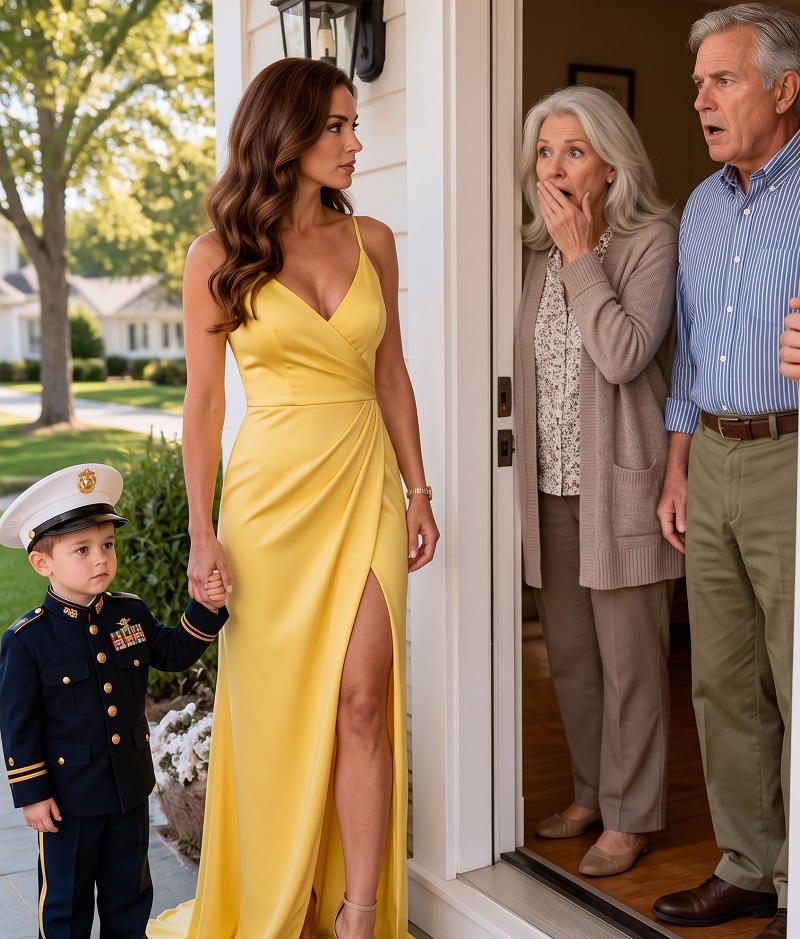
He wore his school honors uniform that day because his class had held a citizenship ceremony that morning. He looked so serious in the navy jacket and little cap that I almost cried when he walked out of his bedroom.
“Too much?” he asked shyly.
“You look like a young gentleman,” I said.
He smiled, but his eyes were nervous.
That night, after dinner, we sat at our small kitchen table. The candles flickered on the cake between us.
“Make a wish,” I told him.
He closed his eyes.
Then he opened them without blowing out the candles.
“Mom,” he said, “my wish is to meet them.”
I knew who he meant.
My hand tightened around the plastic cake knife.
“Leo…”
“Just once,” he said. “I don’t need them to love me. I just want to know where I come from.”
I turned away because I didn’t want him to see the fear on my face.
For ten years, I had carried the truth like a sealed box inside my chest.
Inside that box was Evan.
Inside it was the factory explosion.
Inside
it was the photograph Evan had left with me.
Inside it was a yellow folder filled with copies of safety reports, emails, and a small USB drive that had once felt too dangerous to touch.
And inside it was the sentence Evan had written on the back of the photo the week before he died.
“Your father tried to save us.”
I had never understood it fully.
Not then.
All I knew was that Evan had worked with my father. He had respected him. He had said Thomas Whitaker was stubborn, difficult, honest, and braver than he looked.
That was why my father’s rejection had hurt so deeply.
He had not only rejected me.
He had rejected Evan’s son.
Three days after Leo’s birthday, I packed the yellow folder, the photo, and the USB drive into my backpack.
Then I bought two bus tickets to Albany.
The House That Hadn’t Changed
We arrived on a Saturday afternoon.
The neighborhood looked smaller than I remembered.
The trees were taller, the sidewalks cracked in new places, but my parents’ house looked almost exactly the same. The brown door. The porch light. The flower beds my mother loved. The same front step where I had sat crying with my suitcase ten years earlier.
Leo reached for my hand.
“Are you okay, Mom?”
I looked down at him.
He was trying to be brave for me.
That gave me courage.
“Yes,” I lied. “I’m okay.”
We walked up the path.
For a moment, I couldn’t knock.
I just stood there, feeling nineteen again.
Then Leo squeezed my hand.
So I knocked.
Footsteps approached.
The door opened.
My father stood there.
His hair was almost completely gray now. His shoulders looked narrower. But his eyes were the same—sharp, guarded, proud.
When he saw me, his face went pale.
“Chloe?”
My mother appeared behind him.
She looked older too, softer somehow, wrapped in a beige cardigan. When she saw me, her hands flew to her mouth.
Then her eyes moved to Leo.
She gasped.
No one spoke.
Leo moved slightly behind me.
I lifted my chin.
“Hello, Dad,” I said. “Hello, Mom.”
My mother whispered my name as though it hurt to say it.
My father gripped the doorframe. “After ten years?”
“Yes,” I said. “After ten years.”
His eyes flickered to Leo again.
“Is this…”
“My son,” I said. “Leo.”
Leo stepped forward because I had raised him to be polite even when adults didn’t deserve it.
“Hello,” he said quietly.
My mother began to cry.
My father looked away.
I could have turned around then. A part of me wanted to. But I had not come for apologies only.
I had come for the truth.
“I need to talk to you,” I said.
Dad’s jaw tightened. “About what?”
I pulled the yellow folder from my backpack.
“About Evan Miller.”
The name landed between us like thunder.
My father stepped back.
My mother looked at him in confusion. “Thomas?”
Dad stared at the folder. “Where did you get that name?”
I walked past him into the house of my childhood.
And for the first time in ten years, my son followed me inside.
The Photograph on the Table
The living room had changed only a little.
New curtains. A different rug. The same coffee table.
That almost broke me.
I placed the folder on it, exactly where I had placed the pregnancy test ten years before.
Then I took out the old photograph.
In it, Evan stood smiling in an engineer’s hard hat beside my father outside the factory gates. Dad looked younger in the picture, tired but proud, one hand resting on Evan’s shoulder.
My mother picked up the photo with trembling fingers.
“Who is he?” she asked.
I looked at my father.
“You never told her?”
Dad’s face turned gray.
“Chloe,” he said carefully, “where did you get this?”
“Evan gave it to me.”
My mother looked from him to me. “You knew this man?”
“I loved him,” I said.
My voice shook, but I did not stop.
“He was Leo’s father.”
Mom sank into the armchair.
Dad closed his eyes.
Leo stood beside me, silent and confused.
I turned the photograph over and placed it on the table.
There, in Evan’s uneven handwriting, was the sentence I had read a thousand times.
Your father tried to save us.
My mother read it aloud in a whisper.
Then she looked at my father.
“Thomas… what does that mean?”
For the first time in my life, I saw my father look afraid.
Not angry.
Afraid.
He sat down slowly, as if his legs could no longer hold him.
“It means,” he said, his voice rough, “that I should have listened to him sooner.”
The room went still.
Dad rubbed both hands over his face.
“Evan was a safety engineer at the plant. Smart boy. Too smart for that place. He found problems in the pressure system. He said the company was cutting corners.”
I felt my heartbeat pounding.
“I know,” I whispered.
Dad looked up sharply. “You know?”
I opened the folder and spread the documents across the table.
“Evan gave me copies. He said if anything happened, I should keep them safe.”
My father stared at the papers.
Then he began to cry.
I had never seen him cry before.
Not once.
“I thought they were destroyed,” he said.
My mother’s voice trembled. “Thomas, what happened?”
Dad swallowed hard.
“I signed off on a maintenance delay,” he admitted. “Not because I wanted anyone hurt. Because management pressured us. Because I thought we had time. Evan argued with me. He begged me to shut the line down.”
He looked at me, shame breaking across his face.
“I didn’t listen fast enough.”
My chest tightened.
Dad continued, each word heavier than the last.
“That day, Evan came running into the control area. He saw the pressure spike before anyone else. He pulled the emergency release and shoved me out before the blast hit.”
My mother covered her mouth.
“He saved my life,” Dad whispered. “And he died doing it.”
Leo’s small hand slipped into mine.
I could barely breathe.
For ten years, I had imagined my father rejecting Evan because he didn’t know who he was.
But he had known him.
He had known the man who saved him.
And still, when I came home pregnant, he threw me out.
“Why didn’t you tell me?” I asked.
Dad’s face crumpled.
“Because I was ashamed. The company buried the investigation. They blamed a system malfunction. I let them. I told myself I had a family to protect. A mortgage. A reputation.”
He looked at Leo.
“But the truth followed me anyway.”

The Sentence That Broke Us Open
I had spent years dreaming of what I would say if I ever faced my father again.
I imagined shouting.
I imagined accusing.
I imagined making him feel every lonely night I had survived.
But when the moment came, my voice was quiet.
“This is Evan’s son,” I said.
Dad flinched.
I put my hand on Leo’s shoulder.
“The man you called my shame was the reason you came home alive.”
My mother sobbed.
Dad bowed his head.
That was the sentence that destroyed my family.
Not because it ended us.
Because it destroyed the lie we had been living under.
It destroyed my father’s pride.
It destroyed my mother’s silence.
It destroyed the version of our family that cared more about what neighbors thought than what was true.
For a long time, no one moved.
Then Leo spoke.
“Grandpa?”
Dad looked up.
His face changed when he heard that word.
Not completely.
But enough.
Leo swallowed. “Did my dad save you?”
Dad pressed a shaking hand over his mouth.
“Yes,” he said. “He did.”
“Was he brave?”
Dad nodded. Tears ran down his face.
“He was one of the bravest men I ever knew.”
Leo looked at the photograph.
Then he looked at my father.
“Then maybe you can tell me about him.”
That broke something in my father that my anger never could.
He stood, took one unsteady step toward Leo, then stopped, as if he knew he had no right to touch him.
“I don’t deserve that,” he whispered.
Leo looked at me.
I nodded through my tears.
So my son walked forward and placed the photograph in my father’s hands.
“You can start with one story,” Leo said.
My father cried harder.
And my mother came to me.
For ten years, I had imagined refusing her arms.
But when she reached for me, I was nineteen again, exhausted and heartbroken, wanting my mother.
“I’m sorry,” she sobbed into my shoulder. “I watched you leave. I watched my baby leave, and I did nothing.”
I closed my eyes.
“I needed you,” I whispered.
“I know,” she cried. “I know.”
I did not say it was okay.
Because it wasn’t.
But I let her hold me.
That was the first step.
What Came After the Truth
The truth did not heal us in one afternoon.
Real healing never works that way.
My father gave the documents and USB drive to an attorney the following week. The factory case was reopened, not for revenge, but because the families who had been hurt deserved honesty.
Evan’s name was finally cleared from the rumors that had followed the accident.
A small memorial plaque was placed outside the factory gates.
It read:
Evan Miller
For courage, integrity, and the lives he protected.
My father stood beside me and Leo at the ceremony.
He did not ask to be forgiven.
That mattered.
Instead, he said, “I will spend the rest of my life becoming someone worthy of knowing my grandson.”
And slowly, he tried.
He called before visiting. He listened more than he spoke. He told Leo stories about Evan—how he carried a notebook everywhere, how he laughed when nervous, how he once stayed four hours after work to help a janitor fix a broken car.
My mother sent letters first, because I wasn’t ready for daily phone calls.
She wrote about the garden, about recipes, about the years she had missed. Sometimes she included apologies. Sometimes she simply wrote, I thought of you today when I folded towels.
I kept every letter.
Not because all pain was gone.
Because effort deserved to be witnessed.
One evening, months after we returned to Chicago, Leo asked me, “Do you forgive them?”
I thought about it for a long time.
“I’m learning how,” I said.
He nodded like that made sense.
“Is learning enough?”
I kissed the top of his head.
“Sometimes learning is where love begins again.”
The Door That Finally Opened
A year later, we visited Albany for Thanksgiving.
This time, I did not stand on the porch shaking.
This time, my mother opened the door before I even knocked.
The house smelled like roasted turkey and cinnamon. My father was in the kitchen wearing an apron over his shirt, pretending not to be emotional when Leo ran in carrying a pie we had bought at the bus station.
“Careful,” Dad said gruffly. “That looks important.”
“It is,” Leo replied. “Mom said dessert can save any dinner.”
Dad looked at me.
For a second, I saw the man who had thrown me out.
Then I saw the man trying every day not to be him anymore.
“That sounds like your mother,” he said softly.
During dinner, there were awkward silences. There were tears. There were moments when old pain rose between us like a wall.
But there was also laughter.
There was Leo asking for more potatoes.
There was my mother touching my hand when she passed the rolls.
There was my father clearing his throat before saying, “Evan would have been proud of you, Chloe.”
I looked down at my plate.
For years, I had survived by being strong.
But hearing those words almost made me fall apart.
“Thank you,” I whispered.
After dinner, Leo stood in the living room looking at the family photos on the wall.
There was a new one in the center.
A picture of Evan holding his hard hat, smiling in the sun.
Beside it was a photo of Leo.
My son turned to my father.
“Grandpa?”
“Yes?”
“Can we put Mom’s picture there too?”
Dad looked at me.
His eyes filled.
“We should have done that a long time ago,” he said.
And just like that, the wall changed.
Not enough to erase the past.
Nothing could.
But enough to make room for the truth.
The Family We Rebuilt
People think one sentence can destroy a family.
Maybe it can.
But sometimes destruction is not the end.
Sometimes it is the breaking of something false so something honest can finally grow.
The sentence I spoke that day shattered my parents’ pride, silence, and denial.
But it also gave my son his history.
It gave Evan his honor.
It gave my parents a chance to face what they had done.
And it gave me something I never thought I would have again.
A door that opened.
I am not the same girl who left that house with a suitcase and a broken heart.
I am a mother now.
I am a woman who built a life from nothing.
I am someone who learned that forgiveness does not mean pretending the wound never happened.
Forgiveness means deciding that pain will not be the only thing passed down.
Leo knows the truth now.
He knows his father was brave.
He knows his grandfather failed, then chose to change.
He knows his grandmother was silent once, but found her voice later.
And he knows he was never a shame.
He was a gift.
The gift that brought us back to the truth.
The gift that carried Evan’s eyes into the future.
The gift that made a broken family sit together again under one roof, not perfect, not untouched by regret, but finally honest.
Ten years ago, I left my parents’ house with nothing but fear.
When I came back, I carried my son’s hand in mine, a yellow folder under my arm, and the truth in my heart.
And that time, when I stood at the door, no one sent me away.
This time, the door opened.
Note: This story is a work of fiction inspired by real events. Names, characters, and details have been altered. Any resemblance is coincidental. The author and publisher disclaim accuracy, liability, and responsibility for interpretations or reliance. All images are for illustration purposes only.