My Dad and I Work at the Same Hospital
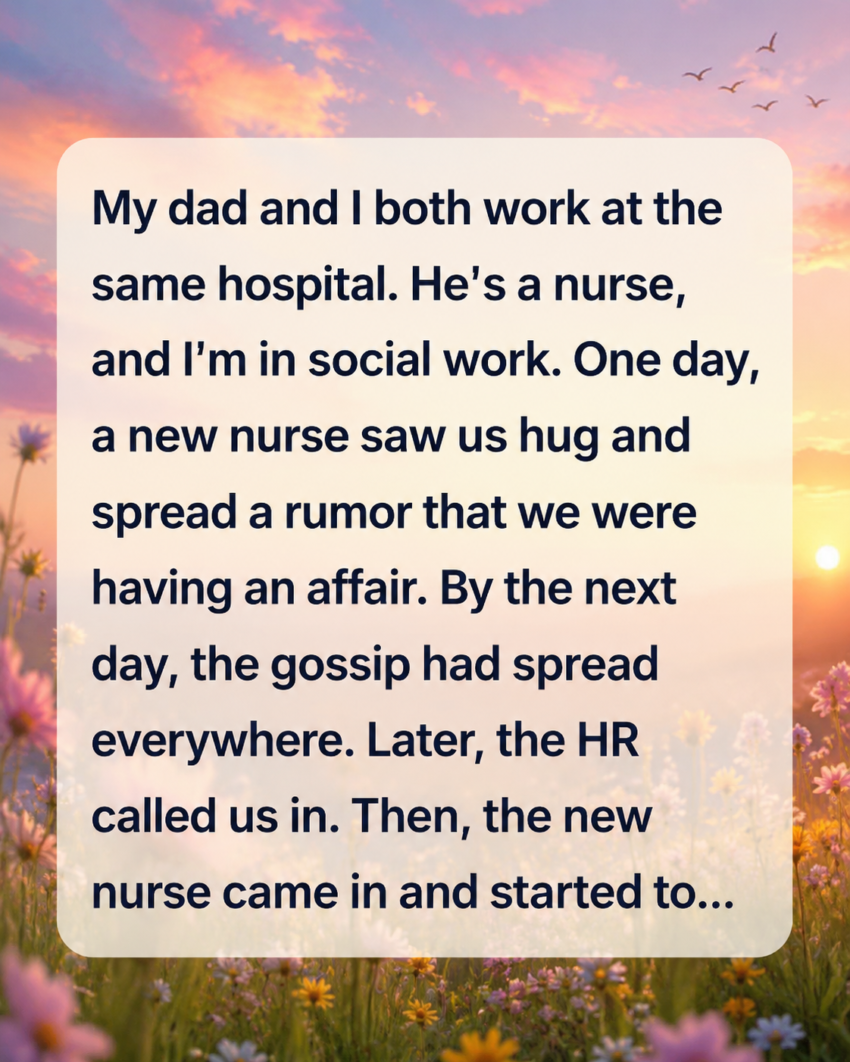
My father and I work at the same hospital. He’s a nurse, while I work in social services. We’ve always had a strong relationship because he raised me alone after my mother left when I was five.
We’re affectionate with each other, and we’ve never thought twice about showing it. We hug, joke around, check on one another during exhausting shifts, and make sure the other is doing okay.
To us, that’s simply what family does.
But one afternoon, a new nurse saw my dad and me hugging in the hallway.
And somehow, that innocent moment turned into something disgusting.
The new nurse started telling people that my father and I were having an affair.
By the following morning, the rumor had traveled through the hospital like wildfire. Whenever I entered a room, conversations stopped. People exchanged uncomfortable looks. Even the atmosphere around my father changed.
Eventually, HR summoned both of us.
The nurse who had started the rumor came into the meeting too. Her name was Roxy, and she looked almost amused by the entire situation.
“I just thought it was strange,” she said. “The way they hugged. It was really close.”
My face went cold.
Then HR asked the question that made the whole situation even more absurd.
“Can you clarify your relationship?”
I answered as calmly as I could.
“He’s my father.”
Roxy’s expression instantly changed.
My father looked at HR and said, “She’s my daughter. My only daughter. I’ve raised her since she was five.”
Nobody said anything.
The silence in that room felt endless.
HR finally cleared her throat.
“Okay. That clarifies the situation. Thank you.”
Except it didn’t really fix anything.
Once a rumor gets into people’s heads, correcting it isn’t nearly as easy as starting it.
My dad and I left the meeting together. I tried to laugh about it, but deep down, I felt sick.
From that day forward, we became conscious of everything we did at work.
We stopped hugging in the hospital.
We were careful about standing too close.
Even normal conversations suddenly felt like something other people might misinterpret.
And Roxy never apologized.
Instead, after avoiding us for a while, she started telling people that maybe we had only claimed to be related because we were embarrassed about what had been seen.
By the end of the week, several coworkers had stopped speaking to me. Others smirked when I walked past. Once, I heard someone whisper something about me before two nurses laughed.
I pretended I hadn’t heard.
My dad kept telling me the same thing.
“Eventually, people will see the truth.”
But they didn’t.
Then strange things began happening at work.
Patient charts I had updated disappeared. Cases I had been assigned to suddenly went to someone else. Notes I knew I had entered into the system were suddenly missing.
At first, I assumed they were technical mistakes.
Then I realized there was a pattern.
One afternoon, my supervisor, Mr. Linton, asked to speak with me privately.
“Is there some kind of problem between you and the staff?” he asked.
I explained everything. I told him about the rumor, the way I was being treated, and the strange things happening with my work.
He listened, nodded, and then said something that made my stomach drop.
“Just keep your head down for now. Don’t make the situation bigger.”
Keep my head down?
I already felt like I was being buried alive.
That evening, I sat alone in my car after my shift. I had managed to stay composed all day, smiling at patients and answering calls as though nothing was happening.
But once I was alone, everything came crashing down.
I cried.
Then my phone buzzed.
It was a message from Dad.
“Dinner’s on the stove. Don’t let it burn.”
I smiled through my tears.
When I got home, he was sitting on the couch watching a documentary. He moved over and patted the seat beside him.
After a long silence, I finally asked, “Why do people believe the worst about someone so easily?”
He sighed.
“Because asking questions takes more effort.”
A couple of days later, I learned something that explained a lot.
Roxy was related to the hospital’s chief of surgery.
Suddenly, her confidence made more sense.
Still, I decided to focus on my patients.
Until another complaint appeared.
This time, it was anonymous.
The complaint accused me of behaving “inappropriately” with the spouse of a patient.
I knew immediately who they meant.
Her name was Simi. Her husband had died unexpectedly, and I had spent time with her the following day. We had cried together, and at one point, she hugged me.
Someone had taken that moment of compassion and twisted it into something shameful.
HR called me in again.
I brought Simi’s handwritten thank-you card with me.
“This isn’t an official warning,” they said. “But we have to follow up.”
I placed the card on the table.
“She had just lost her husband. I was doing my job. Someone is trying to destroy my career, and I believe this is personal.”
They told me they would investigate.
Once again, nothing happened.
So I decided to protect myself.
I started keeping records of everything.
Dates.
Times.
Names.
Witnesses.
Screenshots.
Emails.
Every strange reassignment.
Every missing note.
Every inappropriate comment.
I documented everything.
Then, one morning in May, everything changed.
An elderly man named Mr. Kovalenko was admitted for post-surgical care. My father was assigned to him, and I was responsible for coordinating his transition into assisted living.
At 83, Mr. Kovalenko was remarkably sharp. I later learned he had spent much of his career as a civil rights attorney.
He noticed the way people treated me.
One afternoon, he looked at me and asked, “Why does everyone act like you’ve done something wrong?”
Eventually, I told him part of the story.
He listened carefully.
Then he gave me advice I would never forget.
“Keep records,” he said. “People who do bad things depend on everyone else forgetting.”
A few days later, I received a call from a blocked number.
It was Mr. Kovalenko’s granddaughter, Nira.
She was a journalist.
He had told her about my situation.
“Can we meet?” she asked.
We met at a coffee shop near the hospital.
I showed her everything.
My notes.
The screenshots.
The complaints.
The timelines.
The emails.
She investigated. She verified names and dates, contacted former employees, reviewed hospital policies, and spoke with Simi.
Then Nira discovered something I hadn’t fully recognized.
Almost every questionable incident I had documented occurred shortly after Roxy had interacted with me or become involved in some way.
The pattern was impossible to dismiss.
Nira asked me one question.
“Are you certain you want this story published?”
For months, I had been terrified that speaking up would make everything worse.
Then I realized something.
They had already made my life worse.
So I said yes.
The article was published on a Monday morning.
Its headline read:
“She Was Targeted for Hugging Her Dad: A Hospital’s Failure to Protect Its Own.”
Within hours, it exploded online.
By lunchtime, the hospital communications department had issued a vague statement.
By that evening, local news outlets were discussing the story.
Then the hospital announced an internal investigation.
Everything changed almost overnight.
Coworkers who had avoided me suddenly wanted to hear my side.
And Roxy?
She was suspended while the investigation took place.
Investigators discovered that Roxy had previously made complaints against other employees. Those complaints had repeatedly been dismissed or quietly buried because of her connection to the chief of surgery.
Other employees had raised concerns about her behavior before.
Eventually, Roxy left the hospital.
The hospital board publicly apologized.
HR leadership was restructured.
Mr. Linton, my supervisor, was asked to step down.
My documentation made it impossible for him to claim he hadn’t known what was happening.
Eventually, even the hospital CEO personally apologized to me.
But the apology wasn’t the part that mattered most.
What mattered was that my father’s name had finally been cleared too.
People finally saw him for who he actually was.
A father who had raised his daughter alone.
A nurse who had worked exhausting shifts.
A man who had simply loved his daughter openly.
One evening, Dad came home from work and stood in the kitchen looking at me.
Then he smiled.
“So… are we allowed to hug now?”
I laughed.
For the first time in months, I wrapped my arms around him without worrying about who might be watching.
We didn’t hide anymore.
Later, we were even invited to speak at a healthcare ethics panel at a local university.
My father stood in front of the room and said:
“Hug the people you love. And don’t let anyone make you ashamed of loving them.”
I nearly cried.
Because for months, I had made myself smaller just to survive.
I had stopped doing something as simple as hugging my own father because strangers had decided our relationship looked wrong.
Not anymore.
Things aren’t perfect.
There are still people who judge us.
But I know what happened.
My dad knows what happened.
And now, so do countless other people.
The truth didn’t arrive as quickly as the rumor.
But eventually, it arrived.
And when it did, it changed everything.
If you’ve ever been falsely accused, misunderstood, or judged by people who never bothered to hear your side, remember this:
Don’t make yourself smaller to accommodate someone else’s lies.
Document what happens. Protect yourself. Stand your ground.
Because sometimes the truth takes longer to travel.
But when it finally arrives, it can clear the entire room.