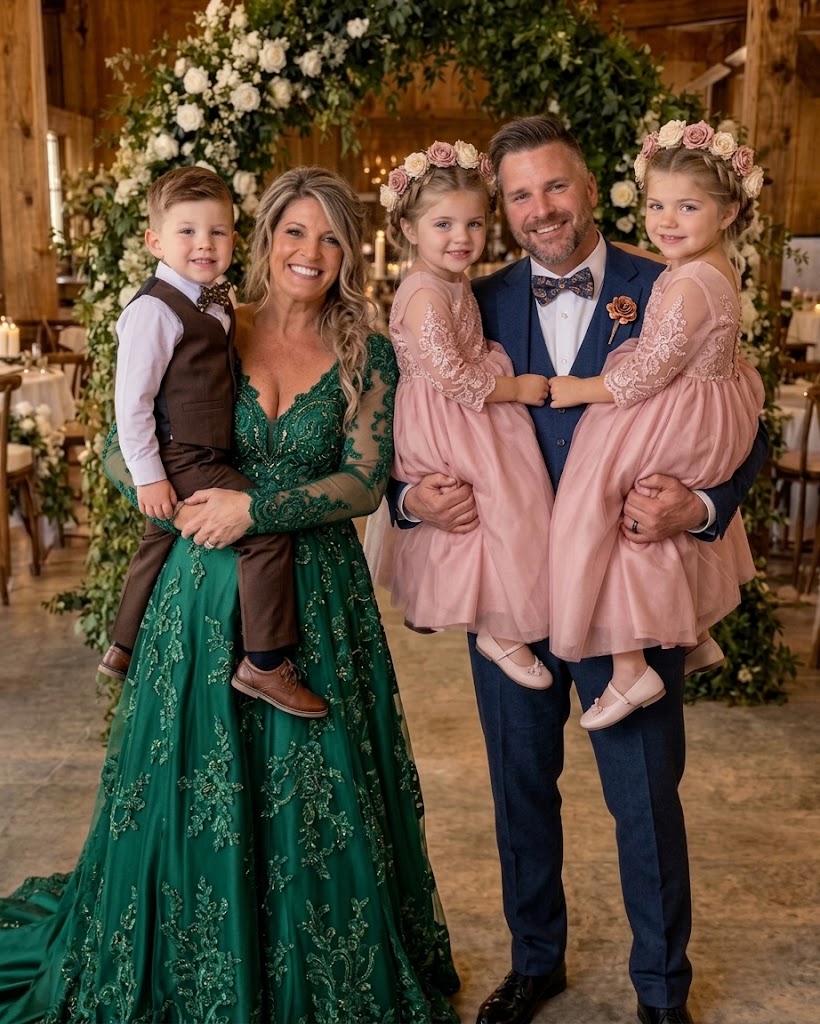
He thought a tired single mother of three would sign anything if he said it was “for the kids.” He forgot that I’d made a promise long before I ever met him — and that I don’t break promises.
Part One: Blush or Red
Two nights before my wedding, I learned more about the man I was marrying in eleven minutes than I had in three years.
It was a little after ten. The house had finally gone quiet, which in a home with three children under nine is its own small miracle. The dishwasher was humming. A basket of clean laundry sat unfolded at the foot of my bed. And on the back of the closet door, zipped inside a garment bag, hung my wedding dress — ivory, simple, with long lace sleeves I had fallen in love with the second I tried it on.
Everything was ready.
My aunt was driving in from Ohio. My cousins were flying in from Arizona. The venue — a converted barn by the river — was paid in full. The flowers were ordered, the cake chosen, the programs stacked in a box by the front door.
All that was left was one silly decision about ribbon.
My fiancé, Grant, called me on FaceTime from his parents’ house, where he was staying the last few nights before the wedding. His mother had insisted. “Tradition,” she’d said, smiling the way she always smiled at me — warm on the surface, measuring underneath.
“Okay, final question, I promise,” he said. “The ribbon for the chairs. Blush or red?”
“Blush,” I said immediately. “Definitely blush. Red will fight with the peonies.”
He grinned. “See, this is why I don’t make decisions without you. You’re always right about this stuff.”
“Write that down,” I teased. “I want it in the vows.”
He laughed. Then his head turned toward something off-screen.
“Mom’s calling me from the kitchen. One second, babe.”
The image tilted, slid, and went black.
I assumed he’d ended the call. I was reaching to set my phone on the nightstand when I noticed the timer in the corner was still counting.
He hadn’t hung up. He’d just set the phone face-down on something — a counter, maybe, or a table — or slipped it into his pocket.
At first, all I heard was the ordinary noise of someone else’s house. Footsteps on tile. The clink of dishes. A cabinet door closing. A television murmuring in another room.
I smiled a little, honestly. It felt intimate, almost sweet, listening to the background of his evening. I was about to hang up and text him you left me on, goof when I heard his mother’s voice.
Lorraine.
“Well?” she asked, low, the way people talk when they think the walls might be listening. “Did you get her to sign it yet?”
My thumb stopped an inch above the red button.
Sign what?
Grant laughed. It was a lazy, comfortable laugh — the kind I’d heard a hundred times on our couch, during movies, at barbecues with friends.
“Almost,” he said. “She keeps dragging her feet on the paperwork. But after the wedding, she’ll do it. Once everything’s official, she’ll trust me. That’s the whole point.”
I didn’t move. I don’t think I breathed.
Part Two: The Promise I Made at a Hospital Bed
To understand why those words hit me the way they did, you have to understand what my life looked like before Grant.
My name is Claire. I’m forty-three years old. And three years before that phone call, my entire world split in half.
My younger sister, Amelia, was diagnosed with an aggressive cancer when her twin daughters were barely four. She was raising them mostly alone. Their father had drifted out of the picture before they could walk, and he never drifted back.
I went to every appointment I could, answering work emails in waiting rooms while my son, Owen, colored on the back of pharmacy receipts. I drove the girls to preschool when Amelia was too sick to stand.
Near the end, when Amelia could barely lift her head off the hospital pillow, she grabbed my hand with more strength than I thought she had left.
“Promise me, Claire,” she whispered. “Promise me Ruby and Josie will be safe. That they’ll always have someone. That nobody will ever take what’s theirs.”
“I promise,” I said. “They’ll always be safe with me. Always.”
She died eleven days later.
Ruby and Josie moved into my house that same month. They were four. Owen was five. Overnight, I went from a single mom with one little boy to a single mom with three grieving children, a mortgage, a full-time job in hospital billing, and a promise I intended to keep with everything I had.
It wasn’t easy. I won’t pretend it was.
There were nights I stood in the kitchen at midnight, packing three lunches, signing three permission slips, staring at a stack of bills and wondering how other people did it. There were mornings I cried in the car after drop-off and then fixed my mascara in the rearview mirror before walking into work.
But slowly, we built something.
I kept the house — the small blue one with the creaky porch swing that I’d bought years before. I built an emergency fund one paycheck at a time. With a lawyer’s help, I set up trusts for all three kids, including the small life-insurance payout Amelia had left for her girls. I made the children the beneficiaries of my own policy. I put everything in writing, because I’d learned the hard way that life doesn’t wait for you to be ready.
It wasn’t glamorous. But it was ours.
Part Three: The Man at the Hardware Store
I met Grant during one of the worst weeks of that first year.
A pipe under my kitchen sink was leaking, and I couldn’t afford a plumber. So one Saturday I stood in the plumbing aisle of a hardware store, staring at a wall of fittings that all looked exactly the same.
“You look like someone who’s about to buy the wrong washer,” a voice said behind me.
I turned. He was tall, with kind eyes and sawdust on his flannel sleeve. He handed me the right part, walked me through the whole repair right there in the aisle, wished me luck, and left. He didn’t flirt. He didn’t ask for my number.
Two weeks later, I ran into him at the same store. This time, he asked how the sink was holding up. Then he asked if I’d like to get coffee.
I almost said no. Instead, I said yes — and on our very first date, I told him everything.
“I have a son,” I said. “He’s five. And I’m raising my sister’s twin girls. They’re four. I have almost no free time. I’m always tired. My house is loud and messy and covered in crayon. If you’re looking for something easy, I’m not it.”
I’d given that speech before and watched men politely disappear.
Grant didn’t flinch.
“What are their names?” he asked.
“Owen. Ruby. Josie.”
“What do they like?”
I blinked. Nobody had ever asked me that.
“Owen’s obsessed with dinosaurs. Ruby wants to be a veterinarian. Josie likes drawing. And thunderstorms terrify all three of them.”
He smiled. “Sounds like a pretty great house to me.”
Over the next three years, he became part of our lives so gradually that I barely noticed the moment it happened.
He played dinosaurs with Owen on the living room floor, doing a ridiculous T-rex voice. He helped with spelling homework. He came to every school concert and soccer game. He memorized that Josie was allergic to tree nuts and that Ruby couldn’t sleep without her stuffed rabbit.
One night, during a storm that knocked out the power, I found him on the couch with Owen curled against his side, a flashlight between them, telling stories about a dinosaur who was scared of thunder too.
Later that night, he told me, “I hope someday they think of me as something like a dad. But I’ll never push it. That has to be their choice.”
I cried into his shoulder. I thought I had finally found someone who understood what I was carrying and wanted to help me carry it.
He’d spent three years proving it.
At least, that’s what I believed.
Part Four: Eleven Minutes
Back in my bedroom, with my wedding dress hanging twenty feet away, I listened to a version of Grant I had never met.
Lorraine said something too quiet to catch. Grant answered more clearly, almost amused.
“With three kids, stability is everything to her. She’s exhausted, Mom. She’s been carrying it alone for years. She wants someone to help her carry the load. If I tell her something is better for the children, she’ll agree to it. She always does.”
My fingers tightened around the phone so hard my knuckles ached.
Then they started talking about specifics.
The house. How much it was worth now, after the market went up. Whether it could be refinanced once his name was on it.
My savings. Grant knew roughly how much was there — I’d never hidden it from him. He talked about combining accounts “right away, before she starts overthinking.”
The paperwork. A joint account application. A quitclaim deed he’d printed months ago “just in case,” which I’d set aside twice because something about it made me uneasy.
“And the trusts?” Lorraine asked.
“Those are trickier,” Grant admitted. “But once I’m her husband, I’ll be in the room for every decision. She’ll want my opinion. She already does.”
Then there was a pause, and the clink of a glass, and he said the sentence that ended my engagement.
“Honestly, I’m not planning to stick around forever. Give it a year, maybe two. Once everything’s combined and settled, I’m out. I’ve done my time with the dinosaurs and the spelling tests.”
Lorraine laughed.
Not a shocked laugh. Not a nervous one. A warm, knowing, almost proud laugh. The laugh of a mother who had heard the plan before and approved of it.
“You’ve been very patient,” she said.
“Three years,” Grant said. “Three years of soccer games. Believe me, I’ve earned it.”
He talked about my children like chores. Like a long, boring shift he’d been forced to work to get paid at the end. Owen’s dinosaurs. Ruby’s rabbit. Josie’s allergies. All of it — every story, every flashlight, every bedtime — had been an investment.
I ended the call.
My hands were shaking so badly I dropped the phone on the carpet. I didn’t pick it up. I just sat on the edge of my bed and stared at the garment bag on the closet door.
Two days.
The invitations were out. My aunt was somewhere on Interstate 70. My cousins had boarding passes. There was a box of programs by my front door with our names printed on them in gold.
And the man I was about to marry was planning how fast he could get his hands on everything my sister had trusted me to protect — and then walk away from the children who loved him.
Part Five: What I Didn’t Do
My first instinct was to call him back and scream.
I wanted to demand he explain. I wanted to hear him stammer. I wanted to tell him exactly what I’d heard, word for word, and watch him squirm.
But I stopped myself, because I knew Grant.
He was good with words. I’d watched him talk his way out of a speeding ticket and turn an argument with his brother around so completely that his brother ended up apologizing. Whenever someone challenged him, he made them doubt their own memory.
I used to think that was confidence. Charm. Emotional intelligence.
Sitting on my bed that night, I finally saw it for what it was.
If I called him now, half-crying, he’d say I misheard. That he was joking. That I was stressed. And some exhausted, hopeful part of me might want to believe him.
So I made a decision. I wasn’t going to say a single word to Grant until I knew — legally and financially, down to the last dollar — exactly what was at risk.
First, though, I needed to see my kids.
I walked down the hallway in my socks. The living room lamp was still on. Owen had fallen asleep on the couch with a dinosaur encyclopedia open on his chest. Ruby and Josie were curled together in the big armchair like two kittens, Ruby’s rabbit tucked between them, Josie’s hand still holding a purple marker.
They looked peaceful. Safe.
I stood there for a long time.
The shock slowly hardened into something clearer.
These children had already lost so much. Ruby and Josie had lost their mother. Owen had watched me grieve my sister while trying to hold all of us together. They had already learned, far too young, that people can leave.
I wasn’t going to let anyone teach them that lesson twice.
I carried each of them to bed. Then I got out a legal pad and started making a list.
Part Six: The Longest Day
I barely slept. By eight the next morning, I was on the phone with my bank.
I reviewed every account and whose names appeared on each one. Mine. Only mine. I changed every password and set up alerts for any login, transfer, or new authorized user.
Then I called the family-law attorney who had helped me with the trusts three years earlier. Her name was Denise Okafor. She cleared her lunch hour, listened to everything, and walked me through the facts one by one.
“Your house,” she said. “You purchased it before you met him. It’s titled solely in your name. Getting married doesn’t automatically put him on the deed. The only way he gets on it is if you sign something that puts him there.”
“The quitclaim deed,” I said quietly.
She nodded. “Did you sign it?”
“No.”
“Good. Don’t.”
She moved down the list.
My savings were mine unless I voluntarily added him as a joint owner. I hadn’t.
My life-insurance policy named the children as beneficiaries. That wouldn’t change unless I changed it.
The trusts I’d created for Owen, Ruby, and Josie were legally separate entities, with a trustee and clear terms. A new spouse wouldn’t have any automatic say in them.
“From what you’re describing,” Denise said, “he doesn’t have the access he seems to think he’s about to get. He was counting on you giving it to him.”
And that’s when the last few months rearranged themselves in my head.
Grant had been gently, consistently encouraging me to “simplify things” before the wedding. To combine accounts. To put both our names on “the important stuff.” Every time, he used the same words.
It’ll be better for the kids.
Don’t you want them to have two parents on paper?
I’d hesitated every time. Not because I suspected him. Just because I’d spent three years doing everything carefully, and some deep, stubborn instinct kept whispering, Not yet.
That instinct had just saved my children’s future.
“Don’t sign anything,” Denise said. “Not before the wedding, not after, not ever, until you’re absolutely sure. Keep every financial arrangement exactly as it is.”
Then she set her pen down.
“Claire, I have to ask. Do you feel physically safe with him?”
“He’s not violent,” I said. “His weapon is talking.”
“Then don’t end this alone in your kitchen, where he can talk you in circles,” she said. “Do it somewhere with people around. People who will remember exactly what was said.”
Before I left, we checked one last thing: the marriage license.
We’d picked it up from the county clerk two weeks earlier. But it hadn’t been signed by an officiant, witnesses, or either of us. It hadn’t been filed.
“Without a completed ceremony and a properly signed and filed license,” Denise said, “there is no legal marriage. It’s that simple.”
That part, at least, was simple.
No signature. No filing. No marriage.
Part Seven: “Just Wedding Nerves”
Grant called that afternoon while I was in the car outside the attorney’s office.
“Hey, beautiful,” he said, sounding cheerful and relaxed. “You disappeared on me last night. Everything okay?”
I looked at my reflection in the rearview mirror. Pale. Puffy-eyed. Hands steady on the wheel.
“Just wedding nerves,” I said.
“Two more days,” he said warmly.
“Two more days,” I echoed.
“Blush ribbons are all set, by the way. Mom says they look perfect.”
“I’m sure they do.”
He had no idea anything had changed. He’d never really been watching me — just the house, the accounts, the trusts.
That night, I made my final decision.
I would still go to the venue. My family was coming from three states away, and I wasn’t going to hide at home and let Grant tell everyone I’d gotten cold feet.
But there would be no vows. No officiant reading from a script. No pen touching that license.
Before anything could become binding, the truth was going to be said out loud, in a room full of people, in a way no one could twist afterward.
I told my aunt and my maid of honor, Tasha, everything. Tasha cried, then swore, then asked what I needed.
“Keep the kids close,” I said. “No matter what happens.”
Part Eight: The Bride Who Didn’t Walk the Aisle
The wedding day arrived bright, clear, and almost unbearably beautiful.
The blush ribbons fluttered on the white chairs, and the peonies, I have to admit, looked perfect.
My aunt fastened the tiny buttons on my dress. Tasha pinned my veil. My cousins came in with hugs and champagne. I smiled for the photographer.
And underneath all of it, I kept running through the same checklist, over and over, like a prayer.
The kids are with Tasha.
My accounts are locked down.
The trusts are untouched.
The license stays unsigned.
Denise knows what’s happening today.
Owen, Ruby, and Josie came in just before the guests sat down. Owen wore a navy suit and a clip-on bow tie. The girls wore lavender dresses with flower crowns — and so did Ruby’s rabbit.
“Mommy, you look like a princess,” Owen said solemnly.
I knelt in my dress and pulled all three of them into my arms.
“Listen to me,” I said. “Today might be a little different from what you expected. But no matter what happens, you three are my whole heart. Okay? We’re a team.”
“Team,” Josie repeated, very seriously.
Through the window, I watched Grant arrive.
He looked exactly like the groom everyone expected — gray suit, blush pocket square, shaking hands and clapping my uncle on the back.
Lorraine settled into the front row in pearls, looking like a woman who already knew how the story ended.
For three years, I’d trusted that picture.
Now I could see every seam in it.
Part Nine: “Is This Some Kind of Surprise?”
Before the ceremony, guests gathered in the reception area for drinks. When the room was full and buzzing, I walked to the band’s small stage, picked up the microphone, and tapped it twice.
Heads turned. A few people laughed, expecting a sweet surprise.
Grant made his way through the crowd toward me, smiling, a little confused.
“Is this some kind of surprise?” he asked, leaning close.
“In a way,” I said.
I didn’t need to shout. The truth, said plainly, would be loud enough.
“Thank you all for being here,” I began. “Because you came all this way, you deserve to hear the truth.”
I took a breath.
“Two nights ago, Grant called me on FaceTime from his parents’ house to ask about ribbon colors. When his mother called him into the kitchen, he thought he’d ended the call. He hadn’t. I stayed on the line for eleven minutes.”
The room went completely silent.
“I heard Lorraine ask him whether he’d gotten me to sign ‘it’ yet. I heard Grant explain that he’d been encouraging me to add him to my house and my savings, and that once we were married, I’d trust him enough to do it. I heard him talk about refinancing my home. About getting involved in the trusts I set up for my children — including the money my late sister left for her daughters.”
I looked out at the faces in front of me. My aunt’s jaw was set. My cousins looked stunned. Grant’s best man had frozen with his drink halfway to his mouth.
“And then I heard him say that he didn’t plan to stay. That once everything was combined, he’d leave. He said he’d ‘done his time’ with my children. And his mother laughed.”
Somewhere near the back of the room, a glass clinked against a table.
Grant stepped forward, his smile completely gone now, replaced by a careful, wounded expression I’d seen him use before.
“Claire,” he said softly, reaching for the microphone. “Sweetheart, you misunderstood. That was taken completely out of context. We were joking around. Nothing was decided. You’re under so much stress right now—”
I didn’t hand him the microphone. And I didn’t raise my voice.
“I thought you might say that,” I said. “So I spent the last two days confirming everything that matters.”
I counted it off, calmly, one point at a time.
“The house remains in my name only. It always has, and it always will.”
“The children’s trusts are legally protected. You will never have a say in them.”
“My savings are not joint. They never will be.”
“And the marriage license will not be signed.”
For the first time in three years, I watched Grant run out of words.
His eyes flicked toward his mother, then the exits. A whole room had heard the same thing at the same time, and there was no version of the story he could tell to make it go away.
Part Ten: The Woman in Pearls
Lorraine rose from her chair.
“How dare you,” she said, her voice shaking with indignation. “How dare you humiliate my son like this, in front of everyone, on his wedding day. After everything he’s done for you and those children.”
I turned and looked at her. Really looked at her. The pearls. The perfect posture. The polite, measuring smile she’d given me at every holiday for three years.
“I’m not doing this to humiliate anyone,” I said quietly. “I’m doing it because I won’t walk into a marriage when I no longer trust the reasons behind it. And I won’t lie to my family about why.”
“You eavesdropped on a private conversation—”
“He called me,” I said. “I didn’t hang up because he didn’t. And I don’t think the problem here is that I heard it.”
She had no answer to that. She sat back down, slowly, her face blotchy and stiff.
I turned back to Grant one last time.
“You spent three years planning around what you thought marriage would give you access to,” I said. “My house. My savings. My children’s future. You thought if you said ‘it’s better for the kids’ enough times, I’d hand you the keys to everything.”
I paused.
“But you misunderstood something important. My children and I were never looking for someone to control our future. We were looking for someone to share it with.”
My voice wavered, just for a second.
“And those are not the same thing.”
There was no ceremony.
No vows.
No officiant.
No signed license.
No marriage.
I set the microphone down and walked across the room — past the ribbons, past the cake — to where Tasha sat with my kids.
Owen held out his hand. I took it.
Then Ruby took my other hand, her rabbit tucked under her arm.
Then Josie grabbed a fistful of my lace sleeve.
And the four of us walked out of that barn together, into the sunshine, while a hundred people parted to let us through.
Behind me, I heard my aunt’s voice, clear and firm: “Well. I suppose the open bar is still open.”
Part Eleven: Pancakes in a Wedding Dress
Out in the gravel parking lot, Owen tugged on my hand.
He was eight. He understood that something serious had happened. He just didn’t know all of what, and I wasn’t going to tell him — not today, maybe not ever, not in those words.
“Mom?”
“Yes, baby?”
“Can we still get the pancakes you promised?”
I’d promised them pancakes “on the big day” to get them through a long dress fitting.
For the first time all day, I laughed. A real, from-the-stomach laugh that surprised even me.
“Absolutely,” I said.
Ruby’s face lit up. “Even in our fancy clothes?”
“Especially in our fancy clothes.”
So we drove to our favorite diner off the highway. Every head turned when a bride in full lace walked in with three kids in party clothes. Our waitress, Bev, didn’t ask a single question.
Owen ordered pancakes with chocolate sauce and extra sprinkles. Ruby and Josie split blueberry pancakes. I ordered coffee.
We sat in that vinyl booth, in wedding clothes, on what should have been the biggest day of my life.
And strangely — impossibly — I felt relieved.
Bev kept the hot chocolates full without being asked.
When it was time to go, I quietly told her, “It’s been a really hard day.”
She looked at my dress, then back at me, and smiled softly.
“Pancakes are on the house today, honey,” she said. “You keep your money for those babies.”
That was what finally broke me.
I cried right there in the booth.
Owen reached across the table and patted my arm with a hand that was very, very sticky.
“It’s okay, Mom,” he said earnestly. “The pancakes are really good.”
I laughed through my tears.
Part Twelve: What Was Left
In the weeks that followed, the noise died down faster than I expected.
Grant texted a few times. Long messages at first, full of explanations and hurt feelings and “you never gave me a chance to explain.” Then shorter ones. Then one that just said, You’ll regret this. I forwarded every message to Denise and never answered a single one.
Lorraine never contacted me again. The florist donated the peonies to a nursing home, and the cake went to a local shelter.
And when everything was finally sorted out, here is what was left:
The house remained ours — creaky porch swing and all.
The savings remained secure.
The children’s trusts remained exactly where Amelia and I had built them, untouched.
And most importantly, Owen, Ruby, and Josie remained surrounded by people who truly, unconditionally loved them. People who weren’t keeping score. People who didn’t think of soccer games and spelling tests as “time served.”
Final Part: Just Early Enough
That night — the night of the wedding that wasn’t — after the kids were bathed and in pajamas and finally asleep, I sat alone in the living room.
I was still in the dress, with a smear of chocolate sauce on the skirt where Owen had hugged me.
For months, I had pictured that day as the moment I would finally stop carrying everything alone. The day someone would pick up the other end of the load.
Instead, it became the day I realized I had been strong enough all along — strong enough to protect the life I’d built, and to walk away the moment he showed me who he really was.
I thought about Amelia in that hospital bed, her thin fingers gripping mine.
Promise me they’ll be safe. That nobody will ever take what’s theirs.
When I’d made that promise, I thought keeping it would mean groceries and doctor’s appointments and school supplies. A roof. A savings account. A college fund.
I never imagined it might also mean standing in a barn full of people in a wedding dress and refusing to say “I do.”
But protecting those children meant protecting the life around them, too. The house they felt safe in. The money that was meant for their future. The idea that the adults in their lives would stay because they wanted to — not because there was something to gain.
And that’s exactly what I’d done.
Not perfectly.
Not painlessly.
But in time.
Sometimes the truth hurts more than anything else in the world. Sometimes it arrives at the worst possible moment — two nights before your wedding, with your dress hanging on the closet door and your family already on the highway.
But sometimes it arrives just early enough to stop you from making a decision that would be so much harder to undo.
Grant forgot to hang up.
And I will be grateful for that mistake for the rest of my life.