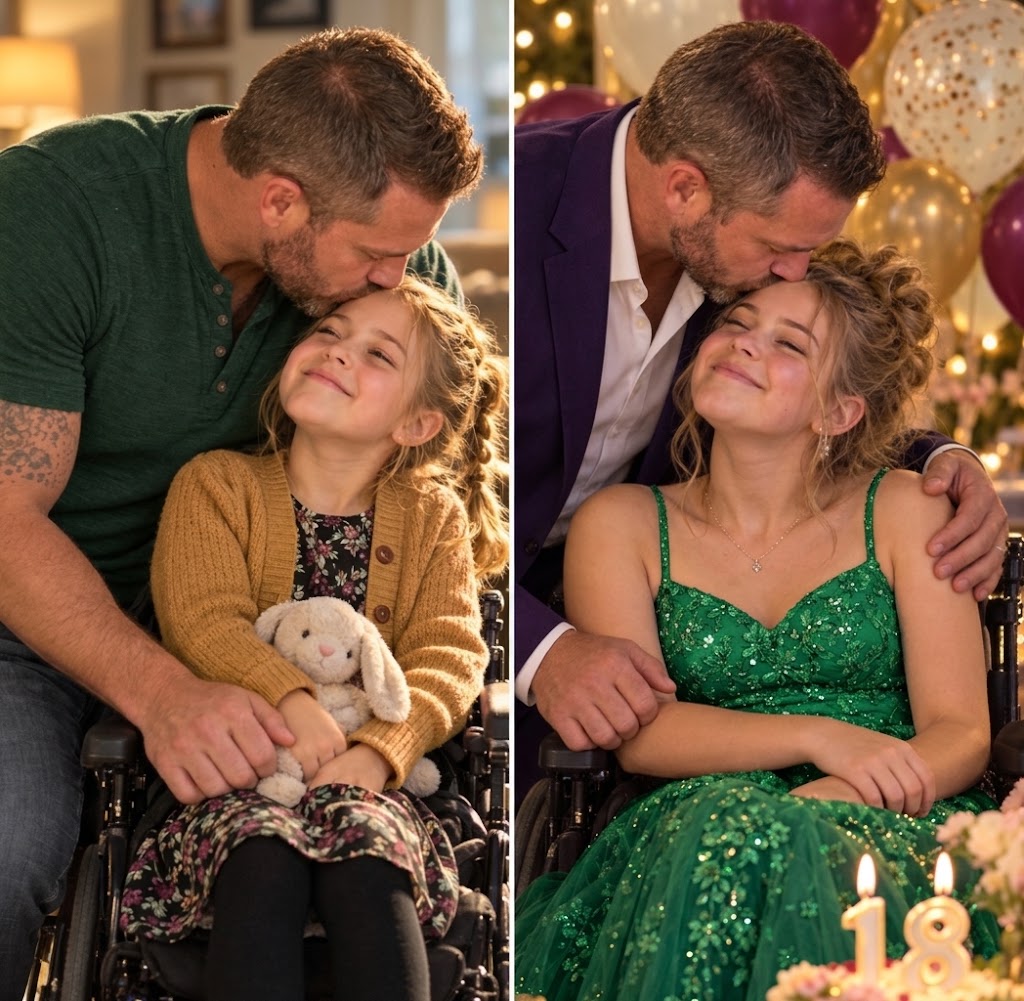
PART 1 — THE MOTHER WHO LEFT AND THE FATHER WHO SACRIFICED EVERYTHING
The instant my mother walked into my eighteenth birthday celebration, the smile disappeared from my father’s face.
Just moments before, he had been laughing with his coworkers, balancing a plate of cake in one hand and sharing one of his famously awful jokes. But the moment he noticed the woman standing in our doorway with a bouquet of flowers, his entire expression shifted.
“Rachel?” he murmured.
“Hello, Daniel.”
Eleven years had gone by since they had last been face-to-face.
Eleven years since she had abandoned us.
I reached over and took Dad’s hand.
“I invited her,” I told him quietly.
He glanced at me before looking back at her. Questions filled his eyes, mixed with an old pain I had never fully understood.
Yet he didn’t protest.
He simply gave my hand a gentle squeeze and said, “It’s your birthday, Bug.”
That was the kind of father he was.
Even when his own heart was hurting, he always found a way to put my happiness ahead of his.
What he couldn’t imagine was that I had spent months organizing a surprise that would transform his life forever.
And I had no idea that my mother’s return had nothing to do with the reason I desperately hoped it did.
To understand what unfolded that evening, we need to return to eleven years earlier.
Back to the day I was seven, lying in a hospital bed while listening to my parents arguing outside my room.
The accident happened so unexpectedly that it felt as though my childhood had been split into two different worlds.
There was the world before it happened, when I raced across playgrounds, climbed trees, and grumbled whenever Dad asked me to help clean the car.
Then there was everything that came afterward.
Hospital hallways, endless medical appointments, unfamiliar machines, and a wheelchair I had yet to learn how to navigate.
The doctors told us that my spinal injuries had left me paralyzed from the waist down. They couldn’t guarantee that I would ever walk again.
At seven years old, I couldn’t completely grasp what those words meant.
All I understood was that I could no longer feel my legs as I once had.
And I was terrified.
One afternoon, while I lay staring at the blanket covering my knees, I heard my mother’s voice coming from the hallway.
“She’ll need assistance with everything, Daniel. For the rest of her life. I can’t go on living this way.”
I froze, barely daring to breathe.
Dad responded in a quiet voice.
“She’s our daughter, Rachel.”
“I know what she is.”
Those five words wounded me more deeply than anything the doctors had said.
I know what she is.
Not who I was.
What I was.
As if the accident had transformed me from her little girl into something else entirely.
I waited, hoping Dad might agree with her.
Instead, his voice grew stronger.
“Emma is still Emma. She needs us more than ever right now.”
My mother replied with something I couldn’t make out.
Then everything went quiet.
By the following morning, she had disappeared.
No farewell.
No promise to return.
No explanation that a seven-year-old could possibly understand.
I continued waiting for her to walk through the door carrying my favorite stuffed rabbit, smiling as she explained that she had only stepped outside for a little while.
But she never returned.
That evening, Dad brought a chair over to my hospital bed and sat beside me.
He looked exhausted, and I noticed he had been wearing the same shirt for two days.
He reached for my hand.
“We’ll work this out together, Bug.”
That was what he always called me.
He had started using the nickname when I was a toddler because I was constantly crawling into places I wasn’t supposed to explore.
I looked up at him.
“Even walking?”
For a few seconds, he couldn’t find an answer.
Tears began gathering in his eyes.
“Maybe that’s something we won’t be able to fix, sweetheart,” he replied softly. “But everything else? The difficult days, the frightening moments, all the things we haven’t figured out yet? We’ll get through them together.”
“Promise?”
He gently tightened his fingers around mine.
“I promise.”
And unlike my mother, Dad never broke that promise.
For illustrative purposes only
Before the accident, my father had been on the verge of achieving one of his biggest dreams.
He worked as a mechanic and loved automobiles almost as much as he enjoyed embarrassing me with his ridiculous jokes.
Mr. Harris, who owned the garage where Dad worked, had offered him the opportunity to purchase the business.
Dad had been putting money aside for years.
He even kept a photograph of the garage tucked away inside his toolbox.
On some Sunday afternoons, he would take it out and tell me how incredible it would feel to own a place of his own.
One day, he hoped his name would hang above the entrance.
Then my accident happened.
The hospital expenses.
The wheelchair.
The access ramp we needed at our front door.
The bathroom renovations.
The medical equipment that our insurance wouldn’t cover completely.
Little by little, every dollar Dad had saved was spent.
I remember finding him alone at the kitchen table, staring at the bills scattered in front of him.
He hadn’t realized I was watching.
For a few moments, he rested his forehead against his hands. Then, when he noticed me, he quickly sat upright.
“Hey, Bug. Want to help me repair something?”
“What is it?”
“That ramp. I think we can make the surface a little smoother.”
I nodded enthusiastically.
He smiled at me.
And just like that, he pushed his own troubles aside.
Dad never brought up buying the garage again.
Instead, he began accepting additional shifts at work.
Before long, he was managing three separate jobs.
Some evenings, he returned home so exhausted that he could barely pull off his boots.
Even then, he always came to check on me.
Sometimes, he sat beside my bed and read me a story.
Other nights, he would drift off in the middle of a sentence, the book still lying open in his hands.
I would carefully place a blanket over his shoulders without waking him.
In our own small ways, we learned to look after each other.
But Dad did much more than help me adapt to using a wheelchair.
He found ways to make my new life more joyful.
When I complained that my wheelchair looked dull, he painted bright yellow suns onto its wheels.
When I struggled to reach the books I loved, he designed a small attachment that I could operate with a pink butterfly-shaped button.
“Every princess deserves a pair of wings,” he announced proudly.
“Dad, you’re making me look ridiculous!”
“That’s part of the job.”
He also constructed a hidden compartment underneath my seat where I could store stickers, little toys, and anything I wanted to keep away from other people’s hands.
Whenever I outgrew a wheelchair, he transferred the compartment to the replacement.
On my first birthday after the accident, I opened it and discovered a folded note.
Dear Bug,
You turn every day of my life into an adventure. Never forget how much joy being your father brings me.
The next year, he wrote another note.
He continued writing one every year after that.
I saved every single one.
However, the invention that would eventually transform our lives began with something far less sentimental.
It started with an unusual little red lever Dad attached to my wheelchair.
The device helped adjust part of the chair’s support whenever I traveled across uneven pavement.
It wasn’t particularly attractive.
It squeaked.
Sometimes, it jammed.
Dad had also fastened a tiny brass bell beside it.
“I’m not a bicycle!” I protested.
“Then quit ringing that bell at me.”
He laughed every time.
Years later, I learned that he had added the bell because he worried I might need assistance when he was too far away to hear me calling.
That was Dad.
He couldn’t always repair everything that was wrong with the world.
But he never stopped searching for ways to make life easier for me.
Without realizing it, he had also awakened something inside me.
Curiosity.
Perseverance.
A passion for transforming broken objects into things that could be useful.
By the age of eleven, I was dismantling old radios.
At thirteen, I could fix household appliances Dad brought home from work.
And when I turned fourteen, I began examining the unusual red lever attached to my wheelchair.
One afternoon, I spent nearly an hour studying it.
Eventually, a question popped into my head.
What if a wheelchair could adapt to uneven surfaces automatically?
What if people like me didn’t have to struggle whenever they encountered a bump, crack, or sloping path?
I had no idea whether such a thing was possible.
I didn’t know how to get started.
But when I shared the idea with Dad, he smiled, placed a screwdriver in my hand, and said something that would influence the rest of my life.
“Then let’s figure it out, Bug.”
Neither of us understood that his simple red lever would eventually inspire an invention worth millions.
And neither of us could have imagined that the success it brought me would expose the real reason my mother had finally decided to return.
PART 2 — THE SECRET I HID FROM DAD FOR YEARS
By the time I turned fifteen, our backyard shed had transformed into something far more complicated than a storage space for gardening equipment.
It had become a small engineering workshop.
Old motors were piled beneath the workbench, loose cables dangled from hooks, plastic containers overflowed with screws, and unfinished experiments occupied nearly every available surface.
Dad had constructed the workbench especially for me.
He had even lowered one section so I could work comfortably from my wheelchair.
“Every brilliant inventor needs a headquarters,” he announced.
I surveyed the dusty walls.
“This place doesn’t exactly look like a famous research facility.”
He shrugged.
“Neither did the places where plenty of brilliant ideas were born.”
I laughed.
He remained serious.
“I’m not joking, Emma. Don’t let the things you lack prevent you from making the most of what you have.”
Whenever an experiment failed, I remembered those words.
And in the beginning, failures were practically unavoidable.
My earliest attempts to improve Dad’s wheelchair lever were disastrous.
One design adjusted far too slowly.
Another responded to movements it wasn’t supposed to detect.
One prototype produced such a frightening grinding sound that Dad rushed into the shed, certain I had damaged something expensive.
“Is everything all right?”
I stared at the malfunctioning device.
“No.”
He inspected it carefully.
“What went wrong?”
“It doesn’t work.”
He examined the wiring before turning toward me.
“All right, what have we learned?”
“That I’m terrible at engineering.”
“Absolutely not.”
He set a screwdriver down beside my hand.
“We’ve discovered one approach that doesn’t work.”
It was one of his favorite expressions.
I heard it after faulty circuits, unsuccessful experiments, and science competitions where my inventions failed to perform the way I had expected.
Somehow, his words always gave me the courage to try again.
My science teacher, Ms. Bennett, also became an important influence in my life.
She noticed my enthusiasm for electronics and began sharing articles, textbooks, and details about engineering programs with me.
When I presented my first serious wheelchair design, she leaned over the workbench and examined it closely.
“Emma, have you considered taking this beyond a school assignment?”
I gave an uneasy laugh.
“It barely functions.”
“That isn’t what I asked you.”
She meant every word.
And something inside me changed.
For the first time, I let myself picture my invention helping people other than myself.
People who struggled to travel along uneven sidewalks.
People living in communities where accessibility was rarely treated as a priority.
People who wanted greater freedom of movement without constantly depending on someone else for assistance.
The possibility thrilled me.
But it also scared me.
Because turning dreams into reality required money.
And Dad had already spent so much trying to make mine possible.
When I was younger, he gave me a used laptop for Christmas.
It wasn’t new, and it certainly wasn’t fast.
Its battery barely lasted, and a scratch marked one of its corners.
Nevertheless, I thought it was the most incredible gift imaginable.
At last, I could properly study programming.
I could explore sensors and motors.
I could sketch designs and experiment with my ideas without having to borrow a computer from school.
That Christmas, I wrapped my arms around Dad so tightly that he burst out laughing.
“Easy, Bug. You’re going to crack my ribs.”
For illustrative purposes only
A few weeks later, I noticed that something was missing from our garage.
His motorcycle.
Dad had treasured that bike for years.
Every Sunday, regardless of how exhausted he felt, he would polish it.
Sometimes, he would take it out for a quick ride and return with a smile I rarely saw after a demanding week at work.
But now, the spot where he normally parked it was empty.
“Dad, what happened to your motorcycle?”
Without looking up from the engine he was repairing, he answered.
“I sold it.”
I stared at him in disbelief.
“You did what?”
“Sold it. I didn’t really need it anymore.”
“But you loved that bike.”
He shrugged.
“Couldn’t teach me anything new.”
I glanced toward the laptop on my desk.
Then I looked at the electronic parts he had recently purchased for my experiments.
Suddenly, everything became clear.
He had given up one of the few possessions that was entirely his so I could have better opportunities.
That evening, I found him sitting in the kitchen.
“You didn’t need to do that.”
He looked at me, puzzled.
“Do what?”
“Sell your motorcycle because of me.”
He placed his coffee cup on the table.
“Emma.”
“You spent years working for that bike.”
He offered me a gentle smile.
“Sweetheart, I enjoyed plenty of wonderful years with that motorcycle.”
“But—”
“Now, let’s see what you can accomplish with that computer.”
I wanted to protest.
Instead, I made a promise to myself.
Someday, I would find a way to repay him for at least a small part of everything he had done for me.
When I was seventeen, after countless unsuccessful experiments, I finally created a working prototype of my adaptive wheelchair system.
It combined sensors with an adjustable support mechanism that responded to uneven surfaces.
The original concept had grown out of Dad’s little red lever.
But now, the system could make those adjustments automatically.
When I demonstrated the prototype to Ms. Bennett, she covered her mouth in astonishment.
“Emma…”
I looked at her anxiously.
“Is something wrong?”
She shook her head.
“No. I think something might be wonderfully right.”
She helped me get in touch with professionals working in mobility technology.
Before long, a company specializing in assistive devices expressed interest in my design.
Meetings followed.
Technical evaluations.
Additional testing.
Lengthy discussions about developing the system for broader use.
Eventually, a lawyer helped me understand the licensing contract the company proposed.
Since I was still seventeen, we made arrangements to complete the agreement after my eighteenth birthday.
When I read the financial terms, I assumed I had misunderstood something.
The initial licensing payment alone would amount to millions of dollars.
I sat staring at the documents for a long time.
Then I began to cry.
Not because I was suddenly dreaming of designer clothes or a luxurious home.
I cried because I understood what that money could finally make possible.
Years earlier, I had discovered the old photograph Dad kept inside his toolbox.
It showed Mr. Harris’s garage.
Written on the back in Dad’s handwriting were four simple words.
Someday, it will be mine.
When I was fifteen, I finally gathered the courage to ask Mr. Harris about it.
He sighed.
“Your dad came very close, Emma. He really did.”
“What stopped him?”
Mr. Harris looked at me sympathetically.
“You already know what happened.”
I lowered my gaze.
Then he quickly added, “But he never complained about it. He simply stopped talking about buying the place.”
I carried that conversation with me.
Now, two years later, I finally had the opportunity to change things.
Before the licensing money had even been officially finalized, I approached Mr. Harris in private.
He was getting ready to retire.
When I explained my intentions, his eyes filled with tears.
“You’re serious about this?”
“Absolutely.”
“Does Daniel know?”
I shook my head.
“Not a word. I want it to be a surprise.”
Mr. Harris smiled.
“In that case, we’d better keep this between us.”
With Ms. Bennett’s assistance, I organized the necessary paperwork.
Not long after my eighteenth birthday, the licensing contract was signed, and the payment arrived.
Just before my birthday party, I finalized the purchase of Mr. Harris’s garage.
Dad knew nothing about it.
He assumed I was simply busy working on my projects.
He had no idea about the millions of dollars.
He knew nothing about the garage.
And there was one more secret I was struggling to share with him.
A research institute in another city had offered me a place.
I had accepted their offer.
It was the kind of opportunity I had spent years working toward.
Yet after eleven years of watching Dad sacrifice his own ambitions to support mine, the thought of moving away made my stomach tighten.
Would he feel as though I had abandoned him?
Would he return home to an empty house and relive the memory of the day Mom walked out?
I couldn’t stand the thought of putting him through that.
So I kept postponing the conversation.
I was still trying to figure out how to tell him when something happened that unsettled me even more.
Three weeks before my birthday party, a message arrived from an unfamiliar number.
Emma, it’s Mom.
My heart seemed to freeze.
I know I have no right to expect a reply. But I’ve spent years wishing I could tell you how sorry I am.
I read the message six times.
Eleven years.
Not one phone call.
Not one letter.
Not even a birthday card.
And now, without warning, she wanted to speak to me.
My fingers shook as I typed my response.
Why now?
Her reply appeared almost immediately.
Because I’ve been a coward for far too long.
I wanted to block her out.
I wanted to demand answers about where she had been when I needed help learning to use my wheelchair.
Where she had been during painful medical appointments, school performances, and birthday celebrations.
Where she had been when Dad was so exhausted from working endless hours that he fell asleep at the kitchen table.
But another part of me remained that frightened seven-year-old girl.
The little girl who was still waiting for her mother to come home.
So I decided to respond.
Initially, our conversations were brief and awkward.
Gradually, however, they became longer.
She recalled the bedtime tales she used to tell me.
She remembered how much I enjoyed wearing socks that didn’t match.
She even remembered the toys I had loved as a little girl.
When I started telling her about school, she began to cry.
“I’ve missed so much,” she whispered.
“You missed all of it,” I replied.
“I know, sweetheart.”
Hearing her say that word almost shattered my heart.
I told her about Dad, our small home, and my growing passion for engineering.
But I kept the company a secret.
I said nothing about the licensing contract.
And I didn’t mention the millions of dollars.
I wanted to believe she had returned because she missed her daughter.
Not because I had achieved something remarkable.
Eventually, I asked her to come to my eighteenth birthday party.
“Are you certain?” she asked.
“No,” I confessed. “But I want to give this a chance.”
I kept the invitation from Dad.
I knew it would hurt him.
Still, I imagined the three of us sitting together once more, perhaps discovering a way to mend the damage left behind eleven years ago.
I had arranged the perfect present for the father who had never abandoned me.
And I hoped my mother’s appearance might offer us a second gift: the chance to become a family again.
Then, shortly before the celebration, Mom sent me another message.
“I can’t wait to see what you’ve accomplished with your life, Emma.”
At that moment, I believed her words came from a place of love.
I had no idea how differently I would interpret them before my birthday ended.
PART 3 — THE BIRTHDAY GIFT THAT LEFT MY FATHER IN TEARS
My eighteenth birthday celebration was held approximately a month after my actual birthday.
By that point, I had taken care of the major arrangements.
The garage was mine, ready to be handed over to Dad.
The licensing contract had been completed.
Ms. Bennett had helped me put together a brief video showcasing my adaptive wheelchair system.
Mr. Harris had promised to attend with the ownership paperwork.
Everything seemed perfectly arranged.
Or so I believed.
I had devoted so much energy to planning Dad’s surprise that I had barely considered how he might react to seeing my mother again.
That Saturday afternoon, our modest home filled with guests.
Our neighbors brought dishes to share.
Dad’s coworkers showed up with presents and homemade treats.
A few relatives traveled from other towns.
Ms. Bennett arrived early to help me prepare the presentation.
Mr. Harris also came, carrying a neatly sealed envelope.
Dad surveyed the crowded living room.
“Emma, what in the world is happening here?”
I grinned.
“My birthday party.”
He glanced at the decorations.
Then he looked at the growing crowd.
“Bug, this is a birthday celebration, not a wedding.”
“Just relax and enjoy it, Dad.”
He shook his head.
But I could see how pleased he was.
He loved seeing me surrounded by people who genuinely cared about me.
For years, he had worried that my disability would make life more difficult.
Now, our little house was overflowing with proof that my future could include meaningful friendships, exciting opportunities, and people who believed in my abilities.
Then the doorbell rang.
And everything changed.
My mother was standing outside, holding a bouquet of flowers.
She looked older than I remembered.
Fine lines had appeared around her eyes, and nervousness showed on her face.
For several seconds, neither of us said anything.
“Emma?”
I nodded.
She moved closer and embraced me.
I had imagined that reunion hundreds of times throughout the years.
I thought I might feel furious.
Perhaps relieved.
Or maybe strangely numb.
Instead, I felt like that little girl all over again.
The child who had spent years hoping her mother would return.
I wrapped my arms around her.
Then Dad’s voice came from behind me.
“Rachel?”
She let go of me.
“Hello, Daniel.”
The color drained from his face.
I immediately reached for his hand.
“Dad, I asked her to come.”
He looked down at me.
I could almost hear all the questions he was too considerate to ask in front of our guests.
Why hadn’t you told me?
How long have you two been speaking?
Why would you bring her back into our lives?
But he simply nodded.
“It’s your birthday, Bug.”
He stepped aside and allowed her to come inside.
And somehow, that made me love him even more.
Even so, the mood in the house shifted.
Dad barely spoke during dinner.
Mom repeatedly glanced in his direction.
At one point, I caught him staring at his plate, hardly eating anything.
A wave of guilt washed over me.
I had wanted to give him the most wonderful evening of his life.
Instead, without warning, I had brought back a painful chapter from his past.
I convinced myself that everything would feel better once I revealed the surprise.
I was only partly correct.
After dinner, Dad stood up to make a toast.
Speaking in front of a crowd had never been his strength.
He cleared his throat twice before beginning.
“Well, public speaking has never exactly been my thing.”
Several of his coworkers chuckled.
He turned toward me.
“But I’ve had eighteen years’ worth of reasons to feel proud.”
His voice grew gentler.
“Emma, you are the greatest blessing life has ever given me.”
I felt tears gathering in my eyes.
He smiled.
“Even if you’ve turned that shed into a place where I’m scared to touch anything.”
The room erupted in laughter.
“Happy birthday, Bug.”
I raised my glass.
“Thank you, Dad.”
Then I reached for the microphone Ms. Bennett had prepared.
“But I have a few words I’d like to share tonight, too.”
Dad looked startled.
I wheeled myself toward the middle of the living room.
For a moment, I struggled to find my voice.
I looked down at his hands.
The hands that had repaired thousands of engines.
The hands that had built ramps, adapted wheelchairs, and worked exhausting hours to support us.
The hands that had never been too tired to hold mine whenever I felt afraid.
“Most of you know my dad as a mechanic,” I began. “But I’ve always known him as an inventor.”
Dad smiled.
I continued.
“When I was seven, everything in my life changed. Suddenly, there were so many things I couldn’t do the way I once had.”
I glanced at Mom.
She lowered her gaze.
“But Dad never allowed me to think my life was over. Instead, he kept discovering new ways to help me continue doing the things I loved.”
I told everyone about the bright yellow suns he’d painted on my wheelchair.
The butterfly-shaped button.
The secret compartment.
And that ridiculous little brass bell.
Dad laughed as tears ran down his face.
“I still say that bell was a work of genius!” he called out.
The guests laughed along with him.
Then I reached beneath the table and brought out a small red object.
The original lever.
“Dad, do you remember this?”
He narrowed his eyes at it.
“Oh, goodness. That’s the ugliest thing I’ve ever built.”
Everyone laughed again.
I raised the lever for the room to see.
“Actually, Dad, this is where it all began.”
Ms. Bennett lowered the lights.
The television screen flickered to life.
A video appeared, showing my adaptive wheelchair system adjusting its support automatically as it traveled over uneven pavement.
Dad leaned forward in his chair.
For several seconds, he remained completely still, watching the screen.
Then he turned toward me.
“Emma… did you make that?”
I nodded.
“I designed it.”
His eyes returned to the television.
“But how?”
I smiled through my tears.
“Because you taught me to keep trying.”
I explained how his original lever had inspired the design.
How Ms. Bennett had helped me find the resources I needed.
How the company had evaluated my invention and eventually offered a licensing agreement.
When I explained that the technology might eventually benefit other wheelchair users, Dad covered his mouth with one hand.
Tears streamed freely down his face.
“Bug,” he whispered. “You really did that?”
“We did it, Dad.”
“No,” he replied quietly. “You did.”
I shook my head.
“If you hadn’t created that lever, I never would have started any of this.”
Then I took a deep breath.
“And there’s one more thing.”
Mr. Harris walked forward.
He placed the envelope in my hands.
Dad looked confused.
“What is happening?”
For illustrative purposes only
I opened the envelope and took out the old photograph of the garage.
Dad recognized it immediately.
His expression shifted.
“Where did you find that?”
“In your toolbox.”
He looked embarrassed.
“Emma…”
I turned the photograph around.
On its back were the four words he had written so many years ago.
Someday, it’ll be mine.
Then I placed the ownership documents into his hands.
“Dad, that someday has finally arrived.”
He stared down at the papers.
I swallowed nervously.
“I bought the garage for you.”
The room fell silent.
Dad remained motionless.
“The garage?” he finally whispered.
I nodded.
“Mr. Harris is retiring. The business belongs to you now.”
Dad turned toward him.
“Is she telling the truth?”
Mr. Harris smiled through his tears.
“Every single brick, Daniel.”
Dad lowered himself beside my wheelchair.
He wrapped his arms around me and held me so tightly that I could hardly breathe.
For a long time, neither of us said a word.
Eventually, he whispered, “You remembered?”
I pressed my face against his shoulder.
“You remembered every dream I’ve ever had, Dad. How could I forget the one dream you had?”
Applause filled the room.
Several people were crying.
Ms. Bennett dabbed at her eyes.
Even Dad’s coworkers looked deeply moved.
For the first time in years, that photograph of the garage no longer symbolized a dream he had been forced to surrender.
It represented a future he could finally claim.
I thought nothing could make that evening more memorable.
I was mistaken.
While everyone gathered around Dad to congratulate him, Mom came over to me.
“Emma, I’m so proud of you,” she said softly.
I offered her an uncertain smile.
“Thank you.”
“Would you mind taking a picture with me?”
I hesitated before nodding.
She handed me her unlocked phone and leaned closer to my wheelchair.
I opened the camera.
Then a notification appeared at the top of the screen.
It was from someone named Linda.
Normally, I wouldn’t have paid much attention to it.
But the first line included my name.
Rachel, did you manage to see Emma? Did she tell you about the deal? Call me when you get a chance.
My smile disappeared.
I stared at the message.
Did she tell you about the deal?
My heart began racing.
“Mom?”
She turned toward me.
“What happened?”
“Who is Linda?”
For a brief moment, her expression changed.
“She’s an old friend.”
I looked back at the message.
“Does she work for the company that licensed my invention?”
Mom paused.
Then she nodded.
“Yes.”
Suddenly, the room felt unbearably hot.
“Did she tell you about my invention?”
Mom swallowed nervously.
“Emma, sweetheart…”
“Before you got in touch with me?”
She glanced away.
“Yes,” she admitted quietly.
A chill spread through my chest.
“Did she tell you about the money, too?”
Mom said nothing.
As I watched her turn her face away, I realized the question was no longer whether she had known about my success.
The real question was whether she would ever have come back if I hadn’t achieved anything extraordinary.
Then she spoke, and her words sent my entire childhood crashing back into my mind.
“Emma, please. You need to understand why I reached out to you now.”
PART 4 — THE TRUTH THAT SHATTERED MY HEART AND THE FATHER WHO HELPED HEAL IT
For several seconds, I could hear nothing except the pounding of my heart.
Around us, the other guests continued admiring the video of my invention and congratulating Dad on becoming the owner of his new garage.
Laughter came from the kitchen.
Someone was cutting another piece of birthday cake.
This was supposed to be the happiest evening of my life.
Instead, I was looking at the woman who had disappeared when I was seven, wondering whether her return had brought another betrayal into my life.
I met her eyes.
“You knew about the licensing agreement before you contacted me.”
She lowered her voice.
“Linda mentioned that your invention was receiving a great deal of attention.”
“And the money?”
Mom let out a sigh.
“She told me you had done very well.”
I felt nauseated.
Three weeks of messages.
Conversations about my childhood.
Apologies.
Tears.
The way she had started calling me sweetheart again.
I had convinced myself that all those things meant she had missed me.
Now, I no longer knew what to believe.
“Would you have contacted me if Linda hadn’t told you?”
Mom looked away.
I waited for her response.
“Please, just answer the question.”
She adjusted the bouquet she had brought, even though it was already arranged neatly in a vase.
“Emma, the situation is more complicated than you realize.”
“No,” I whispered. “It’s a straightforward question.”
Her silence gave me the answer I feared.
For eleven years, I had imagined what it would be like if my mother returned.
Sometimes, I pictured her knocking on our front door.
Other times, I imagined unexpectedly running into her at a supermarket.
In those childhood fantasies, she would tell me she had regretted leaving every single day.
She would admit that fear had overwhelmed her and that she had made a terrible mistake.
She would promise that she had never stopped loving me.
And at last, I would no longer have to wonder why she had abandoned me.
Now, she was standing right in front of me.
And all I could think about was that notification.
Did she tell you about the deal?
Mom placed a hand on my shoulder.
“Emma, whatever Linda told me, I truly wanted to rebuild our relationship.”
I shifted away from her touch.
“Then why didn’t you come back when I was eight?”
She blinked in surprise.
“What about when I was nine? Or twelve? Where were you when I returned to school? Why weren’t you there for my first science competition?”
Her eyes filled with tears.
“I was ashamed.”
I swallowed hard.
“Did you know Dad was working three jobs?”
She remained silent.
“Did you know he sold his motorcycle so I could have a computer?”
“Emma…”
“Did you know he stayed awake worrying about me, even when he was so exhausted he could barely remain standing?”
Tears began rolling down her cheeks.
“Please don’t do this in front of everybody.”
Her words brought me to a sudden stop.
Even now, she seemed more worried about the people around us than the daughter standing before her.
And just like that, my mind returned to the hospital.
The blanket covering my legs.
The voices outside my room.
The words I had carried inside me for eleven long years.
“I heard you.”
Mom frowned.
“What?”
“That day at the hospital.”
She stared at me in disbelief.
I forced myself to continue.
“I wasn’t asleep.”
The color drained from her face.
“I heard you tell Dad that I’d be a burden for the rest of your lives.”
Dad had approached us while we were talking.
Now he stopped beside my wheelchair.
“Emma?”
I lifted my eyes toward him.
“I heard everything, Dad.”
His eyes immediately filled with tears.
“You heard that conversation?”
I nodded.
For years, I had buried that memory deep inside me.
Partly because I didn’t want him to blame himself.
Partly because speaking about it would force me to experience that pain all over again.
“I used to believe,” I whispered, “that maybe if I became clever enough or successful enough, she would finally decide I was worth coming back for.”
Dad knelt beside my chair.
“Oh, Bug.”
His voice cracked.
“You thought you had to prove that you deserved to be loved?”
I couldn’t respond.
Because that was exactly what I had believed.
Every science competition.
Every difficult experiment.
Every achievement.
I had always told myself I pursued engineering because I loved it.
And I truly did.
But somewhere deep inside, I had also been trying to prove my mother wrong.
I wanted to show her that I wasn’t a burden.
I wanted to become someone she could feel proud of.
Someone she would never abandon.
Dad held both of my hands in his.
“Emma, look at me. You were deserving of love long before you ever created anything.”
Tears streamed down my cheeks.
“Do you understand?”
I nodded, but the crying wouldn’t stop.
Mom stepped closer.
“I was scared,” she whispered. “I said something terrible, and I’ve regretted it ever since.”
I looked at her.
“But you walked away anyway.”
She shut her eyes.
“And you never came back.”
“I know.”
“Eleven whole years, Mom.”
Her sobs grew more intense.
For a moment, I thought we might finally have an honest conversation.
Perhaps she would acknowledge that she had returned after discovering my financial success and ask whether there was any possibility of rebuilding our relationship without pretending those eleven years had never happened.
Instead, she said something that revealed everything.
“I understand that I don’t deserve your forgiveness. But now that your life is going so well, perhaps we could do something for each other.”
I stared at her in disbelief.
“Do something for each other?”
She paused.
Then her eyes shifted toward the garage paperwork Dad was still holding.
“You’ve purchased an entire business for your father, Emma. I thought you might be willing to help me as well.”
For several seconds, I couldn’t find my voice.
I had spent eleven years longing for my mother to return.
She had finally appeared after learning that I had money.
And now she wanted a share of it.
“I wanted my mother back,” I whispered. “I didn’t want someone I would have to pay to keep around.”
Her expression became slightly defensive.
“Your father isn’t the only parent you have, Emma.”
Dad rose to his feet.
“Rachel. That’s enough.”
Several people turned in our direction.
Gradually, the room fell silent.
I could feel everyone’s attention focused on me.
Normally, I would have wanted to hide from their stares.
But not this time.
I reached for the microphone.
My hands shook, yet my voice remained firm.
“There’s one more thing I want to say.”
Nobody interrupted.
I looked around the room.
“Eleven years ago, an accident changed my life. I lost the ability to walk, and it changed my family, too.”
I turned toward Mom.
“She believed looking after me would be more than she could handle.”
She lowered her head.
“But my father never made me feel that I was too difficult to love.”
Dad gently shook his head.
I continued.
“He abandoned his dream of owning a garage. He sold things that mattered to him. He worked until his hands were cracked, sore, and exhausted.”
My voice began to break.
“Sometimes, he came home so tired that he could hardly keep his eyes open.”
I raised the original red lever.
“But he still made time to create things that improved my life.”
I looked down at the little device.
“My invention began with him. He wasn’t trying to become wealthy or famous. He simply wanted his daughter to have greater independence.”
Dad wiped away his tears.
I turned toward Mom.
“For eleven years, I believed I needed to become smart enough, successful enough, and extraordinary enough to earn your love.”
She started to speak.
I gently shook my head.
“But tonight, I’ve finally realized something.”
I looked at Dad.
“The person who loved me most never expected me to be extraordinary.”
The entire room fell quiet.
“He loved me when I couldn’t walk. He loved me when my experiments failed. He loved me when I was frightened, frustrated, angry, and certain that I wasn’t good enough.”
I drew a trembling breath.
“And even if my invention had never earned me a single dollar, he’d still be standing right here beside me.”
Dad stepped closer.
I smiled through my tears.
“That is what love should feel like.”
For several moments, everyone remained still.
Then one person began clapping.
Soon, others joined in.
But the applause barely registered with me.
My attention remained on Dad.
He was looking at me with the same expression he’d worn years ago when I proudly showed him a radio I had managed to repair.
The same quiet satisfaction.
The same unwavering love.
Mom left not long afterward.
I didn’t try to stop her.
For the first time, I felt no need to run after her.
Later that evening, after everyone had departed and our house had finally become quiet, Dad sat beside me in the living room.
The ownership documents for the garage were resting on the coffee table.
The old photograph lay on top of them.
I turned toward him.
“I’m sorry I didn’t tell you she was coming.”
He remained silent for a moment.
Then he nodded.
“I wish you’d told me.”
“I know.”
“But I can understand why you wanted her here.”
I lowered my eyes.
“I thought maybe we could be a family again.”
Dad reached over and held my hand.
“There’s nothing wrong with hoping for that, Bug.”
My eyes filled with tears once more.
“I’m sorry you had to witness everything that happened.”
He slowly shook his head.
“I’m sorry you heard those things at the hospital. I never realized you’d been carrying those words inside you for all these years.”
I swallowed.
“I just wanted you to be proud of me.”
He looked at me as though he couldn’t believe what he’d heard.
“Emma, I was proud of you when you first learned to tie your shoes.”
A tearful laugh escaped me.
“And when you repaired the toaster.”
“I nearly electrocuted myself doing that.”
“Still proud.”
We both laughed.
Then his eyes returned to the documents.
“This garage…”
His voice faded.
I smiled.
“It’s yours, Dad.”
He slowly shook his head.
“You didn’t need to do this.”
“You gave up your dream because of me.”
He turned toward me.
“No, sweetheart.”
I waited for him to continue.
He gently squeezed my hand.
“I made a choice. I chose you.”
Those three words settled somewhere deep inside my heart.
For years, I had convinced myself that Dad had lost everything because of my accident.
But he had never considered me the reason his life had been ruined.
He had made his decisions out of love.
And he had never expected me to repay him.
At last, I understood.
For illustrative purposes only
There was still one thing I hadn’t told him.
“Dad?”
“Yeah, Bug?”
“I received an offer from a research institute.”
His face brightened immediately.
“That’s fantastic!”
“It’s located in another city.”
His smile remained.
“And?”
“I accepted their offer.”
He stared at me for a moment.
Then a wide grin slowly spread across his face.
“You accepted?”
I nodded.
“But I was scared to tell you.”
His smile faded slightly.
“Why?”
I looked toward the hallway and the rooms that had been our entire world for eleven years.
“Because you’ll be here alone.”
He fell silent.
“And after Mom left, I kept thinking…”
The words wouldn’t come.
Dad understood what I meant.
He reached toward my wheelchair and gently touched the tiny brass bell he’d attached to it years earlier.
“Emma, I didn’t spend eleven years helping you discover ways to get around so you’d spend the rest of your life staying in one place.”
My eyes filled with tears.
“You aren’t abandoning me by going out and building a life of your own.”
I began to cry.
He did, too.
For a while, we sat together without saying anything.
Then I reached beneath my wheelchair seat and pulled open the little secret compartment Dad had built when I was a child.
Inside were eleven folded birthday letters.
Every single one he’d written since my accident.
Dad looked at them in surprise.
“You kept all of those?”
“Every one.”
I took out a fresh sheet of paper.
This note was meant for him.
Dad,
When I was seven, I believed my world had become smaller and would never grow again.
But throughout the next eleven years, you kept showing me just how much was still possible.
You taught me how to build things, how to keep trying, and how to trust myself.
You gave me much more than a place to live.
You gave me the confidence to discover my own path.
No matter where life takes me, I’ll always have a home wherever you are.
Love, Bug.
Dad read the letter twice.
Then he pulled me into his arms.
And for the first time that night, neither of us had anything else to say.
The following morning, sunshine poured through the kitchen window while Dad prepared breakfast.
He seemed happier than usual.
He was humming to himself.
Rather badly.
I smiled.
“Somebody seems cheerful today.”
He glanced over his shoulder.
“Someone just became the owner of a business.”
I laughed.
He reached for the old photograph of the garage.
For years, he had hidden it inside his toolbox as a reminder of a dream he believed he had lost.
Now he turned it over.
His thumb rested against the word Someday.
Then he looked at me.
“Tomorrow,” he said. “Will you come with me to open the place?”
I grinned.
“There’s nowhere else I’d rather be.”
He smiled.
And as I watched him, I noticed something I hadn’t seen so clearly in years.
It wasn’t exhaustion.
It wasn’t sacrifice.
It was hope.
My mother had left because she believed my future would be a burden.
My father had stayed because he believed my future was worth every effort.
Now, with a garage waiting for him and a research opportunity waiting for me, we were finally ready to move forward into the next chapters of our lives.
But as Dad carefully folded the photograph and slipped it into his pocket, another realization brought tears to my eyes.
For eleven years, he had helped open doors I couldn’t open by myself.
Tomorrow, I would have the privilege of watching him walk through the door to a dream he had once believed was gone forever.
And I couldn’t help wondering what wonderful things we might create together in the years ahead.
Because the man who taught me that broken things could be transformed into something beautiful was finally getting the opportunity to build a dream of his own.