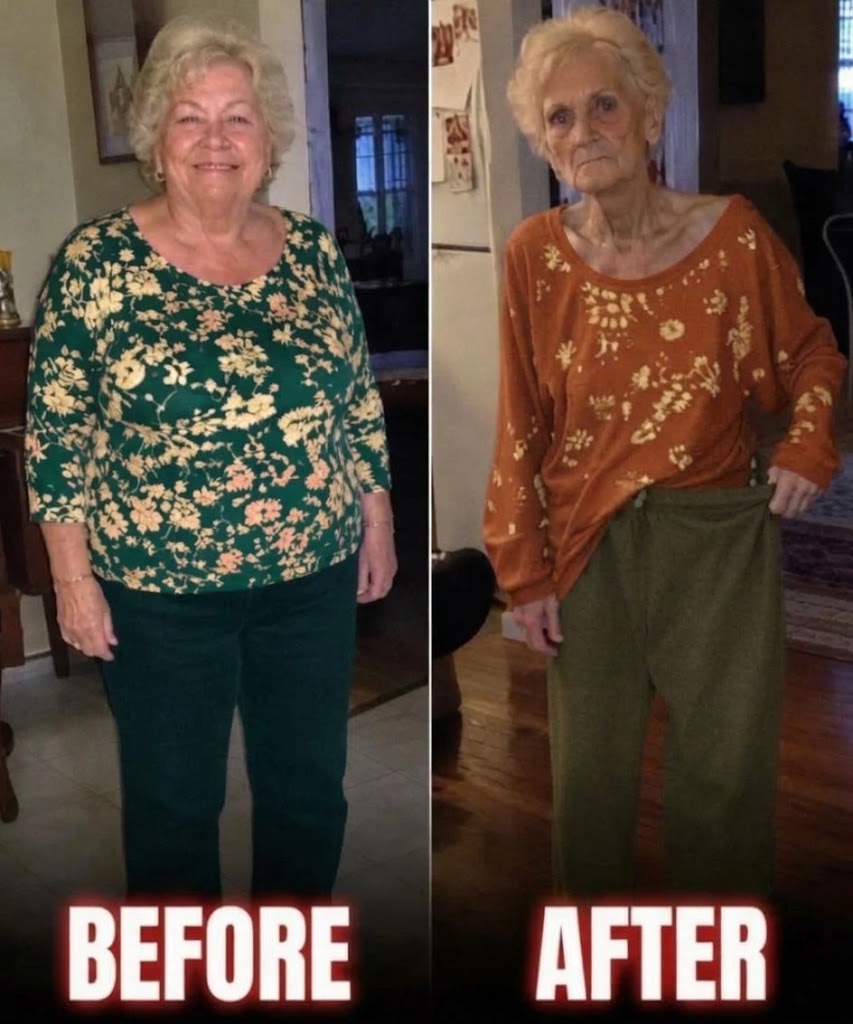
I Could Barely Recognize My 80-Year-Old Mother When I Picked Her Up From the Train Station After a Week Away Visiting an Old Friend.
She had become so thin that her clothes hung loosely from her shoulders, and she was struggling to drag an enormous black suitcase behind her.
“Mom, what happened to you?”
She managed a faint smile. “Nothing, Laura. I’m just tired.”
But I could tell something was seriously wrong. And when I finally opened that strange suitcase, I found a photograph, a child’s sweater, and a secret my mother had hidden from me for almost fifty years.
I nearly walked right past her at the station.
She stood beside a bench, gripping the handle of a large black suitcase. Her gray hair was untidy, her face looked unusually pale, and her familiar cardigan seemed several sizes too big.
“Mom?”
She turned around.
“Hi, sweetheart.”
I hurried toward her.
“Are you feeling okay?”
“Of course, darling. I’m just a little exhausted from the journey.”
But her cheeks were sunken, and even her voice sounded frail.
My mother, Evelyn, had always been cheerful and full of energy. Even at eighty, she loved tending her garden, baking treats, and arranging our Sunday family dinners.
Just seven days earlier, she had left to visit her childhood friend Margaret, whom she said she hadn’t seen in twenty years.
When I dropped her off at the station, she had seemed excited and full of life.
Now she looked utterly drained.
“Mom, are you feeling ill?”
“My stomach’s a little upset. It’s nothing serious.”
“I think you should see a doctor.”
She shook her head.
“Please, Laura. I just want to get home.”
That was when I noticed her luggage.
“What happened to your blue suitcase?”
“Margaret gave me this one. My old one broke.”
She held the handle even more tightly.
“Can we go now?”
I wanted to ask her more, but she seemed too exhausted to carry on a conversation.
I took the suitcase from her.
It was much heavier than I had expected.
As we made our way toward the parking lot, I recalled how enthusiastic Mom had been about her trip.
Margaret lived about three hours away, and the two women had been friends since childhood.
When Mom told me that Margaret’s daughter had invited her to stay for a week, I encouraged her to go.
“You haven’t seen her in ages,” I had told her.
“Twenty years,” Mom had answered.
“Then you should definitely visit her.”
She paused.
“I hate leaving you to handle everything on your own.”
I laughed.
“Mom, I’m fifty-two. I’m pretty sure I can manage one week without your Sunday dinners.”
She smiled and eventually agreed to go.
The following Monday, I drove her to the train station.
She brought her usual small blue travel bag, packed with clothes, medication, and homemade cookies for Margaret.
Before boarding, she gave me a telephone number.
“That’s Margaret’s number, in case you need to get in touch with me.”
I saved it without giving it much thought.
We spoke twice during the week.
On both occasions, Mom assured me she was having a wonderful time.
However, whenever I asked what she and Margaret had been doing, she quickly steered the conversation elsewhere.
At the time, I didn’t think anything of it.
Now, as I watched her struggle to keep pace beside me, I regretted not asking more questions.
When we reached my car, I lifted the black suitcase into the trunk.
It felt far too heavy to contain only a week’s worth of belongings.
“What on earth have you packed in here?” I asked casually.
“Oh, just a few things Margaret asked me to bring back.”
She offered no further explanation.
During the drive home, Mom rested her head against the window and hardly spoke.
I kept checking on her.
Several times, she closed her eyes and seemed to have difficulty staying awake.
When we arrived, she insisted on carrying the suitcase upstairs herself.
But after climbing just two steps, she stopped to catch her breath.
“Mom, please let me carry it.”
She finally gave in.
“Just leave it in my bedroom.”
I carried the suitcase upstairs and set it beside her dresser.
Mom followed me into the room.
Then, as soon as I stepped into the hallway, she shut the door.
A few moments later, I heard the lock click.
I stood there, bewildered.
My mother had never locked her bedroom door in the middle of the day.
That evening, I prepared chicken soup and took a bowl upstairs to her.
She managed only a few spoonfuls.
“Mom, you really should see a doctor.”
“Maybe tomorrow.”
“You look completely worn out.”
“Thank you for such a wonderful compliment, sweetheart.”
She tried to smile.
“I’m not joking.”
“Neither am I. I’m tired, Laura. I just need to rest.”
I took her temperature and urged her to drink some water.
She assured me that a good night’s sleep would help her recover.
Still, something didn’t feel right.
After she went upstairs, I decided to call Margaret.
Perhaps her friend could tell me what had happened during the visit.
I Took Out the Number Mom Had Given Me and Dialed It.
A man answered the phone.
“Hello?”
“Good evening. Could I please speak to Margaret?”
He paused.
“I’m sorry, but Margaret doesn’t live here.”
I frowned.
“Are you certain? Someone gave me this number about a week ago.”
“I’m absolutely certain. I’ve had this number for years.”
“Do you know where she might have moved?”
“No, unfortunately, I don’t.”
I thanked him and hung up.
Then I stared at my phone in confusion.
Why had Mom given me an old telephone number?
Had she simply forgotten it was outdated?
Or had she deliberately wanted to stop me from contacting Margaret?
I tried calling her mobile phone.
I could hear it ringing upstairs.
She didn’t pick up.
I thought about knocking on her bedroom door, but she was clearly exhausted.
Instead, I decided to wait until the following morning.
The next day, I discovered Mom sleeping in her armchair.
She was still wearing the same cardigan she’d had on when she returned by train.
On the little table beside her was a train ticket.
I picked it up.
The date immediately caught my attention.
It was dated three days before I had collected her from the station.
Why had she bought a ticket to return home early?
Underneath it was a luggage tag.
The name printed on it read Ellen.
Not Margaret.
Not Evelyn.
Ellen.
I glanced down the hallway.
Mom’s bedroom door stood open, and the mysterious black suitcase was still beside her dresser.
I hesitated.
I had never felt comfortable rummaging through someone else’s belongings.
But Mom was obviously unwell, and her explanations no longer added up.
Carefully, I carried the suitcase into the hallway and opened it.
Inside, I found several neatly folded outfits, a sealed brown envelope, and an old digital camera.
The Clothes Looked Far Too Large for Mom.
Beneath them was a small yellow sweater that appeared to have belonged to a young child.
Beside it sat a tiny wooden rolling pin.
I picked it up.
Something about it awakened a distant memory.
I remembered seeing one just like it when I was a little girl.
For a moment, I could almost see myself standing beside a kitchen counter, with flour scattered everywhere.
But the memory was so distant that I couldn’t quite identify it.
Next, I examined the camera.
Its battery was almost dead.
Only four pictures were saved on it.
The first showed Mom standing outside a modest brick house.
In the second, she was sitting beside an elderly woman lying in bed.
The third showed a handwritten schedule attached to a refrigerator.
It listed meal times, medication reminders, and instructions for helping someone move around the house safely.
Then I opened the fourth picture.
And suddenly, everything was different.
It was an image of an older printed photograph.
A woman stood outside a small white house, holding the hand of a toddler wearing a yellow sweater.
I recognized the child immediately.
It was me.
I must have been about four years old.
But the woman holding my hand was what truly shocked me.
I knew her face.
“Aunt Maggie,” I whispered.
I hadn’t said that name in decades.
All at once, pieces of my childhood began to return.
A cozy kitchen.
The aroma of freshly baked pies.
A little white house with a porch.
A gentle woman who let me scatter flour over the table.
I remembered calling her Aunt Maggie.
Mom had always described her as an old family friend who moved away when I was young.
I had simply assumed she had died many years ago.
At the bottom of the photograph, someone had written an address.
I recognized the street.
It was in the neighborhood where I had spent countless afternoons as a little girl.
I made sure Mom was resting comfortably, left her a note, and drove across town.
The little white house was still standing.
The porch had been replaced, and the garden looked different, but I recognized the place.
I got out of my car and stared at the front steps.
Memories came rushing back.
I remembered sitting there with a bowl of strawberries.
I remembered someone showing me how to roll pastry dough.
And I remembered feeling completely safe.
I walked up to the front door and knocked.
A middle-aged man answered.
“Can I help you?”
“I’m Sorry to Disturb You. Did a Woman Named Margaret Ever Live in This House?”
He nodded.
“Yes. She owned this place before we did.”
“Do you know where she went?”
He shook his head.
“Sorry, I don’t. That was quite a long time ago.”
I showed him the photograph.
He examined it closely.
“Is that you when you were little?”
“Yes.”
He smiled.
“I wish I could help you track her down.”
I thanked him and walked back to my car.
Then I examined the digital pictures again.
The brick house where Mom had been photographed had a street number that was clearly visible.
I compared it with the address printed on the luggage tag.
They were identical.
The address was roughly three hours away.
That had to be where Mom had spent the week.
And if Margaret was the same woman I had once called Aunt Maggie, I needed to find out why my mother had concealed her identity from me.
When I arrived home, Mom was sitting at the kitchen table with a glass of water.
The black suitcase rested beside her chair.
She raised her eyes toward me.
“You opened it.”
I froze.
“Yes.”
Disappointment crossed her face.
“Laura, those things are private.”
“I understand, Mom, and I’m sorry. But I was worried about you. You came home looking terribly unwell, and none of your explanations make sense.”
“You should have asked me first.”
“I did ask you. More than once.”
She lowered her gaze.
I pulled out a chair and sat opposite her.
“Mom, who is Aunt Maggie?”
Her expression changed instantly.
“Where did you hear that name?”
“I remember her.”
Mom said nothing.
“The woman who taught me to bake. The one who lived in the white house.”
I placed the photograph in front of her.
“Margaret is Aunt Maggie, isn’t she?”
After a long silence, Mom nodded.
“Yes.”
“Why didn’t you ever tell me?”
“I didn’t think you would remember her.”
“Why wouldn’t I remember someone who looked after me?”
Tears began gathering in Mom’s eyes.
“Because you were so little.”
I pushed the photograph closer to her.
“Then please tell me what happened.”
She studied the picture for a long time.
At last, she began to speak.
“Your father had just left us. You were four years old. I was working two jobs, and I had no idea how I was going to make ends meet.”
I knew my father had abandoned us when I was little.
But Mom had seldom spoken about the hardships that came afterward.
She had always made those years sound as though everything had been manageable.
“Margaret lived close by,” she went on. “She offered to watch you while I worked in the evenings.”
I looked at her in disbelief.
“She took care of me?”
Mom nodded.
“Sometimes, you stayed at her house until late at night. On especially difficult evenings, you would sleep there.”
“How long did that go on?”
“Nearly two years.”
I could hardly believe what I was hearing.
Two whole years.
A woman I had barely heard mentioned since childhood had played such a significant part in raising me.
“She prepared your meals,” Mom explained. “She helped you learn your letters, read bedtime stories to you, and taught you how to bake.”
My eyes shifted toward the little rolling pin on the counter.
“Did that belong to me?”
“Yes. Margaret made it especially for you.”
Suddenly, I remembered standing on a chair beside a kitchen counter, proudly pressing the dough flat with that tiny rolling pin.
I had always believed those memories came from our own home.
But they had actually belonged to Margaret’s house.
“Why did she disappear from our lives?” I asked.
Mom clasped her hands together.
“She moved away after her husband found a job in another town.”
“And you stopped keeping in touch?”
“Not immediately.”
“What changed?”
She hesitated.
Then she murmured, “I was ashamed.”
“What were you ashamed of?”
“Of depending on her so much.”
I stared at my mother.
She continued speaking.
“Margaret was incredibly kind to us, Laura. She never complained, asked for money, or expected anything in return. But whenever I left you with her, I felt as though I wasn’t being the mother you deserved.”
“Mom, you were working hard to provide for us.”
“I understand that now.”
Her voice began to shake.
“But at the time, I couldn’t bear the thought that someone else might give you the attention I wasn’t always able to provide.”
“So you slowly pushed her out of our lives?”
“Little by little. I called less frequently. Then I missed a visit. Eventually, so much time went by that I didn’t know how to reach out again.”
I glanced at the photograph.
For most of my life, I had believed my mother had somehow managed those difficult years entirely by herself.
She had allowed me to believe that because she wanted me to remember her as strong and self-reliant.
“Mom,” I said softly, “accepting help didn’t make you a bad mother.”
She brushed away her tears.
“I wish I’d realized that years ago.”
I wanted to ask her more.
But suddenly, Mom leaned forward and grabbed the edge of the table.
“Mom?”
She squeezed her eyes shut.
“I feel lightheaded.”
I rushed to her side.
“That’s it. We’re going to the hospital.”
For once, she didn’t protest.
At the hospital, the doctor examined her and ordered several tests.
Mom was dehydrated and exhausted, and she had lost a considerable amount of weight.
The doctor explained that her loose-fitting clothes and weakened state made the changes in her appearance seem particularly noticeable.
He wanted to keep an eye on her condition and investigate whether other factors might be contributing to her symptoms.
Once she was settled in a hospital bed, I pulled a chair up beside her.
“Mom, please tell me what actually happened at Margaret’s house.”
She let out a weary sigh.
“Margaret hasn’t been doing well.”
“How bad is it?”
“She’d recently come home from the hospital. Ellen needed help looking after her.”
“Ellen is Margaret’s daughter?”
“Yes.”
“Why didn’t you tell me any of this?”
“Because I knew you’d worry.”
I gently squeezed her hand.
“I’m already worried.”
Mom turned her face away.
“Margaret helped me when I needed her most. When Ellen called, I thought it was finally my chance to do something for her.”
She explained that she had expected a peaceful week catching up with an old friend.
Instead, Margaret needed help preparing meals, moving around the house, and managing ordinary daily activities.
Ellen had spent months caring for her mother while trying to keep up with her job.
When Mom arrived, she volunteered to help for a few days.
However, at eighty years old, she hadn’t understood how physically demanding the work would become.
She spent her nights listening for Margaret in case she needed assistance.
During the day, she helped prepare food and manage household responsibilities.
She became so overwhelmed and exhausted that she began missing meals herself.
By the fourth day, her stomach was bothering her, and she could barely bring herself to eat.
“I bought a train ticket to return home early,” Mom confessed.
“The ticket I discovered?”
She nodded.
“But Margaret was having a particularly difficult morning, and Ellen had already left for work. I couldn’t leave her alone.”
“So you missed your train?”
“Yes.”
“And stayed for another three days?”
“I believed I could handle it.”
I stared at her in disbelief.
“Mom, you’re eighty years old.”
She gave me a weak smile.
“Yes, I’m aware.”
“Why didn’t you call me?”
“Because I knew you’d tell me I needed assistance.”
“Because you did need it.”
She looked ashamed.
“I know.”
Mom spent the night in the hospital.
After receiving fluids and getting some rest, she began to feel better.
The doctor scheduled follow-up appointments and stressed that any ongoing weight loss, weakness, or trouble eating would require further medical attention.
When we got home, I carried the black suitcase into the living room.
There was still one thing I couldn’t understand.
“Mom, why did Ellen give you this suitcase?”
She glanced at it.
“Margaret wanted you to have the things inside.”
“Me?”
She nodded.
“She knew I’d see you when I came home. She asked me to bring back some belongings she’d been keeping.”
I lifted the sealed brown envelope.
“What does this contain?”
“Go ahead and open it.”
Inside were old photographs, birthday cards, and several letters.
Some were written in my mother’s handwriting.
Others had been written by Margaret.
There were pictures of me baking pies, sleeping on Margaret’s sofa, and standing between the two women in a park.
I looked through them with tears in my eyes and a smile on my face.
Then I discovered a letter Mom had written when I was five.
It said:
“I don’t know how I would manage without you. Laura asks about you every morning. You’ve given her a safe, loving place to stay whenever I haven’t been able to be there.”
I read the words twice.
Then I found Margaret’s reply.
“Evelyn, you’re doing everything possible for your daughter. Working hard to give her a home doesn’t mean you’ve let her down. Please stop feeling guilty for allowing me to care for Laura.”
I looked at Mom across the table.
“She understood how you felt.”
Mom nodded.
“She always understood.”
“Then why did you spend so many years thinking you owed her something?”
She gently touched the little rolling pin.
“Because I couldn’t believe someone could give us so much kindness without expecting something in return.”
“And what about now?”
“I thought this visit would finally give me the chance to repay her.”
I reached across the table and took her hand.
“Mom, friendship isn’t a debt you have to settle. You don’t need to exhaust yourself to repay someone’s kindness.”
She remained quiet for several moments.
Then tears began streaming down her face.
The next afternoon, I called Ellen.
This time, Mom gave me her telephone number willingly.
Ellen sounded relieved when I introduced myself.
“How is Evelyn?” she asked straightaway.
“She’s recovering. She became dehydrated and needed medical care.”
“Oh, I’m terribly sorry. I knew she was tired, but she kept assuring me she was fine.”
“What about Margaret?”
“She’s resting. She’s been asking about Evelyn.”
I paused before speaking again.
“Ellen, can I ask how much assistance your mother actually needs?”
The line went quiet for a moment.
Finally, she admitted, “More than I’ve been willing to accept.”
Margaret could still handle certain things independently, but she needed practical help and supervision throughout the day.
Ellen had already cut back her working hours to look after her mother.
Keeping everything going was becoming increasingly difficult.
“I thought Evelyn would enjoy spending some time with Mom,” she explained. “I never expected her to take on so much responsibility.”
“My mother has never been very good at admitting when she needs help.”
Ellen laughed wearily.
“Neither has mine.”
We spent the next thirty minutes discussing possible ways to arrange additional support.
I encouraged Ellen to speak with Margaret’s medical team about appropriate care services and other forms of assistance.
I couldn’t take care of every problem myself from three hours away.
However, I could help her explore available resources and ensure that neither woman felt pressured to do more than she could safely manage.
Before ending the call, I asked one last question.
“Do you think Margaret would like to see me?”
Ellen’s voice grew gentle.
“Laura, she’s been hoping you’d come to visit for years.”
Two weeks later, Mom and I traveled there together.
This time, I was behind the wheel.
She was feeling considerably stronger, eating properly, and following her doctor’s recommendations.
She even started criticizing my driving during the first hour.
I took that as a promising sign.
When we arrived, Ellen greeted us at the front door.
Margaret was sitting in a comfortable chair near the window.
A knitted blanket lay across her lap.
She looked smaller and more delicate than I remembered.
But the moment she saw me, her face lit up.
“Laura?”
I nodded.
She opened her arms toward me.
I walked across the room and embraced her.
Suddenly, I noticed a familiar scent.
Vanilla.
She was wearing the same soft perfume I remembered from my childhood.
“My goodness,” she whispered. “Look how much you’ve grown.”
I laughed through my tears.
“You used to let me eat the scraps of pie dough.”
Margaret smiled.
“You never seemed particularly interested in waiting for permission.”
We both burst out laughing.
Mom sat beside Margaret and gently held her hand.
Margaret examined her face.
“You certainly gave us a fright, Evelyn.”
Mom sighed.
“That’s what everyone keeps telling me.”
We spent the afternoon going through old photographs and reminiscing about the past.
Margaret recalled things I had completely forgotten.
The day I lost my first tooth.
The yellow sweater she had knitted for me.
The afternoon I insisted on baking a birthday cake for Mom and accidentally put salt in it instead of sugar.
I listened in astonishment.
For decades, those memories had remained in someone else’s heart, waiting for us to discover one another again.
Before we left, I thanked Margaret.
“Thank you for everything you did for Mom and me.”
She shook her head.
“Your mother worked incredibly hard, Laura. I simply helped make sure you were looked after while she earned a living.”
“That was more important than you realize,” I told her.
Margaret gently squeezed my hand.
“No,” she admitted quietly. “I suppose it was.”
Over the following months, Ellen arranged extra support for her mother.
Mom continued visiting Margaret, but her stays were shorter, and nobody expected her to provide round-the-clock care.
I called both women regularly.
And our Sunday family dinners carried on as usual.
But something had changed.
Instead of expecting Mom to prepare every dish, I started doing the cooking myself.
At first, she objected.
Eventually, she began arriving with recipes instead of meals that were already prepared.
One afternoon, I walked into my kitchen and found Mom standing beside my daughter.
The two of them were making an apple pie together.
The small wooden rolling pin Margaret had kept safe for nearly fifty years was lying on the counter.
My daughter carefully rolled the pastry.
“Don’t press down so hard,” Mom advised.
My daughter laughed.
“You sound exactly like Grandma Maggie.”
Mom looked up.
For a brief moment, tears filled her eyes.
Then she smiled.
We had begun calling Margaret Grandma Maggie again.
For twenty years, my mother had believed that the only way to show gratitude for her friend’s generosity was to repay every kindness without ever allowing herself to ask for help.
But Margaret had never expected repayment.
She had simply wanted her friend back in her life.
And that mysterious black suitcase hadn’t brought a burden from the past into our home.
It had returned the forgotten memories, unconditional generosity, and love that had quietly held our family together all along.