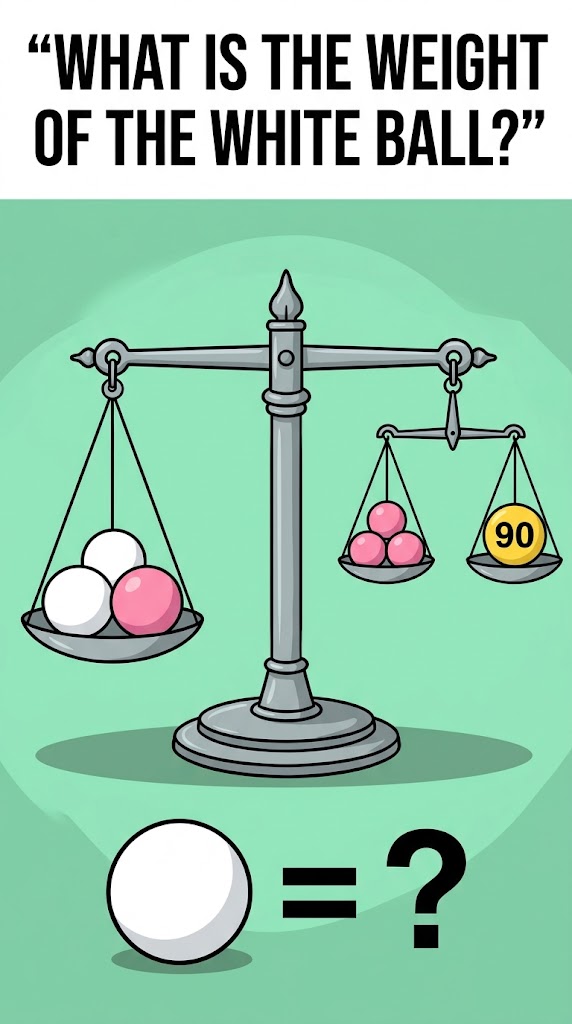
The puzzle features two balance scales that appear simple at first glance: a smaller scale holding pink balls and a weight labeled 90, and a larger scale carrying white balls on one side and the entire smaller scale on the other. The question seems easy enough—what is the weight of one white ball?—but people often arrive at different conclusions. Some confidently answer 30, others argue for 45, and a few notice an important detail that completely changes the calculation. The smaller scale offers the first useful clue: three pink balls balance perfectly with a weight of 90. Since both sides have equal weight, the three pink balls must weigh 90 altogether. Dividing 90 by 3 reveals that each pink ball weighs 30.
The larger scale is where many people make a mistake. Its right side is not carrying only the single weight marked 90; instead, it supports the entire smaller scale, which includes the three pink balls as well as the weight of 90. Because the smaller scale is balanced, each of its two sides accounts for 90 in weight. Therefore, the combined load hanging from the right side of the larger scale is 180. On the left side, there are two white balls and one pink ball. Since we already know that a pink ball weighs 30, the total on this side can be expressed as two white balls plus 30, which must equal 180. Subtracting 30 leaves 150 for the two white balls combined. Dividing that amount by 2 gives a weight of 75 for each white ball. The entire solution relies on recognizing that the larger scale carries the weight of both sides of the smaller scale, rather than just the visible weight labeled 90.