Part 2 — The Boy Who Would Speak Only to the Dog
My name is Rachel Moreno. When the crash happened, I was thirty-six and employed by a pediatric transport unit that served clinics and community hospitals throughout the Pittsburgh area. Over the years, I had transported hundreds of children between medical facilities, and I had discovered that fear could reveal itself in countless ways. Some children screamed until their voices gave out. Others asked endless questions about every monitor and medical device. Then there were children who grew so silent that a medic had to watch their chests rise and fall to confirm they were still breathing.
Noah was one of those children.
He arrived at the urgent-care clinic at 2:11 on a chilly Tuesday afternoon in November. His downstairs neighbor, Mrs. Ellison, had brought him in. She had discovered him sitting barefoot on the second-floor landing of their apartment building, one hand clutching his chest and the other holding an empty inhaler. His sweatshirt was wet from the rain, and both knees were scraped, as if he had fallen somewhere outside.
Mrs. Ellison informed the clinic receptionist that Noah’s father had been drinking since the previous evening. Around noon, she had heard shouting followed by a door slamming. Forty minutes later, she discovered Noah alone.
The boy offered the medical staff only a few disconnected details.
His father had woken up confused and demanded to know where Noah had gone.
Noah had gone downstairs to borrow a telephone because the electricity in their apartment had been disconnected.
His father had driven away.
Noah attempted to follow him on foot, became breathless, and collapsed near the parking lot.
When Mrs. Ellison asked where his father had gone, Noah replied, “He went to find me.”
That statement made little sense until much later.
The clinic staff treated his asthma attack, cleaned the scrapes on his knees, and started contacting the necessary services. His oxygen level improved, but he remained pale and dehydrated. He required observation, an examination of his chest, and a safe discharge arrangement that the small urgent-care facility could not provide.
The regional children’s hospital agreed to receive him at 2:56.
Beacon was already inside the building because the hospital’s child-life program conducted a weekly outreach session there. He was a five-year-old Golden Retriever weighing seventy-one pounds, with a warm, cream-colored golden coat, dark brown eyes, and a small, pale scar on the right side of his muzzle from an accident that had occurred before his training.
Beacon belonged to the hospital’s program rather than any individual child. Trainers had selected him because he remained calm around loud noises, sudden movements, wheelchairs, medical odors, and frightened children who sometimes grabbed too roughly. He understood more than forty commands, including “visit,” “lap,” “rest,” “bring,” “brace,” and “place.”
Beacon had never been trained to identify vehicles.
He was not a police dog.
Making decisions about emergency transportation was not part of his job.
When his handler, Tessa Lane, entered Noah’s examination room, the boy had already refused food, water, and questions for almost an hour. Beacon entered, glanced at Noah once, and settled beside the examination table without moving closer.
Noah studied him.
Two minutes passed before the boy lowered one hand.
Beacon gently moved his head beneath it.
Noah’s fingers sank into the thick fur behind the dog’s ear, and his breathing gradually slowed from thirty-one breaths per minute to twenty-three.
Tessa asked, “Would you like him to come closer?”
Noah nodded.
Those were the first instructions he had given anyone.
Beacon remained beside him while a nurse checked his blood pressure again. He stayed when the clinic’s social worker asked whether Noah felt safe returning home. The boy said nothing, but his grip tightened around the dog’s coat.
At 3:19, Noah asked Beacon, “Do you have a dad?”
Tessa did not pretend to answer on the dog’s behalf. Instead, she explained, “Beacon stays with me when he isn’t working.”
Noah lowered his eyes.
“My dad’s looking for me.”
The clinic called Aaron Bennett’s phone again. The call went straight to voicemail. Police officers had been asked to check the apartment, but nobody was home when they arrived.
Our ambulance arrived at the clinic at 3:31. I anticipated a routine transfer complicated by a social-work issue at the receiving hospital. Then I walked into the room and found Noah refusing to let go of Beacon’s vest.
“No dog, no ride,” he declared.
Tessa crouched beside him. “Beacon can’t always travel in an ambulance.”
Noah’s expression immediately shut down.
His shoulders lifted. His breathing became shallow, and the monitor showed his heart rate climbing.
The physician, transport supervisor, Tessa, and I discussed possible solutions. Beacon had completed vehicle-desensitization training and had occasionally traveled in authorized hospital transport vans, although riding in ambulances was not a regular part of his duties. Noah was stable enough to undergo a carefully arranged nonemergency transfer, and removing the only source of comfort he accepted could trigger another worsening of his breathing.
The supervisor authorized an exception.
Beacon’s crash-tested tether would be secured to a floor anchor beside the center bench. Tessa would sit next to him. Noah would occupy the forward-facing pediatric transport chair installed beside the passenger-side wall.
Before climbing aboard, Beacon paused at the ambulance step.
He turned and looked toward the clinic parking lot.
A dark-blue pickup had just entered, slowed near the entrance, and driven away again.
At that moment, none of us associated the truck with Noah.
Part 3 — The Vehicle That Kept Returning
At 3:47, Noah climbed into the ambulance with one hand gripping Beacon’s vest. He was wearing borrowed hospital socks because his wet shoes had been placed inside a plastic bag with his belongings. Tessa took a seat on the center bench, Beacon settled at her feet, and I checked Noah’s restraint twice before shutting the rear doors.
The belt lay securely across Noah’s chest and hips. The buckle was locked, and the chair’s indicator confirmed that it was correctly positioned.
I recorded every detail.
Noah’s pulse was 108. His oxygen saturation remained at 97 percent. His breathing sounded clear following treatment, although stress continued to make his shoulders rise with every inhalation.
Beacon rested his chin on Noah’s left knee.
We departed the clinic at 3:53.
Our driver, Marcus Hill, had seventeen years of experience operating emergency vehicles. He approached every transport as though someone had entrusted him with the most important person in the world. He avoided sudden braking, announced turns over the intercom, and maintained a warmer temperature in the rear compartment than in the cab because sick children frequently felt cold.
For the first ten minutes, Noah watched the buildings pass outside the window. He asked whether the hospital had a television. He wanted to know if Beacon slept in a kennel. Then he asked whether someone could be arrested for being sick.
“What kind of sickness?” I asked.
He pinched a corner of Beacon’s vest between two fingers.
“The kind where they drink and get mean.”
Tessa and I exchanged a quick look.
“People can receive treatment for that kind of sickness,” she explained. “But being sick never makes hurting someone okay.”
Noah looked down at the floor.
“He doesn’t hit me.”
The speed with which he defended his father revealed more than the statement itself.
I asked him, “Does he drive after drinking?”
Noah stopped moving his foot.
Beacon raised his head.
The boy remained silent.
At approximately 4:02, a dark-blue pickup appeared behind us. One headlight sat slightly higher than the other, and a light-colored scrape marked the passenger side of its front bumper. The driver followed closely enough that Marcus mentioned him over the intercom.
“There’s a pickup tailing us. I’m slowing down.”
The truck fell back when Marcus reduced our speed, but it accelerated again after we changed lanes.
Beacon turned toward the rear windows.
“Place,” Tessa instructed.
He lowered himself to the floor but kept his head raised.
Noah twisted around in his chair to look.
“Do you recognize that truck?” I asked.
He turned forward again.
“No.”
His response came far too quickly.
When the pickup pulled alongside the ambulance, Beacon stood up. His toenails tapped against the rubber flooring. Through the narrow window on the right, his nose followed the vehicle until it disappeared from view.
Tessa placed a hand on his shoulder.
“Beacon, settle.”
He sat down, although his body remained angled forward.
The pickup slowed near the next exit, allowing us to move ahead. For a brief moment, I saw the driver: a white man in his thirties with an unshaven face and one hand positioned high on the steering wheel. Something dangled from his rearview mirror, and the cab looked cluttered.
Noah bent his face toward Beacon.
“Don’t let him see me,” he whispered.
I heard him clearly.
“So you recognize that truck.”
Noah’s eyes filled with tears, but none fell. “It looks like ours.”
I asked Marcus to notify dispatch that a potentially impaired or aggressive vehicle might be following our ambulance. Dispatch contacted highway patrol and requested our route, current location, and a description of the truck.
For four minutes, the pickup vanished.
Noah began speaking again, though his words came in brief, scattered fragments. His father, Aaron, had lost his construction job eight months after Noah’s mother died from a sudden brain aneurysm. Initially, Aaron drank at night, after Noah had gone to bed. Eventually, beer cans started appearing at breakfast.
Some days, Aaron was still the same father who cut sandwiches into triangles and knew how to fix a bicycle chain.
On other days, he wandered around the apartment searching for things he had already broken or misplaced.
That morning, Aaron had awakened after drinking and realized he could not find Noah in his bedroom. Noah had gone downstairs to Mrs. Ellison’s apartment because their electricity had been shut off, and he needed to charge the tablet he used for school.
Aaron had shouted his name throughout the building.
Noah heard him but remained downstairs because something about his father’s voice frightened him.
Aaron drove away to search for him.
Noah followed, afraid that his father might get hurt.
That was when his asthma attack began.
The clinic had attempted to contact Aaron nineteen times. Police officers had checked the apartment. Nevertheless, Aaron had not returned home.
He had been driving.
Searching.
Drinking.
At 4:12, the pickup appeared again.
This time, it emerged from an entrance ramp and crossed two lanes to catch up with us. Marcus increased the gap between our ambulance and the traffic ahead while dispatch informed us that a patrol unit was approaching from the west.
Beacon rose before the pickup reached our rear quarter.
His tail dropped, his mouth closed, and the fur along his shoulders shifted beneath his blue vest.
Noah noticed the change.
“That’s him,” he said.
“Your father?”
The boy nodded.
I moved closer to his transport chair.
Tessa shortened Beacon’s tether and gave him the “place” command. He obeyed for three seconds before standing again as the pickup’s hood appeared beside the right-side window.
The truck began drifting toward us.
Marcus sounded the ambulance horn. The pickup corrected its course and dropped behind us, only to accelerate forward once more.
I contacted dispatch directly over the radio.
“Vehicle positively identified by the child. Driver may be his father. Possible impairment. Older dark-blue pickup with damage to the passenger-side bumper.”
The dispatcher instructed us to keep moving and advised that law enforcement was less than three minutes away.
Three minutes seems insignificant when written in an incident report.
Inside a moving ambulance, with a potentially impaired driver beside you and a frightened child strapped against the nearest wall, those three minutes can feel like an entire lifetime.
Beacon watched the side window without looking away.
He ignored the juice box that had fallen to the floor.
He ignored Tessa’s hand signal.
Then, as we approached the green light at Ardmore and Fulton, the pickup accelerated toward the cross street.
Marcus spoke one word through the intercom.
“Brace.”
Part 4 — The Seat That Was Empty at Impact
At 4:18 p.m., our ambulance entered the intersection. Marcus had already reduced our speed because of the pickup, but we were still traveling at approximately forty-two miles per hour. The cross traffic signals were red. A white sedan and a delivery van remained stopped where they were supposed to be.
The blue pickup did not stop.
It left the right-turn lane, crossed the painted shoulder, and entered the intersection against the red light. Its engine climbed into a strained, metallic roar. The driver seemed determined either to cut in front of our ambulance or force us to stop.
Beacon spotted the truck first.
I know this because his body moved before Marcus had finished saying “Brace.”
The dog launched himself from beside Tessa and lunged toward Noah’s chair. His tether snapped tight, bringing him to an abrupt stop. Tessa grabbed the quick-release tab, believing his hind leg had become caught beneath the strap.
Once the tether came free, Beacon did not run around the compartment.
He headed straight for Noah.
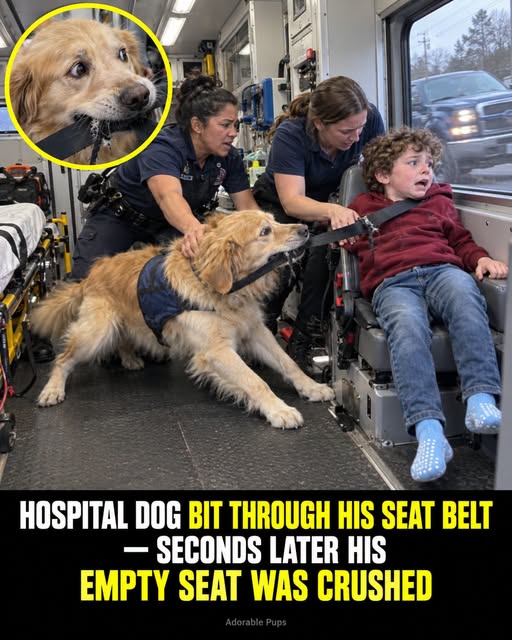
His jaws clamped onto the black shoulder belt.
For a split second, my mind misunderstood what I was seeing. There was a large dog, an eight-year-old patient, exposed teeth, and sudden, forceful movement. Every instinct told me to protect the child from the animal.
I grabbed Beacon’s vest.
“Release!”
Beacon pulled backward. The webbing stretched but remained intact.
Noah screamed, “He’s biting me!”
“He’s got the belt,” Tessa shouted.
She reached for the buckle, but the pickup’s approach forced Marcus into a sharp leftward correction. The sideways pressure tightened the restraint across Noah’s body, and the release button refused to move.
Beacon bit down again.
The threads snapped with a dry, cracking sound. The belt narrowed to half its original width.
The truck’s horn blared from our right.
Beacon braced his front paws against the base of Noah’s chair and tugged hard. The muscles in his neck tightened beneath his coat. His lower lip folded against the torn belt, but he refused to let go.
The remaining fibers finally broke apart.
Noah slipped sideways. I caught one of his arms, but the turn swept his legs toward the floor. Without touching the boy’s skin, Beacon seized the back of his red sweatshirt and pulled him onto the center bench.
His movements followed a clear pattern.
Belt. Pull. Distance. Cover.
Beacon had no understanding of impact physics. He could not distinguish an ambulance from a pickup in the way a trained vehicle specialist might. But he recognized a vehicle rushing toward Noah’s side, a blaring horn, adults preparing for impact, and a frightened child trapped beside the approaching danger.
He made room between Noah and the threat.
Three seconds after the belt snapped, the pickup slammed into the ambulance directly beneath the right-side window.
The sound was more than a simple bang. It was a deep, crushing impact, metal folding into metal as glass shattered overhead. The transport chair twisted away from its floor mounting. The right wall buckled inward until the edge of a cabinet pressed against the headrest.
Noah was no longer sitting there.
The collision hurled me against the rear doors. My shoulder absorbed most of the impact. Tessa’s harness locked across her chest, keeping her secured to the bench. Beacon and Noah slid across the padded floor until the dog struck the base of the cabinet on the opposite side.
The ambulance spun clockwise. Supplies spilled from open compartments. An oxygen mask landed beside my hand. The ceiling lights flickered but stayed on.
When the vehicle finally stopped moving, it leaned slightly toward the curb.
Dust floated through the rear compartment.
For several seconds, nobody said anything.
The first thing I clearly saw was Beacon’s blue vest. The dog was lying across Noah’s chest and abdomen, with his front paws positioned on either side of the boy. His body protected Noah from loose debris and the crushed section of the wall.
“Noah, look at me,” I said.
His eyes opened.
“My head hurts.”
“Can you move your fingers?”
He moved them.
“Your toes?”
His hospital socks shifted.
Beacon raised his head as I approached. A shallow cut marked his lower lip, probably caused by the torn belt, and his right shoulder was beginning to swell where it had struck the cabinet. He remained alert and able to bear weight, but he refused to move away from Noah.
Tessa examined the dog while I assessed the boy. Noah had a cut above his eyebrow, bruising across one hip, and pain around his left wrist. His airway remained clear. Although he was breathing rapidly, each breath was effective.
Marcus called from the cab.
“I’m okay. Is everyone back there?”
“Everyone’s conscious,” I replied. “We need firefighters and two additional units.”
Dispatch had already received several calls reporting the collision.
The rear doors were jammed, so firefighters stabilized the ambulance before entering through the left side. One of them glanced at Noah’s destroyed transport chair, then at the severed belt dangling from Beacon’s mouth.
“Was the kid sitting there?”
“Three seconds ago,” Tessa answered.
Outside, a man shouted.
“Where is Noah? I want to see my son!”
The boy goes completely still.
Beacon bends down and shields him with his body once more.
A police officer positions himself between the pickup driver and our ambulance. The man is wearing a gray sweatshirt and work boots. A small cut on his forehead is bleeding beside his nose, but he remains on his feet. His movements are unstable, and his words tumble over one another.
“I was trying to stop them. They took him away. That’s my boy.”
Noah tightens his hold on Beacon’s vest.
“Dad?”
The driver immediately turns toward the sound.
“Noah!”
He moves one step forward before an officer blocks his path and orders him to put his hands behind his back.
Aaron Bennett resists, but not by fighting. Instead, he responds with the confused, unsteady refusal of someone who cannot understand why repeating the same explanation will not make everything right.
“I was searching for him,” he insists. “My son had disappeared.”
Noah watches through the shattered opening on the side of the ambulance.
His father stands beside the pickup with handcuffs around his wrists.
During their search of the vehicle, officers discover open alcohol containers, a nearly empty bottle underneath the passenger seat, a school photograph of Noah on the dashboard, and a handwritten list of places Aaron thought his son might have visited.
There are six locations on the list.
The clinic is listed fourth.
Aaron had found his son.
Then he pursued the ambulance transporting Noah to safety and almost drove his truck into the very spot where the boy was sitting.
Part 5 — The Father Behind the Wheel
Noah and Beacon arrived at the children’s hospital in different vehicles. Another ambulance transported Noah with me, while Tessa accompanied Beacon to an emergency veterinary clinic because the dog refused to put his full weight on his right front leg.
During the twenty-two-minute journey, Noah asked about Beacon thirteen times.
“Is Beacon still alive?”
“Yes.”
“Was he hit?”
“He struck a cabinet. Tessa is taking care of him.”
“Is he angry with me?”
“No, Noah.”
That final question remained in my thoughts.
Children frequently blame themselves when the world around them falls apart. When an adult drinks, abandons them, crashes, shouts, or disappears, a child begins searching for the one decision that might have changed everything. Noah had gone downstairs without waking his father. In his mind, that seemingly insignificant choice had set every terrible event in motion.
At the hospital, scans revealed a minor fracture in Noah’s left wrist but no internal injuries. The cut above his eyebrow required three stitches. Bruises appeared across his hip and shoulder over the following two days, but the crushed transport chair had never made contact with him.
The veterinarian found that Beacon had a bruised right shoulder, a cut on his lip, and no broken bones. He needed rest, veterinarian-prescribed pain medication, and ten days away from his hospital duties.
Aaron’s blood-alcohol testing proceeded through the legal system. Police arrested him on suspicion of driving under the influence, reckless endangerment, and offenses related to the collision. The final charges and court decisions would take months to resolve, but the first immediate consequence came before sunset.
Noah could not be released into his father’s care.
The hospital social worker contacted Rebecca Cole, Noah’s maternal aunt, who lived ninety miles away in Erie. Rebecca had not seen Noah for almost a year. After an argument about Aaron’s drinking, he had stopped responding to her calls. She had no idea that their electricity had been disconnected or that Noah had been missing school.
She drove throughout the night.
When Rebecca entered Noah’s hospital room at 11:26 p.m., the boy pretended to be asleep. She sat quietly without touching him and draped her coat over the chair.
“I should have kept trying to reach you,” she said.
Noah opened his eyes.
“Are they going to take Dad away forever?”
Rebecca clasped her hands tightly in her lap.
“I don’t know.”
For children, uncertainty often feels like danger. Noah turned his face toward the wall.
The following afternoon, Beacon came back.
Tessa brought him through the staff entrance without his work vest, using only a simple blue collar. The dog walked with a slight limp. As soon as Noah spotted him, he pushed himself upright despite the cast on his wrist.
Beacon approached the bed at a gentle pace.
Noah reached out and touched the cut beneath his lip.
“You got hurt because of me.”
Beacon rested his chin on the blanket.
Tessa explained, “He acted because he recognized danger approaching. That was his choice. The accident wasn’t your fault.”
Noah turned to look at me.
“Was it Dad’s fault?”
Nobody answered immediately.
I moved a chair closer to his bed.
“Your father decided to drive after drinking. He also chose to follow the ambulance. Those decisions caused the crash.”
“But he was trying to find me.”
“He can love you and still make dangerous decisions.”
Noah’s lower lip trembled.
“Can both things be true?”
“Yes.”
That became the most difficult truth in the entire story.
Aaron was not a stranger who despised the child in his care. He was a father who had once prepared Noah’s lunches, slept on the floor beside him when he had pneumonia, and built a cardboard rocket for his sixth birthday. He was also the man who had allowed grief and alcohol to destroy the parts of his life responsible for keeping his son safe.
Noah now faced the possibility of losing the only parent he had left.
Aaron faced the possibility that he might have begun getting sober too late.
Beacon could not put either of their lives back together.
But when Noah began trembling, the dog carefully climbed onto the lowered portion of the bed and settled alongside the boy’s uninjured side.
He remained there until Noah fell asleep.
Part 6 — What Happened After the Sirens Stopped
Following an emergency family-court hearing, Rebecca was granted temporary guardianship. Noah moved into her modest home outside Erie, where she lived with her husband, Daniel, and their fourteen-year-old daughter, Mae. The new arrangement provided him with a secure bedroom, consistent meals, transportation to school, and adults who would not vanish without warning.
At first, however, safety did not feel safe to him.
He slept wearing his shoes.
He concealed food beneath his mattress. Whenever a pickup slowed on the street, he checked the driveway. He refused to sit on the passenger side of any vehicle and became stiff with fear whenever a seat belt tightened across his chest.
After Noah missed a follow-up appointment because he refused to get into Rebecca’s car, she contacted the hospital’s child-life office.
The program arranged for Beacon to meet him outside the hospital before the rescheduled appointment.
Tessa opened the rear door of her vehicle. Beacon stepped out, noticed Noah standing beside Rebecca’s car, and walked straight toward the passenger-side door. He sniffed the lower frame, glanced at the boy, and then climbed into the back seat.
Noah stayed on the sidewalk.
Beacon waited patiently.
Six minutes later, Noah finally sat beside him.
The seat belt terrified him. The moment Rebecca pulled it across his chest, his breathing quickened. Beacon placed one paw over Noah’s shoe, repeating the same comforting gesture he had used at the clinic.
Noah fastened the buckle.
Throughout the drive, the dog remained between him and the window.
The hospital could not assign Beacon permanently to a single child, but the team arranged regular visits as part of Noah’s therapy and follow-up care. During those sessions, Noah gradually learned to talk about his memories without believing he was responsible for what had happened.
He remembered the smell of rubber inside the ambulance.
He remembered Beacon’s teeth gripping the belt.
He remembered the wall folding inward.
He remembered hearing his father shout his name outside.
What he could not remember was the instant the pickup first entered the intersection. His thoughts repeatedly returned to the belief that Beacon must somehow have known the collision was coming.
A behavior specialist provided a more straightforward explanation. Beacon had probably recognized a combination of immediate warning signs before the people in the rear compartment reacted: the truck approaching from the side, the engine growing louder, the horn sounding, Marcus shouting the command to brace, Noah sitting close to the approaching vehicle, and the tension among the adults.
The dog had not predicted what would happen next.
He had reacted to what was happening in front of him faster than we did.
Years of hospital work had also taught him that restraints kept frightened children in position. Under ordinary circumstances, that was beneficial. During those three seconds, however, the belt prevented Noah from moving away from the approaching danger.
Beacon did not understand the engineering behind seat belts.
He understood what the belt was doing.
The restraint was keeping Noah beside the danger.
That explanation made Beacon’s actions even more remarkable to me. He had not simply performed a rehearsed command. He had assessed the situation, made a decision, and carried out four actions in the only sequence that could help: break the restraint, pull the child inward, create space between him and the impact, and shield him once the ambulance stopped.
Aaron remained in county custody until a judge authorized his transfer to a residential alcohol-treatment facility. His attorney sent a letter to Rebecca for Noah, but she asked the child’s therapist to examine it before showing it to him.
The letter included apologies, explanations, and promises.
The therapist did not remove any of its contents. Instead, she waited until Noah was ready to hear it.
Three months after the collision, Rebecca read the letter aloud while Beacon rested beside Noah’s chair.
Aaron wrote that he remembered watching the ambulance leave the clinic. He remembered believing that someone had taken Noah away from him. He remembered deciding he could catch up with the vehicle at the next intersection.
He could not recall the red light.
He could not remember the collision.
He remembered waking in the emergency department with a police officer standing beside his bed and asking whether his son had died.
Noah listened silently. When Rebecca finished, he reached down and wrapped both hands around Beacon’s neck.
“Does saying sorry make everything better?” he asked.
“No,” the therapist replied.
“Then why say it?”
“Because you cannot begin to make things right without telling the truth.”
Noah considered her answer.
“Do I have to forgive him?”
“No.”
“Can I still love him?”
“Yes.”
Aaron completed ninety days of residential treatment before entering an outpatient recovery program. He accepted responsibility in court, surrendered his driving privileges, agreed to continued alcohol monitoring, and did not challenge Rebecca’s temporary guardianship.
None of those steps could undo the collision.
However, they established the first conditions that might eventually allow Noah to see his father safely.
Seven months after the accident, the court and treatment team approved a supervised visit at a family-services center. Noah agreed to attend on one condition.
Beacon had to accompany him.
The hospital program considered the request. Because Beacon was already supporting Noah’s treatment and the meeting would take place in a controlled environment with his handler present, the team authorized a single visit.
Aaron arrived twenty minutes before the scheduled time.
He wore clean jeans and a plain blue shirt, with a monitoring device attached to his ankle. A counselor inspected his bag, reviewed the rules for the meeting, and asked him to wait at a round table.
When Noah entered the room, Aaron rose too quickly.
Beacon moved into the space between them.
He was not acting aggressively. He simply stood in the open space separating father and son.
Aaron stopped.
Noah held on to the dog’s vest.
For several seconds, they stared at each other across Beacon’s golden back.
Aaron spoke first.
“I was supposed to protect you.”
Noah’s fingers tightened in the dog’s fur.
“You almost killed me.”
“I know.”
“You almost killed Beacon.”
Aaron lowered his gaze.
“I know that, too.”
He did not blame the alcohol. He did not use grief, unemployment, panic, or confusion as excuses. He did not ask Noah to comfort him or make him feel better.
“I made the decision to drive,” he said. “I caused the crash.”
Noah sat down.
Beacon settled between their chairs.
The meeting lasted eighteen minutes.
Noah did not embrace his father. He stood up, took hold of Beacon’s handle, and walked toward the exit. Before leaving, he glanced back.
“Come next week,” he said.
Part 7 — The Space Between Them
Aaron attended every supervised visit that followed. Some lasted twenty minutes, while others continued for the full hour. A supervisor remained in the room, Rebecca waited close by, and Aaron complied with every requirement established by the court and treatment plan.
Progress was not always steady.
During the fourth visit, Noah asked why his father had chosen beer instead of him. Aaron attempted to explain addiction, but the words sounded like excuses, and Noah walked out.
During the sixth visit, Aaron brought photographs of Noah’s mother. They discussed the cardboard rocket she had helped him build for his sixth birthday and the summer she taught him to swim.
At the ninth visit, Noah allowed his father to assist him with a school project.
Beacon joined them whenever the hospital program and his work schedule permitted. During weeks when the dog could not attend, Noah brought a small photograph of him and placed it on the empty chair in the middle.
Whenever Beacon was present, he followed the same routine. Tessa entered first. Beacon surveyed the room, walked over to Noah, and then sat right between the father and his son. He never showed obvious tension around Aaron, but he never stepped aside until Noah moved first.
Aaron learned not to reach across the dog.
He waited.
One winter afternoon, almost a year after the collision, Noah rested his hand on Beacon’s back and said, “You can go lie down now.”
The dog glanced at Tessa.
She gave him the release command.
Beacon crossed the room and settled beside the wall, leaving the space between the two chairs open for the first time.
Aaron remained where he was.
That was important.
Noah is ten years old now. He continues to live with Rebecca, and his relationship with Aaron remains under professional supervision while the adults responsible for his welfare determine the next steps. Aaron has continued his recovery, although everyone involved understands that sobriety must be maintained one day at a time.
Beacon is seven. The fur around his scar has begun turning pale, and he works fewer hours than he once did. He still visits Noah during hospital follow-ups and selected family sessions.
The piece of black seat belt Beacon tore apart was never turned into a trophy. Tessa keeps it inside a plain evidence-style bag in the child-life office because Noah asked her to preserve it.
Once a year, on the Tuesday closest to the anniversary of the collision, Noah visits Beacon. He brings two items: a fresh tennis ball for the dog and a handwritten note containing one sentence about something safe that happened during the year.
The most recent note reads:
Dad came sober. I chose to stay. Beacon didn’t have to sit between us the entire time.
Beacon saved Noah by creating distance during three terrifying seconds.
Afterward, he helped the boy decide when that distance could safely begin to close.
Follow this page for more moving dog stories about bravery, second chances, and the animals who protect children when the adults around them fail.