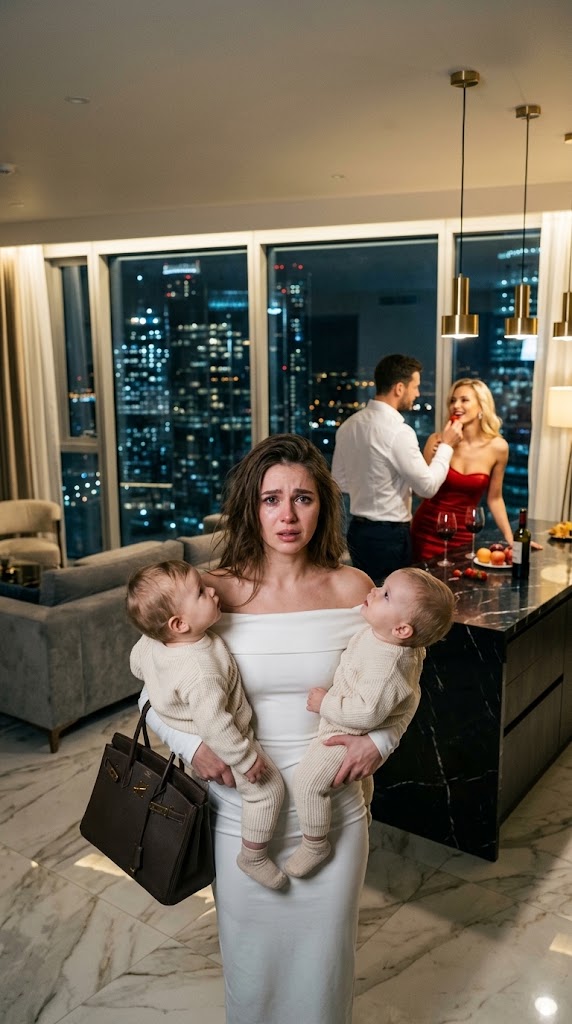
Chapter 1: 11:47 p.m.
At precisely 11:47 on Christmas Eve, my husband shattered our marriage by accidentally sending me a photograph meant to remain hidden.
By the time the sun rose, he would return to a quiet apartment, an empty nursery, and two babies who were nowhere to be found. For once, his money, connections, and influence would not be enough to bring us home.
Snow drifted past the windows of our Manhattan apartment while Noah burned with fever in my arms and Lily sobbed beneath the Christmas tree.
I hadn’t washed my hair in three days. My sweatshirt reeked of baby formula and medicine, and I was so exhausted that even standing upright felt like an achievement.
The apartment looked stunning in the most heartbreaking way.
Cole had hired a decorator to adorn our twelve-foot Fraser fir with silver ribbons and white lights because he expected important guests might stop by before New Year’s.
Not a single important guest had shown up.
Neither had any of our relatives.
And my husband was still nowhere to be seen.
There were just two sick six-month-old babies, their terrified mother, and a Christmas tree that probably cost more than the car I drove when I graduated college.
When my phone buzzed on the kitchen counter, I nearly smiled.
For one foolish second, I imagined Cole was finally on his way home.
With Noah resting against my shoulder, I rushed over and opened his message.
Don’t wait up. Important clients. Keep things quiet so I can concentrate.
I stared at the screen.
It sounded exactly like something he would say.
Keep things quiet.
Don’t interrupt me.
Deal with everything on your own.
Then I noticed the photograph attached to his message.
At first, my exhausted brain couldn’t quite process what I was seeing.
A hotel mirror.
A bed covered in rumpled white sheets.
A champagne bottle beside the bed.
A woman’s bare shoulder.
Long blonde hair scattered across Cole’s chest, with his arm wrapped possessively around her waist.
His wedding band was clearly visible.
So was hers.
I knew who she was before I could bring myself to acknowledge it.
Sierra Vaughn.
Cole’s so-called “client relations consultant.”
The woman who laughed a little too loudly at business dinners and always seemed to find an excuse to touch his arm.
The woman who had once smiled at me across a crowded ballroom as if the two of us shared a secret.
It turned out we did.
My heart didn’t break because I was surprised. It broke because I finally had undeniable proof.
For months, I had found excuses for things I already suspected were wrong.
Strange perfume clinging to his jackets.
Lipstick on his collar, supposedly left behind by “holiday hugs.”
Late-night meetings followed by immediate showers.
A second phone he claimed contained confidential client information.
Passwords that changed without explanation.
Business trips that kept getting longer.
Private balcony calls on Sundays in February.
A restaurant receipt from SoHo on an evening he had insisted he was eating alone at the office.
Every time I questioned him, he somehow made me feel ridiculous.
“Do you even hear yourself, Lauren?”
“You’re exhausted.”
“You’ve been paranoid ever since the babies arrived.”
“Not everything revolves around you.”
Sometimes, he laughed at me.
That hurt more than his anger ever could.
Anger at least meant he recognized I was there.
His laughter made me feel as though I didn’t matter at all.
Outside, snow transformed Manhattan into something straight out of a Christmas postcard.
Inside, my marriage came to an end without a sound.
Noah whimpered against my shoulder.
I glanced down at him and remembered why Cole had walked out six hours earlier.
Both babies had been running fevers all afternoon.
Lily’s temperature had climbed first, followed by Noah’s.
I had called the pediatrician twice, checked their temperatures every twenty minutes, offered them fluids, replaced their cool cloths, and watched the clock with growing anxiety.
At 5:45, Cole walked out of our bedroom wearing a crisp white shirt and a black tie.
I stood in the hallway with Lily crying against my chest.
“Where are you going?”
He barely broke his stride.
“I already told you.”
“You said dinner.”
“It is dinner.”
“Their condition is getting worse.”
He straightened his cuff link.
I remember that detail because cruelty doesn’t always announce itself through shouting.
Sometimes, it looks like a man carefully adjusting his cuff links while his sick child cries a few feet away.
“Please stay,” I begged.
He looked at Lily as though she were an inconvenience.
“Lauren, I’m not canceling Christmas Eve with clients because the babies have colds.”
“They don’t have colds.”
“Then call the pediatrician.”
“I already did.”
“Excellent.”
I stepped in front of him as the elevator waited nearby.
“Please.”
That was one of the last times I ever begged my husband for anything.
His face turned cold.
“Move.”
“Cole—”
“If you’re worried, call the pediatrician again.”
“I need help.”
His jaw clenched.
“That’s what mothers are supposed to do.”
The elevator doors opened.
He stepped inside while Lily cried in my arms and Noah screamed from the nursery.
Cole looked at me one last time.
“And don’t turn tonight into some kind of emergency.”
The doors slid shut.
Six hours later, I stood in our kitchen staring at a photograph of him with another woman.
I expected to feel furious. I thought I would scream, break something, or desperately call him.
Instead, an unexpected calm settled over me.
Noah’s skin was frighteningly hot against my cheek.
That was what mattered.
Lily’s fever was what mattered.
The man in the photograph had ceased to matter.
I took screenshots, sent the evidence to an email account Cole didn’t know I still maintained, and saved a backup in a secure folder established with help from my grandmother’s attorney.
My fingers hardly shook.
Somehow, that frightened me more than tears would have.
At midnight, Noah needed another dose of infant medication. I carried him into the nursery and laid him beside Lily.
Her tiny hand opened and closed.
I rested my fingers against her chest and counted her breaths.
“Mommy is right here,” I whispered.
The words felt like a promise.
I had no idea yet how much that promise would cost me.
I went to the entry closet because Cole had insisted he’d collected the additional fever reducer our pediatrician had recommended.
He claimed he had put it in his coat pocket.
His charcoal overcoat hung behind three other jackets.
One pocket was empty.
In the other, my fingers brushed against velvet.
I pulled out a small Tiffany box.
For one foolish, humiliating moment, hope flickered inside me.
Perhaps he had remembered Christmas after all.
Maybe he had bought something for me.
I lifted the lid.
A pearl-and-diamond necklace sparkled beneath the hallway lights.
It was delicate and expensive, exactly the kind of jewelry Cole liked women to wear when standing beside him.
Beneath it lay a receipt.
Five handwritten words stretched across the top.
To Sierra — Christmas Eve.
I collapsed onto the floor.
The babies were crying nearby while the Christmas lights glimmered across the diamonds.
I had never felt so stupid in my entire life.
Cole scrutinized nearly every purchase I made.
Once, he demanded that I explain why our grocery bill had increased by $87.
He had forced me to return an expensive cashmere blanket my mother bought for the babies, insisting that gifts like that encouraged “bad habits.”
He had even removed my name from our household credit card after I ordered another bottle sterilizer without asking his permission.
Yet he had purchased his mistress a necklace worth more than six months of groceries.
A bitter laugh escaped me.
Then the laughter dissolved into tears.
I pressed my hand over my mouth so the babies wouldn’t hear me crying.
For a long time, I sat staring at the box, remembering the woman I had been before Cole Whitmore entered my life.
Lauren Bennett.
Twenty-six years old.
New to Manhattan.
Innocent enough to mistake ambition for integrity.
Cole had remembered my coffee order after meeting me only once.
He sent flowers to my office without signing the card, claiming I would somehow recognize the gesture as his.
Three months later, he took me to Cape Cod.
After nine months together, he proposed.
“You make all the noise disappear,” he whispered when I accepted.
At the time, I thought it was romantic.
He called me his safe place.
Then, little by little, he began taking that safety away.
Don’t wear that.
Why were you talking to him?
Your mother doesn’t respect our marriage.
Your friends are immature.
Why do you need an accountant of your own?
We’re a team now.
Eventually, his criticism became harsher.
You’re making me look bad.
You’re too emotional.
You don’t understand how the real world works.
Stop crying.
After the twins were born, my life grew smaller and smaller.
Three weeks after I returned from the hospital, Cole fired our nanny, arguing that having someone help me would make me lazy.
He took control of every household account, claiming I was “too overwhelmed to handle money properly.”
My debit card would decline unless he transferred funds into the account.
He demanded receipts, tracked my location and car service rides, and complained whenever I spent too long talking to my mother.
Two nights before Christmas, Sierra’s name appeared on his phone.
When I reached toward the device, Cole grabbed my wrist so tightly that bruises formed.
Later, he kissed the marks he had left behind.
“You know how crazy you make me when you invade my privacy.”
Those words had haunted me for two days.
Now I finally understood what I had forgotten.
Before becoming Cole’s wife, I had been someone’s daughter.
And someone’s granddaughter.
My father, Richard Bennett, had spent most of his career serving as a federal judge.
He believed in rules so firmly that when I was twelve, he made me repay my brother the thirty-seven cents I had taken from him without permission.
My grandmother, Margaret Bennett, had founded Bennett National Trust decades before I was born.
She had transformed a small regional fiduciary business into a major institution overseeing family trusts, charitable foundations, and private assets across multiple states.
She had distrusted Cole from the moment they met over dinner.
Not because he was ambitious.
She admired ambition.
What she distrusted was greed pretending to be love.
Three months before my wedding, Grandma had insisted that my inheritance remain protected inside a separate trust.
Cole considered the arrangement insulting.
I thought it was unnecessary.
Grandma believed it was protection.
“There’s a difference between sharing your life with someone and handing over all your leverage,” she had told me.
I rolled my eyes at the time, but I signed the documents to make her happy.
One provision had struck me as particularly extreme.
The emergency clause.
If I believed that a spouse, partner, guardian, or authorized household representative posed a threat to my safety, financial independence, or freedom of movement, I could immediately activate protective measures for my separate assets.
Cole knew the trust existed.
He had no idea that the emergency clause was part of it.
He also believed I had stopped communicating with the trust’s attorney because he repeatedly accused Mr. Harris of trying to turn me against him.
For the sake of keeping the peace, I had pretended to agree.
At 12:06 a.m., while the twins finally slept, I called the attorney Cole thought I had abandoned.
Daniel Harris answered on the fourth ring.
“Lauren?”
We hadn’t spoken in almost eleven months.
“Mr. Harris.”
Something changed in his voice.
“What happened?”
I looked toward the nursery, then down at my bruised wrist.
“Activate the emergency clause.”
Silence.
Not the silence of disbelief or uncertainty.
It was the silence of someone who understood the gravity of what I was asking.
“Are you completely sure?”
I glanced at Sierra’s necklace, the photograph of Cole, and the faint marks his fingers had left beneath my sleeve.
“Yes.”
Mr. Harris released a long breath.
“Then I need you to pay close attention.”
I pulled out a chair and sat at the kitchen table.
“I’m listening.”
“Are the children safe at this moment?”
“Yes.”
“Are you facing any immediate physical threat?”
“Cole isn’t here.”
“Do you think he’ll return soon?”
“I have no idea.”
“Whatever happens, do not confront him.”
“That wasn’t my intention.”
“Good.”
I heard papers shifting on his side of the call.
“I’m activating the clause.”
My stomach knotted.
“What happens next?”
“Any assets held exclusively for your benefit will become inaccessible to anyone acting under spousal authority, household authorization, or secondary access privileges.”
I swallowed hard.
“Can Cole prevent this?”
“No.”
For the first time that night, I felt something other than heartbreak stirring inside me.
Room.
Just enough space to draw a breath.
Then Mr. Harris spoke again.
“Lauren, there’s another matter we need to address.”
“What is it?”
“If you intend to leave tonight, don’t walk out empty-handed emotionally or practically.”
I frowned.
“What are you saying?”
“I’m saying you need to collect documents.”
My eyes moved toward Cole’s study.
“Bank statements, financial records, messages, medical documents, photographs of your injuries, and anything that demonstrates restrictions on your finances or freedom of movement.”
My heartbeat quickened.
“What about the photograph?”
“Preserve it, but don’t center your case on the affair.”
I looked at the jewelry box.
“Why shouldn’t I?”
“Infidelity may have ended your marriage.”
His voice remained steady.
“But controlling behavior may determine whether you can leave it safely.”
That was the moment everything finally shifted.
Not when I saw Sierra.
Not when I found the necklace.
Not even when I called Mr. Harris.
Everything changed when I stopped asking myself whether Cole loved me and started gathering evidence of what he had been doing.
Chapter 2: The emergency clause
For the next hour, I walked through my home like someone investigating a stranger’s life.
Perhaps that was exactly what I was doing.
Over the past year, Cole’s study had become a room I almost never entered.
He had never directly forbidden me from going inside.
Instead, he made every visit so uncomfortable that eventually I stopped trying.
His desk drawers contained everything Mr. Harris had told me to locate.
Household banking statements.
Credit card histories.
Records of wire transfers.
Monthly payments into the modest spending account Cole permitted me to use.
I also uncovered emails I had printed during previous moments of courage and later concealed behind old tax documents.
You have no reason to access the investment accounts.
Get my approval before buying anything above $200.
Turn your location tracking back on.
Cancel your lunch with your mother.
We already discussed this.
Do not force me to come home because you cannot handle the babies.
Each message had once seemed possible to explain away.
Read together, they exposed a disturbing pattern.
I photographed every document.
Then I came across a household budget spreadsheet.
Mortgage.
Employees.
Cars.
Club dues.
Restaurants.
Travel.
Lauren.
My existence had been reduced to a line in a financial report.
Beside my name sat a monthly spending allowance.
Underneath it, Cole had added a note:
Cut it again.
I stared at those words.
Six months earlier, I would have searched for reasons to excuse him.
Maybe his business was struggling.
Perhaps work had overwhelmed him.
Maybe I had spent too much.
Now I couldn’t stop wondering why a man purchasing diamonds for his mistress needed to cut his wife’s budget for diapers.
The truth was painfully simple.
This had never really been about money.
It had always been about control.
My phone rang.
Cole’s name appeared on the screen.
At 12:58 a.m., I watched it flash repeatedly.
He had discovered his mistake.
Perhaps the photograph had been meant for Sierra, a friend, or somebody else entirely.
None of that changed what I had seen.
I let the call go unanswered.
Ten seconds later, a message appeared.
Forget that picture.
Another arrived almost immediately.
A client sent it. Just a joke.
Then came another.
Lauren?
Pick up.
Don’t start anything tonight.
The woman I had been before that evening would have answered immediately, desperate to hear an explanation.
I would have spent Christmas morning debating whether I could trust my own eyes.
Instead, I captured screenshots and turned off my read receipts.
At 1:12 a.m., Mr. Harris called again.
“The initial protections have been activated.”
“Already?”
“That is precisely why emergency provisions exist.”
I looked at the papers spread across Cole’s desk.
“What have you frozen?”
“Nothing that belongs to Cole.”
That distinction was important.
“We’ve restricted access to your assets and the protected accounts established for the twins.”
I had never realized Cole could access the children’s accounts.
Mr. Harris appeared to sense my surprise.
“Lauren?”
“Go on.”
“Any existing authorization that allows him to obtain information, approve transfers, or act as your household representative has been suspended until the review is complete.”
My fingers tightened around the phone.
“Has he been using that authority?”
“We’ll establish that during the audit.”
The thought of an audit made my head spin.
“Don’t guess tonight.”
“I won’t.”
“Do you have somewhere safe to stay?”
“Yes.”
The answer wasn’t entirely honest.
I had several possibilities.
My parents’ home in Connecticut.
My grandmother’s residence.
A family property north of Manhattan.
But the snowstorm made the idea of driving with two feverish infants frightening.
“I’m worried about the babies.”
“Then their safety comes first.”
Twenty minutes later, I contacted the pediatrician’s overnight service.
I explained their symptoms and gave the nurse their temperature readings.
She told me what warning signs to watch for and when we would need emergency medical attention.
Noah’s fever had started to come down.
Lily finally drank several ounces from her bottle.
The relief almost brought me to tears.
Instead, I began packing.
Two sleepers for each baby.
Diapers, formula, medicine, thermometers, and blankets.
Birth certificates, insurance cards, and passports.
Lily’s beloved stuffed elephant.
Noah’s little green fabric dinosaur.
For myself, I packed jeans, underwear, three sweaters, a toothbrush, Grandma’s ring, and my laptop.
Everything else suddenly seemed unnecessary.
My closet was filled with thousands of dollars’ worth of dresses chosen for Cole’s dinners, shoes I wasn’t supposed to scuff, and jewelry he had selected because he disliked my personal taste.
I left almost all of it behind.
At 2:03 a.m., my mother called.
“Mom?”
“Daniel contacted your father.”
Of course he had.
Dad was listed as an emergency contact for the trust.
“Is Dad furious?”
“Your father is pacing around our kitchen in his bathrobe, using words I have never heard him utter from the bench.”
Despite the circumstances, a small smile crossed my face.
Then her voice grew gentler.
“Are you safe?”
That simple question nearly broke me.
She hadn’t demanded an explanation or challenged my decisions.
She had only asked whether I was safe.
“He isn’t here.”
“That wasn’t what I asked.”
I covered my mouth with one hand.
“I think I am.”
“Are the babies safe?”
“Yes.”
“Are you going to leave?”
“Yes.”
“Good.”
One word.
No judgment.
No lecture.
No hint of satisfaction.
Tears filled my eyes, and I sank onto the nursery floor.
“I should have listened to you.”
“No.”
“Grandma tried to warn me.”
“Lauren.”
“I defended him.”
“You loved your husband.”
“I stopped calling you.”
“I know.”
“I let him convince me you were trying to control my life.”
“I know.”
“I’m sorry.”
Mother took a trembling breath.
“We can discuss all of that another time.”
I wiped my face.
“How can you say that?”
“Because right now, I need my daughter to get her babies somewhere safe.”
The word daughter reminded me that I had existed long before I became Mrs. Cole Whitmore.
“I don’t want Dad coming here.”
“He won’t.”
“Promise me.”
“I promise.”
“He can’t use his position to help me.”
“He understands that better than anyone.”
“I mean it, Mom.”
“So do I.”
I closed my eyes.
People often imagined that a federal judge could make a few phone calls and change the outcome of a legal dispute.
My father considered that kind of behavior corruption.
He would not influence another judge, pressure law enforcement, or interfere with custody proceedings.
But he could stand beside me as my father.
That was enough.
At 2:26 a.m., Cole called again.
I ignored the call.
His messages gradually changed from dismissive to irritated, then took on an oddly affectionate tone.
Baby, please answer.
It’s not what you think.
You’re exhausted.
We’ll talk when I get home.
Don’t do anything reckless.
I stared at the final message.
Apparently, spending Christmas Eve with another woman while our babies were sick wasn’t reckless.
Leaving him was.
At 2:41 a.m., his tone shifted once more.
Where are you?
I checked my location settings.
Disabled.
Then another message appeared.
Turn your location back on.
Now.
My heart began pounding.
I suddenly understood just how deeply his behavior had conditioned me.
Cole wasn’t even nearby.
Yet a command on my screen made my body brace for punishment.
I saved the message, forwarded it to Mr. Harris, and locked my phone.
At 3:10 a.m., I finally located the medicine.
It wasn’t in Cole’s coat.
It was still inside the pharmacy bag on our dining table, hidden beneath two unopened bottles of wine intended for Christmas.
He hadn’t put it away or told me where to find it.
He had simply left me to figure everything out myself.
I gave the babies their medicine according to the pediatrician’s instructions, then sat between their cribs until they fell asleep.
The nursery walls were painted pale blue.
While I was seven months pregnant, I had painted tiny stars above the molding.
Cole had complained about the fumes and insisted we should hire a professional.
I had wanted to create something special for our children with my own hands.
As I looked at those stars, I realized how much it would hurt to leave this room behind.
Noah had slept for more than three hours straight here for the first time.
Lily had learned to roll over in this nursery.
I had comforted them through colic and whispered promises into their hair after arguments with Cole.
This was the first home they had ever known.
But four walls could not guarantee safety.
Furniture could not replace family.
And no nursery was worth staying trapped.
At 3:38 a.m., Mr. Harris called.
“The vehicle will be waiting downstairs at four thirty.”
“Who’s driving?”
“A driver from the security company retained by the trust.”
I paused.
“Cole will accuse me of kidnapping the children.”
“You’re their mother, leaving the marital residence with your children because you believe their environment is unsafe.”
He stopped briefly.
“However, this is exactly why you need legal counsel first thing in the morning.”
“I don’t want a war.”
“I understand.”
“I just want him to leave us alone.”
“Sometimes, those two things turn out to be the same battle.”
I hated how accurately he described the situation.
“What should I leave behind?”
“Anything that puts your safety at risk.”
I glanced at the Christmas tree.
An idea began to take shape.
I told myself it wasn’t revenge.
Perhaps it was simply the first statement I had made entirely on my own in years.
I opened the Tiffany box, took out Sierra’s necklace, and placed it with the receipt inside an evidence envelope.
After photographing both items, I set the empty box beneath the Christmas tree.
Then I slipped off my wedding ring.
Without it, my hand looked strangely young.
I placed the ring inside the box.
Taking one of Cole’s thick white thank-you cards, I considered everything I wanted to tell him.
I know the truth.
You deceived me.
You hurt me.
You abandoned your sick children.
You controlled my life.
You made me afraid inside my own home.
I could have covered the apartment in accusations.
Instead, I wrote just one sentence:
You should have been home for Christmas.
I left the card beside the box.
At 4:24 a.m., I woke the babies.
Noah fussed as I dressed him in his snowsuit.
Lily watched me with heavy, sleepy eyes.
“I’m sorry,” I whispered.
I wasn’t sure whether I meant for waking them or for everything that had brought us to that moment.
At 4:31 a.m., the service elevator opened.
A gray-haired driver named Thomas stood waiting. Beside him were two car seats arranged through Mr. Harris so I wouldn’t have to carry ours through the parking garage.
“Mrs. Whitmore?”
I glanced at him, then turned to look at the apartment one final time.
“You can call me Lauren.”
He gave a small nod.
“Lauren.”
By five o’clock, Noah and Lily were securely fastened into their car seats inside a black SUV.
Cole had lost access to my protected accounts.
My documents were packed inside a leather bag at my feet.
My children were right beside me.
We headed north through the falling snow.
I never turned around.
Forty-seven minutes later, Cole would arrive home expecting tears, arguments, and a wife he could still intimidate into remaining where he wanted her.
Instead, he would find a darkened apartment, an abandoned nursery, Sierra’s Tiffany box beneath the Christmas tree, and something else waiting on the dining table.
A courier had delivered it three minutes after I left.
It was a certified notice from Bennett National Trust.
Cole later admitted to his attorney that the opening paragraph told him everything he needed to know.
Losing his wife was just the beginning.
Chapter 3: What Cole found under the tree
I wasn’t present when Cole came home.
I learned what happened through written statements, messages, security recordings, and eventually Cole himself.
The lobby cameras showed him arriving at 5:47 on Christmas morning.
He entered alone, wearing the same charcoal overcoat he had worn when he left the previous evening.
He looked exhausted, but he didn’t appear frightened.
Not yet.
According to the doorman, Cole asked whether I had come downstairs during the night.
When he learned that I had left with the babies, he froze.
“Where did she go?”
“I don’t know, sir.”
“Who was driving?”
“I’m not permitted to share that information.”
The answer made him furious.
Cole was accustomed to people responding whenever he asked a question.
He went upstairs.
The Christmas tree was the apartment’s only source of light.
Beneath it sat my wedding ring.
You should have been home for Christmas.
He called me nine times within eleven minutes.
I watched the lights from the snowy highway slide past without answering.
At 6:02, he noticed the envelope resting on the dining table.
It had been sent by outside counsel representing Bennett National Trust.
The letter didn’t accuse him of a criminal offense.
Instead, it did something he despised even more.
It withdrew his authority.
He could no longer obtain information about my separate assets through household authorization, request distributions on my behalf, or use any existing permissions to access protected accounts.
Any transactions involving delegated access would undergo review, and all communication from the trust would be directed through my attorney.
Cole called Mr. Harris.
Nobody answered.
Then he tried calling me again.
His voicemail arrived while Noah was asleep in his car seat.
“Lauren, this has gone too far.”
I stared at the phone.
He had just returned from a hotel room shared with another woman to discover that his family had disappeared, yet he somehow believed I was the one who had crossed a boundary.
More messages followed.
“You can’t take my children and vanish.”
“We’re married.”
“Whatever you think you saw, I can explain it.”
Then came a voicemail I kept for years.
“I know you’re upset, but don’t let your family turn this into something it isn’t.”
I played it twice.
Cole had a remarkable ability to make something happening directly in front of him sound like someone else’s manipulation.
At 6:31, we reached my parents’ home in Connecticut.
Mother stood outside wearing pajamas, winter boots, and a heavy coat.
She opened the SUV door before Thomas could reach it.
Then she saw me.
Her eyes immediately dropped to the bruises showing beneath my sleeve.
“Lauren.”
“I’m fine.”
I heard the words leave my mouth automatically.
It was the familiar response people gave when the truth was far too complicated to explain while standing on a doorstep.
Mother’s expression crumpled.
Without asking a single question, she reached for Noah.
I allowed her to lift him from his seat.
Dad appeared behind her, dressed in an old Navy sweatshirt and sweatpants.
I had never seen him look less like a federal judge.
He looked at Lily, then at me, and finally at my wrist.
His jaw tightened.
“Come inside.”
That was all he said.
No speeches.
No threats.
No influential calls to anyone.
Just an invitation to enter the house.
Inside, the air smelled of coffee, pine, and cinnamon.
Christmas candles flickered in the living room, and presents beneath the tree had the twins’ names written on them.
I had previously told my parents we wouldn’t visit because Cole insisted that traveling with sick babies was irresponsible.
The babies hadn’t been ill when he made that decision.
He simply hadn’t wanted to go.
Still, my parents had purchased gifts for them.
I turned away, unable to manage the emotion rising inside me.
Dad picked up my bag.
“Your old bedroom is ready.”
“You knew I was coming?”
“Your mother has kept that room prepared for thirty-four years.”
“I’m thirty-two.”
“She got started early.”
I laughed.
Then I began crying so uncontrollably that I nearly lost my grip on Lily.
Dad took her from me as my knees began to buckle.
I sat down on the stairs while Mother wrapped her arms around me.
“I’m sorry,” I repeated over and over.
“Stop apologizing for surviving your own marriage.”
I rested my head against her shoulder.
“I don’t know what happens next.”
“You don’t need to figure that out this morning.”
But by eight o’clock, the next chapter had already begun.
Cole sent me a photograph of the empty nursery.
COME HOME.
Two minutes later, another message arrived.
We can work this out.
Then came a third.
I will forgive what you’ve done if you bring the children back before noon.
I stared at the screen.
He was offering to forgive me.
I forwarded the messages to Mr. Harris.
At 9:15, I spoke with Evelyn Shaw, a family-law attorney recommended by the trust’s legal team.
She sounded unsurprised by what I described, which somehow made me feel both reassured and heartbroken.
“Has he threatened you?”
“Not directly.”
“Has he ever physically restrained you?”
“He grabbed my wrist.”
“Take photographs of the bruises today.”
“I’ve already done that.”
“Good.”
The word felt strange.
There was nothing good about any of this.
“Has he restricted your access to money?”
“Yes.”
“What about transportation?”
“Sometimes.”
“Has he interfered with your communication with family?”
“He never outright forbade me from calling them.”
“But?”
“He made me pay for every conversation afterward.”
Evelyn paused.
“What do you mean by that?”
“He punished me.”
“In what way?”
“By refusing to speak to me.”
I watched Dad entertaining Noah.
“Financially, too.”
Another pause followed.
“Did he cancel things you depended on?”
“Yes.”
“What sort of things?”
“A credit card.”
“A car.”
“Help with the babies.”
“Anything I needed.”
“And the physical incident?”
“That happened two nights ago.”
“Were there other incidents?”
I wanted to say no.
Then I remembered Cole blocking the bedroom doorway, gripping my upper arm, keeping my phone overnight, and refusing to let me use the elevator “until I could speak rationally.”
“He never hit me,” I said.
“That isn’t what I asked.”
My eyes filled with tears.
“I know.”
By noon, Evelyn had collected enough information to begin taking protective legal measures.
I had slept for barely forty minutes.
Both babies’ temperatures were still coming down.
That was the only Christmas miracle I felt comfortable believing in.
At 12:17, Cole called my parents’ house.
Dad checked the caller ID.
“What would you like me to do?”
A year earlier, he would have answered without hesitation.
This time, he allowed me to decide.
“Put him on speaker.”
Mother sat beside me.
Dad answered the phone.
“Richard speaking.”
Cole sounded out of breath.
“Is Lauren there?”
Dad looked at me.
I nodded.
“She is.”
“Put her on.”
“I’m here,” I said.
Silence followed.
Then Cole lowered his voice.
“Baby.”
My entire body stiffened.
“Don’t call me that.”
“Lauren, please.”
I had heard him use that same gentle, reasonable, almost wounded tone with investors after difficult negotiations.
“I’ll communicate through my attorney regarding the children.”
His voice immediately changed.
“Your attorney?”
“Yes.”
“You’re serious about this?”
I looked toward my parents’ Christmas tree.
“I was serious when I asked you to stay home.”
“Lauren—”
“I was serious when I asked you about Sierra.”
“Nothing happened with Sierra.”
I closed my eyes.
“I have the photograph.”
“That picture makes things look worse than they were.”
Mother recoiled in disbelief.
I remained surprisingly composed.
“Is that your explanation?”
“There were other people in the suite.”
“They aren’t in the photograph.”
“You don’t know that.”
“I know your arm was around her waist.”
“You’re destroying our family over one stupid picture.”
“No.”
My voice became stronger.
“You destroyed it yourself.”
He drew a sharp breath.
“Your father put you up to this.”
Dad looked almost uninterested.
“No.”
“Your grandmother?”
“No.”
“Harris?”
“No.”
“Then why are you doing this?”
I glanced at my bruised wrist.
“Because I’ve finally decided to trust what I see and hear.”
For once, Cole had nothing to say.
Then he made the mistake that erased the last of my uncertainty.
“If you file anything, Lauren, things are going to get ugly.”
Dad closed his eyes.
Mother tightened her grip on my hand.
“Are you threatening me?”
“No.”
His response came too quickly.
“I’m telling you how reality works.”
“Then I’ll face reality.”
“You have no idea what custody litigation is like.”
“Neither do you.”
“I have resources.”
“So do I.”
He fell silent.
Cole had spent so long convincing me that I was powerless without him that he had eventually started believing his own lies.
“You don’t want this fight,” he said.
“I never wanted any of this.”
“Then come home.”
“No.”
One word.
It was the most liberating and expensive word I had ever spoken.
His breathing became uneven.
“What do you mean, no?”
“I mean I’m not coming back.”
“Lauren.”
“I’m finished.”
He said my name again.
This time, I heard panic rather than possession.
I ended the call.
Dad placed the phone facedown on the table.
After several moments of silence, Mother asked me a question.
“How are you feeling?”
I looked at Noah and Lily sleeping beside the fireplace.
“Terrified.”
I wasn’t lying.
But I was terrified, and I was still choosing to leave.
For years, I had believed courage meant having no fear.
That Christmas, I discovered that courage could mean refusing to return even when every frightened part of you desperately wanted the comfort of what was familiar.
Chapter 4: The life he thought he owned
The weeks that followed weren’t cinematic.
There were no triumphant montages or dramatic entrances into courtrooms.
There were only forms, interviews, written statements, medical appointments, lawyers, sleepless nights, custody arrangements, and painstaking reviews of bank records.
Leaving a controlling marriage wasn’t a decision made once.
It meant making hundreds of difficult choices over and over until the life I was building became stronger than the one I had escaped.
At first, Cole tried charm.
Flowers arrived at my parents’ house.
I declined them.
Two days later, a bracelet appeared.
I returned it through my attorney.
Then came an eight-page letter.
He apologized for “allowing boundaries to become blurred” with Sierra and described the photograph as “a foolish moment of intoxicated stupidity.”
He denied having an ongoing affair.
By that point, I had learned not to waste my energy arguing over terminology.
Sierra hadn’t been the reason I left.
The photograph had forced me to acknowledge the truth I had spent months avoiding.
Cole blamed pressure at work, professional responsibilities, adjusting to fatherhood, my relatives, and my supposed “postpartum anxiety.”
He claimed that my dependence on him had become unhealthy, conveniently ignoring how deliberately he had created that dependence.
I read the letter once, then handed it to Evelyn.
The financial investigation uncovered another, quieter reality.
Cole hadn’t stolen my inheritance.
That distinction was important.
I had been so frightened that every possibility seemed believable, including the idea that he might have committed a financial crime.
Instead, the investigators discovered something less dramatic but equally revealing.
My protected assets were still intact.
However, Cole had repeatedly used my wealth as an excuse to limit my access to ordinary marital funds.
Whenever I requested money, he reminded me that I was “already wealthy.”
When I proposed using some of my separate assets, he accused me of betraying him.
The outcome was ridiculous.
I possessed wealth that I was discouraged from touching.
Meanwhile, he maintained control over the household money.
And somehow, I had become financially dependent on him.
The trust’s audit also revealed that Cole had requested information about my holdings and distributions far more often than I had realized.
Those inquiries weren’t necessarily improper on their own.
However, they exposed his interest in financial matters he had always insisted were too complicated and stressful for me to handle.
Mr. Harris spread the records across the conference table.
“There isn’t some spectacular case of hidden theft here.”
I nodded.
“I understand.”
“Does that disappoint you?”
His question caught me off guard.
“No.”
I thought about it for a moment.
“Perhaps I’m relieved.”
“You have every reason to be.”
“I kept expecting some enormous secret to emerge.”
“Control doesn’t always require one.”
I raised my eyes toward him.
“What do you mean?”
“Sometimes, the truth is simply the life you’ve already been living.”
I never forgot those words.
For years, I had waited for evidence significant enough to justify the pain I experienced.
A hidden bank account.
A confession.
A criminal act.
Something impossible to deny.
But my everyday existence had already given me all the evidence I needed.
The photograph.
The messages.
The bruises.
The spreadsheet detailing my allowance.
The cards I couldn’t use freely.
The empty space beside me in bed.
I had been taught to demand more evidence for my own suffering than I would ever demand from another person.
When apologies stopped working, Cole tried a different approach.
His attorney requested broader access to the twins.
I never tried to stop him from being their father.
That surprised people who expected me to seek revenge.
I wanted protection and clear boundaries, not punishment.
Evelyn explained the difference.
“We request whatever safeguards you and the children need.”
She tapped her pen against the table.
“We don’t make demands simply because you’re upset about Sierra.”
“I understand.”
“Do you really?”
I met her gaze.
“I want him to experience what it’s like to lose us.”
“That’s a human feeling.”
I lowered my eyes.
“But?”
“But the courtroom isn’t the place to make him feel that pain.”
She leaned back in her chair.
“You make him feel it by creating a life he can no longer control.”
I carried that advice with me.
Temporary parenting arrangements were put in place.
Child exchanges took place through mutually agreed channels.
All communication about the twins had to remain in writing.
Cole particularly resented that requirement.
He could no longer telephone me at midnight to demand explanations or turn a single conversation into twenty separate accusations.
His words now existed in a permanent record.
People like Cole tended to become more careful when their statements couldn’t simply disappear.
Before long, Sierra became irrelevant to me.
At first, that surprised me.
I had expected to feel angry or become obsessed with discovering more.
But once the mystery surrounding her disappeared, so did my interest.
Cole’s disclosures confirmed that the necklace had been purchased for her and that the hotel suite had been booked through a corporate travel account.
That was sufficient to establish that his explanation had been dishonest.
I didn’t need to know every detail.
I never contacted Sierra or confronted her.
I didn’t ask what she had that I supposedly lacked.
My husband’s affair wasn’t a contest between two women.
He had made his own decisions.
I refused to interpret those decisions as proof that I wasn’t good enough.
Three weeks after Christmas, I saw Cole in person for the first time.
We met in a neutral conference room with our attorneys present.
I barely recognized him.
It wasn’t because he looked different.
It was because I had changed.
I wore a navy-blue sweater, black trousers, and no wedding ring.
The bruises on my wrist had faded.
For the first time in months, I had managed to sleep for four consecutive hours the previous night.
That alone felt extraordinary.
Cole stood when I entered.
“Lauren.”
I gave him a brief nod.
His eyes searched my face, perhaps looking for the woman who used to study his expressions before deciding what she could safely say.
She wasn’t there anymore.
“You look well.”
“Thank you.”
My formal response seemed to annoy him.
“How are the babies?”
“You received their medical update yesterday.”
“I was asking you.”
“They’re healthy.”
His expression softened.
“I miss them.”
For the first time, I believed him.
He loved Noah’s laughter, could hold a sleeping Lily for an hour, and had cried when they were born.
Leaving him had never been simple because the man who hurt me was also connected to memories I genuinely treasured.
Cole lowered his voice.
“I miss you, too.”
I looked at him.
“I don’t know what you expect me to say.”
“Tell me you miss me.”
My old instinct returned.
Protect his feelings.
Make the truth easier to hear.
Offer him reassurance.
I allowed the impulse to pass.
“I miss the person I believed you were.”
His expression shifted.
For the first time since Christmas, he seemed genuinely wounded.
“That’s cruel.”
“No.”
I remembered all those nights I had waited for him to come home.
“It’s the truth.”
His attorney entered before he could respond.
For the next two hours, we discussed property, parenting, access, and temporary arrangements.
Cole became visibly irritated whenever the conversation turned to financial figures.
He wasn’t losing my inheritance.
He had never legally owned it.
He was facing a consequence he had never expected.
My money would no longer help maintain the lifestyle surrounding his success.
Our Manhattan apartment had been maintained jointly, but many of the luxuries he considered normal were indirectly supported by the choices I had made for our marriage.
I stopped making those choices.
I no longer subsidized events I didn’t attend.
I stopped approving expenses unrelated to the children.
I discontinued trust distributions that covered conveniences benefiting Cole more than anyone else.
I took nothing that belonged to him.
I simply stopped contributing.
He couldn’t accept the difference.
Within a few months, he sold his larger vehicle, cut back on household staff, and gave up a club membership he had always described as essential to his career.
His business remained profitable.
He was still wealthy.
This wasn’t some fairy tale in which a single legal document turned a rich man into a pauper.
Cole still had money, influential connections, and expensive legal representation.
What he had lost was access to me.
And that was something he couldn’t purchase.
Then came the reputational consequences he had always feared.
Not because my relatives launched public attacks against him.
They didn’t.
Dad refused to discuss our divorce in public.
Grandmother maintained the same silence.
Bennett National Trust issued no dramatic announcement.
Nevertheless, people in influential business circles began noticing the changes.
Cole and I stopped attending events together.
He no longer appeared at functions connected to my family’s charitable foundation.
He quietly removed references to Bennett family partnerships from presentations where our association had previously strengthened his image.
Dad didn’t have to ruin Cole’s reputation.
Cole had built part of his public standing on a marriage he privately disrespected.
Once that marriage ended, the prestige he had borrowed from it disappeared.
One afternoon in February, Cole stopped me in the lobby after a scheduled custody meeting.
He didn’t touch me.
He knew better than to try.
“Are you enjoying this?”
I stopped walking.
“Enjoying what?”
“Watching everything fall apart.”
For a moment, I recognized the same entitlement I had seen in the hotel photograph.
He believed consequences were unfair only when he was the one experiencing them.
“I’m not doing anything to your company.”
“You know what people are saying.”
“I can’t control what other people think.”
“Your family can.”
“No.”
I stepped closer.
“My family makes its own decisions.”
He gave a bitter laugh.
“How convenient.”
“What exactly have they done?”
He opened his mouth.
No answer followed.
“Did my father contact your board?”
“No.”
“Did my grandmother approach your clients?”
“No.”
“Did Bennett National Trust make a public accusation against you?”
“No.”
“Then what are you blaming us for?”
His jaw tightened.
“The way people perceive me.”
I nodded.
“You mean people know your wife left you.”
“They don’t understand the situation.”
“Then tell them what happened.”
His eyes flashed.
“You’d love that, wouldn’t you?”
I almost smiled.
“No, Cole.”
I straightened my coat.
“I no longer need everyone to understand.”
That was another freedom he hadn’t anticipated.
As I walked away, he called after me.
I turned around.
For the first time, he looked worn out rather than furious.
“Was there ever a chance for us?”
I understood what he was asking.
Was there a chance after the photograph?
After Christmas?
After his apologies?
Before the lawyers became involved?
I considered the question carefully.
“Yes.”
Hope flickered across his face.
I hated what I had to say next.
“That chance came at six o’clock on Christmas Eve.”
He went completely still.
“When I asked you to stay home.”
Snow drifted past the lobby windows.
I watched him begin to understand.
Our marriage hadn’t ended at 11:47 p.m.
That was simply when the evidence reached me.
Something had died much earlier.
Perhaps it happened each time I apologized after he hurt me.
Each time he insisted I needed permission to make an ordinary decision.
Or when our sick babies cried and he chose to spend the evening in a hotel room.
I walked away before he could answer.
Chapter 5: The thing money couldn’t buy
Our divorce took almost a year to finalize.
Recovering from the marriage took longer.
The final agreement wasn’t about revenge.
That distinction mattered to me.
I retained everything that legally belonged to me.
Cole kept his property.
We reached an agreement dividing our marital assets.
The parenting arrangements placed Noah and Lily’s needs first.
We continued documenting our communication because that approach was healthier for everyone.
The law didn’t pronounce me perfect or declare Cole a monster.
It simply provided a framework for our separation.
I had once imagined that justice meant making Cole suffer exactly as I had suffered.
Instead, it meant being able to open my bank statements without feeling afraid.
Purchasing diapers without explaining why I needed them.
Visiting my mother whenever I wanted.
Turning off location sharing.
Leaving my phone on the nightstand instead of hiding it beneath my pillow.
Hearing the elevator without wondering what might happen during the next five minutes.
Those ordinary freedoms became my new definition of wealth.
Eventually, I moved into a townhouse outside the city.
It was nowhere near as grand as our Manhattan apartment.
There was no view of Central Park.
No marble entrance.
No private elevator.
The kitchen floor creaked near the refrigerator, and the upstairs bathroom faucet required extra force to turn.
I loved every part of it.
Noah learned to walk while gripping the living-room sofa.
Lily spoke her first word: “Light.”
She said it while pointing at the stars I had painted above their new cribs.
Yes, I painted them again.
Mother offered to hire a professional.
I declined.
Some things mattered enough for me to do with my own hands.
Cole continued to play a role in the twins’ lives.
That might disappoint anyone hoping the villain would simply disappear.
Real families are rarely that straightforward.
He learned to respect communication boundaries.
Being late came with consequences.
Demanding information no longer guaranteed that he would receive it.
Being their father didn’t give him ownership of their mother.
I couldn’t say whether he had genuinely become a better person.
He had certainly become more careful.
Perhaps that was a form of progress.
Perhaps it wasn’t.
His personal development was no longer my responsibility.
Almost two years after that Christmas, Cole asked to speak with me after dropping off the twins.
It was December again.
The afternoon was bitterly cold, the trees were bare, and there was no snow.
He stood on my porch while Noah and Lily hurried inside to find Mother.
“Do you still decorate that house like a department store?” I asked.
It was the first joke I had shared with him in years.
He nearly smiled.
“I sold the apartment.”
I hadn’t heard about that.
“Oh.”
“Last month.”
“Why?”
He glanced toward the hallway.
A crooked paper snowflake Lily had made at preschool hung beside the stairs.
“It never felt the same after you left.”
I couldn’t think of a response.
Cole slipped his hands into his pockets.
“I came across your note again while packing.”
My chest tightened.
You should have come home for Christmas.
“I thought I’d thrown it away,” he continued.
“Apparently, I kept it.”
I waited for him to continue.
He looked older.
Not destroyed or broken.
Simply older.
“For a long time, I hated you for writing that sentence.”
“I know.”
“I thought you were trying to make me feel guilty.”
“Maybe a part of me was.”
He nodded slowly.
“Eventually, I understood that wasn’t the real reason it bothered me.”
“Then what was?”
“Because you were right.”
Silence settled between us.
I had imagined this conversation countless times.
Cole would finally admit everything, regret his decisions, and understand what he had lost.
In those imagined conversations, I felt powerful.
In reality, I mostly felt exhausted.
He continued speaking.
“I kept telling myself you left because of the affair.”
I said nothing.
“Then I convinced myself your family had talked you into it.”
I folded my arms against the cold.
“And after that?”
“Then I found that spreadsheet during discovery.”
My stomach tightened.
The spreadsheet showing my allowance.
Lauren.
Cut it even more.
“I can’t even remember putting that in writing.”
“I remember it.”
He briefly shut his eyes.
“I know.”
Neither of us said anything.
A car drove past outside.
From inside the house, Lily’s laughter drifted toward us.
“I thought providing everything made me a good husband.”
“You didn’t provide everything.”
“I understand that now.”
“You controlled who could access everything.”
“I know.”
There was a time when I thought hearing those words from him would mend something inside me.
It didn’t.
Perhaps because I had already begun healing without his acknowledgment.
Cole looked directly at me.
“I used to believe your money was what made you impossible to leave.”
I frowned.
“What are you talking about?”
He gave a humorless laugh.
“That’s not quite what I mean.”
“Maybe you should explain it differently.”
“I assumed you had too much to lose by ending the marriage.”
I understood what he meant.
The penthouse.
Our lifestyle.
Our standing in society.
Our public image.
He believed those things were chains because they would have kept him from walking away.
“You thought I cared more about that life than I cared about myself.”
Shame crossed his face.
“Yes.”
I nodded slowly.
“Perhaps, for a time, I believed that too.”
Admitting it wasn’t easy.
Cole glanced toward the doorway.
“Are you happy now?”
I considered telling him something that would protect my feelings.
Then I realized I no longer needed to hide the truth.
“Most of the time.”
A faint smile appeared on his face.
“I’m glad.”
“What about you?”
He took longer to respond.
“Some days.”
It was probably the most honest conversation we’d shared.
He turned toward his car, then stopped.
“Lauren?”
“Yes?”
“I owe you an apology.”
He had apologized before.
In letters, during mediation, through flowers, and with expensive presents.
But every previous apology had carried an expectation.
Come back to me.
Withdraw the legal filing.
Protect my reputation.
Convince me I’m not a terrible person.
This time, he wanted nothing from me.
I believed he meant it.
“Thank you.”
Something shifted in his expression, as though he had expected forgiveness or absolution in return.
I couldn’t offer either simply because he wanted it.
I had learned too much about giving things away before I was ready.
Cole walked toward his car.
I shut the door behind me.
That evening, after the twins had fallen asleep, I settled beneath our Christmas tree with a cup of tea.
It was smaller than the tree in our old Manhattan apartment.
The ornaments didn’t coordinate.
Some were beautiful gifts from Mother.
Others were crooked paper decorations the children had made.
One was a little wooden house Noah had colored almost entirely black after discovering a marker.
It was perfect.
I thought back to 11:47 p.m. on Christmas Eve two years earlier.
People sometimes asked whether I felt grateful that Cole had accidentally sent me that photograph.
I never knew how to answer.
I wasn’t grateful for his betrayal.
I wasn’t grateful for the bruises.
And I certainly wasn’t grateful that my babies had spent their first Christmas fighting fevers while their father shared a hotel bed with another woman.
But I had learned something important.
The photograph hadn’t ruined my marriage.
It had revealed what was already happening.
For months, Cole had taught me to question my own judgment.
That single photograph forced me to confront reality in one devastating moment.
I had seen what I had seen.
I had felt what I had felt.
And I had every right to respond to the truth.
That was the unexpected gift hidden inside the most painful night of my life.
Not revenge.
Understanding.
My grandmother passed away the following spring at eighty-nine.
Before she died, I sat beside her bed and apologized for dismissing her warnings about Cole.
She frowned at me.
“Did you learn something?”
“Yes.”
“Then stop wasting the lesson by regretting the past.”
That was Margaret Bennett.
She preferred clear instructions over poetic speeches.
I laughed.
She squeezed my hand.
“Money serves a purpose, Lauren.”
I waited for her to continue.
She had spent her entire life delivering lessons as though every conversation were a boardroom meeting.
“But?”
“But the greatest thing money can give you is time to make your own choices freely.”
I looked at her.
“What if you already have that freedom?”
“Then don’t give it away cheaply.”
Her words stayed with me.
Cole had assumed my inheritance made me powerful.
In truth, the trust had simply given me choices.
Mr. Harris helped protect my assets.
My parents gave me a place to stay.
My attorneys provided the legal framework I needed.
But none of them had walked out of that apartment on my behalf.
That decision belonged to me.
At 4:30 on Christmas morning, I had carried one baby and pushed the stroller containing the other.
I had packed our belongings and saved the evidence.
I had taken off my wedding ring.
And I had closed the door behind me.
I had made that choice myself.
For years, I had waited for someone to confirm that Cole’s behavior was bad enough to justify leaving.
Bad enough to confront him.
Bad enough to end the marriage.
Bad enough to disappoint the people around me.
Eventually, I realized I had been asking myself the wrong question.
I didn’t need to prove that my suffering was extraordinary.
I needed to decide whether I wanted my children to grow up believing that love required fear and submission.
My answer was no.
And that was all the justification I needed.
On Christmas morning, two years after we left, Noah woke up before six.
He climbed into my bed carrying his green dinosaur, the same toy I had packed during our escape.
Lily followed close behind, dragging her stuffed elephant.
“Christmas,” she whispered.
I pulled both children under the blankets.
“Not yet.”
“Now,” Noah insisted.
I laughed.
“Just five more minutes.”
“No.”
Apparently, stubbornness was hereditary.
They dragged me downstairs.
Tiny white lights illuminated the living room.
Gifts covered the space beneath the tree.
Snow had fallen during the night.
For a moment, the scene reminded me of our old Manhattan apartment.
Then Lily climbed into my lap.
Noah began tearing open a present before I could stop him.
Mother called from the kitchen, announcing that nobody was allowed to open gifts until she had finished her coffee.
Dad protested that she had never enforced such a rule when I was a child.
The house filled with noise.
Ordinary, wonderful noise.
Nobody ordered me to be quiet.
I looked around and finally understood what Cole had truly lost when he sent that photograph.
It wasn’t my inheritance.
It wasn’t my family’s influential connections.
It wasn’t the penthouse.
It wasn’t the appearance of a perfect marriage.
He had lost the woman who once believed she needed his permission to live her own life.
His wealth could buy another luxury apartment.
Another necklace from Tiffany.
Cars, vacations, private hotel suites, extravagant apologies, and the finest attorneys money could hire.
But it couldn’t reopen a door I had deliberately shut.
It couldn’t give him back that Christmas Eve.
And it would never purchase my silence again.
At 11:47 that night, after everyone had gone to bed, my phone screen lit up.
Cole had sent a message.
Merry Christmas, Lauren.
I glanced at it briefly.
Two years earlier, seeing his name appear on my screen would have made my entire body tense.
Now, it was simply a message.
I typed four words in response.
Merry Christmas to you.
Then I turned my phone facedown.
I went upstairs, straightened Noah’s blanket, moved Lily’s elephant away from her face, and turned off the hallway light.
Before entering my bedroom, I stopped beside a framed photograph hanging near the stairs.
It wasn’t a wedding photograph.
I no longer kept those on display.
This picture had been taken the previous summer.
Noah was perched on Dad’s shoulders.
Lily held Mother’s hand.
I stood between them, laughing at something happening beyond the camera’s view.
My hair was tousled by the wind.
My dress was creased.
Nobody had arranged the scene or approved the photograph.
I looked genuinely happy.
Not flawless.
Free.
I touched the frame before heading to bed.
Years earlier, Cole had called me his safe place.
Perhaps I had once been that person for him.
But somewhere along the way, I had made a terrible mistake.
I became so concerned with making him feel secure that I stopped asking myself whether he was a safe person for me.
Christmas Eve finally gave me the answer.
And at five the following morning, with two feverish babies secured inside a black SUV and my wedding ring sitting in a box intended for another woman, I answered the question myself.
I walked away.
Not because I had stopped being afraid.
Not because I knew what the future would bring.
Not because my family had money.
Not because my father held an important position.
Not because my grandmother had protected my inheritance.
I left because looking at my children reminded me of something Cole had spent years teaching me to forget.
Lives can be rebuilt.
Wealth can be divided.
Homes can be replaced.
Reputations can recover.
But every day you surrender your freedom teaches the people watching you what love is supposed to cost.
I refused to teach my children that lesson.
Instead, I chose to teach them something different.
When someone turns love into a prison, leaving doesn’t always mean destroying a family.
Sometimes, walking away is the first truly meaningful act of protecting one.
And that was the Christmas I finally found my way home.
PART 2:
For the next hour, I walked through my own home as though I were investigating someone else’s life. Cole’s study had gradually become a place I avoided, not because he had ever explicitly forbidden me from entering, but because he made every visit so uncomfortable that I eventually stopped going inside. That night, I opened the drawers and discovered exactly what Mr. Harris had warned me I might find.
There were household bank statements, credit card records, wire transfer confirmations, and printed documents showing the small monthly deposits into the spending account Cole permitted me to access. I also found emails I had printed months earlier: You don’t need access to the investment accounts. Inform me before buying anything over $200. Turn your location back on.
Every message looked more disturbing when placed beside the others. Then I came across a spreadsheet detailing household expenses: mortgage, staff, vehicles, club memberships, dining, travel, and Lauren. Next to my name was a monthly allowance, with two words Cole had typed underneath: Reduce further.
In the past, I would have spent hours trying to justify his behavior. But a man who purchased a diamond necklace for another woman had been cutting back the money his own wife needed for diapers. This had never truly been about finances. It had always been about control and permission.
At 12:58, Cole called me. I let the phone ring until it stopped, and within seconds, messages began appearing: Ignore that photo. Client sent it. Joke. Lauren? Answer me.
Another message followed: Don’t start this tonight. The old me would have answered immediately, pleading for an explanation and giving him an opportunity to invent one. Instead, I captured screenshots of everything and disabled my read receipts.
At 1:12, Mr. Harris called to inform me that the initial safeguards were already active. Nothing belonging to Cole had been frozen, but access to my assets and the twins’ protected accounts had been restricted, as had any existing authority that permitted him to act as the household representative. When I asked whether he had exercised those powers, Mr. Harris explained that the audit would establish that.
The babies remained my first priority. I contacted the pediatrician’s overnight service, explained every temperature reading and symptom, and received instructions about what to watch for. Noah’s fever began to subside, Lily finally managed to drink several ounces, and I started preparing to leave.
I packed their sleepers, diapers, formula, medicine, thermometers, blankets, birth certificates, insurance cards, passports, and favorite toys. For myself, I took just a few outfits, my grandmother’s ring, and my laptop. Nearly everything else remained where it was.
At 2:03, my mother called after Daniel had reached out to my father. She didn’t question my decision or insist that I explain myself. Instead, she asked, “Are you safe?”
That simple question shattered the little composure I had left. When I told her I was leaving, she responded with just one word: “Good.” Then she made it clear that the only thing that mattered was getting her daughter and grandchildren to a place where they would be safe.
Cole tried calling again, but I refused to answer. His messages gradually changed from affectionate words to outright orders, until he finally sent: Where are you? Turn location on. Now.
My heart began racing even though he wasn’t anywhere near me. A single command appearing on my screen was enough to make my body brace itself for punishment. I took another screenshot, forwarded it to Mr. Harris, and locked my phone.
At 3:10, I finally noticed that the babies’ medicine was still inside the pharmacy bag. I administered it according to the pediatrician’s instructions, then sat between their cribs until they fell asleep. Looking around the nursery was painful, but I understood that walls did not guarantee safety, furniture did not make a family, and no room was worth remaining imprisoned inside.
At 3:38, Mr. Harris informed me that a vehicle would be there at four thirty. I confessed that I feared Cole would accuse me of taking the children away from him, but Mr. Harris reminded me that I was their mother and that I was leaving because I believed their surroundings were unsafe. I told him I didn’t want a war, and he replied, “Sometimes those are the same fight.”
Before departing, I took Sierra’s necklace out of the Tiffany box, placed it alongside the receipt inside an evidence envelope, and photographed both items. Then I slipped my wedding ring into the empty box beneath the Christmas tree. On a plain white card, I wrote just one sentence: You should have come home for Christmas.
At 4:24, I woke the babies and dressed them warmly against the cold. At 4:31, the service elevator opened, revealing a driver named Thomas waiting beside two car seats that Mr. Harris had arranged. When he addressed me as Mrs. Whitmore, I glanced back at the apartment and said, “Lauren is fine.”
By five o’clock, Noah and Lily were securely fastened into their seats in the SUV. My documents rested at my feet, Cole could no longer reach my accounts, and my children were beside me as we drove north through the falling snow. I never turned around.
Forty-seven minutes later, Cole would return to our apartment expecting tears, arguments, and a wife he could still frighten into remaining with him. Instead, he would discover a silent home, an empty nursery, and his mistress’s Tiffany box waiting beneath the Christmas tree. On the dining table, he would also find a certified notice from Bennett National Trust, delivered three minutes after I had departed.
Losing his wife was merely the beginning.