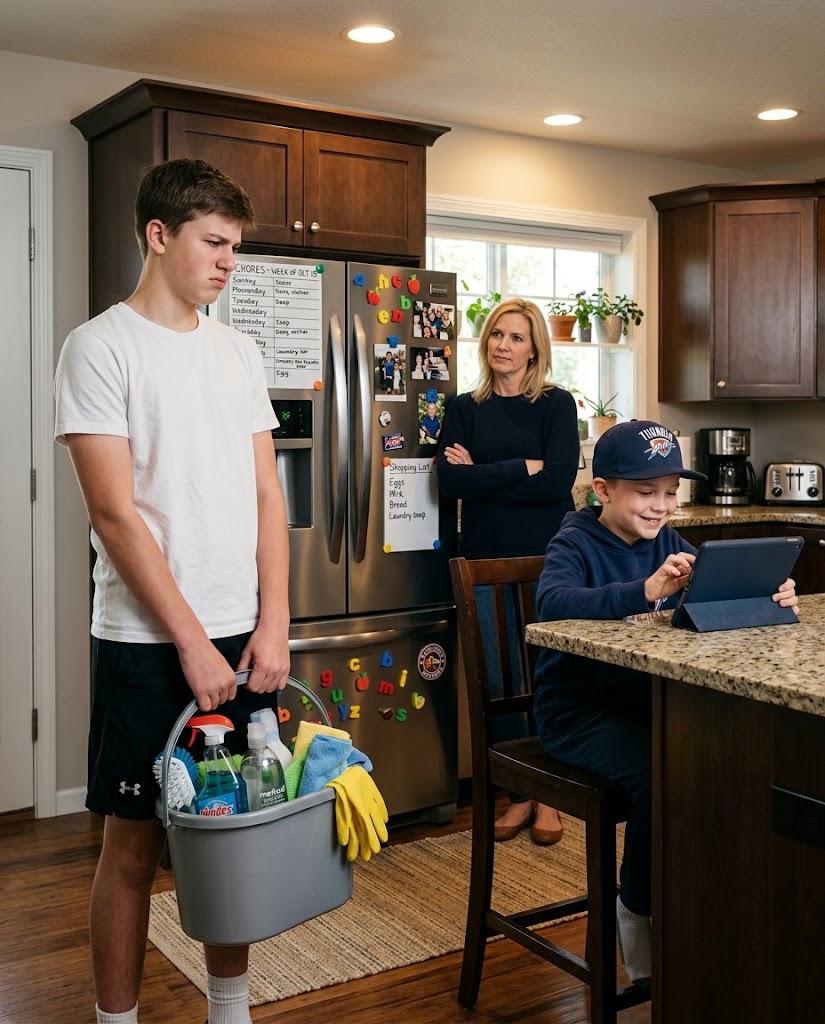
MY WIFE FORCED MY 12-YEAR-OLD TO SCRUB TOILETS WHILE HER SON RECEIVED AN iPAD—THEN OUR NEIGHBOR SENT ME A SINGLE PHOTO
My neighbor sent me the photograph just nine minutes after my son assured me that everything was fine.
I was sitting in a Dallas hotel room, still wearing the tie I’d loosened during our video call. Ethan had smiled at the camera. My stepson, Jayden, had proudly shown off his new iPad.
Then a message from Debbie Foster appeared on my screen.
Andy, I took this picture in your kitchen this morning. Before you call anyone, take a close look at both columns.
The refrigerator in the photograph belonged to me.
So did the crooked Oklahoma City magnet, the grocery list, and the photograph of two boys wearing matching baseball caps.
But the chore chart was different.
ETHAN: Wash dishes every night. Vacuum downstairs. Vacuum upstairs. Walk Duke before school. Walk Duke after dinner. Take out the trash. Clean both bathrooms. Saturday yard work.
JAYDEN: Homework. iPad time.
A smiling face appeared beside Jayden’s name.
I zoomed in until I noticed a blue smear beneath the word bathrooms. My twelve-year-old son’s list nearly filled the entire page. My wife’s eleven-year-old son had absolutely no household chores assigned to him.
Back in June, I had created a completely different chart.
The boys had helped decorate it. We’d divided the smaller chores between them, while Vanessa and I handled the bigger responsibilities.
That original chart had been hanging on the refrigerator every weekend I returned home.
I knew because I’d even congratulated myself for creating it.
My name is Andrew Mitchell, though most people call me Andy. I was forty-one years old, working as a regional sales manager, and three years into a marriage I believed had become stable and dependable.
My first wife, Sarah, lived in Dallas. Ethan spent most of the school year with me in Oklahoma City, where he’d remained after our divorce so he could stay close to his school and friends. He visited Sarah regularly and spent longer periods with her during school holidays.
We’d established an arrangement that worked well.
Then, in June, I accepted a temporary assignment covering several territories. What was supposed to last six weeks stretched into sixteen. I left every Monday and returned home on Friday.
My commission checks got bigger.
My son’s life didn’t.
I simply hadn’t realized it yet.
I called Debbie.
She picked up immediately, as though she’d been waiting beside her phone.
“Tell me exactly what I’m looking at.”
“The chart that’s there when you’re away.”
I got to my feet.
“Are you certain?”
“I’ve seen the other one, Andy. The one with both boys’ names side by side and roughly the same number of chores.”
Debbie was sixty, retired from the county library, and lived directly across our narrow residential street. Sometimes she’d bring over a casserole when she cooked too much. Vanessa always returned the dishes washed and clean.
That morning, Debbie had stopped by to collect a glass baking dish.
“Vanessa invited me in for coffee,” she explained. “She received a call and went into the laundry room. I happened to be standing near the refrigerator.”
“You took a picture without asking her?”
“Yes.”
Her voice carried no defensiveness.
“Last week, I’d asked her whether Ethan ever got a break. She told me he enjoyed being helpful. This morning, I saw what being helpful actually meant.”
Debbie sent me two brief clips from her doorbell camera. Both showed the front of our property, with nothing from inside the house visible.
In the first clip, Ethan walked down the sidewalk wearing a raincoat, Duke’s leash in his hand. The timestamp showed 7:02 a.m. He stopped at our steps, wiped the dog’s paws with a towel, and hurried inside.
The second clip was recorded on Saturday. Ethan was carrying a yard-waste bag toward the curb.
Neither recording, on its own, showed anything especially troubling.
Children walk dogs. Children help with yard work.
But when I looked at them alongside that photograph, those ordinary moments suddenly seemed different.
“Did he tell you anything?” I asked.
“Last Thursday, I invited him to help me put together a little weather station I bought. He said he couldn’t.”
“Was he busy with homework?”
“He told me, ‘I haven’t earned any free time yet.’”
I pressed my thumb against the paper cup in my hand until its rim crumpled.
During our video call, I’d asked Ethan whether he’d finished his math homework.
“Done,” he’d replied.
Vanessa had been standing beside him. She placed a hand on the back of his chair and smiled.
“He gets distracted sometimes, but we’re working on it.”
I opened my email.
Two weeks earlier, his seventh-grade teacher had contacted me to say he seemed unusually tired during first period. He had three missing assignments. She wanted to know whether anything had changed at home.
I’d forwarded her message to Vanessa.
Her response arrived quickly.
He’s testing boundaries. I’ll make the routine stricter.
I’d answered: Agreed. School comes first.
Then, during the following weekend, I’d taken Ethan’s game controller away until he caught up with his schoolwork.
I could still picture his expression when I’d done it.
He hadn’t protested.
“Andy?” Debbie asked.
“I’m listening.”
“I haven’t shared these pictures with anybody else. This concerns your son’s life. Please handle it carefully.”
I thanked her before calling Vanessa.
She answered with the television playing somewhere in the background.
“Is everything all right?”
“How’s the chore schedule working?”
“Fine.”
“Are both boys doing their share?”
“Of course.”
I stared at the smiling face beside Jayden’s name.
“Ethan seemed tired.”
“Andy, he’s twelve. At twelve, everything feels like a tragedy.”
That morning, she’d been looking at the actual chart. That evening, she delivered the answer without the slightest hesitation.
I asked where Ethan was.
“Getting ready for bed.”
“Can I talk to him privately?”
She paused.
“He’s brushing his teeth. Don’t start another conversation now. You know how difficult it is to get them settled.”
I said goodnight.
Then I called my manager and explained that I needed to work remotely for the rest of the week. I wasn’t requesting time off. I’d continue managing my accounts. I simply needed to get home.
After that, I opened the photograph I’d taken in June, when the boys stood beside our original chore chart.
Two boys. Two columns. Two smiling faces.
Until that night, I’d believed the picture showed a fair and balanced household.
Now I Realized It Was a Picture of the Life I Was Allowed to See.
I arrived home on Wednesday, two days earlier than expected.
At 5:40, I opened the garage door quietly and entered a house filled with the scent of lemon cleaner and baked chicken.
Duke greeted me first.
Jayden was sprawled on the sofa with his headphones on. He looked up in surprise and lifted one earcup.
“Hey, Andy. You’re home early.”
“Where’s Ethan?”
“Upstairs in the bathroom.”
I walked past the refrigerator.
The long column was still there.
Vanessa was standing at the stove. The moment she noticed me, her eyes moved toward the chart before settling on my face.
“What happened?”
“I finished everything I needed to do.”
“You should’ve called first.”
I went upstairs.
Ethan was kneeling beside the toilet in the hallway bathroom, wearing yellow cleaning gloves. A cloth lay on the closed toilet lid. His backpack was sitting outside the doorway.
He spun around so quickly that his shoulder struck the vanity.
“Dad?”
I crouched beside him.
“Take those gloves off.”
“I only have this one left.”
“I’ll take care of it.”
He glanced toward the staircase.
For a brief moment, I watched him trying to decide which adult’s instructions he could safely follow.
“Have you finished your homework?” I asked.
“Some of it.”
“Go get your books. We’ll sit down at the table together.”
Vanessa appeared in the doorway.
“He needs to finish what he starts, Andy.”
“He’s done enough.”
I spoke quietly. Ethan removed his gloves.
Vanessa waited until he’d gone downstairs.
“You’re undermining me.”
“I’m taking over the bathroom.”
“This is how he learns that he can run to you whenever he doesn’t like something.”
I lifted the damp cleaning cloth.
“We’ll discuss this later. You and I will talk later.”
For the next ten minutes, I scrubbed the floor around a toilet while trying to remember the last time I’d cleaned one in my own home.
I could recall negotiating a six-figure contract.
I could remember precisely what I’d paid for our new grill.
But I couldn’t remember this.
Downstairs, Ethan had opened his math book. Jayden had paused his game and stood watching him from the doorway.
I washed my hands and took a seat beside my son.
“Which problem are you working on?”
He pointed to one.
We continued until dinner. Once he understood the pattern, he solved three problems independently. His pencil moved steadily across the page. He wasn’t being careless. He wasn’t refusing to make an effort.
He simply needed time.
During dinner, Vanessa talked about a customer at the dental office where she handled billing. Jayden described something he’d created in his game.
Ethan ate with both feet tucked beneath his chair.
When dinner ended, he stood up and started gathering everyone’s plates.
“Leave those,” I told him. “I’ll wash them tonight.”
His fingers tightened around a fork.
“But it’s Wednesday.”
“What happens on Wednesdays?”
He looked toward Vanessa.
“Nothing.”
Jayden seemed puzzled.
“He always has to do it when you’re gone.”
Vanessa placed her glass on the table.
“Jayden.”
“What? It’s true.”
I took the plates from Ethan.
“Finish your homework. Afterward, you can spend some time doing something you enjoy.”
“Even if I haven’t finished vacuuming?”
“Even then.”
That was the first moment Vanessa stopped pretending everything about the evening was perfectly normal.
After Ethan finished his homework, I took him onto the front porch. We sat on the steps where he used to line up his toy trucks.
He’d grown too tall for that game, but I could still see a small scratch one of the wheels had made in the paint.
I placed my phone between us and opened Debbie’s photograph.
“I know about this chart.”
He examined it without appearing surprised.
“How long has this been happening?”
“Since you started traveling for the summer.”
“What happens to the other chart?”
“She puts it back on Friday before you get home. Usually.”
“Does Jayden know?”
“He thinks the rules are different on weekends.”
I waited for him to continue.
Ethan picked at a loose thread on his jeans.
“It’s okay. He’s younger. I can do it.”
“He’s only one year younger than you.”
“He gets upset.”
“And you don’t?”
His chin began to tremble. He lowered his eyes toward the street.
I wanted to tell him immediately, loudly, that none of this was his fault. I wanted the entire neighborhood to hear me say it.
Instead, I gave him time.
Then I told him, “You don’t have to protect anybody in this house by doing all the work yourself.”
He covered his face with both hands and started crying.
“She said you’d be disappointed in me.”
“What would I be disappointed about?”
“If I told you. She said you were working so hard to keep us together, and if I complained, it meant I didn’t want this family.”
A car drove past us. Neither of us turned to look.
“She said maybe I should live somewhere I wouldn’t have to share.”
“With your mom?”
He nodded.
“I love Mom. But I didn’t want you to think I didn’t want you.”
I moved closer without pulling him toward me. He leaned against my shoulder by his own choice.
“I want you here because you’re my son,” I said. “You never have to earn that by cleaning.”
He began to cry harder.
There was no dramatic collapse. He cried the way a child cries after spending a long time trying to convince everyone that he’s fine.
I stayed beside him.
After a while, he began describing his evenings.
He washed dinner dishes, then vacuumed if Duke had shed. After that came the trash and another check of the bathrooms. Some chores appeared on the chart; others were added whenever Vanessa noticed something that needed doing.
By the time he opened his schoolbooks, he was exhausted. On most school nights, he said, it was around nine thirty.
When he asked about the fifteen dollars I’d promised him every Sunday beginning in August, Vanessa told him she was keeping the money until he became more responsible.
Eight Sundays.
Not a single payment.
“I should’ve told you,” he whispered.
“I should’ve asked better questions.”
“You did ask if everything was okay.”
“With someone standing right beside you.”
He nodded.
I apologized for taking away his game controller. I apologized for treating his missing assignments as a discipline problem. I apologized for allowing an email from his teacher to become another reason to punish him.
He listened with his cheek resting against my sleeve.
When we went inside, he stopped near the bottom of the stairs.
“Dad?”
“Yes?”
“Did you tell the science camp I didn’t want to go?”
I remembered the camp brochure. I remembered Vanessa telling me Ethan had changed his mind.
“No,” I replied. “I was told you’d changed your mind.”
His expression shifted.
“I filled out the entire form.”
Then he went upstairs and returned with a folder he’d kept beneath his bed.
Written across the front, in careful block letters, were the words: THINGS TO ASK DAD WHEN HE’S HOME.
The Following Morning, I Drove Both Boys to School.
Before Ethan got out of the car, I promised him there would be no cleaning assignment waiting for him when he returned home. We’d work out a reasonable amount of household responsibility later.
For now, he could concentrate on school and enjoy being twelve.
Jayden waited until Ethan had closed the car door.
“Am I in trouble?”
“What for?”
“The iPad.”
“No.”
“Mom said Ethan doesn’t like games.”
“Ethan enjoys some games. People can like different things.”
Jayden studied the tablet case resting in his lap.
“I thought he just liked cleaning.”
I couldn’t answer that without turning an eleven-year-old into a witness against his own mother.
“Go have a good day,” I told him. “The adults have some things to work out.”
When I returned home, Vanessa had taken the weekday chart off the refrigerator.
“Put it on the table,” I said.
“There’s no reason to make a production out of this.”
“And bring me the other chart.”
She stared at me for a long moment before opening the pantry and reaching behind a roll of shelf paper.
The weekend chart was folded and creased.
She placed both sheets on the table.
There they were: the household I’d approved and the household my son had actually been living in.
“Ethan volunteers,” she said.
“Then why did you need two separate charts?”
“The routines are different when you’re away.”
“Why didn’t you tell me?”
“Because you come home wanting everything to be easy.”
The accusation struck a nerve.
I did want easy weekends. Pancakes, movies, two boys who appeared happy, and a wife who assured me that she’d handled the difficult parts.
I’d accepted those explanations without asking many questions.
“You’re right that I wanted things to be easy,” I admitted. “But that doesn’t explain why you threatened him when he wanted to tell me the truth.”
“Did he tell you that?”
“He told me he believed complaining would cost him his place in this family.”
“I never said he’d lose his place.”
“You told him that telling me meant he didn’t want this family.”
“I was trying to stop him from comparing everything with Sarah’s house.”
“Then explain the chart.”
She placed her fingers on the corner of the longer sheet.
“Jayden has trouble adjusting to changes.”
“He can put a plate in the dishwasher.”
“Ethan is older.”
“By one year.”
“You have no idea how much I have to manage while you’re away.”
“Then you should’ve asked me for help.”
“I couldn’t exactly call you back from Texas just to vacuum.”
“No. But you could’ve told me the arrangement wasn’t working. We could’ve hired help, changed my travel schedule, or lowered our standards. Instead, you made Ethan carry the burden.”
She pushed her chair backward.
“He isn’t my child, Andy. I can’t manufacture the same feelings.”
Her words hung between us.
I waited until I could speak without raising my voice.
“You married into a household with a child. You agreed to help care for him. Whatever your feelings are, he deserves to be treated decently.”
She started crying.
I didn’t tell her to stop, but I didn’t allow her tears to bring the conversation to an end, either.
I photographed both charts, placed the originals in a folder, and told her the boys would not be dragged into any arguments about what had happened.
“There’s more,” I added. “The camp. The money. I’m checking everything.”
“You think I’m a criminal now?”
“I think I’ve accepted explanations that weren’t true.”
That afternoon, I met Ethan’s homeroom teacher, Ms. Greer, after dismissal while he waited in the office.
I explained enough to account for his exhaustion and missing assignments. I kept the details of Vanessa’s childhood and our marriage out of the conversation.
Ms. Greer opened a folder.
“He wrote this last week.”
His assignment concerned a summer experience. Ethan’s paragraph appeared halfway down the page.
This summer I learned how to clean a whole house. Jayden learned how to beat his game. I think we both got better at something.
Below the paragraph, Ms. Greer had written: What would you have liked to learn?
His response consisted of a single word.
Robotics.
I sat down.
“He told me he never attended the summer program,” she explained. “I helped organize that program. We had reserved a place for him.”
“Vanessa told me he’d changed his mind.”
Ms. Greer paused.
“That’s what the cancellation notice said.”
“Could I see it?”
She checked the correspondence on her computer and printed the message that had released his place.
It had been sent from Vanessa’s own email address. She was listed as an authorized household contact.
Ethan has decided he would rather help at home this summer. Please give his place to another child. Andrew is traveling, so please confirm with me.
There was no forged signature.
There didn’t have to be.
She had taken advantage of the trust we’d placed in her.
I checked the date: June 18.
Two days later, I’d texted Ethan, Sorry camp didn’t work out. We’ll find something else.
He’d replied: Okay, Dad.
I’d never found anything else.
Ms. Greer offered him a place in an after-school building club. I asked for the details and promised to arrange transportation.
Then I walked into the office.
Ethan stood up as soon as he saw the paper in my hand.
“I didn’t change my mind,” he said quickly.
“I know.”
“I really wanted to go.”
“I know that now.”
He studied my face, searching for any sign that I was angry with him.
I knelt beside his chair.
“I believe you.”
He nodded once.
I Wish Those Three Words Had Come Before the Summer Was Over.
That night, I spread the household records across my desk.
In June, I’d transferred six hundred dollars for summer activities: three hundred for each boy. Vanessa had asked to handle the registrations because I was leaving for a sales meeting.
The money had been spent on Jayden’s tablet, a gaming chair, a protective cover, cables, and the sales tax.
All six hundred dollars.
The explanation I’d received for the iPad was that Jayden’s grandparents were helping pay for a device he could use for school. When I questioned Vanessa about it now, she admitted they hadn’t contributed anything.
She’d simply wanted me to stop asking questions.
There was also another eighty dollars I’d sent in July to repair Ethan’s bicycle. The bike was still leaning against the garage wall, its wheel bent.
Then there were the eight Sunday payments of fifteen dollars, covering August 2 through September 20.
Jayden had received his money.
Ethan hadn’t received a cent.
Inside his folder, I found a sheet listing eight dates, each followed by an empty box.
At the bottom, he’d written: Ask when things are less busy.
I added up the money that had specifically been meant for him.
Three hundred dollars for activities. Eighty dollars for the bicycle. One hundred twenty dollars in allowance.
Five hundred dollars.
“The money for the bicycle went toward buying groceries.”
“We already had money for groceries.”
“Unexpected expenses happen.”
“And what about his allowance?”
“I planned to give it to him once his grades got better.”
“His grades were falling because he was spending time doing the chores you gave him.”
She lowered her eyes to the documents.
“Do you want me to return the money?”
“Yes. It will come out of your personal spending budget. We’ll set aside the activity money for him, repair his bicycle, and reinstate his allowance.”
“All right.”
Her answer came too easily. It sounded like a deal she wanted to finish so she could escape the conversation.
I shut the folder.
“Returning the money doesn’t resolve everything else.”
“What more do you expect from me?”
“I haven’t made a decision about our marriage yet. But I know Ethan cannot continue living like this.”
Then I called Sarah.
I didn’t start by talking about Vanessa.
I started by admitting my own mistakes.
“I failed to notice something serious happening in our home. I need you to understand what happened and what I’m doing about it tonight.”
She listened quietly as I explained everything: the chore charts, the unfinished assignments, the canceled camp, and the missing money.
When I finished, she said, “Let me speak to Ethan.”
He carried the phone upstairs.
I remained at the kitchen table, waiting for him to return.
His eyes were damp when he came back, but he seemed to be holding himself differently.
“Mom says she never thought I was being difficult.”
“Why would she think that?”
He glanced toward the hallway.
“Vanessa told her Mom was upset because I kept asking to change the times of our calls.”
Sarah had requested earlier calls because of her hospital shifts. Vanessa had told her that Ethan preferred speaking later.
Meanwhile, Ethan had been led to believe his mother was too busy and didn’t want him interrupting her.
Another decision had been made for him without his knowledge.
Another conversation between adults had taken place while he was left out.
I picked up the phone.
Sarah’s voice was unusually soft.
“I asked you twice this summer if everything was all right.”
“I remember.”
“You told me you had everything under control.”
“I honestly thought I did.”
“You need to stop saying that.”
“You’re right.”
She told me she would drive up on Friday. Ethan could spend the weekend with her, or they could stay somewhere nearby. He would have a say in what happened, and we would hear his wishes before making any major decisions.
“I don’t want him thinking he’s the one being sent away,” she said.
“Neither do I.”
“But we need an actual plan. You can’t take a couple of days off and then return to the airport as if nothing happened.”
After ending the call, I opened the job listings on my company’s website.
An account-training position was available at our Oklahoma City office. I had previously dismissed it because the salary was lower and the job title didn’t feel like a promotion.
This time, I read the entire listing.
Less travel. Mostly local clients. A more consistent schedule.
The position paid approximately eighteen thousand dollars less each year.
For months, I had convinced myself that all my traveling was for the family’s benefit.
I had pictured a renovated kitchen, a healthier savings account, and a more expensive family vacation.
I had never imagined my son saving empty boxes so he could earn money he was too frightened to ask for.
I emailed my manager and requested a discussion about transferring to the position.
Then I canceled our appointment with the kitchen contractor.
The following afternoon, Sarah arrived carrying an overnight bag and the blue sweater Ethan was always borrowing from her.
She hugged him before she even said hello to me.
While the boys spent an hour at Debbie’s house putting together the weather station Ethan had missed, Sarah and I talked.
Vanessa objected when Sarah suggested reviewing the living arrangements and consulting someone who could help us develop a practical parenting plan.
“So now you’re letting your ex-wife control our household?”
“She’s helping protect her son,” I replied.
“Our son,” Sarah corrected.
I nodded.
That evening, Ethan decided to stay home. Sarah slept in the guest room, and I stayed down the hall. He wanted to sleep in his own bed.
Before going upstairs, he asked where the new plan would be written down.
“We’ll put everything on a calendar,” I told him.
“No. I mean, what happens if it doesn’t work?”
I glanced at Sarah.
Ethan nervously twisted the cuff of her sweater.
“What if you have to leave again? Or someone gets angry when I say no? Where can I go then?”
He wasn’t asking us to guarantee that everyone would suddenly become kind.
He wanted to know there would be somewhere safe for him if we failed him again.
On Saturday morning, we gathered around the kitchen table.
There were no videos playing and no collection of accusations for the boys to look through. Sarah and I had already reviewed the records with Vanessa.
Now the children needed an explanation they could understand, along with a plan the adults would be responsible for following.
I turned to Ethan first.
“I believed things without checking the facts. When your teacher told me you were struggling, I blamed you instead of finding out what was happening. I was wrong.”
He kept his eyes on the edge of the table.
“You will never have to earn your place in this family by cleaning.”
Then I faced Jayden.
“You didn’t make these rules. You’ll learn to help with some household chores because you live here too. Having things doesn’t mean you’ve done anything wrong.”
Jayden nodded, although he continued watching his mother.
Vanessa had brought a printed confirmation from the bank.
She placed it in front of Ethan.
“Five hundred dollars has been returned to you. Your dad will keep your activity money separate and arrange to have your bicycle repaired. Your allowance belongs to you.”
Ethan looked at me for confirmation.
I nodded.
Vanessa took a deep breath.
“I gave you chores I never assigned to Jayden. I kept it secret from your dad. I also said things that made you afraid to speak up.”
Her voice trembled.
“I canceled your camp after you told me you wanted to go.”
For the first time, Ethan raised his eyes to meet hers.
“Why?”
For a moment, I expected her to blame stress, her job, or the challenges of managing two children.
Instead, she answered honestly.
“Because it was easier for me to keep you home helping me.”
Everyone fell silent.
“That wasn’t right,” she continued. “You deserved to have things you wanted for yourself.”
“Did I fill out the form incorrectly?”
“No.”
That question almost broke me.
For the entire summer, he had been wondering whether the problem was something as small as his handwriting.
Sarah rested her hand on the table beside his.
“You don’t have to respond to anything right now,” she assured him.
He nodded.
I brought out the new chore board.
Across the top, I wrote ANDY and VANESSA in large letters.
Jayden leaned closer to look.
“What goes up there?”
“Most of the household work,” I explained.
Cooking. Cleaning the kitchen after meals. Bathrooms. Laundry. Yard work. Walking Duke.
Beneath those names, we listed the boys’ regular responsibilities: putting away their belongings, helping set or clear the table on agreed days, folding their clean clothes, and spending a little time each weekend tidying their bedrooms.
Homework would come before additional chores. A major school assignment could mean changing the schedule. The same applied to illness, school activities, or a reasonable request for an adjustment.
The adults would handle those decisions.
Neither boy would have to convince the other to cooperate before being allowed to finish his responsibilities.
“What about Duke?” Ethan asked.
“Vanessa and I will take care of his regular walks. You can come along whenever you feel like it.”
“But he likes me.”
“He’ll still like you when someone else holds his leash.”
We agreed that both boys would receive equal allowances, paid directly to them every Sunday. Their device restrictions would be clear and similar. They would always have access to school resources and be able to contact their parents.
Sarah helped us prepare another calendar showing who would collect Ethan, where he would go after school, and how he could reach us.
With Debbie’s permission, we added her phone number beside ours.
“You aren’t responsible for keeping an eye on the adults,” I told Ethan. “We’ll communicate with one another. You can tell us when something feels wrong without having to fix it yourself.”
He studied the calendar twice.
Then I took a photocopy of the old chore chart.
I ripped the copy in half.
I kept the original documents in the folder because I wanted a record of what had happened, even when we no longer needed to examine it every day.
“This chart doesn’t control our home anymore,” I told him.
Ethan picked up the marker.
Beside my name, he wrote: Trash on Tuesdays.
I smiled.
“That’s fair.”
On Monday evening, Jayden helped me wash the dinner dishes.
His job was to rinse six plates and place them in the rack while I washed the pans. Vanessa stood nearby, putting away the leftovers.
He was wearing rubber gloves that were much too big for his hands.
One plate slid against the side of the sink. It didn’t break, but he immediately froze.
“It’s okay,” I assured him.
He tried again, splashing water onto his shirt.
Then he started crying.
“I’m terrible at this.”
“You’re still learning.”
“Ethan knows how to do everything.”
Ethan was walking through the kitchen with a book in his hands. He stopped when he heard that.
For a moment, I recognized his old instinct to solve every problem himself.
Before I could remind him that he didn’t need to take over, he spoke.
“I could show him one thing.”
He looked at me for permission.
“Just one thing.”
“That’s up to you.”
He moved beside Jayden and demonstrated how to angle the plates so they would sit securely in the rack.
“Put them in like this. Then they won’t fall over.”
Jayden wiped his cheek against his shoulder.
“Did you get it wrong too?”
“Yeah.”
“Did you cry?”
Ethan glanced down at the sink.
“How could I not? Most of the time, I didn’t even know when I was finished.”
He paused to take a breath.
“I cried a lot at first.”
Vanessa shut the refrigerator door.
Ethan demonstrated the plate placement once more before returning to his book.
I stayed in the kitchen until the final pan was clean.
That night, at 10:14, I heard someone walking in the hallway.
Ethan stood in front of the new board, wearing his pajamas.
“What’s the matter?”
“Nothing.”
He stared at the empty space beneath Tuesday.
“I thought maybe I’d forgotten something.”
I walked him back to his bedroom.
“You can go to sleep now.”
He climbed into bed, but when I switched off the light, his eyes were still fixed on the doorway.
The old chart was gone.
My son was still afraid he might have missed something.
PART 6 — WHEN SAYING NO COMES AT A COST
During the first few weeks, Ethan kept asking permission to do ordinary things.
Could he read before dinner?
Could he attend the building club even if Duke needed to be walked?
Could he call Sarah without waiting for Vanessa to finish whatever she was doing in the kitchen?
Sometimes, he apologized before asking.
We answered him patiently every time.
After Sarah and I discussed the idea with him, Ethan agreed to see a counselor who worked with children. He would be allowed to speak privately, and nobody would demand that he tell us what he discussed afterward.
Vanessa started attending counseling herself. We also began marriage counseling with a woman named Ms. Tobin.
During our second appointment, Vanessa spoke about her mother.
Her mother had earned a living cleaning other people’s houses. During school holidays, Vanessa sometimes went along with her, sitting at kitchen tables doing homework while her mother worked.
“I hated watching her come home exhausted,” Vanessa explained. “I promised myself that Jayden wouldn’t spend his childhood cleaning up after other people.”
Ms. Tobin allowed her to finish speaking.
“Helping around the house doesn’t make a child less important,” she said. “And your mother’s work was worthy of respect.”
Vanessa wiped the tears from her eyes.
“I understand.”
“What did you believe Ethan was supposed to be?”
Vanessa remained silent.
The counselor waited for her to respond.
At last, Vanessa admitted, “I expected him to be useful.”
“And what did you expect Jayden to be?”
“Happy.”
The atmosphere in the room suddenly felt suffocating.
Ms. Tobin asked Vanessa about the two chore charts.
“You understood what Andy would regard as fair. So what made you put that chart aside?”
Vanessa glanced at me before lowering her gaze.
“I thought I could get away with using the other one.”
For the first time, she offered an explanation that didn’t depend on Ethan having misunderstood her intentions.
During my own counseling session, I described how frequently I had asked whether everything at home was running smoothly.
The counselor wanted to know how often I had asked Ethan what he actually did during his afternoons.
I struggled to remember more than a handful of occasions.
I had confused a quiet child with a happy one.
Two weeks after submitting my application, I interviewed for the local training position. My manager encouraged me to carefully consider the reduction in pay.
I had already considered it.
When the offer arrived, I accepted.
Our kitchen remained unchanged. We went through our expenses, postponed the vacation we had been planning, and agreed on how much each adult would contribute.
I explained to the boys that I was changing positions because the new schedule would be better for our family.
I never told Ethan that he was the reason I would earn eighteen thousand dollars less.
He had already spent far too much time worrying about responsibilities that belonged to adults.
By the end of October, he was attending the building club twice each week. I picked him up afterward, listened to him explain motors and gears, and learned that a project could fail without its creator deserving punishment.
His overdue assignments gradually became fewer. His first improved math score wasn’t flawless.
He pinned it above his desk anyway.
But the afternoon that followed meant more to me than any report card.
I was participating in a work call from the spare bedroom. Vanessa had invited two friends over for coffee. Jayden was arranging cookies, while Ethan worked on a project that was due Monday.
Through the doorway, I heard Vanessa say, “Ethan, could you quickly vacuum the living room before my friends arrive?”
There was a brief silence.
“That’s not on my list.”
“I know. I’m asking you to help.”
“I need to finish my project.”
Another pause followed.
Then I heard a sharper tone in Vanessa’s voice.
“It would only take ten minutes.”
My hand immediately reached for the doorknob.
Then I heard Ethan respond.
“I opened the door.
Ethan stood there with his notebook pressed against his chest.
Vanessa noticed me, and a flush spread across her face.
For a moment, none of us said anything.
I finally spoke.
“We need to respect his answer.”
She glanced at the notebook in his hands.
“Right,” she replied.
Her response wasn’t smooth or immediate.
Nevertheless, she turned toward the closet and pulled out the vacuum cleaner.
“I’m having guests over. I’ll take care of it.”
Ethan remained where he was.
Vanessa looked at him again.
“You’re not in trouble.”
He returned to his bedroom.
Later, Vanessa asked if we could talk privately.
“I wanted you to support me,” she admitted.
“I know.”
“I felt humiliated.”
“His answer still deserved respect.”
She slowly nodded.
That evening, she called Sarah herself.
She explained what had happened, including how she had continued pressuring Ethan after he refused.
She didn’t dismiss the incident as a simple misunderstanding.
“Andy had to step in and stop me. I still have a lot of work to do on myself,” she told Sarah.
Sarah listened and thanked her for telling the truth.
After the call ended, Vanessa remained seated at the kitchen table for a long time.
The next challenge came from someone who had known her since childhood.
Her mother called on Sunday. At first, I heard only Vanessa’s side of the conversation. Then she switched on the speakerphone so I could hear a question about their next visit.
Her mother eventually said, “I hope all this drama about housework is over now. Boys his age should learn to be useful.”
Vanessa switched off the speaker and walked into the pantry.
I could still hear her clearly.
“Mom, please listen to me. I wasn’t asking him to do normal household chores. I was making him do most of the work and keeping it hidden.”
There was a pause.
“No. Sarah didn’t make this happen.”
Another silence followed, longer than the first.
“If you come to visit, you will not tell Ethan he’s ungrateful. You won’t bring this up with either of the boys.”
She returned with tears in her eyes.
Jayden looked up from the model kit he was assembling.
“Is Grandma angry?”
“Grandma and I don’t agree about something,” Vanessa explained. “It’s not your job to fix it.”
I watched Ethan carefully.
He had heard what she said.
He returned to attaching a wheel to the little car he was building, although his hands had stopped trembling.
That night, Vanessa asked whether she could see his project.
He answered, “Not right now.”
She paused.
“That’s okay. Let me know if you change your mind.”
He never did.
She respected his decision and allowed him to leave his bedroom door open without entering.
PART 7 — THE DECISION ETHAN MADE
In December, Sarah returned for the review we had agreed to conduct after approximately ninety days.
There was no formal gathering or special occasion. We sat together with coffee while the boys worked on a model bridge in the living room.
We began by reviewing the practical arrangements.
I was home on school nights. Transportation to and from the club was arranged. Ethan received his allowance every Sunday, and his bicycle had been repaired in September. Both parents could contact him directly.
The new chore board remained the same regardless of who was home.
Throughout those months, Sarah had continued speaking privately with Ethan. She had also visited whenever her schedule permitted, sometimes staying for an entire weekend and other times coming for a few hours.
We had consulted a family-law attorney about our existing parenting arrangements and the documentation we needed. None of us pretended that an agreement made around a kitchen table could determine the outcome of a court case.
Our goal was to establish clear responsibilities and ensure that genuine alternatives remained available.
When we invited Ethan to join us, he brought along the instruction booklet for his bridge.
“Do I have to choose which house I want to live in?”
“No,” Sarah assured him. “We just want to know whether this arrangement is working for you.”
He turned toward me.
“I still want my bedroom here.”
“That’s fine.”
“And I still want my weekends with Mom.”
“Absolutely.”
He turned the booklet over in his hands.
“Sometimes I still worry that I’m going to get in trouble.”
Vanessa’s eyes began to fill with tears.
Sarah continued gently.
“What do you do when that feeling comes back?”
“I talk to Dad. Or I call you.”
“Does anyone try to stop you?”
“No.”
“Is there anything you’d like us to change?”
He considered the question.
“Can we stop asking whether I’m doing better at every dinner?”
I realized that I had been asking about his grades almost as frequently as I once asked whether everything at home was running smoothly.
“Yes,” I answered. “We can stop doing that.”
He appeared relieved.
“And I don’t want everyone watching whenever I help Jayden. Sometimes we’re just doing things together.”
Vanessa nodded.
“I understand.”
He returned to working on his bridge.
That evening, after the boys had gone to bed, Vanessa and I talked privately.
She wanted to know whether I had decided to remain in the marriage.
“I want to continue working on our relationship,” I told her. “But I need these changes to continue even when nobody is praising us for making them.”
“They have to last.”
“And Ethan doesn’t owe us a happy ending just because we want one.”
“I understand.”
I believed she had learned more than she understood back in September. Still, I couldn’t guarantee that her new understanding would prevent every problem in our future.
But she was making an effort, even when things became uncomfortable.
And I was doing the same.
A few days later, Vanessa brought home two brochures for the following summer.
One advertised a robotics program. The other listed art workshops that might interest Jayden.
She placed both brochures on the kitchen table.
“Ethan, the activity money we put aside is still available. Registration opens in January. Would you like to look at this one?”
He picked up the robotics brochure.
“Is this the same program?”
“It’s a longer session. You can choose this one, the original program, or something completely different.”
“You haven’t registered me already?”
“No. I wanted to ask you first.”
He carefully examined the dates.
“What about Duke?”
“I’ll take him for his walks.”
“What if you’re at work?”
“Your dad and I will figure it out.”
“And who’s going to look after the house?”
Vanessa swallowed.
“We can manage the house ourselves.”
He continued studying the brochure for several minutes.
Then he turned to the section describing a motorized arm designed to move small objects.
“This one,” he said. “That’s what I want to do.”
Vanessa added the registration date to the family calendar.
Ethan picked up the marker and wrote his own reminder beside it.
Not ASK WHEN THINGS ARE LESS BUSY.
Simply SIGN UP.
At Christmas, Jayden gave Ethan a reading lamp.
He had saved some of his allowance and asked me to help him find one that could be attached to a desk.
“I chose the adjustable kind,” he explained. “So you can use it while you’re building things.”
Ethan bent the lamp’s arm and smiled broadly.
His gift to Jayden was a small model-building kit and a pair of green kitchen gloves that fit properly.
When he showed me the gloves at the store, I had hesitated.
“Are you certain you want these?”
“He keeps filling the oversized ones with water,” Ethan explained. “He told me he wanted a smaller pair.”
He wrote a message in a card and sealed the envelope before I could read it.
On Christmas morning, Jayden opened the gloves before anything else.
The card read: KITCHEN CREW. SIX PLATES. NO PANIC.
Jayden burst out laughing.
“You made washing dishes sound like a spaceship mission.”
“It might be if you flood the sink again.”
They both laughed.
Nobody asked Ethan to justify why he was joking about something that had once caused him so much pain.
The joke had been his choice.
After breakfast, I found the boys standing in front of the refrigerator, writing on the marker board.
They had listed their small responsibilities for the upcoming week. They had also added reminders beside the adults’ names.
Vanessa: Walk Duke Wednesday morning.
Andy: Make pancakes Saturday. Don’t burn the first batch.
At the bottom, in Jayden’s handwriting, they had written: Ask before changing anyone’s plans.
Ethan stepped back to examine their work.
“You have to follow it too, Dad.”
“Me too.”
He replaced the marker’s cap.
For the first time, the board looked like something he could change without needing anyone’s permission.
By May, the refrigerator in our kitchen was still the same one.
One of its shelves was loose. The ice dispenser made a sound like a truck struggling to start in the winter. Our kitchen renovation was still on hold.
I had stopped feeling ashamed about it.
Our home looked lived in. Some evenings, puzzle pieces covered the table, and a basket of unfolded laundry sat beside the couch.
The bathrooms were clean enough.
The boys were sleeping peacefully.
That mattered far more than making the house look perfect for a photograph.
Ethan was finishing seventh grade, and most of his old confidence had returned. Difficult days still happened, and a few assignments continued to require reminders.
He no longer apologized whenever someone reminded him.
Instead, he told us when he needed assistance.
Jayden learned to complete his smaller chores without turning every task into an argument. Although, occasionally, he still tried to negotiate.
One rainy Thursday, he asked Ethan to switch their table-clearing duties because a friend was coming over. Ethan explained that he needed to finish a project.
Jayden replied, “Okay.”
Then he cleared the table himself.
I noticed what had happened but didn’t turn it into a lecture.
Vanessa continued attending counseling. She never claimed that all her problems had disappeared. Whenever she caught herself making an old assumption, she corrected herself.
Once, during a family gathering, an aunt commented on what a helpful boy Ethan was.
Vanessa replied, “He really is. He’s also excellent at building things. You should ask him about his project.”
She was giving people another way to see him.
We maintained Sarah’s regular calls and continued planning her weekend visits. Whenever my job occasionally required me to travel, the arrangements were made beforehand. The adults agreed on who would care for the boys, and Ethan knew exactly where he would be staying.
No chore chart changed when my car pulled out of the driveway.
One afternoon, I stopped by Debbie’s house to return the casserole dish that had started everything.
Vanessa had prepared chicken and vegetables in it. She asked me to deliver it and thank Debbie on her behalf.
Debbie invited me to sit on her porch.
“I wasn’t sure you’d appreciate receiving another photograph from me,” she admitted.
“I’d be happy to see a picture of the boys having a good time.”
She smiled before looking toward our house.
“I worried about sending you that first picture.”
“I’m grateful you did.”
“For a while, I convinced myself I was only seeing normal household chores.”
“I made that same mistake.”
She clasped her hands together.
“I had a stepmother growing up. My brother was her biological child. I became the dependable one.”
I turned toward her in surprise.
She rarely spoke about her childhood.
“I learned to say that I didn’t mind helping,” she continued. “People liked hearing that answer. It made their lives easier.”
“Did your father know what was happening?”
“He knew I helped around the house. I don’t think he ever asked what happened when I didn’t want to.”
She wasn’t speaking angrily, which somehow made her words even more painful.
“When Ethan told me he hadn’t earned his free time, I recognized that feeling. Once I saw the chart, I couldn’t keep pretending it wasn’t my concern.”
I thanked her again.
This time, the words carried even more meaning.
On Saturday, May 15, we were preparing to attend the spring open house at the robotics program.
Ethan wanted to see the workshop before summer camp started. Jayden wanted to know whether any of the robots could draw pictures.
Sarah was going to meet us there. She had rearranged her work schedule so she could attend.
I stood at the stove making pancakes.
Vanessa grabbed Duke’s leash. A light rain was falling, and the dog had decided he absolutely refused to go out through the back door.
She slipped on her raincoat.
“Keep the next batch warm,” she told me.
“Which next batch?”
“The one you won’t burn.”
Jayden laughed from his seat at the table.
Duke tugged toward the front door, excited about going for the walk Ethan had once been expected to rush through before school.
Vanessa led him down the steps.
A few minutes later, my phone buzzed.
Debbie had sent me a short clip from her doorbell camera.
Thought you might want to keep this one.
In the video, Vanessa walked Duke past our driveway beneath an umbrella. I stood beside the car, loading the boys’ projects into the trunk.
Ethan stepped onto the porch carrying his model arm. Jayden followed, holding a sketchbook inside his jacket.
Neither boy was carrying a garbage bag.
Neither was rushing back into the house to finish a list of chores.
They were preparing to go somewhere they genuinely wanted to be.
I saved the video.
Later, after receiving everyone’s permission, I printed a still image from the clip and placed it beside the board on our refrigerator.
The original chore charts remained in a folder inside my desk.
I didn’t need to put them on display. But I also didn’t need to pretend that our family had always been this way.
Before we left for the workshop, Ethan stopped near the kitchen doorway.
His model was already in the car. He had put away his breakfast dishes. The table still needed to be wiped, and a pan was waiting in the sink.
“Dad?”
“Yes?”
“I used to think that if I stopped helping, you wouldn’t want me here anymore.”
I turned off the stove.
He wasn’t crying. He was looking straight at me.
“I understand,” I said. “I helped make you feel that way. I’m sorry.”
He nodded.
Then he glanced toward the pan.
“Can I wait in the car?”
“Of course.”
“You don’t need me to finish anything first?”
“I can handle it.”
He remained there for another moment, as though waiting for me to add a condition.
There wasn’t one.
Outside, Jayden called his name.
Ethan walked away.
I watched my son cross the porch and climb into the car beside his stepbrother. Within seconds, they were arguing about which robot they wanted to see first.
It was an ordinary, insignificant argument.
I allowed myself to enjoy hearing it.
Then I picked up the cleaning cloth and wiped the table.
My son had somewhere he wanted to go.
And I had a few things left to do.
Part 2: Debbie was sixty years old, retired from her job at the county library, and lived directly across our narrow residential street. Whenever she cooked more food than her family needed, she sometimes brought a casserole over to our house. Vanessa always returned the dishes washed and clean.
That morning, Debbie had stopped by to collect a glass baking dish.
“Vanessa invited me inside for coffee,” she explained. “She received a phone call and went into the laundry room to answer it. I was standing near the refrigerator.”
“You took a picture without asking her permission?”
“Yes.”
She sounded neither defensive nor apologetic.
“I asked her last week whether Ethan ever got any time to himself. She told me he enjoyed being helpful. This morning, I finally saw what she meant by helpful.”
I lowered myself into the chair again.
Debbie sent me two brief recordings from her doorbell camera. Both captured the front of our property, with nothing inside the house visible.