Part 2: To Mama
The dog sprang into action before Rita could move.
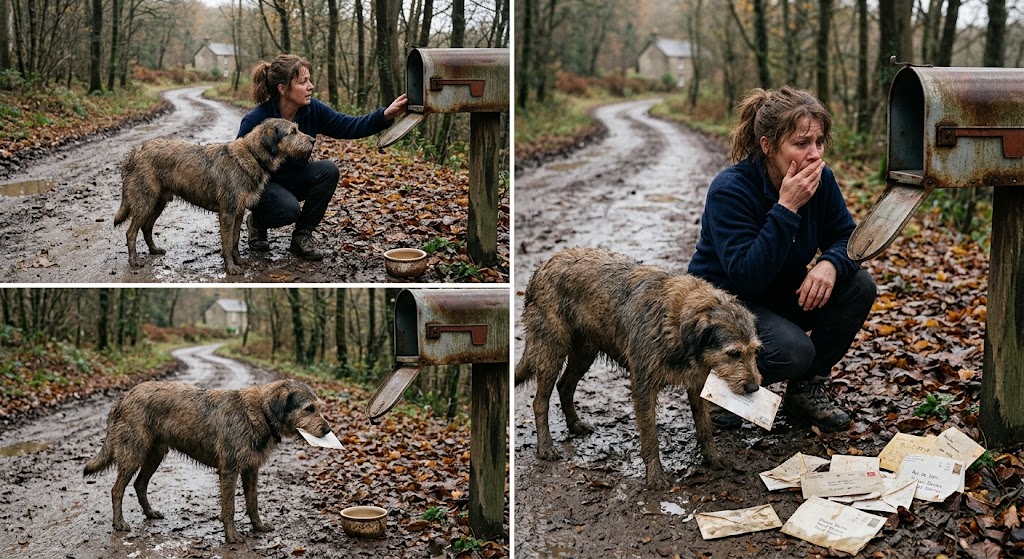
He rushed forward, picked up one of the envelopes lying in the mud with his mouth, and lifted it toward the mailbox, letting out a soft whine. Then he placed it at Rita’s knees and hurried to collect another.
He was trying to return them to the box.
“Alright,” Rita murmured. “Alright, buddy. I’ve got them. I’ll take care of them.”
She bent down and collected the envelopes scattered across the red dirt, brushing away the mud with her sleeve. Dozens more were still stuffed inside the mailbox. She removed them in handfuls.
They weren’t all proper envelopes. A few were, but most were pieces of notebook paper folded and sealed with Scotch tape. Some had been made from the backs of school worksheets. One was even a folded paper plate.
Not a single one carried a stamp or an address.
Every one had the same words written across the front in large, uneven pencil letters. Some were written in crayon, while others were marked in colored pens.
TO MAMA.
Rita lowered herself onto her heels in the mud.
The dog settled beside her, resting his gray-bearded chin on the stack of letters, just as he had been sitting beside the mailbox for the past eight months.
He hadn’t been waiting for someone to arrive.
He had been protecting these letters.
Thunder rumbled over the hills. The light drizzle became a steady rain, with large, icy drops striking the battered mailbox. The paper began to darken with water and curl at the edges.
“No, no, no,” Rita muttered.
She hurried to her Jeep, retrieved an empty plastic mail tub, and returned to collect the letters. She carefully placed every one inside as though each was something precious and fragile.
When she turned around with the tub in her arms, the dog stood directly behind her.
He followed her to the Jeep. As soon as she placed the tub on the passenger seat, he climbed in beside it and settled down, soaking wet and determined to stay within six inches of those letters.
Rita glanced at him. He stared back at her.
“Well,” she said, “looks like you’re coming with me.”
She raised her eyes toward the dirt driveway winding into the trees. Someone had written those letters, and that person couldn’t be far away.
She shifted the Jeep into gear and started up the hill.
The narrow driveway twisted for a quarter of a mile through oak and cedar trees before opening into a clearing. An old single-wide trailer stood at the top, its porch sagging and its roof partly covered by a blue tarp. A child’s bicycle rested among the weeds, and smoke drifted from a stovepipe.
With the mail tub tucked under her arm and the wet dog standing close to her legs, Rita knocked on the door.
It was several minutes before anyone answered.
An elderly woman finally opened it. She appeared to be in her seventies, small and frail, with wisps of white hair and an oxygen tube resting over her ears. An oxygen tank on wheels followed behind her. She peered at Rita through thick glasses.
Then her eyes fell on the dog.
“Rufus!” she exclaimed, her voice weak and breathless. “Where have you been, you stubborn mule? You’re absolutely drenched!”
Rufus wagged his tail and pushed past her into the trailer as though the place belonged to him.
Rita lifted the plastic tub. “Ma’am, I’m the mail carrier for this route. I found these inside the old mailbox down by the road. Your dog was keeping watch over them.”
The elderly woman looked into the tub. Her eyes moved across the crooked pencil writing.
TO MAMA. TO MAMA. TO MAMA.
She slowly raised a hand to cover her mouth.
“Oh, dear Lord,” she whispered. “Those belong to Toby.”
“Toby?”
“My grandson. He’s eight years old and at school right now.” She clutched the doorframe for support. “Every Saturday, he writes a letter to his mama. Every single week. He walks down to the mailbox with Rufus and raises the little flag.”
Rita glanced at the tub filled with letters. Eight months’ worth of Saturdays.
“Ma’am,” she said softly, “that mailbox was removed from my route before I started working here. It’s listed as vacant. Nobody has been collecting anything from it.”
The woman’s expression crumpled with sorrow.
“Nobody ever explained it to him,” she whispered. “He’s just a little boy. Nobody told him that letters need stamps.”
Rita swallowed hard. “Where is his mother?”
The elderly woman reached into the tub with trembling fingers and removed the letter sitting on top. She handed it to Rita.
It was a folded piece of notebook paper sealed with tape. Rita carefully peeled it open.
Inside, written in the same shaky pencil handwriting, were the words:
Dear Mama. I hope prison is not so bad. Rufus says hi. Why don’t you write me back? Did I do something?
Part 3: Eighty-Seven Letters
Her name was Opal Price.
She settled into an old recliner beside the woodstove, the soft hiss of her oxygen filling the room. While rain pounded against the tin roof and Rufus lay near the stove, his wet fur steaming in the warmth, she told Rita the entire story.
Toby’s mother was Opal’s daughter, Shelby. She was twenty-nine years old. Two and a half years earlier, she had received a three-year prison sentence at the McPherson Unit, a women’s correctional facility in Newport.
“Bad checks,” Opal explained quietly. “That’s what they called it. Toby’s daddy left when he was four. Shelby was working two jobs, one at the Sonic and another at the dollar store, but she still couldn’t make ends meet. Toby has terrible asthma. His inhalers cost more than the rent.” Opal shook her head sadly. “She wrote checks knowing there wasn’t enough money in the account. For groceries, medicine, and the electric bill. She thought she could make up the difference before the checks went through. She never managed it.”
Rita lowered her gaze to her hands.
“Felony fraud,” Opal continued. “Three years. The judge said he needed to make an example of her.”
Toby had been five and a half when his mother was taken away. Since then, he had lived with Opal in the small trailer at the top of Pine Hollow Road.
“He began writing to her during the very first week,” Opal explained. “He could barely spell anything back then, so most of his letters were drawings. He’d seal the papers with tape and walk down to our old mailbox with Rufus every Saturday morning. Then he’d raise that little flag.”
“The mailbox by the road?”
“That one. We used it for thirty years. Then, two winters ago, a snowplow knocked it crooked. The post office said it wasn’t safe anymore, so I rented a P.O. box in town instead.” Opal shut her eyes. “I told Toby about the change. I know I did. But he’s still so young. He kept using the old mailbox anyway. And with my lung condition, I can barely make it down to the road anymore. I didn’t realize what was happening, honey. I thought he was giving the letters to his teacher to mail. I had no idea.”
“And Rufus?” Rita asked.
A small smile appeared on Opal’s face.
“That’s Toby’s dog. He found him in a ditch when he was just a puppy. One of his legs was already bad. Toby has trained that dog like a little soldier.” She glanced toward the shaggy brindle dog resting beside the stove. “The first Saturday Toby put a letter in the box, he told Rufus, ‘You watch over Mama’s letters until the mailman comes.’”
Rita stared at the dog.
“And that’s exactly what he did,” Opal whispered. “Every single day. All this time, he’s been waiting for a mailman who never showed up.”
Rita drew a deep breath.
“Has Toby ever received a letter from his mother?”
Opal’s face lost its color.
“No,” she answered. “Not a single one. Not in two and a half years.” Her voice trembled and broke. “Every night, that little boy asks me why his mama never writes back. I tell him she might be busy. Maybe they won’t let her send letters. But he believes…” She stopped, unable to finish the sentence. “He believes she’s forgotten him.”
Rita remained motionless in her chair.
Something was beginning to stir in the back of her mind. A memory connected to the post office.
“Mrs. Price,” she asked slowly, “when did you last check your P.O. box in town?”
Opal blinked in surprise.
“Oh, sweetheart. I haven’t checked it since spring. I can’t drive anymore. My neighbor used to take me, but she died in March.”
Rita immediately got to her feet.
Three hours later, she returned, drenched from the rain and carrying another plastic mail tub.
P.O. Box 114 at the Mountain View post office. Rita had walked past that box every morning for eighteen months. The postmaster had complained about it repeatedly. It was overflowing, packed so tightly with mail that the extra envelopes had been placed in a storage bin at the back.
Rita placed the tub on Opal’s kitchen table.
Inside were dozens upon dozens of envelopes. They were nearly identical in size, and each bore the same blue marking in the corner.
ARKANSAS DEPARTMENT OF CORRECTION. INMATE CORRESPONDENCE.
Every envelope was addressed in neat, careful handwriting to Toby Price, P.O. Box 114, Mountain View, AR.
Opal pressed both hands against her chest.
Rita began counting the envelopes, her fingers trembling as she worked.
Eighty-seven.
Eighty-seven letters from a mother to her son. And an entire tub of letters from a son to his mother. They had been sitting in two separate mailboxes, only four miles apart, for two and a half years.
Neither had ever reached its intended recipient.
“She never forgot him,” Opal cried. “She never forgot her little boy.”
Rita picked up the envelope lying on top of the pile. Her eyes moved to the return address printed in the corner, where the inmate’s name and identification number appeared.
Shelby Price. #714382. McPherson Unit.
Rita suddenly stopped breathing.
She recognized that name. She recognized that number.
For two years, she had slept just eighteen inches beneath it.
At the far end of Pine Hollow Road.
“He began writing to her during that very first week,” Opal explained. “He could barely spell back then. Mostly, he drew pictures. He’d seal them with tape, then walk down to our old mailbox with Rufus every Saturday morning and raise that little flag.”
“The mailbox beside the road.”
“That mailbox served us for thirty years. Then a snowplow knocked it crooked two winters ago, and the post office said it was unsafe. So I rented a P.O. box in town instead.” Opal closed her eyes. “I told Toby. I’m certain I did. But he’s only a little boy. He kept putting his letters in the old box. And with this lung condition, I can barely make it down to the road anymore. I had no idea, sweetheart. I thought he was giving the letters to his teacher to mail. I truly didn’t know.”
“And Rufus?”
A small smile appeared on Opal’s face. “He belongs to Toby. He found him as a puppy in a ditch, with that injured leg. Toby has trained him like a little soldier.” She glanced toward the shaggy brindle dog resting beside the stove. “The first Saturday Toby left a letter in that mailbox, he told Rufus, ‘You guard Mama’s letters until the mailman comes.’”
Rita gazed at the dog.
“And that’s exactly what he did,” Opal whispered. “Every single day. All this time, waiting for a mailman who never arrived.”
Rita drew a deep breath. “Has Toby received any letters from his mother?”
The color drained from Opal’s face.
“No,” she answered. “Not a single one in two and a half years.” Her voice cracked. “Every night, that boy asks why his mama never writes to him. I tell him she might be busy. Maybe they won’t let her write. He believes…” She stopped, unable to continue. “He believes she’s forgotten him.”
Rita remained motionless in her chair.
Something was stirring in the back of her mind. Something she remembered from the post office.
“Mrs. Price,” she said carefully, “that P.O. box you rented in town. When did you last check it?”
Opal blinked at her. “Oh, sweetheart, not since spring. I can’t drive anymore. My neighbor used to take me, but she died in March.”
Rita rose to her feet.
Three hours later, she returned, drenched from the rain and carrying another plastic mail tub.
P.O. Box 114 at the Mountain View post office. Rita had passed it every morning for eighteen months. The postmaster had complained about it countless times. It was overflowing, packed so tightly that the extra mail had to be stored in a bin at the back.
She placed the tub on Opal’s kitchen table.
Envelopes. Dozens upon dozens of them. Every one the same size, each bearing the same blue stamp in the corner.
ARKANSAS DEPARTMENT OF CORRECTION. INMATE CORRESPONDENCE.
Every envelope was addressed in careful, tidy handwriting to Toby Price, P.O. Box 114, Mountain View, AR.
Opal brought both hands to her chest.
Rita counted the envelopes, her fingers trembling. Eighty-seven.
Eighty-seven letters from a mother to her son. And a tub filled with letters from that son to his mother. Two separate mailboxes, four miles apart, holding their messages for two and a half years.
Not a single letter had reached its intended recipient.
“She never forgot him,” Opal cried. “My God, she never forgot him.”
Rita lifted the envelope resting at the top of the pile. Her eyes moved to the return address printed in the corner, where the inmate’s name and identification number appeared.
Shelby Price. #714382. McPherson Unit.
Rita stopped breathing for a moment.
She recognized that name. She recognized that number.
For two years, she had slept eighteen inches beneath it.
Part 4: The Promise in the Visor
Rita stepped onto the porch and stood beneath the falling rain.
Shelby Price.
Top bunk. Cell block C. McPherson Unit.
Rita had been forty-one when she entered that prison. She was serving three years for drug possession. It had started with painkillers after a car accident, then progressed to whatever she could find on the streets when her prescriptions ran out. She arrived trembling, sick, and so furious at the world that she refused to speak to anyone.
But the slender, dark-haired woman sleeping on the top bunk spoke to her anyway.
Every night, whether Rita responded or not.
She talked about her little boy.
Toby. Toby’s freckles. Toby’s asthma. The way he pronounced spaghetti as “pasghetti.” How he had a scruffy dog with an injured leg that he’d rescued from a ditch. How he could whistle by placing his fingers in his mouth.
“He’s going to become a vet,” Shelby would say while lying in the darkness. “Or a fireman. Maybe both. He hasn’t made up his mind yet.”
During Rita’s second month, the withdrawal became so severe one night that she genuinely believed she was dying. She curled up on the concrete floor of their cell, drenched in sweat and shaking uncontrollably. She wanted everything to end.
Shelby climbed down from the top bunk and sat beside her on the freezing floor until sunrise. She held Rita’s hand and talked about Toby for six straight hours, giving her something to focus on besides the pain consuming her body.
“Just hold on,” Shelby whispered over and over. “Keep holding on, and one day you’ll meet my boy.”
On the day Rita was released on parole eighteen months earlier, Shelby pressed something into her palm at the prison gate. It was a school photograph, worn and creased from being carried around for so long. A freckled little boy wearing an oversized red hoodie, smiling broadly with his two front teeth missing.
“He never writes back,” Shelby had told her, her eyes swollen and red. “I send him letters every week, but he never answers. Maybe Mama isn’t giving him my mail. Maybe he’s angry with me.” She tightened her grip on Rita’s hand. “Please find him. Promise me you’ll find my boy and make sure he’s all right. Tell him I love him. Tell him I’m still writing to him.”
“I promise,” Rita had replied.
Then she walked out of prison and became afraid.
There were parole conditions to follow. A new job she desperately needed to keep. A past she wanted to hide from everyone in Stone County. She convinced herself that she didn’t even know where Toby lived. Shelby had only ever said he was somewhere “out past Mountain View.” That could have meant almost anywhere in the county.
Rita slipped the photograph into her sun visor and left it there.
For eighteen months, she had driven past a shaggy dog standing guard beside a damaged mailbox at the bottom of Pine Hollow Road, never realizing that the little boy in the photograph lived at the top of the hill.
Now, standing in the rain, Rita returned to her Jeep and reached up to remove the photograph from the visor.
At 3:40 that afternoon, the yellow school bus rumbled to a stop at the bottom of Pine Hollow Road.
An eight-year-old boy stepped down. He was thin and freckled, with a buzz cut and an oversized red hoodie. An inhaler was clipped to his backpack.
As soon as his sneakers touched the gravel, he turned toward the mailbox and stared at the empty space beside it.
“Rufus?” he called, his voice suddenly filled with fear. “Rufus!”
A shaggy brindle dog came racing down the driveway, limping on his back leg, his ears bouncing wildly. He collided with the boy and sent him tumbling onto the wet gravel.
Toby burst out laughing and wrapped his arms around the dog. Then he noticed the white mail Jeep parked at the bottom of the driveway and the woman standing beside it with a plastic tub in her hands.
His smile disappeared. He stood perfectly still.
“Are you the mailman?” he whispered.
“I’m the mail lady,” Rita replied, her voice trembling. “My name is Rita.”
She knelt on the gravel until their eyes were level. She studied his freckles and the front teeth that had grown back since the photograph was taken. She was looking at the same little face she had carried in her visor for eighteen months.
“Toby,” she began, “I knew your mama. We were friends in that place.”
His eyes widened.
“She talked about you every single night,” Rita continued. “She told me about your freckles, about Rufus, and about how you wanted to become a vet.”
“Or a fireman,” Toby whispered.
“Or both,” Rita answered. “You haven’t decided yet.”
Toby’s lower lip began to quiver.
“She did write to you, sweetheart,” Rita told him. She lowered the plastic tub in front of him. “She wrote every single week. The letters just got lost, the same way yours did.”
Toby stared at the eighty-seven envelopes bearing his name.
The sound that escaped him was something Rita would remember for the rest of her life.
That evening, Toby sat on the trailer floor with Rufus resting his head in his lap. His grandmother sat in her recliner, and Rita settled onto the couch. Together, they read every one of his mother’s letters aloud, starting with the very first. They continued until eleven o’clock at night.
My sweet Toby. I am so sorry, baby. I love you more than all the stars in the sky.
Toby eventually fell asleep with the eighty-seventh letter pressed against his chest.
Before leaving, Rita returned to Opal’s kitchen table and took care of something else. She removed every letter Toby had written from the plastic tub, carefully flattened the pages, and placed them into proper envelopes she had brought from her Jeep. Using her neat postal-carrier handwriting, she wrote the McPherson Unit address on each one.
Then she purchased every stamp herself.
The entire collection went into the outgoing mail the following morning.
The next Tuesday, Rita drove her route with a feeling of lightness in her chest that she hadn’t experienced for years.
As she rounded the bend on Pine Hollow Road, she slowed down.
Rufus was sitting beside the mailbox.
But farther up the driveway, visible through the bare trees, she spotted the flashing red lights of an ambulance. Beside it stood a white car bearing a county seal on its door.
Part 5: The Empty Box
At six that morning, Opal had collapsed on the kitchen floor.
She had suffered a stroke. Toby discovered her when he got up for school and called 911 himself while Rufus barked frantically beside him.
When Rita reached the house, the paramedics were already preparing to place Opal inside the ambulance. She was alive, but one side of her face hung slack, and she could no longer speak.
The white county vehicle belonged to the Arkansas Division of Children and Family Services.
A weary-looking caseworker named Ms. Delaney stood on the porch holding a clipboard. Toby stood beside her in his red hoodie, clutching a black trash bag filled with clothes in one hand. His other hand was buried in the thick fur around Rufus’s neck.
“Do you have any other relatives?” the caseworker asked him gently.
Toby shook his head. “Only Mama. And she’s in prison.”
“All right, sweetheart.” Ms. Delaney bent down to his level. “You’ll need to stay at the children’s shelter in town for a little while, until we work out what happens next.”
Rita stepped forward. “He can stay with me. I’ll take care of him. I know his mother.”
Ms. Delaney turned toward her. “And who are you?”
“Rita Calloway. I deliver his mail.”
The caseworker stopped writing. “Ma’am, I’ll have to conduct a background check before approving any emergency placement.”
Rita felt her stomach sink.
There was no need to run the check. She already knew what it would reveal: a felony drug conviction, a release date less than two years earlier, and an active parole status.
No judge in Arkansas would approve her as a placement for a child.
“Forget it,” Rita whispered.
Toby looked up at her, his eyes shining with tears and confusion.
“Can Rufus come with me?” he asked the caseworker.
“I’m sorry, honey,” Ms. Delaney answered gently. “The shelter doesn’t allow dogs.”
Toby dropped the trash bag. He wrapped both arms around Rufus’s shaggy neck and pressed his face into the dog’s gray beard. Rufus remained completely still, allowing the boy to hold him.
“Guard the box, okay?” Toby whispered into his fur, his voice breaking. “Keep guarding it until Mama comes home. Promise me. Don’t stop guarding it.”
Then the caseworker took his hand, and Toby climbed into the back of the white county car with his bag of clothes. He pressed his face against the window.
Rufus chased the vehicle down the driveway, limping and barking all the way.
When the car reached the road, the dog stopped beside the broken mailbox. He watched until the vehicle vanished around the bend.
Then he settled beside the post.
And stayed there without moving.
The weeks that followed were the hardest Rita had experienced since leaving prison.
Opal was transferred to a nursing facility in Batesville. She could squeeze someone’s hand, but she remained unable to speak. Her doctors couldn’t say whether she would ever recover her speech.
Toby was staying at the county children’s shelter, a low brick building on the northern outskirts of Mountain View. It had a playground and a tall chain-link fence. Ms. Delaney told Rita that Toby wasn’t eating much or speaking very often. He spent long stretches sitting beside the window.
Rita wrote to Shelby, sending her first letter to the prison. It was a long one. She explained everything that had happened: the mailbox, the missing letters, Opal’s stroke, and Toby’s placement at the shelter.
Nine days later, Shelby’s response arrived. It was three pages long, written in shaky handwriting marked by tears.
Rita, my release date is December 19th. Only twenty-six days left. But Ms. Delaney says that if I don’t have a place to live and a job waiting for me, they won’t return him to me. They’ll put him in foster care. He could end up far away. They might even try to take away my parental rights. Rita, I can’t lose him. I can’t. Please help me.
Every day, Rita drove past the mailbox on Pine Hollow Road.
Every day, Rufus sat beside it in the cold, protecting an empty box. Rita stopped whenever she passed. She brought him food and water, along with an old blanket to keep him warm on freezing nights. He accepted the food, drank the water, and allowed her to stroke his fur.
But he refused to abandon that post.
Then, on December 14th, five days before Shelby’s release, Rita rounded the bend on Pine Hollow Road and slowed down.
She brought the Jeep to a stop.
The blanket lay crumpled on the frost-covered ground. The water bowl was still there.
But for the first time in eight months, Rufus was nowhere to be seen beside the broken mailbox.
He had disappeared.
Part 6: The Dog Who Knew the Way
Rita spent four days searching for him.
She drove down every gravel road branching off Route 4. She walked through the woods behind Pine Hollow Road, calling his name. She posted missing-dog notices at the feed store, the gas station, and the Baptist church. Every morning, she contacted animal control.
She found nothing.
On the fifth day, December 19th, Rita sat in her old pickup truck outside the main gate of the McPherson Unit in Newport, Arkansas.
It was the same gate she had walked through eighteen months earlier when she was released.
At 9:42, a thin young woman with dark hair emerged through the gate carrying a brown paper bag. She wore a gray sweatshirt and jeans that were two sizes too large. She looked around the parking lot as though she had no idea where to go.
Then she spotted Rita.
Shelby Price dropped her bag and ran toward her.
The two women held each other in the parking lot for a long time, crying together. They had once shared a concrete prison cell, and now they were reunited through a promise neither had forgotten.
“You found him,” Shelby repeated. “You found my boy.”
“I found him,” Rita answered. “And now we’re going to bring him home.”
The drive to Stone County took two hours. Shelby held Toby’s eighty-seven returned letters in her lap the entire journey. They were the letters he had written to her, finally delivered to the prison shortly before her release. She read every one of them, crying as she went.
When they turned onto Pine Hollow Road, Shelby asked Rita to pull over beside the mailbox.
“I just want to see it,” she whispered.
Rita stopped the pickup. Shelby climbed out and walked slowly toward the leaning cedar post. She ran her fingers over the dented metal, the crooked door, and the little red flag.
Then she heard something.
Barking. Distant at first, but growing louder as it approached from the direction of town.
A shaggy brindle dog came limping around the bend at full speed. His blue bandana flapped as he ran, his gray beard was covered in mud, and the tip of his left ear flopped sideways.
“Rufus!” Rita shouted.
But the dog didn’t stop for her. He raced straight toward Shelby, circling her and sniffing her hands, jeans, and sweatshirt while whining excitedly. Then he sat down at her feet and looked directly into her face.
“Hello, Rufus,” Shelby whispered, sinking to her knees. “Hey, sweetheart. Do you remember me?”
Rufus licked her face once before standing up. He caught the sleeve of her sweatshirt between his teeth and tugged.
He pulled in the direction of town.
Then he released her sleeve, trotted about ten feet down the road, stopped, and turned to look back.
“He wants us to come with him,” Rita said slowly.
They followed. Rita drove the pickup at walking speed while Shelby leaned out of the window. Rufus led the way down Pine Hollow Road, crossed a cattle pasture, followed a creek bed, and continued along the highway. Every few hundred yards, he glanced back to check that they were still following.
Four miles.
At the northern edge of Mountain View, he stopped beside a tall chain-link fence enclosing a playground behind a low brick building.
The county children’s shelter.
In the frozen grass next to the fence was a flattened, matted patch roughly the size of a large dog. It looked like the place where an animal had been sleeping.
“Five days,” Rita whispered. “He’s been sleeping here for five days.”
Suddenly, Rita understood something else.
For eight months, Rufus had disappeared from the mailbox around three every afternoon and returned by five. She had often wondered where he went.
He had been walking to meet Toby’s school bus. Every afternoon, without missing a day. Afterward, he returned to his post to guard the mailbox.
But when Toby stopped coming home, Rufus had followed the boy’s scent. He had traveled four miles to the place where Toby had been taken.
He had found the child when no one else could bring them together.
Beyond the fence, a little boy in a red hoodie sat alone on a swing in the empty playground, dragging his sneakers through the frozen dirt.
Rufus barked once.
Toby lifted his head.
He saw the dog first. Then he noticed the woman standing beside him, gripping the fence with both hands as tears streamed down her face.
Toby fell off the swing.
“MAMA!”
He sprinted across the playground, running faster than any eight-year-old with asthma probably should. On the other side of the fence, Shelby dropped to her knees. Mother and son pressed their hands together through the chain-link and sobbed while Rufus barked again and again.
A shelter employee came rushing out of the building. Ms. Delaney followed, having arrived to check on Toby during his weekly visit.
She looked at the little boy, his mother, the dog, and Rita.
“Well,” Ms. Delaney said quietly, wiping tears from her eyes, “I think it’s time we opened the gate.”
The paperwork took another three months. Shelby found a job sorting mail at the Mountain View post office, thanks to Rita’s recommendation. Rita co-signed the lease for a small rental house in town. In March, a judge approved the reunification plan.
But on that freezing December morning, Ms. Delaney allowed Toby to sit with his mother in the visiting room and hold her hand for two full hours. She even permitted Rufus to join them.
Later, inside the truck, Shelby turned toward Rita.
“Do you know what kept me going in prison?” she asked. “During those last two years, when I believed he had forgotten me?” She shook her head. “Nothing did. I was ready to give up on everything. On him. On myself.”
She looked toward the shaggy dog sleeping in the truck bed.
“And all that time,” she whispered, “that dog was sitting at the end of a dirt road, protecting my baby’s love for me. Waiting for someone to bring it back to me.”
Rita glanced at the photograph she had finally removed from her sun visor.
“He kept my promise alive, too,” she said. “I never fulfilled it. Not until that dog made me stop the Jeep.”
Part 7: Flag Up
In April, Opal returned home from the nursing facility.
She now walked with a cane, and her speech remained slow, but her doctors considered her recovery remarkable. She moved into the little rental house in Mountain View with Shelby, Toby, and Rufus. Each morning, she sat on the porch in the sunshine and watched the mail Jeep travel down the street.
On the first warm Saturday in May, Rita drove to Pine Hollow Road with Toby beside her in the passenger seat and Rufus in the back.
Together, they removed the old rusty mailbox from the leaning cedar post. Toby wanted to keep it, so they placed it in the truck bed.
Next, they installed a brand-new post outside their small rental house in town. Toby painted it red. They attached a shiny black mailbox to the top, and Rita carefully painted the numbers on its side using a ruler and her steady postal-carrier hand.
On Monday morning, Rita’s white mail Jeep rolled along Route 4.
Rufus sat beside the new mailbox.
But this time, he wasn’t guarding anything. When he spotted the Jeep, he sprang to his feet, wagging his tail in circles. His left ear flopped as he limped toward her like an old friend coming to say hello.
Rita reached into her mail tray. There was a letter for Opal, a seed catalog, and a bill.
Then she noticed something unusual.
The little red flag on the side of the new mailbox was raised.
She opened the door.
Inside lay a single envelope. A real envelope this time, with a proper stamp attached slightly crooked. The address had been written in unsteady pencil.
Across the front, in large, uneven letters, were the words:
TO MISS RITA. FROM TOBY AND MAMA AND RUFUS.
Sitting in her Jeep with the engine running, Rita opened it with trembling hands. Inside was a crayon drawing of a white mail Jeep, a shaggy brown dog with one floppy ear, a boy, a woman, an elderly lady holding a cane, and a mail lady with a gray ponytail.
They were all standing beside a red mailbox beneath a bright yellow sun.
Rita taped the drawing to her sun visor, in the exact spot where she had kept the old photograph.
For eight months, a dog had sat at the end of a dirt road, guarding a mailbox filled with letters nobody would ever read.
Now, every letter had a place to go.
If this story touched your heart, follow our page for more stories that remind us why dogs are the best of us. ❤️