Part 2: The Box Beneath the Oak Tree
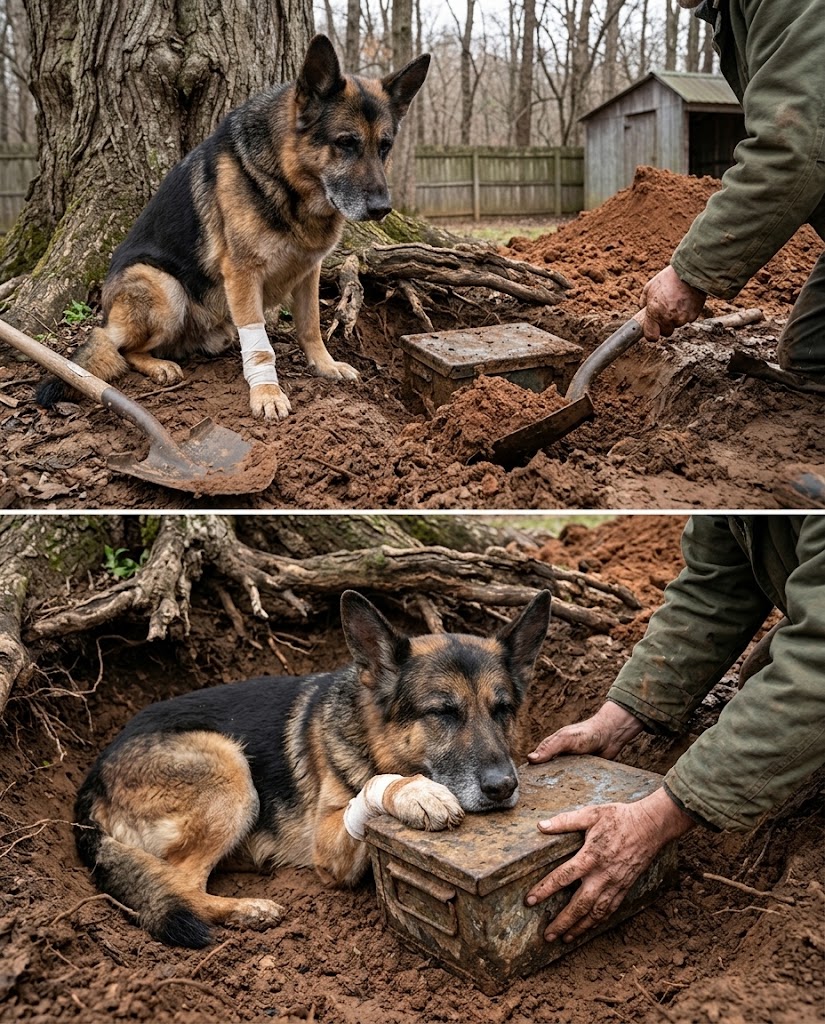
It was an Army ammunition box.
Danny recognized it the instant he brushed the mud away. It was made of olive-drab steel, with a hinged lid and a clamp-style handle, the sort of military surplus container sold in stores throughout Missouri. Someone had wrapped it in two black garbage bags and secured them with duct tape before burying it. The plastic had deteriorated over time, but the metal box had survived.
Two letters had been scratched into the lid with what looked like a nail or a knife. They were uneven and faint.
D.R.
Danny stared at the initials. They were his.
It had to be a coincidence, he told himself. Plenty of people shared those initials.
He pulled the ammunition box from the hole. It weighed far more than its size suggested. But when he placed it on the grass, the German shepherd did something that sent a shiver up Danny’s arms.
The dog approached the box, lowered himself beside it, and rested his chin on the lid.
Then he released a long, weary sigh, like someone who had finally put down an unbearable burden after carrying it for miles.
His eyes closed.
“That’s all?” Danny murmured. “Is this what you’ve been searching for?”
The dog remained perfectly still.
Not a bone. Not a dead animal. Just an old metal box after three weeks of digging until his paws bled.
Danny knelt beside him. Now that he was closer, the damage to the dog’s feet was impossible to ignore. His paw pads were cracked open, dirt had become embedded in the exposed flesh, and one of his claws was nearly torn off.
“All right,” Danny said softly. “Come on, buddy. Let’s get you taken care of.”
He carried the ammunition box to the porch. The shepherd followed directly behind him, keeping his eyes fixed on the container.
For the first time in three weeks, Danny opened the back door and allowed the dog into the house.
The shepherd didn’t behave like an unfamiliar animal entering a strange place. He didn’t sniff every corner or pause uncertainly. Instead, he crossed the kitchen, walked into the living room, and settled onto the rug in front of the brick fireplace.
He chose the corner beside the hearth, where the floor dipped slightly.
It was as though he’d always belonged there.
Danny remained in the doorway, watching him for a long time.
Eventually, he fetched a bowl of warm water and an old towel. Sitting on the floor, he carefully cleaned each paw, removing the dirt and wrapping the worst injury with gauze from the bathroom cabinet.
The dog endured the entire process without making a sound. When Danny finished, the shepherd reached forward and licked his wrist once.
Right above the narrow white scar on the back of Danny’s left hand.
Danny immediately pulled his hand away.
He went into the kitchen and poured himself a whiskey. His fingers trembled as he carried the glass to the living room and placed it on the coffee table. Then he sat on the couch, with the ammunition box resting at his feet.
Before he could lift the glass, the shepherd rose from the rug and approached him. He pressed his nose against the glass and deliberately nudged it toward the edge of the table.
The glass toppled and shattered across the floor.
“Hey!” Danny shouted, jumping to his feet. “What is your problem?”
The dog gazed at him without a hint of agitation. Then he lowered himself at Danny’s feet, positioning his body between Danny and the broken glass.
Danny looked at the shepherd, then turned his attention to the box.
He knelt and released the clamp. The lid creaked as he lifted it.
Everything inside had been carefully protected in plastic freezer bags. Resting on top was a faded olive-green wool cap. Beneath it lay a thin chain holding two stamped metal identification tags. Below those was a thick collection of envelopes, perhaps two dozen, bound together with brown twine.
At the very top sat an old color photograph sealed inside its own freezer bag.
Danny carefully removed it.
The picture showed a German shepherd sitting on a front porch. The black-and-tan dog was younger, his muzzle still dark, and he wore a red service-dog vest. At the edge of the photograph were the legs of an elderly man dressed in jeans and work boots, sitting in a rocking chair.
One of the dog’s ears folded slightly at the tip.
Danny recognized the porch immediately.
It was his porch. The white railing was identical. So was the chipped green step. In the background stood the same rusty mailbox, marked with the number 214.
He glanced from the photograph to the shepherd resting beside him.
This animal hadn’t simply wandered in from somewhere else.
He had once lived here.
Part 3: The Man Who Once Called This Place Home
Mrs. Ada Pruitt had lived across Oak Hollow Road for fifty-one years. At eighty-three, she remained remarkably sharp and rarely missed anything happening in her neighborhood.
When Danny knocked on her door that afternoon with the German shepherd beside him, she pressed a hand against her chest.
“Gunner,” she whispered. “Oh, dear Lord. Gunner!”
The dog’s tail began sweeping back and forth. She bent toward him, and he pushed his gray muzzle into her waiting hands.
“You know him?” Danny asked.
“Know him? I fed him whenever Walt had a doctor’s appointment.” She looked up at Danny, her eyes filling with tears. “Where in the world did you find him?”
“He’s been digging in my backyard for three weeks.”
Mrs. Pruitt slowly lowered herself onto the porch swing.
“Then he’s come home,” she whispered. “He’s found his way all the way home.”
“Who was Walt?”
She gave Danny a puzzled look.
“Walt Reese. The man who owned your house before you. He lived there for forty years. Didn’t your real estate agent tell you?”
Danny’s face lost its color. He remained silent.
“He was a Vietnam veteran,” Mrs. Pruitt continued. “A Marine. When he returned from the war, he wasn’t the same man who’d left. So many of those boys came home carrying terrible things inside them. He had nightmares, a temper, and a drinking problem that went on for years. Goodness knows how much he drank.” She shook her head sadly. “His wife died young, and living with Walt could be difficult.”
Danny sat on the porch steps, keeping his gaze lowered.
“Then, about fifteen years ago, something changed. He finally stopped drinking. He started getting help through the VA, went to therapy, attended meetings, and did everything they asked of him.” She smiled at the dog beside her. “Eight years ago, they matched him with Gunner. He was a psychiatric service dog, specially trained to help veterans like Walt.”
She stroked the shepherd’s head.
“That dog would wake him when his nightmares started. When Walt panicked, Gunner would lie across his chest until he calmed down. And if Walt ever reached for a bottle, the dog would knock it right out of his hand.”
Danny remembered the whiskey glass crashing onto his living room floor.
“Gunner saved that man’s life,” Mrs. Pruitt said. “Walt told me that himself. More times than I can count.”
“What happened to Walt?”
Her smile disappeared.
“Cancer. He received the diagnosis about a year and a half ago. By last summer, he was too ill to manage on his own, so he sold the house and went to the VA hospice in Columbia.” She paused before adding, “They allowed him to take Gunner with him.”
“Is he still…”
“I honestly don’t know.” Her voice softened. “I called a few times, but he didn’t want visitors. He said he couldn’t bear the thought of people seeing him in that condition.”
She glanced at Gunner.
“But if that dog is wandering around alone, I’m afraid…”
She couldn’t bring herself to finish the sentence.
Danny stared at his hands, particularly the thin white scar stretching across the back of his left one.
“Mrs. Pruitt,” he asked quietly, “did Walt ever have any family?”
For a long moment, the old woman said nothing.
“He had a son,” she finally answered. “He rarely spoke about the boy. I remember one Christmas, after Walt had gotten sober, when he mentioned him. He said he’d had a son and done something unforgivable. The boy left and never came back.”
She looked down at her hands.
“Walt said he’d destroyed their relationship. He called it the worst thing he’d ever done.”
“Did he ever tell you his son’s name?”
“No.” She slowly shook her head. “Not once. I think talking about him hurt too much.”
Then she began studying Danny more carefully. Her expression changed as she leaned forward on the swing.
“You know, I’ve been thinking something ever since you moved in,” she said. “You look so familiar to me. There’s something about your face I can’t quite explain.”
Danny stayed quiet.
“It’s your eyes,” Mrs. Pruitt said, her voice suddenly certain. “You’ve got Walt’s eyes. Exactly the same.”
The coffee mug she had given Danny slipped from his fingers and smashed against the porch steps.
Part 4: Twenty-Six Letters
“My name is Daniel Walter Reese,” Danny confessed.
He sat on Mrs. Pruitt’s porch steps, surrounded by pieces of broken pottery. He couldn’t bring himself to meet her eyes.
“I grew up in that house. I left when I was nineteen, and I haven’t spoken to my father in twenty-six years.”
Mrs. Pruitt covered her mouth with both hands.
Danny began explaining what had happened, speaking slowly as he stared at the gravel road.
His mother had died from a heart attack when he was fifteen. Afterward, the house belonged to just Danny and his father. Without his mother, Walt’s drinking spiraled out of control. The nightmares grew worse. His father shouted in the middle of the night, sometimes at three in the morning, and punched holes into the hallway walls.
On the night Danny turned nineteen, his father came home drunk and discovered him packing his belongings. Danny had enlisted in the Navy because he wanted to escape as far away as possible.
“He lost his mind,” Danny said. “He accused me of abandoning him, just like everyone else had. Then he threw a bottle. It smashed against the counter, and a piece of glass cut my hand.”
He touched the scar.
“I told him I hated him. He told me to get out and never come back.”
Danny had obeyed.
He spent twenty years in the Navy, got married, and eventually divorced last spring. Somewhere along the way, a cousin told him his father had moved to Florida with a woman. Danny accepted the story because believing it was easier than wondering what had really happened.
“After the divorce, I couldn’t sleep,” Danny continued. “One night, I was looking through real estate listings when I came across this house. The listing said the elderly owner was relocating to receive care. I assumed Dad had sold the place after moving to Florida.”
He let out a painful, humorless laugh.
“I bought it that very day. I can’t even explain why. Maybe I wanted to stand in that kitchen again and prove to myself that I’d made it through everything.”
“And the oak tree?” Mrs. Pruitt asked gently.
“My treehouse was up in that oak. Dad built it for me when I was eight, before Mom died and before our lives fell apart.”
His voice broke.
“I couldn’t bring myself to go near it.”
That evening, Danny sat on the living room floor in front of the fireplace. The ammunition box stood open beside him, and Gunner rested against his side, his head lying across Danny’s lap.
Danny untied the brown twine.
Inside were twenty-six envelopes. Every one bore the same name, written in his father’s distinctive, careful block letters.
Danny.
None had postage stamps or mailing addresses. Each carried a date, and the dates followed the same pattern.
Danny’s birthday, year after year.
The oldest letter was written twenty-five years earlier. The handwriting was unsteady, and the paper had become stained.
Danny. It’s been one year since you left. I’m drunk while writing this. I don’t know where you are. I’m sorry I hurt your hand. I’m sorry for everything.
The following year’s letter came next, followed by another, and another. Some contained only a handful of sentences. Others filled several pages.
Fifteen years earlier, the handwriting had begun to change. It was steadier, more controlled.
Danny. I’ve been sober for ninety days. The VA has me in a program now. I think about you every single day. I’ve picked up the phone four times this week, but I couldn’t make myself call. I don’t deserve to.
One letter, written eight years earlier, read:
Danny. I got a dog. His name is Gunner. The VA trained him to help men like me. Last night, I had that dream about the river again. He climbed onto my chest and licked my face until I woke up. For the first time in forty years, someone pulled me out of that nightmare. I wish you could meet him. You always wanted a dog when you were little, but I never let you have one. I’m sorry for that, too.
Danny read every letter, one after another, sitting beside the fireplace until well past midnight.
Every single letter ended with the same words.
I love you, son. I always did. I just never knew how to show it.
Danny wept so intensely that the words on the pages became impossible to read. Gunner pressed his head against Danny’s chest and remained there, his warm, solid weight providing comfort. It was the same way he had been trained to help Walt, the same way he had supported the old man through countless terrible nights.
When Danny finally managed to catch his breath, he wiped his face and looked into the empty ammunition box.
His father had spent his final days at the VA hospice in Columbia, only sixty miles away. Perhaps he was still there. Perhaps Danny hadn’t missed his chance completely.
He reached for his phone.
Then he noticed something lying flat at the bottom of the container, hidden beneath the place where the letters had rested.
Another envelope.
It was thick, white, and unmistakably official.
The seal of the United States Department of Veterans Affairs was printed in one corner.
Part 5: Twenty-Three Days
Inside the official envelope were two documents.
The first was a letter from an oncologist at the Harry S. Truman VA Medical Center in Columbia. It was dated the previous July. Danny read it twice before the meaning of the words finally sank in.
Stage IV pancreatic cancer. The disease had spread. The estimated prognosis was approximately six months. Hospice care was recommended.
The second document was handwritten in his father’s familiar block letters.
It was a funeral notice, the kind normally submitted to a local newspaper. Walt had written it himself.
Walter James Reese, 78, of Rolla, Missouri, passed away on ________. He served his country in the United States Marine Corps during the Vietnam War. He was preceded in death by his wife, Margaret. He is survived by his son, Daniel, and his dog, Gunner.
The date had been left empty.
Danny’s hands shook violently, and the paper slipped from his fingers.
He grabbed his phone. It was one in the morning, but he called the VA hospice in Columbia anyway.
A night nurse answered. Her name was Teresa. When Danny mentioned his father’s name, she fell silent for several seconds.
“Are you a member of his family?” she asked gently.
“I’m his son.”
Another long pause followed.
“Oh, honey,” Teresa said softly. “I’m so sorry. Walt passed away twenty-three days ago.”
Danny sank onto the floor.
Twenty-three days.
Three weeks and two days. Exactly the length of time that had passed since a German shepherd appeared in his backyard and began digging.
“His dog,” Danny whispered. “Gunner. How did he…”
“After Walt died, one of our VA volunteers took Gunner into foster care. She lives outside St. James.” Teresa sighed. “He escaped on the very first night. Somehow, he squeezed beneath her fence. She spent weeks searching for him. Eventually, we all feared the worst.”
She paused before continuing.
“St. James is more than twenty miles from Rolla.”
Twenty miles. Without an identification tag or a familiar person to guide him, traveling along roads he had previously known only from the back seat of a truck.
Somehow, Gunner had made the journey home.
“Was anyone with my father when he died?” Danny asked, barely able to speak.
“Gunner was there,” Teresa answered. “He stayed right beside Walt on the bed. I was there, too, along with the chaplain.”
She hesitated.
“We held a small service at Jefferson Barracks National Cemetery. Two VA volunteers attended. That was everyone.”
Danny closed his eyes.
His father had been buried with almost nobody present. Meanwhile, Danny had been living just sixty miles away, sleeping beneath his father’s roof, drinking beside his father’s kitchen window, and passing the old oak tree every day without realizing what he had lost.
“Mr. Reese?” Teresa asked quietly. “There’s something else I think you should know. Every day Walt spent here, he asked me the same question. Every morning, when I brought him his medication, he would ask me.”
“What did he ask?”
“‘Did anybody call for me today?’”
She swallowed hard.
“And every day, I had to tell him no.”
Danny felt as though he could no longer breathe. He ended the call without saying goodbye.
He remained on the living room floor in the darkness, holding the funeral notice in one hand and his phone in the other. Twenty-six letters lay scattered around him. Twenty-six years of apologies and declarations of love, none of which had ever reached him.
Now there would never be an opportunity to answer them.
Danny got to his feet and walked into the kitchen. His hands trembled as he took a bottle of whiskey from the cabinet and twisted off the cap.
Gunner immediately rose.
The shepherd crossed the kitchen in three quick strides and placed himself between Danny and the counter, pressing firmly against his legs.
Danny looked down at the dog, then at the bottle in his hand.
He didn’t pour himself a drink.
But he didn’t put the bottle away, either.
He stood motionless in his father’s kitchen at two in the morning, holding the same kind of bottle his father had once held. He was standing beside the same counter where a shattered bottle had left a scar on his hand decades earlier.
Back in the living room, beneath the scattered letters, one envelope remained unopened.
It was the last one, dated August.
Part 6: The Final Letter
Gunner turned around and headed back into the living room.
He stopped beside the scattered envelopes, pushed his nose between them, and carefully picked one up in his mouth. Carrying it gently, he returned to the kitchen and placed it at Danny’s feet.
It was the August envelope.
The only letter Danny hadn’t read.
Danny set the whiskey bottle on the counter, picked up the envelope, and slid down against the cabinet until he was sitting on the kitchen floor. His hands shook so badly that he accidentally tore the envelope in half while opening it.
Danny,
The realtor came to the hospice today with the paperwork. She told me who bought the house.
I made her repeat your name three times. I thought the morphine was making me imagine things. Then I started crying like a baby right in front of her.
You came home, son. After all these years, you came home.
I wanted so badly to call you. I held the phone in my hand and thought about doing it. But I’m dying, Danny, and I look like it. I didn’t want the first time you saw me in twenty-six years to be in a hospital bed, looking like a dying old man and asking you to forgive me. You might feel obligated to do it, and you shouldn’t have to feel that way.
So I’m handling things differently. I’m putting these letters beneath the oak tree, right where the ladder to your treehouse used to be. I figure that if you ever find a way to make peace with that tree, you’ll discover them.
There’s something else I need you to know.
When I die, they’ll take Gunner somewhere else. He’s an intelligent dog. A lot smarter than I’ve ever been. He watched me bury this box. If he ever finds his way back to you, please keep him.
He’s the last thing I have left to give you.
He’s the reason I got sober. He’s the reason I stopped wishing I were dead. Whenever I reached for a bottle, he put himself between me and it. Whenever the nightmares came, he brought me back to reality. He gave me fifteen good years that I never thought I deserved.
Let him do the same for you.
I know you’ve been drinking, Danny. Your cousin told me after your divorce. I know what alcohol can do to a man. I’ve lived through it myself. I also know what it did to you because of me.
Please don’t let it destroy you the way it destroyed me. Let that dog stand in your way.
I love you, Danny. I always did. I just never knew how to show it.
Dad.
Danny read the letter again and again until the writing dissolved into a blur. Then he covered his face with his hands and broke down on the kitchen floor, crying harder than he had since he was fifteen, when someone had told him his mother was dead.
Gunner lowered himself beside him, pressing his heavy body against Danny’s side.
At last, Danny understood.
The dog hadn’t been digging simply to uncover a box. He had been searching for Walt, for the last thing his owner had touched, for the final place where his scent remained beneath the earth.
The old wool cap. The identification tags. Twenty miles of travel on injured paws and twenty-one days spent enduring rain and mud, all because he had lost the person who meant everything to him. The only part of Walt he could still find was buried beneath that oak tree.
And after finally recovering the box, Gunner had followed Danny inside and knocked his whiskey glass off the table.
He had been doing his job all along. The very job the VA had trained him to perform. The same work he had done for Walt during the eight years they had spent together.
Only now, he was doing it for Walt’s son.
Danny turned his eyes toward the whiskey bottle on the counter. For three weeks, he had watched the rain through that kitchen window and gradually increased his drinking until he was having three glasses every night.
He knew exactly where that path ended. He had grown up watching his father travel it.
Even from a hospice bed sixty miles away, Walt had recognized what was happening to his son. And somehow, he had sent the only help he had left.
Gunner hadn’t returned home because he needed someone to save him.
He had returned to save Danny.
Danny stood and picked up the whiskey bottle. He carried it to the sink and emptied every last drop down the drain. Gunner watched quietly, his tail moving in slow, steady thumps against the floor.
Then Danny lowered himself to the kitchen floor again and wrapped both arms around the old shepherd.
“All right,” he whispered into the dog’s gray fur. “All right, buddy. You can stand in my way.”
At nine the following morning, the VA foster coordinator called. They had learned that Gunner had been found and offered to collect him that afternoon.
“No, ma’am,” Danny replied. “He’s not lost. He’s home.”
That afternoon, Danny helped the dog into the passenger seat of his truck and began the two-hour drive east toward St. Louis.
There was someone they both needed to visit.
Part 7: What He Unearthed
Jefferson Barracks National Cemetery stretched across the green hills overlooking the Mississippi River, its rows of white headstones arranged with perfect precision.
Danny spent nearly an hour searching for the correct grave.
Gunner found it first.
Pulling ahead on his leash, he followed the scent across the grass until he stopped in front of a newly placed white marble headstone. The earth surrounding it was still fresh.
WALTER JAMES REESE. CPL. U.S. MARINE CORPS. VIETNAM.
The shepherd lowered himself onto the grass and rested his chin on his paws. He made no attempt to dig. He simply lay there and released a long, quiet sigh.
Danny knelt beside him.
From his jacket pocket, Danny took an envelope addressed in his own handwriting.
Dad.
He had spent the entire night writing it. It was the first letter in twenty-six years that he had ever sent in the other direction.
He read it aloud. He told his father about his years in the Navy, his divorce, and the night of his nineteenth birthday. He explained how anger had consumed so much of his life that he had forgotten the good memories: the treehouse, their fishing trips, and the way Walt used to sing terribly off-key in the truck before Danny’s mother died.
He spoke about the twenty-six letters and the whiskey he had poured down the drain.
“You were right, Dad,” he said, his voice trembling. “He stood in my way.”
Danny folded the letter and carefully tucked it into the grass at the base of the headstone.
That spring, Danny attended his first meeting at the VA in Rolla. Then he went to a second meeting, and after that, he began attending every Tuesday.
He hung his father’s old dog tags from Gunner’s collar, beside the dog’s worn, frayed brown collar. On the new identification tag Danny had ordered, he had engraved just one simple message:
GUNNER. Home.
On the first warm Saturday in April, Danny walked out to the oak tree carrying a shovel.
Gunner followed him and settled beside the hole he had spent three weeks digging.
This time, the scene was different. A dog was no longer struggling alone in the mud, desperately trying to bring something back from beneath the ground.
A man and his dog stood together, preparing to place something into the earth.
Danny lowered a young lilac bush into the hole. It was his mother’s favorite flower, the same kind that had once blossomed along the porch before she died. He used his hands to press the soil firmly around its roots.
Gunner sniffed the freshly turned earth before lying quietly beside the bush.
Danny rose to his feet, wiped his hands against his jeans, and looked into the branches overhead.
High in the oak’s crooked limbs, two weathered gray boards remained nailed together. They were all that survived of the treehouse a Marine had built for his eight-year-old son many years earlier.
That evening, Danny sat on the back porch with a glass of iced tea. Gunner rested his head on Danny’s boot, gazing toward the oak tree as the final light of day faded.
For twenty-one mornings, the dog had dug through the earth, trying to bring a father back to his son.
There was no reason to keep digging now.
Everything he had been searching for was already here.
If this story touched your heart, follow our page for more stories that remind us why dogs are the best of us. ❤️