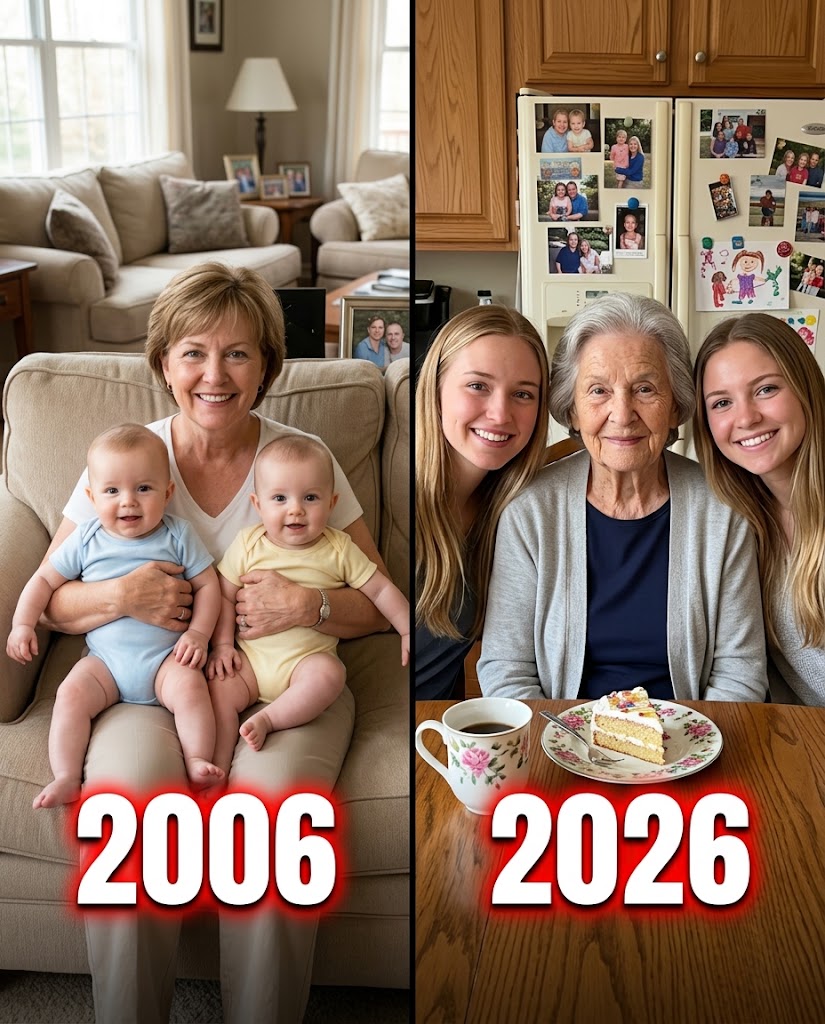
Part 1 — The Day She Left the Twins at My House
Certain moments split your life into two distinct parts: the time before they happened and everything that followed.
For me, that moment began when my daughter-in-law showed up at my house with two tiny baby carriers.
My son had been dead for only a few months.
Even after twenty years, thinking about those days still leaves a weight in my chest.
His twin daughters, Jennifer and Lizzie, were just three months old when their father passed away.
I was fifty-six years old.
I was mourning my son while trying to help his twenty-four-year-old widow cope with a loss that no young mother should ever have to experience.
At least, that was what I thought then.
That afternoon, Kayla looked utterly worn out. Her hair was loosely pulled back, dark circles surrounded her eyes, and her expression carried the emptiness of someone who hadn’t slept properly in days.
She placed Jennifer and Lizzie in their carriers and set two diaper bags beside them.
“Margaret, would you mind looking after them for a few hours?”
“Of course,” I answered without hesitation.
I thought she needed some time to herself.
Perhaps she wanted to take a peaceful shower or sit somewhere quiet, away from the endless demands of caring for two newborns, and find a moment to process her grief.
I understood. I was grieving, too.
Kayla bent down, kissed each baby, and gently straightened Lizzie’s blanket.
“I won’t be long.”
I had no idea that those would be the last words she would ever say directly to her daughters for the next twenty years.
I watched her walk away before closing the door and turning my attention back to the babies.
A few hours went by.
Then a few more.
As evening approached, uneasiness began to creep over me.
I called Kayla.
There was no answer.
I called again later.
Still nothing.
Around midnight, Jennifer started crying, waking Lizzie in the process. For the next hour, I walked around the living room carrying one baby while doing my best to calm the other.
Then, at approximately two in the morning, my phone finally rang.
It was Kayla.
“Where are you?” I asked.
Music played faintly in the background.
Her voice sounded oddly composed.
“I’ve been thinking.”
“About what?”
“My future.”
I glanced toward the two babies.
“When are you coming back for your daughters?”
She remained silent for a long moment.
Then she answered, “I’m not coming back.”
For several seconds, I couldn’t process what she’d said.
“What do you mean?”
“I can’t keep doing this, Margaret.”
“Doing what?”
“Living this life. Raising babies while trying to grieve. Everyone expects me to sacrifice everything just because your son died.”
I lowered myself into a chair.
“They’re your daughters.”
“I know that.”
“Then come home.”
“No.”
My voice grew more serious.
“Kayla.”
She let out a tired sigh.
“I’m only twenty-four. I still have a chance to make something of my life. I could meet a successful man and build the kind of future I’ve always wanted.”
My eyes moved toward the bassinets.
“What about Jennifer and Lizzie?”
“They’ll have a better life with you.”
I struggled to believe the words coming through the phone.
“You can’t just make a decision like this and vanish.”
“You’ve always wanted to be part of their lives.”
“Being involved in their lives isn’t the same as raising them as their mother.”
She paused.
“Maybe it is now.”
Then the call disconnected.
I tried calling her over and over, but she never answered.
By the time the sun came up, I finally accepted the truth.
She hadn’t gone out for a few hours.
She had abandoned her daughters.
I looked at the two sleeping babies, and fear washed over me.
I’d already raised a child. I’d pictured my later years being more peaceful. Instead, I was suddenly facing sleepless nights, endless bottles, diapers, doctor appointments, school responsibilities, and everything else that came with raising children.
Then Jennifer reached toward Lizzie while sleeping, and their tiny fingers brushed against each other.
In that instant, my decision was made.
They had already lost their father.
I wasn’t going to let them lose their home as well.
That very day, I contacted a lawyer, spoke to their pediatrician, and arranged a discussion with my employer.
At fifty-six, while still struggling with the death of my son, I began raising his daughters.
Part 2 — Becoming Their Parent
The legal proceedings lasted for months.
But the girls needed someone to care for them immediately.
There was no time for a slow transition. Two little babies needed someone to be there for them, and that responsibility couldn’t be postponed.
Jennifer had trouble tolerating certain formulas, while Lizzie would only calm down when I hummed a silly tune my son had loved when he was young.
My nights became a series of brief periods of sleep.
Sometimes, I’d wake suddenly, certain I’d heard my son’s key turning in the front door.
Then one of the babies would cry, and the painful reality of his absence would return.
Eventually, I was granted legal guardianship.
Kayla made no attempt to contest it.
She hardly contacted us at all.
Finances were frequently difficult.
Whenever I could, I picked up extra shifts and took on additional work when expenses demanded it. At the grocery store, I often calculated every item carefully before putting it in my cart.
The girls never realized how many times I went without something so they could have what they needed.
I never thought of those sacrifices as extraordinary.
They were simply part of being a parent.
I prepared their lunches.
I attended their school performances.
I helped with homework and science projects.
I remembered their friends’ names and knew which subjects made them anxious.
When Jennifer appeared in a second-grade play wearing a cardboard tree costume, I rearranged my work schedule to be there.
Her part was tiny, but I clapped as enthusiastically as if she had been performing on a professional stage.
Years later, both girls would tease me about how loudly I’d applauded that day.
Those everyday experiences gradually became the heart of our family.
Breakfasts.
Homework assignments.
Sick days.
Birthday parties.
Arguments over curfews.
School applications.
Graduations.
Love doesn’t always arrive through grand gestures.
More often, it means showing up.
Again and again.
Kayla never showed up.
Part 3 — Questions About Their Mother
I never deceived the girls about their mother.
At the same time, I refused to encourage them to resent her.
When they were little, their questions were straightforward.
“Where’s Mom?”
“She doesn’t live with us.”
“Why not?”
“She decided to leave.”
As they grew older, their questions became harder to answer.
One evening, when Jennifer was about nine, she came into my bedroom after Lizzie had gone to sleep.
“Grandma, did Mom ever love us?”
I wished I could give her an answer that would make everything better.
“I believe she loved you in the only way she knew how back then.”
Jennifer considered my response.
“That doesn’t sound like very much.”
I couldn’t honestly disagree.
“No,” I admitted softly. “Perhaps it wasn’t.”
On another occasion, Lizzie wanted to know why her mother had never returned.
I gave her the only truthful answer I had.
“I don’t know.”
“Was it because Dad died?”
“I don’t know.”
“Was it our fault?”
I responded without a moment’s hesitation.
“Never believe that.”
As teenagers, the girls eventually began searching for Kayla online.
I knew what they were doing, even when they kept it to themselves.
One evening, Lizzie came downstairs and sat next to me.
Something she’d discovered was clearly upsetting her.
“She looks happy,” she whispered.
I knew what she meant.
Perhaps she’d found photographs of Kayla enjoying a completely different life.
I held her hand as the tears fell.
After that night, the girls rarely asked about their mother.
Kayla had missed birthdays, school functions, injuries, accomplishments, graduations, and important college milestones.
She sent no cards.
She made no calls.
She never tried to rebuild a relationship with them.
Eventually, her continued silence became an answer in itself.
The girls learned to move forward without expecting their mother to return.
Part 4 — Twenty Years Later
By the time Jennifer and Lizzie turned twenty, both were attending college.
They returned home for the weekend to celebrate their birthday.
Jennifer requested chocolate cake.
Lizzie preferred lemon.
Since neither was willing to change her mind, I baked both.
It was an ordinary morning filled with happiness.
Then someone knocked at the door.
I opened it.
And suddenly, I couldn’t move.
Kayla stood on my doorstep.
For twenty years, I’d wondered what her return might look like.
Sometimes, I’d imagined a woman filled with remorse, arriving to offer a sincere apology.
The reality was nothing like that.
Kayla looked elegant and prosperous. Her hair was carefully styled, her outfit was expensive, and the jewelry she wore appeared to cost more than anything I had ever owned.
“Margaret.”
“Kayla.”
She stepped into my house as if the last twenty years had never happened.
Then she asked a question that left me speechless.
“Where are the girls?”
Jennifer and Lizzie appeared at the far end of the hallway.
Kayla looked at them in astonishment.
“My beautiful girls.”
Neither twin said a word.
“I realize this must be a surprise,” Kayla continued.
Jennifer folded her arms across her chest.
“That’s certainly one way to describe it.”
Kayla attempted to explain herself.
“I imagine your grandmother has told you quite a bit about me.”
Lizzie met her gaze.
“Mostly, we’ve heard your name.”
Kayla’s smile briefly vanished.
The tension in the room was already impossible to ignore.
Part 5 — Why She Had Returned
Kayla sat down and began talking about the reasons she had left.
She spoke about her youth.
She described the grief she’d experienced.
She explained how trapped she’d felt after my son’s death.
Some of what she said was true.
But then she made a remark suggesting that my son hadn’t been able to give her the future she had wanted.
Jennifer interrupted her immediately.
“Okay. We understand.”
Kayla seemed relieved.
“You do?”
Jennifer nodded.
“Of course, Mom.”
The word surprised everyone in the room.
Kayla smiled.
For a brief moment, she appeared convinced that everything was unfolding exactly as she’d hoped.
Then she explained the real reason for her visit.
“My husband’s family is hosting a gathering tomorrow,” she said. “There’ll be a professional family portrait, and I need both of you to be there.”
Lizzie looked at her in disbelief.
“So you came here because you need us for a photograph?”
Kayla gave an uncomfortable laugh.
“You’re my daughters.”
Jennifer and Lizzie exchanged a knowing glance.
“Of course,” Jennifer replied.
The twins then walked into the kitchen.
When they returned, they were carrying a large bag.
Inside was a copy of the invitation to the country-club gathering, along with the photography schedule.
Kayla’s expression shifted as soon as she saw the documents.
The list for the family portrait already included Jennifer and Lizzie.
The girls had discovered that their mother had put their names on the photograph arrangements before she had even spoken to them.
Jennifer explained that Kayla had probably seen Lizzie’s birthday post online and realized that both twins would be home.
“She didn’t return because she missed us,” Jennifer said quietly.
“She came because she needed two people to fill out the picture.”
For the first time, Kayla seemed to understand that her daughters had seen through the real purpose of her visit.
Part 6 — Going to the Family Gathering
The following morning, Jennifer and Lizzie decided they would attend the gathering.
I was worried about what might happen.
Jennifer simply remarked, “Things have been uncomfortable for twenty years. We just haven’t been there to witness it.”
They insisted that I accompany them.
When we arrived at the country club, Kayla looked surprised to see us together.
A man named Graham approached and introduced himself.
He seemed sincerely pleased to meet the twins.
“I’ve been looking forward to meeting you both for years,” he said.
Jennifer glanced at Kayla.
Graham then turned to me and asked who I was.
Jennifer answered for me.
“This is Margaret, our grandmother.”
Graham smiled.
“Kayla’s mother?”
Jennifer shook her head.
“Our father’s mother.”
Then she added something more.
“She raised us.”
Graham’s expression changed immediately.
He turned toward Kayla.
“You told me your mother raised the girls.”
Kayla began explaining that family circumstances could be complicated.
But the first signs that her story didn’t add up were already becoming apparent.
Part 7 — A Story That Wasn’t True
Graham’s children welcomed the twins with surprising warmth.
His daughter Allison embraced them.
“We’ve heard so much about both of you,” she said.
Jennifer asked her what she’d been told.
Allison started describing birthdays, visits, phone conversations, and holiday celebrations involving Kayla and the girls.
The twins exchanged a glance.
Not one of those experiences had taken place.
Little by little, the truth emerged: Kayla had apparently presented an entirely different version of her relationship with her daughters.
She had seemingly convinced Graham’s family that she’d remained an active part of their lives.
Eventually, Graham turned to Kayla and asked when she’d last seen her daughters before the previous day.
A long silence followed.
Finally, Kayla admitted that she hadn’t seen them in twenty years.
The room fell silent.
Kayla attempted to defend herself by explaining that she’d been young, felt ashamed, and hadn’t known how to come back.
Jennifer listened to her explanation.
Then she responded with a few simple words.
“You could have told us the truth.”
Kayla insisted that she’d always planned to reconnect with them once they were older.
Lizzie looked directly at her.
“Why wait until we were older?”
Kayla hesitated before answering that grown children were easier to deal with.
Lizzie immediately understood what she meant.
“Of course we’re easier now,” she replied.
“Grandma has already done all the difficult parts.”
She began listing everything I’d done throughout their childhood: nights without sleep, extra shifts at work, hospital visits, school functions, financial sacrifices, emotional pain, and the countless responsibilities of raising children.
“You missed the years when we needed a mother the most,” she said. “Then you came back when we were old enough to stand next to you for a picture.”
Kayla began crying.
For once, nobody rushed to comfort her.
Part 8 — The Family Photograph
Graham assured the twins that they weren’t obligated to appear in the family photograph.
They understood that.
Nevertheless, Jennifer decided they would take part.
Not because Kayla wanted them to.
They were doing it for themselves.
When the photographer began arranging everyone, the twins moved away from Kayla and stood beside me instead.
The photographer asked if the group needed to be rearranged.
Graham quietly answered that it didn’t.
And so the final arrangement reflected the truth.
Graham stood with his family.
Kayla remained among them.
Jennifer and Lizzie stood beside me.
The camera captured everyone in the same frame.
There was no dramatic showdown.
No argument in front of the guests.
No effort to humiliate anyone.
There was simply a photograph showing where everyone truly belonged.
Jennifer leaned against me.
Lizzie made a joke about the dress I was wearing.
We all burst out laughing.
At that exact moment, the photographer took the picture.
To me, that photograph represented one simple truth.
Love leaves evidence behind.
Absence does, too.
Part 9 — “You Turned Them Against Me”
After the gathering, Kayla came over to confront me.
“This is your fault,” she said.
“What is?”
“You made them hate me.”
I explained that I’d never taught the girls to hate their mother.
Jennifer walked over and backed me up.
“Grandma hardly ever talked about you unless we asked her something.”
Lizzie added that nobody had needed to persuade them of anything.
Kayla reminded them that she was their mother.
Jennifer answered calmly.
“You gave birth to us.”
Then she described the person who had actually been there for them.
The person they called when they were scared.
The person who stayed with them when they were sick.
The person who helped them learn to drive.
The person who attended their graduation ceremonies.
The person who answered when they called.
Kayla acknowledged that she had made mistakes.
Jennifer agreed.
“Yes, you did.”
Kayla argued that they couldn’t possibly understand what she’d gone through.
“Maybe we can’t,” Jennifer replied.
“But you never came back to explain it to us.”
Kayla admitted that she’d believed there would always be another opportunity.
Lizzie looked at her.
“There was.”
“You had twenty years.”
Kayla had no response.
Sometimes, the harm created by decades of absence cannot be undone by a single apology.
Part 10 — The Photograph on the Mantel
Several weeks later, the photographs arrived.
Jennifer brought them over to my house.
Together, we looked through the collection.
Eventually, Jennifer came across the large family portrait.
She studied it quietly for a moment.
In the photograph, she and Lizzie were standing beside me.
All three of us were laughing naturally.
Kayla stood on the other side of the group.
Rather than looking at the camera, she was looking in our direction.
Jennifer decided to have the photograph framed.
When she placed it on my mantel, I asked her why she’d chosen that particular picture.
“Because it tells the truth,” she answered.
I stood looking at it for a long time.
For years, Kayla had apparently constructed a version of motherhood that existed only in the stories she’d told other people.
She had described visits that never took place and celebrations she had never attended.
But Jennifer and Lizzie understood the difference between a story and a lived experience.
They had grown up because somebody had stayed.
Somebody had shown up.
Somebody had answered the phone.
Somebody had come to the hospital.
Somebody had sat in the audience.
Somebody had been there when they needed help.
That somebody was me.
I asked the girls whether they believed Kayla would ever understand what she’d done.
“Maybe,” Jennifer replied.
“Maybe she won’t,” Lizzie added.
I asked them if they thought they might ever speak to their mother again.
After considering the question, Jennifer said they might be willing to, provided Kayla genuinely wanted a relationship with them rather than simply needing something from them.
Her answer remained with me.
“We don’t hate her, Grandma,” Jennifer said.
“I know.”
“Somehow, that almost feels worse.”
I understood what she meant.
Hatred can keep a person emotionally tied to someone.
Sometimes, moving on means finally giving up the wait.
That evening, after the girls had gone upstairs, I sat alone in the living room and gazed at the framed photograph.
For years, I’d questioned whether I’d done enough.
I’d wondered if I had been too old to raise them.
I’d questioned whether I’d made mistakes.
I’d even wondered whether they might have needed someone younger.
But when I looked at the women they had become, I finally understood something important.
I didn’t have to be perfect.
I simply had to be present.
And I had been.
Children rarely remember whether every birthday celebration had flawless decorations.
They remember who attended.
They don’t judge love by the price of a gift.
They remember who stayed beside them when they were frightened.
They remember who answered the phone.
Who sat in the audience.
Who appeared when life became difficult.
And who continued to show up, no matter what.
Kayla had spent twenty years creating the life she wanted.
Perhaps she was comfortable.
Perhaps she was successful.
Perhaps she’d found many of the things she once believed would bring her happiness.
That was for her to decide.
But she had also missed two entire childhoods that could never be brought back.
By the time she returned, her daughters were no longer the tiny babies she’d left behind.
They had become adults with their own experiences, relationships, memories, and decisions to make.
They were free to choose who would have a place in their lives.
I switched off the living-room light and took one final look at the photograph.
Lizzie had been right.
It belonged there.
Not because it showed someone winning and someone else losing.
It belonged because it represented Jennifer and Lizzie finally taking ownership of their own story.
Their past.
Their family.
Their truth.
And this time, nobody else would be able to rewrite it.