She could help pay a portion of the initial bill.
Part 3 — Six Dogs and One Question Asked Again and Again
Estelle never turned her dogs into symbols while they were still alive. They were simply dogs with everyday needs, habits, and occasional challenges.
Ruthie woke Estelle at 4:30 every morning because, as she grew older, waiting became increasingly difficult for her. Samson stole dish towels while showing no interest in expensive toys. Pearl needed encouragement to go outside whenever it rained. Clyde refused to sleep on dog beds, preferring the sofa no matter how many blankets Estelle arranged for him elsewhere.
Bernie consumed food, water, space, and patience in equal measure.
Amos snored.
Estelle loved them all, even when they made life difficult.
That distinction influenced the way she eventually designed her fund.
When visitors explained that they wanted an older dog because senior animals were supposed to be peaceful, Estelle would correct their assumptions.
“Some are peaceful,” she told them. “Others are old criminals.”
She was talking about Samson.
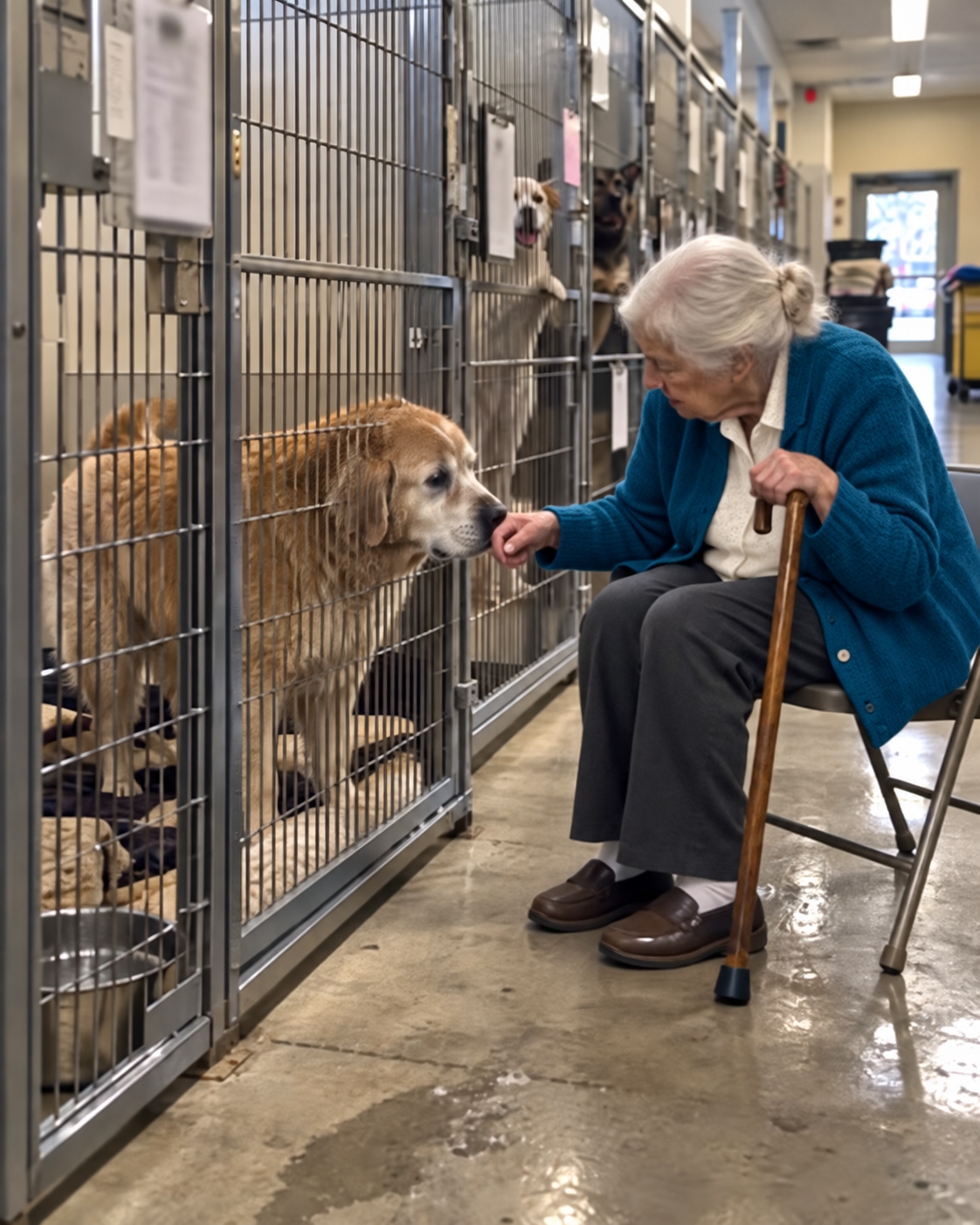
At seventy-nine, Estelle still drove her dogs to veterinary appointments herself. By eighty-two, she had stopped driving after dark. At eighty-four, she began relying on a cane and asking a neighbor to help with appointments outside Charleston.
She adjusted to her changing circumstances.
However, she never assumed that everyone else could manage the same way.
Over the years, Estelle grew familiar with people who approached the senior kennels but hesitated before committing to an adoption. Some depended on fixed incomes. Others had recently lost an older pet and were frightened of facing another medical emergency. Many could afford regular monthly expenses but could not suddenly produce four hundred dollars for an unexpected procedure.
Estelle listened carefully.
She began asking prospective adopters a single question:
“What expense made you reconsider?”
Sometimes, the answer was food.
Large senior dogs could require more food than people anticipated.
Sometimes, it was medication.
Quite often, the real problem was uncertainty. People imagined that every older dog would immediately need emergency treatment, even when a veterinary assessment suggested that the animal’s needs could be managed with a reasonable care plan.
Estelle never pressured anyone to adopt a dog they could not properly support. She did not believe that everyone who wanted a pet should automatically receive one, regardless of their circumstances.
Her goal was to replace general financial anxiety with realistic information.
One December morning, a retired school custodian named Raymond became interested in Molly, an eleven-year-old beagle mix. He could afford her food, regular veterinary visits, and daily medication. However, she needed dental treatment before adoption, and the procedure cost more than he had managed to save.
Molly went back to her kennel.
Three days later, the shelter received a money order.
The sender had requested anonymity.
The amount covered the difference between the available shelter assistance and the cost of Molly’s procedure.
Raymond adopted her.
I called Estelle to let her know that someone had stepped forward to help.
“I’m glad,” she replied.
It wasn’t until after her death that I discovered the anonymous donor had been Estelle herself.
That payment became the beginning of a pattern.
Estelle never handed money directly to an adopter. Instead, she coordinated with shelter employees or arranged payment through the veterinary provider. She required written estimates, proper records, and a clearly identified purpose for every payment.
She also established firm boundaries.
Her assistance did not cover unnecessary purchases. It wasn’t intended to replace an adopter’s normal financial responsibilities, nor did it guarantee unlimited help with future expenses.
Each payment addressed a specific obstacle.
A diagnostic examination.
Dental treatment.
Three months of specialized food.
An initial prescription refill to help an adopter manage the household budget during the adjustment period.
By the time Estelle reached eighty-five, she had quietly helped seventeen senior dogs she never brought home.
Every case was recorded in her handwritten notebook.
In shelter newsletters, we thanked an anonymous donor. Estelle continued attending adoption events, sipping weak coffee beside the refreshments table and keeping her contribution to herself.
That revealed the third important part of her philosophy: Estelle didn’t want recognition for saving dogs. She wanted adopters to understand that they had chosen their animals and remained responsible for the lives they brought home.
At eighty-six, she met with attorney Samuel Carter to update her will.
Estelle wasn’t wealthy. She owned a small house without a mortgage, received a pension after decades of working in a public-school cafeteria, and had carefully saved what she could. She had no enormous fortune hidden away.
The forty thousand dollars she planned to leave represented a substantial portion of her remaining assets.
Samuel asked whether she wanted the money directed toward general shelter expenses. That would allow the organization to decide how best to use it.
Estelle declined.
“Money without restrictions goes wherever the loudest problem is,” she explained. “Old dogs are quiet.”
She designated dogs aged eight and older because different shelters, breeds, and sizes can influence how an animal’s senior status is defined. She also allowed veterinary professionals and shelter leaders to consider each dog’s individual condition instead of relying exclusively on age.
Nevertheless, the age requirement was important.
She didn’t want the fund to become ordinary shelter funding under a different name.
Samuel asked what should happen if the shelter ever closed.
The legal documents directed any remaining funds to another qualifying nonprofit program that supported older dogs.
He also asked whether the money should go first to the cases with the highest veterinary bills.
Estelle shook her head.
“Help when a reasonable amount can change the outcome.”
That principle would later guide hundreds of decisions.
A thousand dollars might make a difference for one dog. The same amount might remove the final obstacle for five others. No formula could replace sound judgment, so Estelle required documentation, veterinary guidance, and written approval.
She wasn’t planning a dramatic rescue.
She was building a lasting bridge between hesitation and commitment.
Part 4 — Amos and the Final Notebook
Amos lived with Estelle for two years and eight months.
During their first winter together, icy conditions made the porch ramp difficult to navigate with his stiff hind legs. Estelle contacted a carpenter and arranged to have rubber traction strips installed.
After recognizing her from a shelter newsletter, the carpenter offered to waive his fee.
Estelle insisted on paying him.
“You can’t build a system around everyone working for free,” she told him.
Amos gradually lost more vision in his cloudy left eye. Estelle responded by keeping the furniture in the same places. She stopped leaving her cane across doorways and installed a small light in the hallway.
Amos learned to navigate by gently brushing his shoulder against the walls.
At night, he slept beside Estelle’s bed, resting his white muzzle on one of her slippers.
During those same months, Estelle’s health continued to weaken. Her hands trembled, and she became tired more easily. A neighbor began preparing two dinners every evening, one for herself and another for Estelle.
Even so, Amos’s medication remained neatly arranged in a seven-day container beside Estelle’s own medicine.
On difficult mornings, she opened his compartment before opening hers.
“He had to wait longer,” she explained.
At eighty-eight, Estelle could no longer visit the shelter herself. I began bringing photographs and printed profiles to her house, where she carefully examined every senior dog.
“How long?” she would ask.
I told her how many days the dog had been waiting.
“What expense?”
I explained the immediate concern.
“Anyone interested?”
Sometimes, the answer was no.
Those dogs received a small blue dot in her notebook.
After Amos died, Estelle kept his bed beside hers for eleven weeks. She decided against adopting a seventh dog because she no longer felt confident that her health would allow her to provide the daily care an animal deserved.
The decision was painful.
It was also responsible.
“I can want a dog and still understand that I shouldn’t take one,” she told me.
Instead of adopting again, Estelle increased her anonymous contributions.
Samuel finalized the trust documents six months before her death. Estelle reviewed every line and insisted that the fund could provide limited assistance after adoption when doing so would help make a placement sustainable.
The money could cover an initial supply of medication, an early follow-up appointment, or a limited quantity of prescribed food. It would not guarantee lifelong payments for every medical condition.
Her objective was stability.
Estelle died at eighty-nine following a brief hospitalization. Her neighbor discovered the yellow notebook, a recipe box filled with veterinary invoices, and six framed photographs of her dogs that she had prepared for Samuel.
Four days after the funeral, Samuel brought everything to the shelter.
The will did not demand a public announcement.
Estelle had requested accurate financial records, annual reviews, and a simple display explaining the fund’s purpose. She had never specified how large her own photograph should be.
“She wanted the dogs to be bigger,” Samuel told me.
We deposited the forty thousand dollars into a restricted account named The Longest Wait Fund. A volunteer accountant offered to establish tracking procedures, while participating veterinary clinics agreed to provide estimates and, in certain cases, discounted services for the nonprofit program.
The first dog approved for assistance was Edith, a nine-year-old Pit Bull mix. She needed dental treatment and an examination of a small external mass beneath intact skin near her right shoulder. The veterinary team did not assume what the mass was based on its appearance. Additional testing was necessary.
A prospective adopter could afford Edith’s routine expenses but couldn’t manage the entire immediate bill.
The fund paid the specific amount approved beforehand.
Twenty-three days later, Edith went home.
The second dog was Norman, a twelve-year-old Shepherd mix who needed initial bloodwork before veterinarians could safely plan his medication.
The third was a ten-year-old Greyhound who required a supply of prescribed food while adjusting to a new home.
Every payment was recorded in the ledger.
Dog.
Age.
Purpose.
Amount.
Outcome.
Estelle’s handwritten notebook eventually became a secure digital record, but we preserved her original pages in the shelter office.
On the last page, beneath a horizontal line, she had written one rule:
“Never make the adopter perform poverty in exchange for dignity.”
We didn’t immediately appreciate the full meaning of those words.
Even a well-meaning assistance program can become humiliating if people must reveal every private financial struggle in front of strangers. Estelle wanted responsible oversight without turning anyone’s hardship into a public performance.
The fund verified the adoption, the veterinary need, and the existence of a reasonable care plan.
It never required families to beg for assistance.
That principle shaped the program for the following six years.
Part 5 — The Money Was Designed to Create a Yes
Estelle understood that forty thousand dollars could never cover every future expense for hundreds of aging dogs.
The fund worked because it focused on removing specific obstacles rather than attempting to pay for everything.
Many senior dogs didn’t need thousands of dollars. They needed one problem resolved at the right time.
Dental treatment could relieve discomfort and allow an adoption to proceed.
Basic diagnostic testing could replace frightening uncertainty with a clearer care plan.
A short supply of prescription food could give an adopter time to adjust to additional expenses.
A mobility harness could help a family safely support a large dog during the first weeks at home.
Every payment served a particular purpose.
The shelter also began giving prospective adopters actual veterinary estimates instead of vague warnings about the possible costs of senior care. Some people decided not to proceed after reviewing the figures. That was better than completing an adoption only to become overwhelmed and return the dog.
Others discovered that the expenses were manageable.
Estelle’s receipts had taught us to distinguish between a genuine expense and a frightening estimate imagined without any limits.
The unexpected insight behind her legacy was straightforward: Estelle hadn’t established a fund simply to help older dogs after someone had already chosen them.
She had investigated why people were unwilling to choose them in the first place.
Every entry in her notebook connected a particular concern with a practical solution.
“Too much food” could mean providing a three-month transition supply for certain large dogs.
“Needs medicine immediately” could mean covering the initial prescription and supplying a written estimate for future refills.
“I don’t know what that lump is” could lead to a veterinary examination and appropriate diagnostic testing instead of unsupported assumptions.
“His teeth will cost too much” could qualify for partial dental assistance when treatment significantly affected the dog’s comfort and chances of adoption.
For twenty years, Estelle had collected the reasons people gave before walking away from a senior dog.
Then she began attaching numbers to those reasons.
She had transformed rejection into a budget.
The anonymous payments she made during her lifetime demonstrated that the approach could work. Her will ensured that the shelter could continue it after she was gone.
The first public report recorded twenty-nine dogs receiving assistance during twelve months. We protected the adopters’ private financial information and reported only the types of support provided and the total amount spent.
A local newspaper published a brief article about Estelle.
Donations soon began arriving.
A retired nurse contributed twenty dollars. A hardware store collected spare change in a jar. One family donated the remaining balance of a memorial fund established for its dog. Samuel contributed the fee he had charged Estelle for part of the estate work.
The original forty thousand dollars remained the foundation, while community contributions helped replenish the account. Veterinary partners reduced certain costs, and the shelter covered fundraising expenses from other sources so the donations could remain restricted to their intended purpose.
During the second year, the fund helped fifty-three dogs.
In the third year, it assisted sixty-one.
Some dogs needed nothing more than prescribed food and an examination. Others received several hundred dollars toward approved treatment.
A small number remained unadopted despite receiving assistance. Their medical needs, behavioral challenges, or lack of a suitable applicant continued to affect their chances.
The fund couldn’t guarantee a happy ending.
It could eliminate financial barriers that might otherwise prevent a responsible adoption.
By the fourth year, other shelters were requesting copies of our program guidelines. We shared the framework without putting Estelle’s name on every page.
The system mattered more than the branding.
Nevertheless, her photograph remained in our lobby.
A local photographer created a large portrait using photographs of Estelle with each of her six dogs. Ruthie stood near her right hand. Samson sat slightly behind her. Pearl rested against her knee. Clyde occupied the sofa. Bernie blocked nearly half the frame, while Amos lay nearby with his cloudy eye turned toward Estelle’s chair.
The portrait did not depict a single real afternoon.
The six dogs had never gathered together in that way.
Instead, it represented the family Estelle had built over twenty years.
Beneath the photograph, a small plaque displayed just one sentence:
“Do not let them be called a burden.”
Visitors frequently paused to read it.
Those considering senior adoption often stayed the longest.
Part 6 — Dog Number 340
Walter arrived during the fund’s sixth year.
He was a thirteen-year-old German Shepherd with a black saddle, a gray muzzle, a cloudy right eye, and noticeably reduced muscle in his hindquarters. His owner had died, and no relative could provide the long-term care he needed.
Walter remained composed during intake. He accepted his examination and walked alongside shelter employees, although his back paws occasionally dragged against the floor.
The veterinarian recommended diagnostic testing before discussing the safest approach to mobility and pain management. Staff observed the way Walter walked but did not attempt to identify the cause based on appearance alone.
He remained at the shelter for sixty-eight days.
A retired mail carrier named Glenn Avery visited him four times. Glenn lived in a single-story house with carpeted floors, a fenced yard, and no other animals.
He could afford Walter’s food, routine veterinary appointments, and the medication he would likely need.
However, the diagnostic estimate gave him pause.
Glenn didn’t ask anyone for charity. He simply requested another week to review his savings.
Our adoption counselor explained how The Longest Wait Fund worked.
Glenn’s expression became tense.
“I’m not taking money that’s meant for someone who has nothing,” he said.
The counselor showed him Estelle’s final rule.
The program wasn’t designed to judge who deserved assistance by measuring how much hardship they could prove. It existed because a clearly identified medical expense stood between a suitable home and an aging dog.
Even after hearing the explanation, Glenn insisted on contributing what he could afford.
The fund covered the remaining approved amount.
Walter became dog number 340.
His diagnostic results gave the veterinary team information they could use to discuss his condition, likely care needs, and appropriate activity. Glenn received written guidance instead of being left to worry about vague possibilities.
The adoption was arranged for Friday at 2:00 p.m.
While the paperwork was being completed, Walter waited in the lobby beneath Estelle’s portrait. His cloudy eye followed Glenn as he walked from the desk toward the door. Whenever Glenn moved more than six feet away, Walter got to his feet.
His hind legs trembled.
Glenn returned and sat beside him.
“You’re coming with me,” he said. “I’m only signing the papers.”
Walter lowered his head onto Glenn’s shoe.
I watched from behind the counter. Six years of financial records were stored in the office. Three hundred and thirty-nine dogs had received assistance before him.
Edith.
Norman.
Sarah.
Duke.
Old Man River.
They were among the dogs who had received examinations, food, dental assistance, diagnostic testing, medication support, mobility equipment, or limited help during their transition into new homes.
Not every case produced a story suitable for a newspaper.
That was part of Estelle’s intention.
Most of the fund’s work happened through ordinary invoices that nobody outside the families involved would ever see.
Before leaving, Glenn asked about the portrait.
I explained the names of Estelle’s six dogs. When I mentioned Samson, Glenn studied the old photograph of the German Shepherd with the notched ear.
“He looks like Walter,” he observed.
“He was eleven when Estelle adopted him.”
“How long had he been waiting?”
“Two hundred twenty-six days.”
Glenn looked at the plaque beneath the portrait.
Then he took out his checkbook.
“You don’t owe anything more today,” I told him.
“This isn’t for Walter,” he replied.
He wrote a check for forty dollars to the fund.
“Dog 341,” he said.
That contribution wasn’t enough to finance an entire rescue. It had never needed to be.
It became another small addition to the resources available to remove the next clearly defined obstacle.
After Glenn and Walter left, I opened Estelle’s original notebook. On the inside of the back cover, a sentence had been written so faintly that we had overlooked it for years:
“When they can, let the people who were helped become the next help.”
That was the final instruction mentioned in the second teaser.
Estelle had never demanded repayment.
She had simply encouraged people to keep the kindness moving.
Some adopters never made a donation. Nobody contacted them to demand one, publicized their names, or judged their decisions.
Others returned months or years later with ten dollars, fifty dollars, an unopened bag of prescribed food, or a contribution made in memory of the dog the fund had helped them bring home.
The assistance continued moving forward.
Walter’s forty dollars became part of a payment toward initial dental treatment for dog 341, a nine-year-old Pit Bull whose adopter needed help covering the expense.
Later, dog 341’s family contributed twenty-five dollars.
The ledger kept growing.
Part 7 — The Photograph in the Main Lobby
Estelle’s portrait hangs in the shelter’s main lobby, directly across from the adoption desk. Her six senior dogs occupy more space in the photograph than she does, just as she wanted.
Beneath it rests a simple blue binder containing public summaries of The Longest Wait Fund. Personal financial information remains confidential. Visitors can review how many senior dogs have received assistance, the types of expenses covered, and the way donations have been spent.
The latest page shows the number 340.
It won’t stay there forever.
Every approved payment begins with the same questions Estelle asked when she first started adopting dogs: What does this animal need right now? What can the prospective adopter reasonably afford over time? Which specific expense is preventing an otherwise responsible placement?
The fund cannot stop the aging process.
It cannot guarantee that every senior dog will recover, remain free of future illnesses, or live for many more years.
What it can do is turn one important belief into practical action:
Old age should not automatically disqualify an animal from receiving care.
Glenn continues to send updates about Walter. The elderly Shepherd sleeps beside the front door and follows Glenn to the mailbox every afternoon. His walks are brief, and his medical plan changes whenever his veterinarian determines that an adjustment is necessary.
Walter is still an old dog.
He is also home.
On the sixth anniversary of Estelle’s death, shelter employees placed six small bowls of white flowers beneath her portrait. Each bowl honored one of her dogs: Ruthie, Samson, Pearl, Clyde, Bernie, and Amos.
No formal ceremony was announced.
Visitors continued coming through the doors.
While waiting to meet a ten-year-old Golden Retriever, a couple stopped in front of the photograph. The woman read Estelle’s words aloud.
“Do not let them be called a burden.”
From the adoption corridor came the slow sound of older paws scraping against the floor.
The couple turned toward the noise.
I opened the gate.
The Golden Retriever walked out.
Estelle’s legacy was still making a difference.