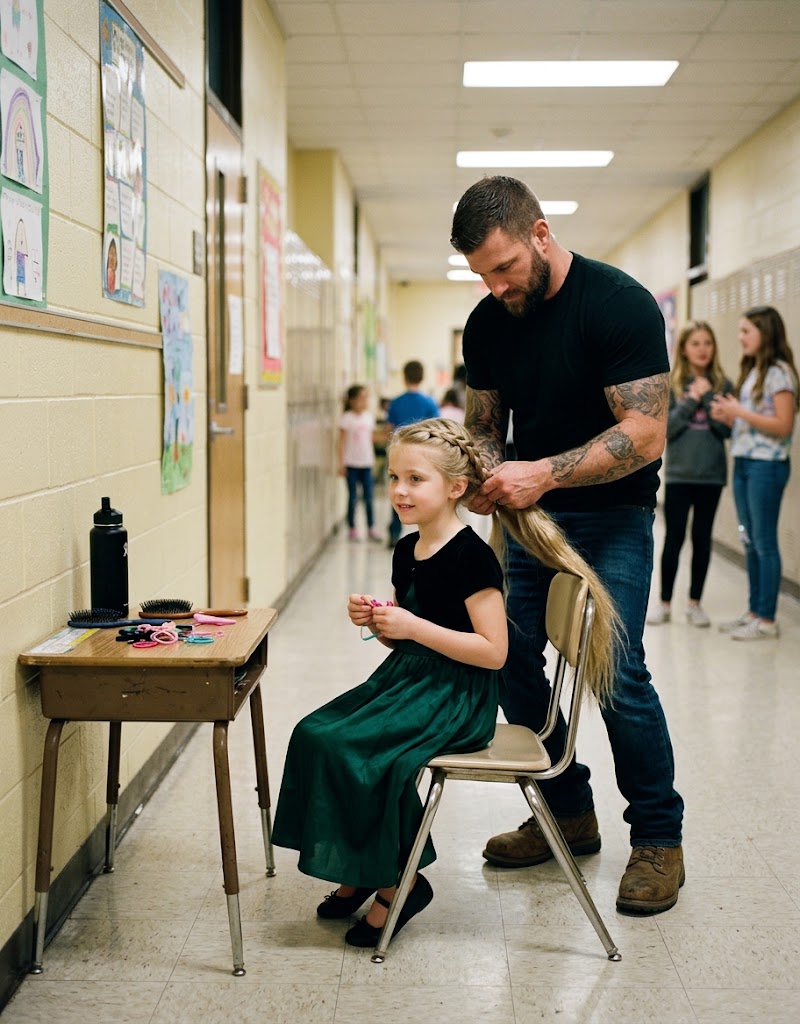
Goldie’s hair fell all the way past her knees, and anyone could see how difficult it was for her to carry all that weight. We assumed her father refused to cut it because of his own reasons, but the reality was far more painful than we ever imagined.
The first time I noticed Goldie’s braid snag on the back of her chair, I genuinely thought she was about to fall.
She had stood up too quickly after an event when her braid caught on the chair, snapping her head backward.
With one hand, she grabbed the seat in front of her, while the other clutched the thick braid of hair.
A couple of children laughed before realizing she was uncomfortable.
Goldie laughed along with them. Somehow, that upset me more than seeing her cry would have.
My daughter was in Goldie’s class, so I had seen her hair many times.
When it was loose, it reached below her knees.
Even when braided, it hung so far down that she had to be careful with it whenever she sat.
Everyone admired how beautiful it was.
And everyone seemed to have something to say about her father.
He arrived early for every school function, often still dressed in his work clothes.
He would bring a little folding mirror from his vehicle, sit Goldie down on a hallway bench, and carefully style her hair himself.
And he was surprisingly good at it.
French braids decorated with ribbons.
Pins placed so perfectly that they appeared to have been done by a professional.
By the time the children stepped onto the stage, there wouldn’t be a single strand out of place.
The other mothers enjoyed watching him.
“Look at that dad,” someone would remark.
“My husband can’t even make a ponytail.”
“That little girl is so lucky.”
And perhaps she was.
Her father was always present.
Still, whenever I watched him work through that incredible length of hair, my attention kept returning to Goldie.
I noticed her gripping the braid in one hand whenever she ran, making sure she wouldn’t step on it.
I saw her pull it into her hand while eating so she could bend toward her lunch tray.
One time, when she stood up from a table, another child’s backpack had accidentally pinned the end of her braid underneath it.
Goldie said nothing.
She simply waited until the other child moved the bag.
She was only nine years old.
That was what stayed in my mind.
Why should a nine-year-old have to arrange so much of her daily life around her hair?
I never questioned Goldie’s father about it.
For some time, none of us did.
That changed during the winter concert.
That afternoon, parents and children crowded the hallway outside the auditorium.
Everyone was waiting for the doors to open.
Goldie’s father had taken his usual place near the window.
Goldie sat in a chair while he worked on her hair.
She was already dressed in her costume, and a silver ribbon rested across his knee.
He separated her hair into sections, his hands moving quickly and carefully.
Goldie repeatedly glanced toward the other girls.
They were running around the hallway in their costumes, whispering and laughing together.
“Stay still, sweetheart,” her father said.
“I’m trying.”
“Just about finished.”
He wasn’t being rough or impatient.
That somehow made the situation even more difficult to understand.
When he was finished, he secured the silver ribbon around the end and lifted the mirror for her.
Goldie looked at her reflection.
“Pretty?”
“Very.”
She smiled, gave him a quick kiss on the cheek, and hurried off toward her friends.
Her father remained behind, carefully returning the pins to a small case.
That was when one of the mothers spoke.
“Someone should have allowed that child to get a proper haircut years ago.”
Several people turned toward her.
Goldie’s father replied, “Thank you, but we’re managing just fine on our own.”
The mother crossed her arms.
“That’s not what I mean. Just look at her. She’s carrying that thing around like a backpack.”
He shut the pin case.
Another mother stepped into the conversation.
“You can tell she’s uncomfortable. That’s gone beyond devotion. It’s something else now.”
I remember wishing they would stop, even though a part of me understood what they meant.
Then another woman quietly said, “Maybe you’re the one who can’t let something go, while she’s the one paying the price.”
Goldie’s father stood. Suddenly, he looked deeply hurt.
Before he could respond, I noticed several people staring behind us.
Goldie was standing at the far end of the hallway.
She had returned.
None of us knew how much of the conversation she had heard.
She walked directly through the group and stopped in front of her father.
“Don’t talk to my dad like that,” she said.
The first mother started to respond.
Goldie continued.
“He takes care of me.”
Her father gently placed a hand on her shoulder.
“It’s okay, sweetheart.”
“No, it isn’t.”
Then she turned toward the adults surrounding them.
Her voice became quieter.
“He cries when he brushes it. I asked him to cut it, and he said we have to wait until I’m 17.”
Her father went completely still.
He looked like someone had suddenly opened a door he had spent years trying to keep closed.
“Goldie,” he whispered.
She looked at him. “I’m sorry.”
He swallowed hard, then crouched down until they were at eye level.
“You don’t have anything to be sorry for.”
The hallway became completely silent.
The same people who had been criticizing him moments before now looked uneasy. So did I.
Because it was suddenly obvious that this wasn’t simply about keeping beautiful hair.
One of the mothers asked, this time with much more compassion, “Why 17?”
Goldie’s father looked at his daughter.
Goldie answered for him.
“Because of my mom.”
Her father briefly closed his eyes.
Goldie looked toward all of us.
“My mom died when I was little.”
I already knew Goldie’s mother wasn’t in her life. My daughter had mentioned it once. But I hadn’t known what had happened to her.
Goldie said, “She had cancer.”
No one said a word.
“She lost all of her hair when she was sick.”
Her father slowly lowered himself onto the bench.
Goldie remained beside him.
“I don’t remember everything about her,” she explained. “I was really little. But Dad tells me stories.”
Her father gave a faint smile. “Probably too many stories.”
“No.” Goldie shook her head. “There aren’t too many.”
Then she reached behind herself and pulled the braid forward across her shoulder.
“Mom used to joke about my hair. Dad told me that even when I was a baby, I had a lot of it.”
Her father rubbed his hands together.
“Your mother used to say you came into the world looking like you’d already missed your first haircut.”
Goldie smiled, and several of us smiled with her.
Then her expression became serious again. “When Mom’s hair fell out, she told me I had enough hair for both of us.”
Her father lowered his eyes.
Goldie continued. “She and Dad decided that I would grow it.”
“Goldie,” he said softly. “We don’t have to talk about this here.”
“I want them to know.”
He studied her face for a long moment.
Then he nodded.
Goldie explained that before her mother passed away, her parents had made a plan.
Goldie would keep growing her hair until she turned 17.
Then she would cut it and donate it to an organization that created wigs for children who had lost their hair while undergoing cancer treatment.
“It was supposed to be for kids like Mom,” Goldie said.
Her father gently corrected her.
“For children going through what Mom went through.”
Goldie nodded.
The explanation should have made everything clear.
Instead, it somehow made the situation even more difficult.
Because Goldie was nine, and turning 17 was still eight years away.
I looked at the enormous braid lying across the front of her costume.
She noticed me looking.
“I still want to donate it,” she quickly said.
Her father looked up.
“I know you do.”
“But I don’t want it this long anymore.”
Goldie’s father looked genuinely surprised.
She wrapped the end of the braid around her wrist.
“It’s heavy, and it keeps getting caught.”
“I know, sweetheart.”
“You always say we’ll fix it.”
He nodded.
“And you do fix it. You braid it tighter or pin it up. But it’s still heavy.”
He looked as though he wanted to answer, but the words wouldn’t come.
Goldie stared down at the floor.
The adults around them stood completely still.
Her father finally said, “I’m sorry, Goldie.”
He closed his eyes.
Goldie’s voice trembled.
“I don’t want you to think I don’t love Mom.”
Her father sprang to his feet so quickly that the bench scraped across the floor. “Never.”
Fear flashed across her face.
He immediately softened.
“Goldie, I would never think that.”
“But what if I cut it?”
He knelt down again. “No. Listen to me. Your hair isn’t proof of how deeply you love your mother.”
Goldie’s eyes filled with tears. “Then why can’t I cut it?”
Not a single person in the hallway moved.
Her father looked at her.
I expected him to have an answer prepared.
Because we made a promise.
Because your mother wanted this.
Because we agreed you’d keep it until 17.
But suddenly, none of those explanations seemed enough.
His little girl was standing there, asking why her own comfort should matter less than a promise made when she had been too young to understand what it meant.
The auditorium doors swung open.
A teacher stepped into the hallway and called the children.
Goldie wiped her cheeks. “I have to go.”
Her father nodded. “Go.”
She took two steps before turning around.
“Are you angry?”
His face crumpled.
He crossed the hallway, pulled her into his arms, and held her tightly.
“No,” he whispered into her hair. “I’m not angry.”
Goldie hugged him back.
Then she hurried off to join the other children.
The concert began ten minutes later.
I hardly remember any of it.
I remember Goldie singing.
I remember her braid draped over one shoulder because she’d pulled it forward before stepping onto the stage.
And I remember her father sitting three seats from me, silently watching her with tears streaming down his face.
Afterward, I watched them leave together.
I didn’t go over to them.
Neither did the mothers who had confronted him.
Two days later, my daughter came home from school and announced, “Goldie’s getting her hair cut.”
“What?”
“Yes, Saturday.”
Apparently, Goldie had already told half the class.
My daughter was almost bouncing with excitement.
“She said she’s donating it now.”
That weekend, Goldie’s father sent a message to several parents who had been standing in the hallway that day.
He didn’t scold anyone for getting involved.
Instead, he explained that what happened at the concert had forced him and Goldie to have a conversation they should have had much sooner.
He also invited some of us to the salon if we wanted to be there.
I almost decided not to go. It seemed like something deeply personal.
But my daughter wanted to be there for Goldie, so we went.
Goldie was already sitting in the salon chair when we arrived.
Her hair had been divided into several thick braids.
Without all the careful styling, I could finally understand just how much hair she had.
Her father stood beside her. He looked worn out.
Goldie, however, looked excited.
“Nervous?” my daughter asked.
“A little.”
The hairdresser showed Goldie where her hair would end afterward, just above her shoulders.
Goldie looked over at her father. “That’s okay?”
He shook his head. “Don’t ask me.”
She blinked.
He smiled. “It’s your hair.”
Goldie smiled back. “Okay.”
The hairdresser fastened the first braid.
Goldie’s father suddenly turned his face away.
She reached toward him. “Dad.”
He turned back.
His eyes were watery. “I’m fine.”
“No, you’re not.”
He gave a small laugh. “No. I’m not.”
The hairdresser paused.
Goldie’s father crouched beside her chair.
“I need to tell you something.”
Goldie listened carefully.
“I kept telling myself this was your mother’s promise.”
Goldie’s smile disappeared.
“But it wasn’t just that,” he continued. “Doing your hair every morning… washing it, brushing it, braiding it… made me feel close to her.”
Goldie reached for his hand.
“When she was sick, she worried she wouldn’t be there to do all those normal things with you. School mornings, pictures, dances, birthdays.”
His voice cracked.
“After she died, taking care of your hair became something I could still do that made me feel connected to her.”
Goldie squeezed his hand.
“And somewhere along the way, I stopped asking myself whether that promise still made sense for you.”
“I like when you do my hair,” Goldie said.
“I know.”
“Just not when there’s this much hair.”
He laughed through his tears. “That’s fair.”
Then his expression became serious. “I’m sorry.”
Goldie lowered her eyes.
“It should have been cut as soon as it started making you uncomfortable.”
Tears filled Goldie’s eyes.
“Your mom wanted us to do something kind. She never would have wanted that promise to feel like a punishment to you.”
“I still want to donate the hair,” Goldie said.
“I know.”
“And I might want to grow it again.”
He blinked. “You do?”
“Maybe.”
She smiled. “But not all the way to my knees.”
“Okay, that’s a deal.”
“And if I don’t like it, I cut it.”
“Agreed.”
“Even if I’m younger than 17.”
“Absolutely.”
The hairdresser raised the first braid. “Ready?”
Goldie took a deep breath. “Ready.”
The scissors closed.
The sound was quieter than I had expected.
The braid dropped into the hairdresser’s hand.
Goldie’s father covered his mouth.
Goldie touched the newly lighter section around her shoulder.
The second braid was cut away.
Then the third. Then the fourth.
When the final braid was gone, Goldie was crying too.
Her father wrapped an arm around her.
For a moment, I wondered if either of them regretted the decision.
Then Goldie pulled away and shook her head.
Her shorter hair moved around her neck.
She laughed again. “Dad, look!”
“I see.”
“It’s so light.”
She shook her head harder.
Everyone in the room laughed.
Even her father.
The long braids were carefully gathered together for donation.
Goldie touched them once before they were placed to the side.
“Mom would like this, right?”
Her father looked at the hair, then at Goldie.
“Your mom would like you.”
Goldie became completely still.
“With long hair, short hair, purple hair, no hair. She’d like you.”
Goldie smiled. “Even purple?”
“Okay, let’s not get carried away.”
That made everyone laugh again.
The mother who had criticized him first at the concert stood near me.
She wiped away her tears.
“I feel terrible,” she whispered.
I understood.
We had noticed something and assumed Goldie’s father was doing it for the wrong reasons.
Our concern for Goldie hadn’t been made up. She really had been struggling.
But we had turned a complicated situation into a simple explanation.
We decided her father was controlling, obsessed, and unable to move on.
The reality was more complicated.
He couldn’t let go.
But it wasn’t because he valued hair more than his daughter.
He had been carrying his grief and failed to recognize when a promise had become too heavy for the child who was carrying it.
Before we left, he walked over to the mothers who had confronted him at the concert.
For a moment, nobody knew what to say.
Finally, one woman said, “I’m sorry.”
“I didn’t know,” she continued.
Her face turned red. “I shouldn’t have spoken to you like that.”
He looked across the salon at Goldie, who was still happily tossing her head from side to side.
“Maybe not,” he replied. “But I’m glad I listened to what you were seeing.”
The woman looked surprised.
He continued.
“I didn’t enjoy hearing it. But the hardest part was realizing Goldie had been trying to tell me exactly the same thing.”
Several weeks later, another school event took place.
I arrived early and found Goldie with her father in the hallway.
He still had the same folding mirror. The same small case of pins.
But Goldie was sitting differently.
There was no braid gathered beside her chair.
There was no enormous weight of hair she needed to move out of the way.
Her father gathered two small sections near the front and began braiding them together.
Goldie watched him through the mirror.
“You’re pulling it too tight.”
He loosened it immediately. “Better?”
“Better.”
He added one small ribbon.
Goldie stood.
Her hair now brushed her shoulders.
That was all.
She turned her head from side to side, checking the style. “Good?”
Her father smiled. “Perfect.”
Then she ran toward her friends.
Nothing caught on the chair.
She didn’t need to hold her hair.
She didn’t turn around.
Her father watched her disappear down the hallway.
For a moment, his hand remained on the small case of pins.
Then he closed it.
I thought about the promise Goldie’s parents had made years earlier.
In one way, they hadn’t fulfilled it.
Goldie hadn’t waited until she was 17.
But as I watched her run freely through that hallway, I realized they hadn’t abandoned the promise either.
Goldie had still donated her hair.
She had still done something generous in memory of her mother.
She simply wasn’t being forced to carry all that hair as proof that her love was real.
Her father had finally understood something the rest of us had almost overlooked.
Sometimes honoring someone means holding on.
And sometimes it means recognizing when the person you love would have wanted you to let go.
When does honoring the wishes of someone we’ve lost stop being remembrance and begin becoming too heavy for the people still living?
If you enjoyed this story, you might also like this one: I had crossed an ocean because I missed my daughter and wanted to understand the life she had created without me. But during one family dinner, I discovered that knowing more could come with a price, and one hidden truth made me question her marriage, my instincts, and even my own reasons.