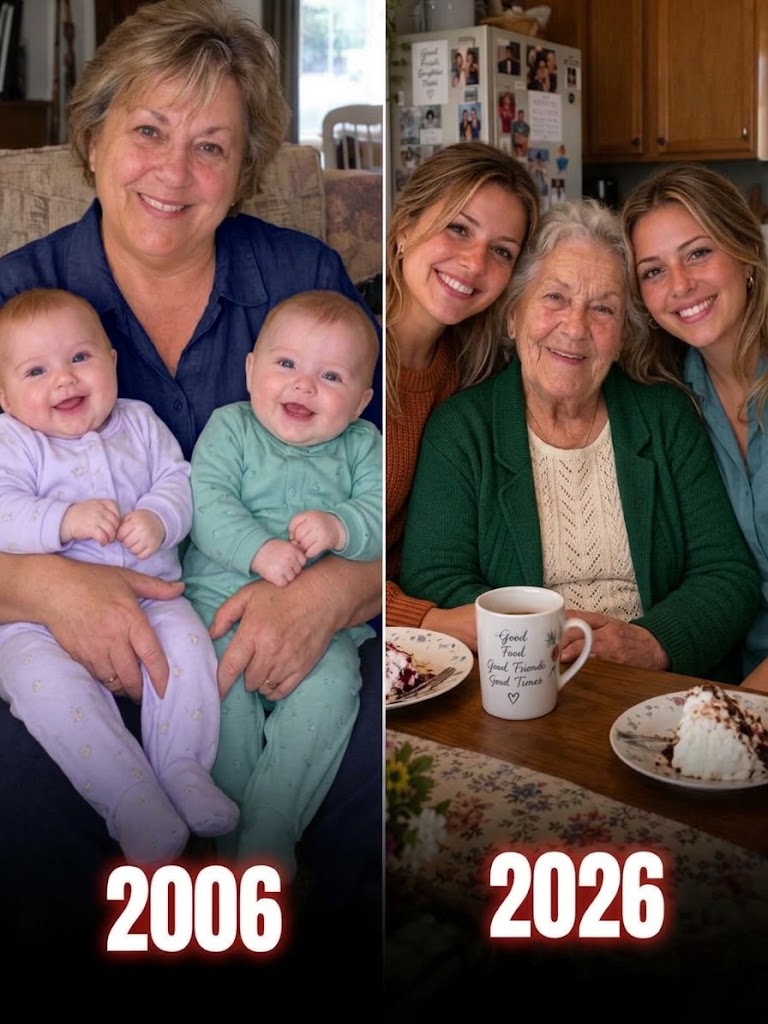
Part 1 — The Afternoon She Left Two Babies at My Door
There are moments in life that divide everything into a before and an after.
For me, one of those moments began with my daughter-in-law standing on my porch, holding two infant carriers.
My son had been gone only a few months.
Even now, after twenty years, I still have trouble saying that without feeling something tighten in my chest.
His twin daughters, Jennifer and Lizzie, had been only three months old when we lost him.
I was fifty-six at the time.
I was grieving my child while trying to help his young widow survive the kind of pain no twenty-four-year-old should have to carry.
At least, that was what I thought I was doing.
That afternoon, Kayla arrived looking exhausted.
Her hair was tied carelessly behind her head. There were dark circles beneath her eyes, and she wore the distant expression of someone who hadn’t slept properly in weeks.
She had Jennifer in one carrier, Lizzie in the other, and two diaper bags hanging from her shoulders.
“Margaret, could you keep them for a few hours?”
I didn’t hesitate.
“Of course.”
I assumed she needed rest.
Maybe she wanted to take a shower without hearing a baby cry.
Maybe she needed to sit somewhere quiet and grieve her husband without also having to warm bottles and change diapers.
I understood that.
I was grieving too.
Kayla bent over Jennifer and kissed the top of her head.
Then she tucked Lizzie’s blanket more securely around her.
“I won’t be long.”
Those were the last words she said to her daughters for twenty years.
I didn’t know that then.
I watched her walk down my driveway and get into her car.
Then I closed the door and went back to the babies.
Three hours passed.
Then five.
By eight that evening, I began to worry.
I called her.
No answer.
At ten, I tried again.
Nothing.
Midnight came.
Jennifer woke crying, which woke Lizzie, and for the next forty minutes I walked circles through the living room with one baby against my shoulder while gently rocking the other carrier with my foot.
At two in the morning, my phone finally rang.
Kayla.
I answered immediately.
“Where are you?”
Music thumped somewhere behind her.
Not traffic.
Not a grocery store.
Music.
She sounded strangely calm.
“I’ve been doing some thinking.”
Something about her voice made my stomach knot.
“Thinking about what?”
“My future.”
I looked across the room.
Jennifer had finally fallen asleep.
Lizzie’s tiny fist rested beside her cheek.
“When are you coming back for the girls?”
There was a pause.
Then Kayla said quietly, “I’m not.”
For several seconds, I genuinely thought I had misunderstood her.
“What do you mean?”
“I can’t keep living like this, Margaret.”
“Like what?”
“With babies. With grief. With everyone expecting me to sacrifice the rest of my life because your son died.”
The words hit me so hard I had to sit down.
“Those are your daughters.”
“I know.”
“Then come home.”
“No.”
My voice sharpened.
“Kayla.”
She exhaled impatiently.
“I want a better life. I’m twenty-four. I could still remarry. I could meet someone successful. Someone who can give me the life I should’ve had.”
I stared at the bassinets.
“And Jennifer and Lizzie?”
“They’ll be better with you.”
“No.”
I stood again.
“You do not get to decide that in the middle of the night from wherever you are.”
“You’ve always wanted to be involved.”
“Involved is not the same as becoming their mother.”
“Well…”
She hesitated only briefly.
“I guess it is now.”
Then she disconnected.
I called back.
Straight to voicemail.
Again.
Voicemail.
Again.
Nothing.
By sunrise, I had called more times than I could count.
And somewhere between the first bottle of the morning and the second load of baby laundry, the truth finally settled over me.
Kayla had not gone out for a few hours.
She had left.
And she expected me to deal with what remained.
I looked at my granddaughters sleeping side by side and felt terror unlike anything I’d known before.
I had already raised a child.
I had already done sleepless nights, scraped knees, school projects, teenage arguments, and college applications.
I had imagined the next stage of my life differently.
But Jennifer stretched one tiny hand toward Lizzie in her sleep, their fingers brushing.
And suddenly none of that mattered.
They had already lost their father.
I would not allow them to lose the only safe home they had left.
That afternoon, I called an attorney.
Then their pediatrician.
Then my employer.
At fifty-six years old, while still mourning my son, I became a mother all over again.
Part 2 — Raising the Children She Left Behind
The legal part took months.
The parenting started immediately.
There was no graceful transition.
No time to prepare.
No stack of parenting books beside my bed.
There were simply two babies who needed to eat every few hours.
Jennifer couldn’t tolerate one brand of formula, while Lizzie would fall asleep only if I hummed the same ridiculous tune my son had loved as a little boy.
For months, I slept in fragments.
Two hours here.
Forty minutes there.
Sometimes I woke convinced I had heard my son’s key turning in the front door.
Then one of the babies would cry, and reality would return.
Eventually, I received legal guardianship.
Kayla did not fight it.
She barely responded.
I wish I could say I was surprised.
I wasn’t.
I took extra shifts when I could.
Later, I found additional work.
Money was tight, but the girls never knew how many times I stood in the grocery aisle doing calculations in my head before putting something back.
They didn’t know that I sometimes wore shoes until the soles were nearly smooth because dance classes or field trips came first.
That wasn’t martyrdom.
It was parenting.
I did what parents do.
I packed lunches before the sun came up.
I sat through school concerts where twenty children played recorders badly enough to frighten wildlife.
I helped build science projects.
I learned the names of their friends.
I knew which teachers they loved and which subjects made them anxious.
When Jennifer played a tree in her second-grade class production, I rearranged my work schedule so I could be there.
She had no lines.
She stood near the back wearing cardboard leaves taped to a brown shirt.
I still cried.
Years later, Jennifer would tell anyone who listened that I applauded as if she’d just performed Shakespeare on Broadway.
Lizzie claimed she could still remember me shouting, “That’s my girl!”
I denied shouting.
Both twins insisted I absolutely did.
Those were the years that built us.
Not one dramatic moment.
Thousands of ordinary ones.
Breakfasts.
Homework.
Late-night fevers.
Bad haircuts.
School pictures.
Birthday candles.
Arguments about curfews.
College applications.
Love rarely looks spectacular while you’re living it.
Most of the time, it looks like showing up.
Again.
And again.
And again.
Kayla did not.
Part 3 — The Questions Children Eventually Stop Asking
I never lied to the girls about their mother.
I also never poisoned them against her.
There was enough pain in the truth without decorating it with bitterness.
When they were little, their questions were simple.
“Where is our mommy?”
“She isn’t living with us.”
“Why?”
“She made a choice to leave.”
As they grew older, the questions became harder.
One night, when Jennifer was about nine, she climbed into my bed after Lizzie had fallen asleep.
“Grandma?”
“Yes?”
“Did Mom love us?”
I remember staring into the darkness for several seconds.
There are answers children deserve, and there are answers adults simply don’t have.
“I think she loved you as much as she knew how to at that time.”
Jennifer was quiet.
“That doesn’t sound like very much.”
My throat tightened.
“No,” I admitted. “Maybe it wasn’t.”
Another time, Lizzie asked why Kayla hadn’t returned.
I refused to invent a comforting explanation.
“I don’t know.”
“Was it because we were difficult babies?”
“No.”
“Because Dad died?”
“I don’t know.”
“Because of us?”
That one I answered immediately.
“Never believe that.”
As the girls became teenagers, they searched for Kayla online.
I knew they did.
I pretended not to notice.
Once, Lizzie came downstairs after midnight and sat beside me without saying anything.
I knew she had found something.
A photograph, perhaps.
A new husband.
A vacation.
A life continuing somewhere without them.
I wanted to ask.
Instead, I waited.
Eventually, she whispered, “She’s smiling.”
I understood.
I held her hand.
That night she cried quietly against my shoulder.
After that, the girls asked fewer questions.
Kayla missed everything.
Birthdays.
Parent-teacher meetings.
Jennifer’s broken wrist.
Lizzie’s scholarship announcement.
High school graduation.
College move-in day.
No cards.
No calls.
No awkward attempts to reconnect.
Nothing.
Eventually, silence became its own answer.
And the twins learned to live without waiting for the woman who had once promised she’d only be gone a few hours.
Part 4 — Their Twentieth Birthday
By the time Jennifer and Lizzie turned twenty, both were in college.
They came home for their birthday weekend, and all three of us agreed we didn’t need anything elaborate.
Jennifer requested chocolate cake.
Lizzie demanded lemon.
Neither would compromise.
So I made both.
Apparently raising twins doesn’t end when they become adults. The arguments simply become more sophisticated.
That morning, Lizzie photographed the cakes and posted them online.
Her caption was something sentimental about spending another birthday at home with Grandma.
I teased her for becoming soft.
She accused me of crying during detergent commercials.
Jennifer sided with her.
It was exactly the kind of ordinary morning I treasured.
We were halfway through lunch when someone knocked on the front door.
“I’ll get it.”
I wiped my hands and walked into the hallway.
When I opened the door, I forgot how to breathe.
Kayla stood on my porch.
For twenty years, I had occasionally imagined that moment.
In some versions, she looked ashamed.
In others, older and broken.
Sometimes I imagined her arriving with an apology so sincere that even I wouldn’t know what to do with it.
Reality looked nothing like those fantasies.
Kayla looked polished.
Expensive.
Her blonde hair was professionally styled.
A designer coat rested over one arm.
A diamond watch glittered on her wrist.
Even her shoes looked as though they cost more than appliances I had saved months to replace.
She smiled.
“Margaret.”
I gripped the edge of the door.
“Kayla.”
There was no apology in her eyes.
No hesitation.
No recognition of what twenty years meant.
She stepped past me as casually as though she had visited last month.
Then she removed her coat and handed it to me.
I stared at it.
She apparently expected me to hang it up.
“Where are the girls?”
Before I could answer, Jennifer and Lizzie appeared at the end of the hallway.
Everything changed.
Both stopped walking.
Kayla inhaled dramatically.
“Oh, look at you.”
Neither twin responded.
She clasped her hands together.
“My beautiful girls.”
Jennifer crossed her arms.
Lizzie’s face became unreadable.
Kayla gave a nervous laugh.
“I suppose this is a little unexpected.”
Jennifer finally spoke.
“A little?”
Kayla’s smile faltered.
Jennifer continued.
“You’ve been gone two decades. I’d call this more of a surprise season finale.”
I had to press my lips together.
Kayla pretended not to hear the sarcasm.
“I know your grandmother probably told you plenty about me.”
Lizzie looked at me.
“Mostly what your name was.”
“There are always different versions of family history.”
Jennifer tilted her head.
“Usually both sides participate in the family first.”
I looked down before Kayla saw my expression.
Part 5 — The Mother Who Suddenly Needed Daughters
Kayla sat down as though she intended to stay.
She began explaining herself.
Not apologizing.
Explaining.
She talked about being young.
About grief.
About how difficult life had been after my son died.
Some of that was true.
She had been young.
She had been grieving.
I had never denied that.
Then she said something that made my blood turn hot.
“Your father couldn’t give me the kind of future I wanted, and after he died, I felt completely trapped.”
My son had been gone for twenty years.
He had loved her.
He had worked long hours.
He had adored those babies.
And somehow, standing in my house two decades later, she still found a way to blame him for the life she’d abandoned.
I started to speak.
Jennifer beat me to it.
“Okay.”
Kayla stopped.
“What?”
Jennifer smiled pleasantly.
“We understand.”
I stared at my granddaughter.
Lizzie looked equally agreeable.
“Yes,” she said. “Completely.”
Kayla’s shoulders visibly relaxed.
“You do?”
Jennifer nodded.
“Of course, Mom.”
Mom.
The word nearly knocked me out of my chair.
Kayla’s eyes brightened.
“Oh, thank goodness. I was afraid Margaret might’ve spent years making you hate me.”
Jennifer smiled even wider.
“She didn’t.”
Kayla looked relieved.
“Wonderful.”
Then she reached the real reason she had come.
“I actually need both of you tomorrow.”
Jennifer’s expression didn’t change.
“For what?”
“My husband’s family is having a gathering at the country club. Graham’s relatives will all be there. We’re doing professional family portraits.”
Lizzie stared at her.
“You came here because you need us for photographs?”
Kayla laughed as though the question were ridiculous.
“You’re my daughters.”
The room became very quiet.
Jennifer exchanged one brief glance with Lizzie.
Then she said, “Sure.”
I nearly dropped my glass.
Kayla beamed.
“I knew you’d understand.”
Jennifer leaned back.
“Actually, we have something for you too.”
Kayla looked delighted.
“Oh?”
The twins disappeared into the kitchen.
When they returned, Lizzie was carrying a large shopping bag.
She handed it to Kayla.
Kayla opened it eagerly.
Then froze.
Inside was a printed invitation to the country-club celebration.
Attached was the photography schedule.
Kayla slowly lifted the pages.
The smile vanished from her face.
“Where did you get this?”
Jennifer met her eyes.
“Allison posted it.”
The change in Kayla was immediate.
“Allison?”
The name came out sharp.
Jennifer said nothing.
Kayla shoved the papers back into the bag, grabbed her purse, and hurried toward the front door.
She moved so quickly she forgot both her coat and her shoes.
Across the street, Mrs. Patel’s curtain shifted.
By the time Kayla reached her car, Mrs. Patel was standing on her porch.
“Margaret? Is everything all right?”
“I’ll explain never,” I called back.
Then I shut the door.
I turned toward my granddaughters.
“What was that?”
Jennifer reached into her pocket.
She handed me another copy of the invitation.
At the bottom was the portrait schedule.
Graham and Kayla with children and grandchildren.
Six adult names were listed.
Four were Graham’s children.
The last two were Jennifer and Elizabeth.
My stomach sank.
“She already put your names on it?”
Lizzie nodded.
“We found it online this morning.”
“Before she came here?”
“Yes.”
Jennifer sat beside me.
Her voice was much quieter now.
“She didn’t suddenly miss us, Grandma.”
I looked at her.
“She saw that post this morning, realized we were both home, and came here because tomorrow’s family picture has two missing people in it.”
That hurt more than I expected.
Twenty years.
Not one birthday.
Not one graduation.
Not one phone call.
But apparently an incomplete photograph was enough to make her remember where her daughters lived.
Part 6 — “If She Wants Family, She Gets Family”
The following morning, Jennifer came downstairs wearing a dark green dress.
Lizzie followed in a navy one.
I stared at them.
“You’re not seriously going.”
“We are,” Jennifer said.
“Why?”
Lizzie picked up her purse.
“Because I want to hear what she’s been telling these people.”
“This could become very uncomfortable.”
Jennifer’s face softened.
“Grandma, it’s been uncomfortable for twenty years. We just weren’t in the room.”
I hated that she was right.
“Fine. Be careful.”
Jennifer shook her head.
“You’re coming.”
“No.”
“Yes.”
“This has nothing to do with me.”
Lizzie smiled faintly.
“If we’re taking a family photograph, the person who actually raised us should probably be in the building.”
That was how I found myself at a country club wearing the navy dress I’d already worn to both girls’ high school graduation.
Kayla noticed us almost instantly.
Her face lost all color.
A tall man with silver at his temples approached.
He smiled warmly.
“You must be friends of Kayla’s.”
Jennifer extended her hand.
“I’m Jennifer.”
His entire expression brightened.
“Jennifer!”
Then he shook Lizzie’s hand.
“Elizabeth. I’m Graham. I’ve been hoping to meet you both for years.”
I looked toward Kayla.
Years?
Kayla rushed over.
“Graham, everyone’s waiting. Maybe we should—”
He noticed me.
“And you are?”
Kayla opened her mouth.
Jennifer answered first.
“This is Margaret. Our grandmother.”
Graham smiled.
“Kayla’s mother?”
“No.”
Jennifer’s voice remained calm.
“Our father’s mother.”
A pause.
Then she added:
“She raised us.”
Graham slowly turned toward his wife.
Something changed behind his eyes.
“You told me your mother raised them.”
Kayla forced a laugh.
“You know how complicated families are. Sometimes I simplify things.”
Graham didn’t smile.
That was the first crack.
It would not be the last.
Part 7 — The Family Kayla Had Invented
What happened next surprised all three of us.
Graham’s children were lovely.
Not suspicious.
Not cruel.
Not snobbish.
His eldest daughter, Allison, hugged Jennifer and Lizzie the moment she realized who they were.
“I can’t believe you’re finally here!”
Jennifer stiffened slightly.
“Finally?”
“We’ve heard about you forever.”
Kayla stepped closer.
“Allison, why don’t we—”
But Lizzie was already asking the question.
“What exactly did you hear?”
Allison looked confused.
“Everything. Your visits. Birthdays. School. College.”
Jennifer’s expression hardened.
“College?”
“Yes. Kayla was upset when both of you became distant after leaving for college.”
Lizzie blinked.
“We haven’t left college.”
Allison’s smile disappeared.
For a moment, no one spoke.
Then I understood the full shape of Kayla’s lie.
She hadn’t simply pretended her daughters didn’t exist.
She had created imaginary versions of them.
Versions who called.
Visited.
Loved her.
Versions who allowed her to play the role of mother without ever doing the work.
Allison looked toward Kayla.
“You told us you spent Christmas with them three years ago.”
Kayla’s face tightened.
Jennifer found Graham a few minutes later.
“We should talk.”
Kayla immediately stepped between them.
“Today isn’t the right day.”
Jennifer looked directly at her.
“You’ve had twenty years to choose a better one.”
Graham quietly led us into a side room.
Kayla sat opposite him.
Jennifer and Lizzie sat together.
I remained near the door.
Graham didn’t shout.
That somehow made it worse.
He asked one simple question.
“When was the last time you saw your daughters before yesterday?”
Kayla stared at the carpet.
“Kayla.”
She whispered something.
Graham leaned forward.
“What?”
“Twenty years ago.”
The room seemed to shrink.
Graham looked as though he had been struck.
“Twenty years?”
Kayla began crying.
“I was young.”
“You told me you visited them.”
“I was embarrassed.”
“You told me Jennifer called when my mother died.”
Kayla covered her face.
“I didn’t know how to explain everything.”
Lizzie’s voice was quiet.
“You could have tried telling the truth.”
Kayla wiped her cheeks.
“I always thought I’d reconnect when you were older.”
Jennifer frowned.
“Why older?”
Kayla hesitated.
And then, perhaps because she was exhausted or cornered or simply incapable of hearing herself clearly, she gave the most truthful answer she’d offered all weekend.
“Because grown children are easier.”
Silence.
Lizzie’s face changed.
Not rage.
Not tears.
Something colder.
Understanding.
“Yes,” she said softly.
“We’re easier now because Grandma already did everything difficult.”
Kayla’s mouth opened.
“That isn’t what I meant.”
Lizzie shook her head.
“It is.”
She gestured between herself and Jennifer.
“She did the sleepless nights. She worked extra jobs. She sat in emergency rooms. She came to school events. She paid bills when money was tight. She stayed up when we were sick.”
Her voice trembled only once.
“You skipped the entire part where children need a mother, then came back when you thought we could stand nicely beside you in a picture.”
Kayla began sobbing.
For the first time since arriving, nobody rushed to comfort her.
Part 8 — The Photograph
Graham rubbed both hands over his face.
Then he looked at the twins.
“You don’t owe us a picture.”
Jennifer nodded.
“We know.”
“You don’t owe Kayla one either.”
“We know that too.”
Then Jennifer surprised everyone.
“We’ll still take it.”
Kayla looked up hopefully.
But I knew my granddaughter.
There was nothing hopeful in Jennifer’s expression.
Outside, the photographer began arranging everyone.
Graham’s children gathered together.
Their spouses and children joined them.
Kayla moved toward Jennifer and Lizzie.
Both girls quietly stepped away.
Then they came to me.
Jennifer slipped her arm through mine.
Lizzie took the other.
The photographer looked confused.
“Would you like me to reorganize everyone?”
Graham understood first.
“No.”
His voice was tired but steady.
“Leave them where they are.”
So he stood beside Kayla.
His children gathered around them.
And my granddaughters stood beside me.
One large photograph.
One frame.
No speech.
No public humiliation.
No revenge.
Just the truth positioned where everyone could see it.
Jennifer leaned her head toward mine.
Lizzie whispered something ridiculous about how my dress had attended more graduations than she had.
I laughed.
Jennifer started laughing too.
The photographer clicked the shutter.
And for one second, I forgot Kayla was there.
I simply felt the weight of both girls against me.
The babies I’d rocked through the night.
The children I’d raised.
The women they had become.
That photograph did not prove I had won.
Families aren’t competitions.
It showed something simpler.
Love leaves evidence.
So does absence.
Part 9 — “You Turned Them Against Me”
After the photographs, Kayla found me near the coatroom.
Her eyes were swollen.
Her perfect makeup had begun to smudge.
“You did this.”
I turned toward her.
“Did what?”
“You made them hate me.”
For a moment, I almost laughed.
Not because anything was funny.
Because after twenty years, she still needed someone else to be responsible for her choices.
“I never taught them to hate you.”
“You must’ve spent years telling them terrible things about me.”
Before I could respond, Jennifer appeared behind us.
“No.”
Kayla turned.
Jennifer’s voice was calm.
“Grandma almost never talked about you unless we asked.”
Lizzie joined us.
“She didn’t need to convince us of anything.”
Kayla looked between them.
“I was your mother.”
Jennifer’s expression softened, and somehow that made her words hurt more.
“You gave birth to us.”
Kayla flinched.
Lizzie continued.
“Grandma became the person we called when we were scared. The person who stayed home when we were sick. The person who taught us to drive. The person who cried at graduation.”
Kayla whispered, “I made mistakes.”
Jennifer nodded.
“Yes.”
“You don’t understand what I was going through.”
“Maybe we don’t.”
Jennifer paused.
“But you never came back to tell us.”
Kayla’s lips trembled.
“I thought there would be time.”
Lizzie looked at her for several seconds.
“There was.”
Kayla frowned.
Lizzie’s eyes filled, though her voice stayed steady.
“There were twenty years of it.”
Kayla had no answer.
Neither did I.
Sometimes there is no sentence powerful enough to repair what someone chose not to do.
Part 10 — The Picture on My Mantel
A few weeks later, the photographs arrived.
Jennifer brought the envelope over.
We sat together at my kitchen table while she opened it.
There were dozens.
Formal poses.
Smiling grandchildren.
Graham with his children.
Kayla standing among people who were now beginning to understand a very different version of her past.
Then Jennifer pulled out the large group photograph.
I stared at it.
The three of us were on one side.
Jennifer.
Lizzie.
Me.
We were laughing.
Not posing.
Not forcing smiles.
Actually laughing.
Across the photograph, Kayla wasn’t looking at the camera.
She was looking at us.
Something about that image made my chest ache.
I couldn’t decide whether I felt anger, sadness, or simply exhaustion over all the years that could never be recovered.
Jennifer took the photograph to be framed.
When she returned a few days later, she placed it on my mantel.
I protested immediately.
“Why would you want that displayed here?”
Lizzie shrugged.
“Because it’s true.”
Jennifer adjusted the frame until it was straight.
I looked again.
At Graham.
At his children.
At Kayla.
At the twins.
At myself.
For twenty years, Kayla had created a story in which she had been part of her daughters’ lives.
She had apparently described birthdays that never happened.
Visits she’d never made.
Phone calls she’d never placed.
She had built an imaginary motherhood because imaginary children never asked where she’d been.
But Jennifer and Lizzie had grown up.
Not because time magically repaired what Kayla had done.
They grew because someone stayed.
Someone showed up.
Someone loved them through the parts Kayla had called too difficult.
And standing there in front of that photograph, I finally realized why my granddaughters hadn’t gone to the country club to punish her.
They had gone because they were tired of being supporting characters in a story someone else had invented.
They wanted the truth to occupy its rightful place.
I touched the edge of the frame.
“Do you think she’ll ever understand?”
Jennifer thought for a moment.
“Maybe.”
Lizzie sat down beside me.
“And maybe she won’t.”
I looked at them.
“Would you ever speak to her again?”
Neither answered immediately.
Finally, Jennifer said, “Maybe someday.”
Lizzie nodded.
“If she comes because she actually wants to know us.”
“Not because she needs something?”
“Exactly.”
I smiled sadly.
“That seems fair.”
Jennifer rested her head against my shoulder.
“We don’t hate her, Grandma.”
I kissed the top of her head.
“I know.”
“That almost feels worse.”
I understood what she meant.
Hatred can keep someone tied to you.
Indifference sometimes means you’ve finally stopped waiting.
That evening, after the girls went upstairs, I remained alone in the living room.
The house was quiet.
My eyes returned to the photograph.
For years, I had wondered whether I had done enough.
Whether I had been too old to raise them properly.
Whether working so much had cost them something.
Whether they had needed a younger mother.
Whether grief had made me too serious.
Whether my mistakes had marked them.
Every parent wonders.
Every grandmother who unexpectedly becomes a parent probably wonders twice as much.
But now I looked at Jennifer and Lizzie in that picture.
Strong.
Funny.
Compassionate.
Sharp enough to recognize manipulation without becoming cruel themselves.
And I realized that raising them had never required perfection.
It had required presence.
I had been there.
That was what Kayla had never understood.
Children rarely remember whether the birthday decorations matched.
They remember who came.
They don’t measure love by expensive gifts.
They remember who stayed beside the hospital bed.
They remember who picked them up after heartbreak.
Who answered the phone.
Who waited in the audience.
Who came back.
Kayla had spent twenty years chasing what she called a better life.
Perhaps she found wealth.
Perhaps Graham gave her beautiful houses, elegant clothes, expensive vacations, and the status she’d once believed would make her happy.
I couldn’t judge the value of that life for her.
But I knew what she had left behind.
Two babies.
Two childhoods.
Thousands of ordinary moments that could never be recreated.
And when she finally returned, she discovered something painful.
Children do not remain frozen at the age you abandoned them.
They grow.
They remember.
They form lives around the people who actually love them.
And eventually, they become old enough to decide for themselves who deserves a place beside them.
I turned off the living-room lamp.
Before walking upstairs, I looked once more at the framed photograph.
Lizzie had been right.
It belonged there.
Not because it showed Kayla losing something.
Because it showed Jennifer and Lizzie claiming something.
Their history.
Their family.
Their truth.
For once, nobody else was allowed to rewrite it.